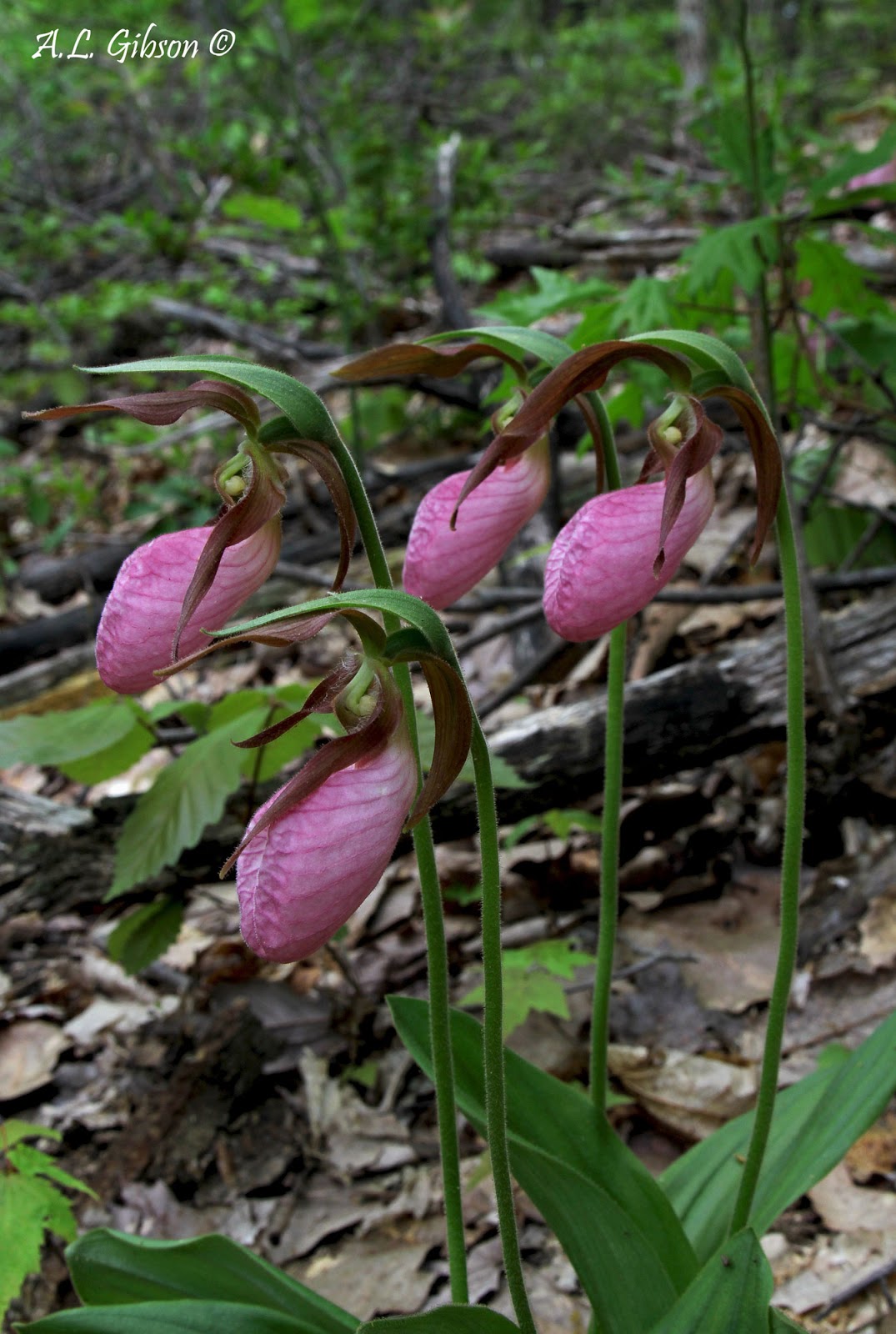
I'm back and ready to march on with my seven part series on the wild and wonderful Bruce peninsula. However, this time around I'd like to do something a bit different. Instead of focusing on a specific place and exploring its depth, I'd like to share the plethora of plant and animal life one can come across by sticking to the roads. As I've mentioned in previous posts, the Bruce is largely an untamed wilderness that's comprised of national park land and nature reserves, and thus quite conducive to high diversity. Roadside botanizing can produce great results and many times one doesn't have to walk much further than a few meters to see dozens and dozens of wildflowers in the spring time.
So with that being said, I'd like to start things off and share some of my favorite wildflowers and critters my group and I came across during our week there in early June. Each photo will be accompanied by a little information but the pictures will definitely do most of the talking!
 |
| Incredible wildflower display at Cabot Head |
The rule is usually to save the best for last but I thought I'd try and grab everyone's attentions right away with the phenomenal wildflower display at Cabot Head. The open meadows are completely covered in a primary color explosion come early June. Scarlet paintbrush (
Castilleja coccinea), balsam squaw-weed (
Packera paupercula), and northern blue-eyed grass (
Sisyrinchium montanum) all pop off the landscape unlike anything I'd seen before or since.
 |
| Starflower (Trientalis borealis) |
 |
| Canada Mayflower (Maianthemum canadense) |
Two common spring-blooming flowers that occur throughout the Bruce's cool, shaded coniferous forests are the starflower (
Trientalis borealis) and Canada mayflower (
Maianthemum candense). Both occur in Ohio, too, but they are done flowering by the time they get going this far north. Botanizing up here is like a literal time machine in the spring!
 |
| Wild Prickly Rose (Rosa acicularis) |
Some wildflowers only look attractive; others are better suited to be enjoyed with your olfactories. Then there's the ones that are a two-for-one and treat both senses well like the wild prickly rose (
Rosa acicularis). This northern species can often be smelled before it's seen, although it would be pretty difficult to not immediately see their bright pink blossoms.
 |
| Male Fern (Dryopteris filix-mas) |
 |
| Male Fern (Dryopteris filix-mas) |
An intriguing member of the Bruce's roadside flora is the rare male fern (
Dryopteris filix-mas). Like many other odd species in the Great Lakes region, the male fern is a disjunct occurrence this far east. It's much more widespread and common out West but only grows in a few scattered locations this far east. Male fern was one of the dozens of life plants I had the pleasure of making acquaintances with while up there and was a surprise find!
 |
| Wood Lily (Lilium philadelphicum) |
If ferns aren't exactly your thing and not aesthetically appealing enough to make you want to visit the Bruce then I think I have you covered with the gorgeous wood lily (
Lilium philadelphicum). Come mid-June the dry, gravelly roadsides and other open areas explode in fire orange as the lilies open their tepal (petals and sepals that look identical) perfection. Wood lilies are excruciatingly rare in Ohio and I easily saw more along a mile of roadside on the Bruce than still exists in the entire state. That's a sight I never, ever got tired of!
 |
| Showy Lady's Slipper (Cypripedium reginae) |
Yet another stunning wildflower to be found in select spots along the Bruce's roadsides is the stately showy or queen's lady's slipper (Cypripedium reginae). They bloom in the second half of June and weren't ready to show off during our 2015 visit but we did find several spots getting ready to bloom. The photo here was from my 2011 trip.
 |
| Large Yellow Lady's Slippers (Cypripedium pubescens) |
 |
| Northern Small Yellow Lady's Slippers (Cypripedium parviflorum var. makasin) |
The Bruce is an orchid wonderland and not a single post during this long series will be bereft of their beauty. I wish I had a photo to really show off exactly how common and dense the yellow lady's slippers are along the roadsides in many spots but even then it wouldn't do much to beat seeing them in person. Both the large and northern small yellow lady's slippers (Cypripedium pubescens & C. parviflorum var. makasin) occur and can often times form extensive hybrid swarms of integrating plants, making true identification one way or the other nigh on impossible.
 |
| Female Ruffed Grouse with her chicks, sadly not seen in photo |
One of my favorite roadside happenings was seeing a gorgeous female ruffed grouse perched on a log not more than ten feet off the road. She stayed completely still for a long while and allowed for some photos to be taken. It was easily the best, and really only time I've seen this bird up close. Most times they're exploding at/near my feet and about giving me a heart attack. My friends, Paul Marcum and his wife Jean Mengelkoch were in the car behind mine and later informed me she had a line of chicks with her! A shame I didn't have the angle to see them...
 |
| Fire Cherry (Prunus pensylvanica) |
 |
| Prickly Currant (Ribes lacustre) |
A couple neat woody plants exhibiting their pretty flowers during our stay were the fire cherry (Prunus pensylvanica) and prickly currant (Ribes lacustre). I'd seen fire cherry a handful of times before when botanizing up north but the prickly currant was a new life plant for me and curiously growing literally right beside our cabin. Nice to find a lifer without much effort!
 |
| Limber Honeysuckle (Lonicera dioica) |
One of the best parts of the Bruce is the fact that invasive species, while present are fewer and farther between and not nearly the issue they are down home's way. While honeysuckle is largely heard as an evil name in Ohio, the Bruce is home to a handful of indigenous honeysuckle vines/shrubs like the limber honeysuckle (Lonicera dioica) featured here. It occurs all over the place in large, dense tangles and was in picture perfect flower.
 |
| American Fly Honeysuckle (Lonicera canadensis) |
 |
| Swamp Fly Honeysuckle (Lonicera oblongifolia) |
A couple more native honeysuckles I was fortunate enough to see while on the Bruce was swamp fly honeysuckle (L. oblongifolia) and American fly honeysuckle (L. canadensis). Both are more shrubby in form and have exquisite blossoms. Interestingly, the American fly honeysuckle (odd it's commonly called American with the epithet meaning 'of Canada') was just barely still in flower at the beginning of my trip; the the swamp fly honeysuckle just barely starting to bloom on my last day. It felt like I timed it just right to get both on my list!
 |
| Black bear out foraging in a meadow |
One of the best critter sightings of the trip was a large black bear foraging in a meadow off the road. Black bears are a common occurrence throughout the Bruce but I'd yet to lay eyes on one in the flesh. This fella was a few hundred yards away and my zoom lens was able to get a decent shot or two. Hilariously, my friend Rob decided to do his best moose call impression and got the bear to stand up on its back legs and look back our way a few times!
 |
| Federally Threatened Dwarf Lake Iris (Iris lacustris) |
 |
| Federally Threatened Dwarf Lake Iris (Iris lacustris) |
No tribute to the region's best roadside botany would be complete without mention of the federally threatened dwarf lake iris (Iris lacustris). I went into more detail about this globally rare wonder in my earlier post on the Singing Sands but its splendor was more than worth sharing again! I tossed in an iPhone photo with my hand in the frame to give you a grasp on just how dainty these irises are.
 |
| A splendid wetland complex full of awesome flora |
Wetlands dot the landscape throughout the northern half of the peninsula and just about every one of them is worth taking the time to explore. One particular boggy pond near our cabin was full of exciting plants, including a mass of one in perfect flower I almost never get to see.
 |
| Bog Buckbean (Menyanthes trifoliata) |
 |
| Bog Buckbean (Menyanthes trifoliata) |
The bog buckbean (Menyanthes trifoliata) isn't a rare plant to come across while up in the northern Great Lakes by any stretch but finding it blooming en masse can be a fickle task. One edge of the pond was covered in the stuff and a wonderful chance to enjoy their unique flowers adorned with hair-like fringing. The pseudo-bottom of the pond was covered in a thick mat of dead, sunken vegetation that could just barely hold my weight and keep the waterline below my boots. One wrong step could, and did a time or two send my leg plunging deeper down and soaking me thoroughly. Well worth it to see such a wonderful wildflower!
 |
| Bunchberry (Cornus canadensis) |
Perhaps my favorite plant of all to be found in the northern woods is the bunchberry (Cornus canadensis). This member of the dogwood genus is a small trailing vine/shrub that produces stunning flowering dogwood-like bracts and flower clusters each spring but at your feet instead of above your head. The Bruce is covered with the stuff and I never, ever got tired of seeing it.
 |
| Flat-leaved Bladderwort (Utricularis intermedia) |
 |
| Northern Pitcher Plant (Sarracenia purpurea var. purpurea) |
Even the roadside wet ditches can be a botanical treasure trove up on the Bruce. In the more secluded back roads it wasn't uncommon to see long stretches of ditch covered in a medley of carnivorous plants such as the northern pitcher plant (Sarracenia purpurea var. purpurea) and flat-leaved bladderwort (Utricularia intermedia). If only home's roadside ditches could be this cool, eh?
 |
| Wild Columbine (Aquilegia canadensis) |
The large patches of wild columbine (Aquilegia canadensis) were impossible to miss with their ruby red flowers quivering in the cool breezes. Not too shabby a place when your roadside 'weeds' are gobs of columbines!
 |
| Blanding's Turtle! |
 |
| Blanding's Turtle! |
Hands down my favorite wildlife sighting during our Bruce trip was also our most serendipitous find. While cruising over to the Cabot Head region along the Georgian Bay we happened across this Blanding's turtle trying to cross the road. I'd never seen one before but instantly recognized it by its distinct yellow markings. As it turns out, Blanding's turtles are quite rare in Ontario, as they are in Ohio and listed as a threatened species. Rob turned in an electronic record for our sighting in the Ontario database and was shocked to see this was only the second or third recorded sighting of a Blanding's turtle on the Bruce in the last 20 years! Hopefully that's just folks being lazy and not turning in their data and they're more common than that. Regardless, it was so awesome to spend time with this increasingly rare but always beautiful reptilian critter.
 |
| Red Thimbleweed (Anenome multifida) |
Yet another example of the Great Lakes playing home to disjunct western plants is the red thimbleweed (Anenome multifida). I had hopes to find some and managed to luck out on a single flowering plant along the road. The sun was bright and the wind constantly blowing so I only managed a quick iPhone photo and figured I'd come back with my camera for a better chance later in the day...only to come back to the petals fallen! Quite the ephemeral flower, I'd say. Even so, it was another check next to a life plant on my list! The magic of the Bruce continues.
 |
| Rough-leaved Ricegrass (Oryzopsis asperifolia) |
 |
| Sweet Grass (Hierochloe odorata) |
I'll cap off this long blog of Bruce roadside botany with a pair of grasses to please my inner grami-nerd'ness. The rough-leaved ricegrass (Oryzopsis asperifolia) won't win any awards for its looks but as a critically endangered species back home in Ohio and a life plant, I was ecstatic to find some! On the other hand, sweet grass (Hierochloe odorata) isn't nearly as rare in Ohio but is restricted to higher-quality fens and wet meadows. Always nice to see and get a whiff of its sweet aroma!
I hope everyone enjoyed this look at but a small sampling of the pretty, rare, unusual, exciting etc. plants one might find along the Bruce's roadsides in spring. I also hope you're enjoying this series as it hits its mid point! I have three more posts to go and think the best is yet to come. So check back soon for more on the wild and wonderful Bruce peninsula!
- ALG -