Showing posts with label Ericaceae. Show all posts

Friday, May 4, 2012

Flame Azalea (Rhododendron calendulaceum)

Flame Azalea (Rhododendron calendulaceum)

If the plant kingdom had the ability to hold their own beauty contests I think it would be safe to say that the Flame Azalea (Rhododendron calendulaceum) would be a perennial powerhouse pick to take home the crown each and every year.  It's hard enough to compete with the other azaleas and rhododendrons within the Ericaceae family but the brilliant and unique flame orange blooms of this species really sets it apart from the rest.

Flame Azalea (Rhododendron calendulaceum)

Ohio is home to four indigenous species of Rhododendron : Rosebay (R. maximum); Rose Azalea (R. prinophyllum); Pinxter-flower (R. periclymenoides) and the featured Flame Azalea (R. calendulaceum).  All four are state-listed and quite rare in Ohio with the flame azalea being the rarest and currently listed as endangered.  Fathom that our most gorgeous and unsurpassed rhododendron species would also be our most uncommon.  Even in pre-settlement times these plants were infrequent and scattered in local populations throughout south-central Ohio, only to be dug up and transplanted by early pioneers and settlers for their homesteads and gardens; a practice still used today.  I can't say that I blame them for wanting to bring the beauty and 'fire' home with them to enjoy and cherish.

Rhododendron calendulaceum distribution map courtesy BONAP

Observing the range of the flame azalea reveals its southern Appalachian distribution from Alabama and Georgia, up through the Cumberland plateau and onto the Allegheny plateau in Ohio and West Virginia before suddenly ceasing before reaching into New England.  Ohio's outlier part of the range is a direct result of the antiquated and pre-glacial Teay's River flowing northwest from Virginia, though West Virginia and on into our state.  This long extinct river was a super highway for southern and coastal plain flora to migrate up into current day southern and southeastern Ohio; such as the flame azalea.

Flame Azalea (Rhododendron calendulaceum)

The scientific epithet calendulaceum translates to 'like a calendula', which is a genus of vascular plants with similarly colored flowers native to Macaronesia and the Mediterranean region.  The common name of flame azalea actually recognizes the resemblance of the shrubs swollen, unopened flower buds to the flame of a candle.  It's just as easy to assume it also refers to the scintillating orange color of the flowers.

Flame Azalea (Rhododendron calendulaceum)

Unlike the evergreen and leathery leaves of the later-blooming rosebay rhododendron, the flame azalea as well as the other two pink taxa have deciduous leaves.  Without such obvious and conspicuous leaves it can be pretty difficult to notice and locate these deciduous azaleas when not in their blatantly obvious flower-mode.  I can only imagine what was going through famed French botanist Andre Michaux's mind when he first came across this striking shrub back in the late 1700's in the southeastern United States.  Seeing large patches and colonies of these in full, glorious bloom must be something an individual is not likely to forget in their lifetime.

Flame Azalea (Rhododendron calendulaceum)

It's not too uncommon to see these remarkable shrubs planted and used in cultivation throughout the acidic soiled regions of Ohio.  It has become an increasingly difficult thing to determine the validity and origin of newly discovered populations of this species considering their ornamental value and popularity.  I'd find it hard to believe that there would be any natural populations left undiscovered in Ohio.  Being so pronounced and meretricious during a few weeks in late spring is an easy way to get noticed by even the most casual observer.

I'm very thankful to have come across the opportunity to see and photograph this flawless and superlative plant and mark it off my life species list.  The only thing better than the thrill of the hunt is the ecstasy of discovery!  I hope you enjoyed this post but now it's time to pack up and head down to Shawnee state forest for Flora-Quest 2012!  I can't wait for what adventures and experiences this year holds and will be sure to share it all upon my return.

Wednesday, January 25, 2012

The Remarkable Rosebay Rhododendron

Winter is a hard burden to bear for any botanist, birder or naturalist; let alone the one doing the typing.  The rich and vibrant greens give way to the drab greys and browns that adorn the macabre landscape for months on end.  Each day seems more bland than the last with the trees and shrubs laid bear by the chilled winds and blue skies closed out with thick, impenetrable clouds.  There is still an intrinsic beauty to the winter scene however silent or melancholy it may seem.  For not all the light and greenery is gone from the world; some plants still cling to summer's memory.


Winter's chill had finally awoken from its slumber, as if it had suddenly remembered the season.  My slow footsteps broke the stillness of the woods on the brittle ice and accumulated snow as I watched my breath hang in the air and pushed my hands deeper into my coat pockets.  I walked down a lightly-traveled path I'd been down numerous times before.  Deep in the shadows of the Hocking Hills lay the reason for my excursion into the frigid world outside.

Evergreen leaves of the Rhododendron
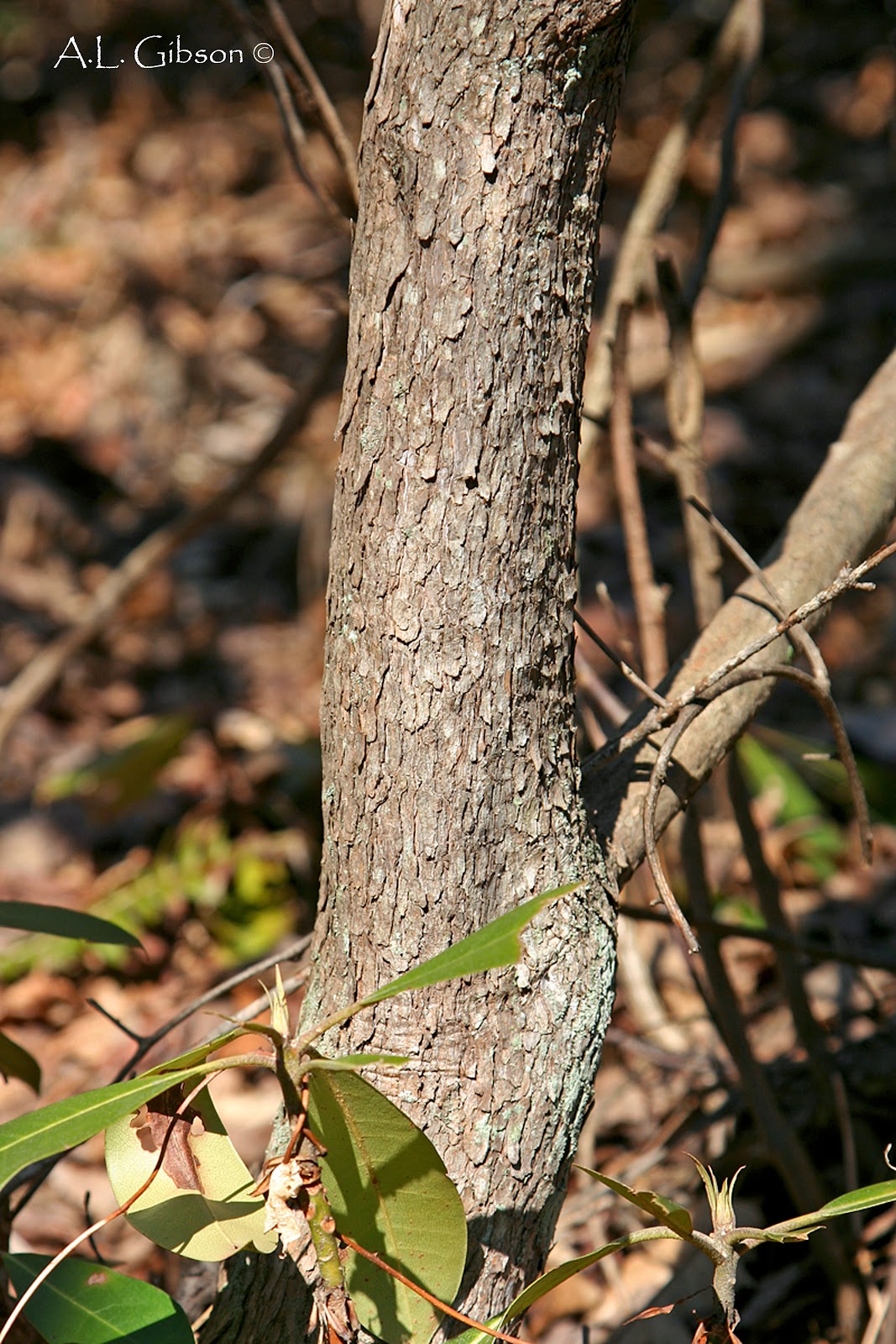
Rhododendron's trunk and bark


Within the cool and moist sandstone hollows my eyes spotted the leathery, evergreen leaves still tightly clinging to the branches of one of our most beautiful and rare native shrubs, the Rosebay Rhododendron (Rhododendron maximum).  Many are familiar with this wondrous species and others in the Heath family (Ericaceae) from cultivation and landscaping.  It's not hard to understand why someone would want these phenomenal plants around come blooming time as you'll soon see.

Flower bud
Last year's emptied seed capsules


Rhododendron's evergreen, thick leaves really set it apart from everything else in Ohio.  There are three other Rhododendron spp. native to Ohio (R. calendulaceum, R. periclymenoides and R. prinophyllum) but none have as thick or leathery leaves as the rosebay.  Larger shrubs of age exhibit a very aesthetically pleasing layering of the branches which help keep this shrub's beauty a year-round thing.  As I stood and admired the maturing flower buds and emptied seed capsules my mind slipped back to a time six months in the past.  Back to a steamy and hot day in early July when you could see the humidity in the air and feel the sweat dripping down your neck.  Back to a time when this rare shrub was in its prime.

Rosebay Rhododendron in perfect, full bloom

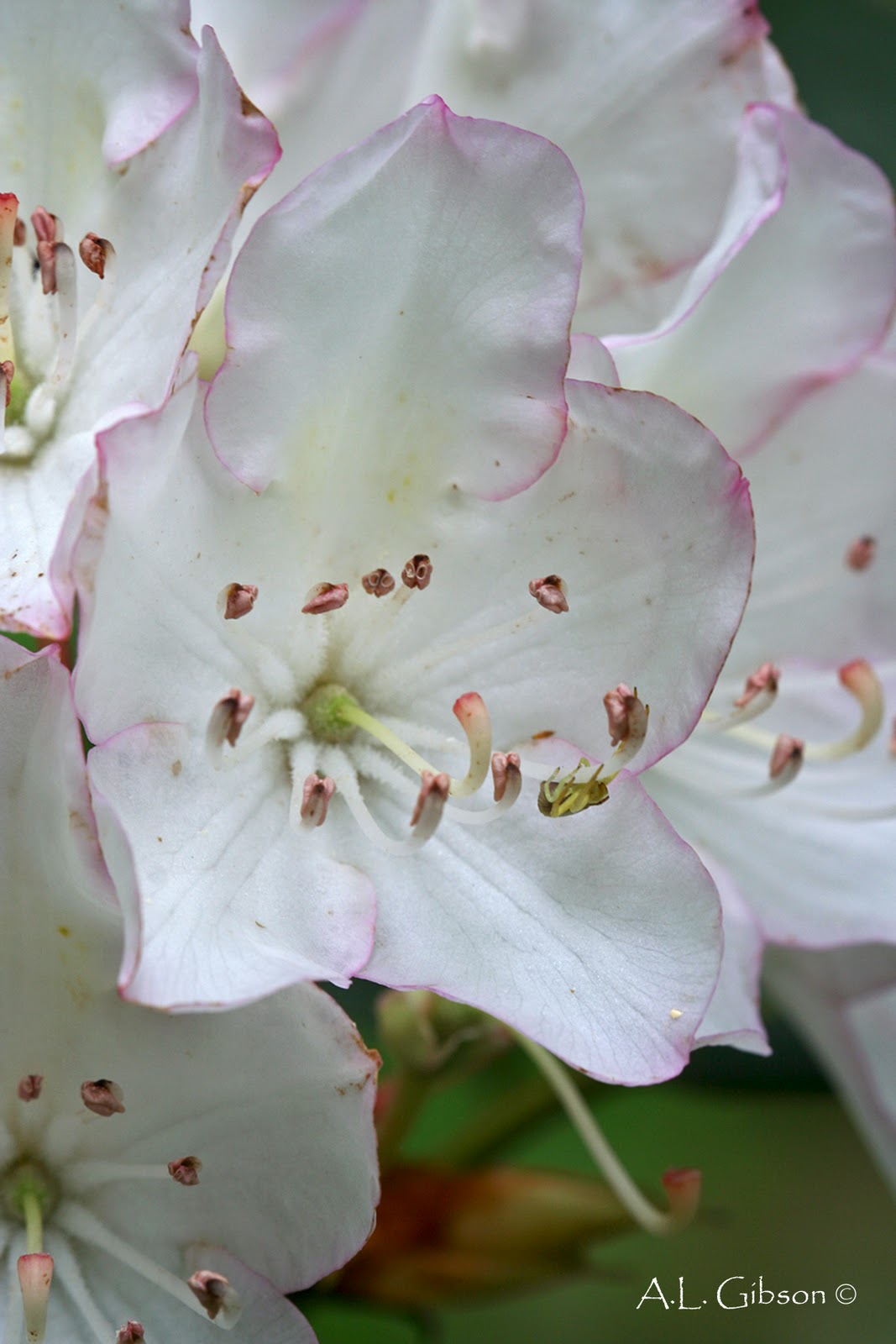
You'd be hard pressed to convince me of a more stunning floral display in Ohio than what the rhododendrons are capable of.  Come late June and into early July the flower buds open to reveal gorgeous clusters of cream-colored blossoms fringed with hints of pink.  Each flower is about the size of a half dollar and when bunched together cause for quite the jaw-dropping arrangement.  The flowers bouquet doesn't disappoint either, giving off a very refreshing aroma.

Rosebay Rhododendron flower cluster

The rosebay rhododendron is one of the most common understory shrubs of the southern Appalachians and was even given the honor of being West Virginia's state wildflower for its timeless and common beauty.  A hike through just about any mesic forest on the lower slopes and valleys in the Great Smokey Mountains will give you plenty of chances to see this plant en masse, along with a handful of other members of its genus.  Its range runs from the southern Piedmont of Georgia and South Carolina, up through the Appalachians and on into New England.  In Ohio, the rosebay is rather rare and occurs in localized populations scattered throughout the southeastern quarter of the state.  This plant is an ancient relic from a long extinct river system that brought it to Ohio's soil many, many thousands of years ago.  The primordial Teays River ushered the rhododendrons into the southeastern quarter of Ohio from the southern Appalachians as it carved its course in a northwesterly fashion through West Virginia, Ohio, Indiana and Illinois before dumping into the ancestral Mississippi River. After the glaciers erased the Teays into nothing more than a geological memory, the rhododendrons remained in the humid, cool and protected coves, hollows and north-facing exposures of sandstone.  

Rosebay Rhododendron

All four species of Rhododendron are state-listed in Ohio.  *After attending the biannual rare plant meeting for Ohio, it was determined the aforementioned R. prinophyllum no longer carries the need for listing and was removed from the state's rare flora list*.  Already limited in number by a combination of restrictive habitat requirements and being on the extreme outer fringes of their range here, they have long had to battle man's shovel too.  Many pioneers and settlers prized these shrubs for their spring and summer beauty and dug them up to plant on their homesteads and property.  Digging still remains a threat to the few remaining populations of these incredible woody plants even well over a century later.  Their popularity in the plant trade has made them and their countless cultivars pretty easy to attain in a more sustainable and legal fashion by visiting your local nursery.

A tiny crab spider lies in wait on the stamen of a flower

A brief but powerful gust of freezing air pulls me back to the present and away from the reminiscing warmth and beauty of July.  If you've never seen this or any of its kin in full flower before I highly recommend seeking them out come spring and summer.  From pink to purple, flame-orange to cream they really are too stunning to pass up.  I look forward to hunting down and photographing the other species of Rhododendron in Ohio and sharing them with you when I do.  I hope this post was able to brighten your day and give you a little spring fever!  Winter is coming to a close faster each and every day.