*Part I* *
Part II* *Part III* *Part IV*
Ah, back to the Adirondacks! For my devotees, you may recall your blogger making the trek to the Saratoga Springs area of upstate New York last July for a week of hiking and botanizing with my dear friend
Jackie. You can read all about the finds and wonderful discoveries by
clicking here to see their respective posts. It wasn't long upon my return back to Ohio that Jackie and I already began to plan for another visit in May 2013. I'd seen the southern Adirondacks in the summer, now it was time to see what late-spring had to offer!
I came prepared with a list of plants I had the highest of hopes to find in blooming shape during my time in the area. I'm constantly in the hunt for new wildflowers to mark off my life list (which recently eclipsed 2,000 species) and in similar fashion to my earlier trip, Jackie was my lucky charm. By the end of the week just about every name on my list had a very satisfying and fulfilling check mark next to it. I have to say that even if all I had seen was chickweeds and yard violets during my stay it would have still been completely worth the drive. Being out in the beauty of the Adirondacks with Jackie are and forever will be some of my most treasured moments. Her love, passion, and knowledge of the outdoors is palpable and very contagious! I was also very pleased to have Jackie's naturalist friend,
Sue take time off work in anticipation of my visit and join us on our forays! Her eagle eyes and wonderful knowledge and lore of the area came in handy while out in the field.
 |
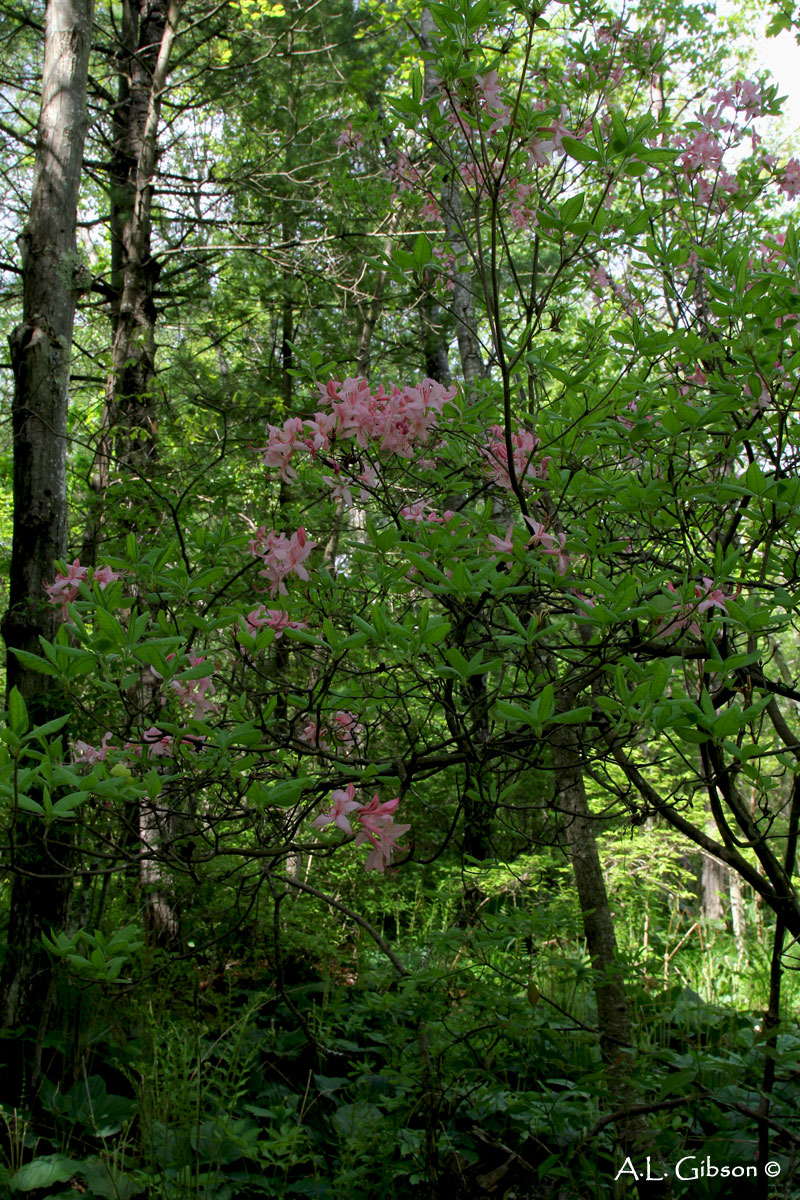
| Early Pink Azalea - Rhododendron prinophyllum |
My first full day back in the Adirondacks had Jackie, Sue, and I visit a few key places in the Saratoga Springs area to see what wildflowers we could happen across and to find a number of specifics I had my eyes on. First up was the Bog Meadow trail outside of Saratoga Springs. Its path through varying habitats of rich, moist woods; spring seeps; and marshes had plenty to see and enjoy.
 |
| Woodland horsetail in a sea of green false hellebore leaves |
It wasn't more than five minutes into my first day of hiking before I came across a new and exciting scene for someone who lives and works in southern Ohio. Growing in a swampy woods was a lush sea of varying greens that seemed to glow in the shade and shadows of the thick canopy. The whorled, elaborate branches of woodland horsetail (
Equisetum sylvaticum) glistened with dew in the waxing morning sunlight, intemixed with the lady's slipper orchid-like leaves of green false hellebore (
Veratrum viride).
 |
| Water Avens - Geum rivale |
 |
| Water Avens - Geum rivale |
One of the first big plants to make it off my list was some of the unique water avens (
Geum rivale) blooming alongside a small brook. Their red sepals and yellow petals hang over its attractive green foliage in quite the aesthetic display. Just about all our other avens (
Geum spp.) are inconspicuous and easily over-looked but this one certainly stands out.
 |
| Nodding Trillium - Trillium cernuum |
As nutty as I am over orchids, and rest assured there will be plenty of those in these posts, I am also a lover and appreciator of our native trilliums. There's just something about their three-parted symmetry and having that "classic" spring wildflower look that sets them at a higher level for me. Halfway through our morning at the bog meadow trail, I was able to finally make the acquaintance of the Ohio extirpated nodding trillium (
Trillium cernuum).
 |
| Showing off those obvious filaments |
 |
| Nodding Trillium |
This particular trillium was first (and only) collected in Ohio back in 1879 in Lake county and subsequently never seen again. It looks excruciatingly similar to our much more common drooping trillium (
T. flexipes) but can be told apart by a close look at the flower's filaments.
T. cernuum has anthers that hang on longer, easily-noticed filaments, while
T. flexipes' anthers seem almost sessile and their filaments are only visible upon pulling apart the flower's petals. Unfortunately, this species is becoming more uncommon across its northern range; a probable response to warming climate conditions. Jackie commented on how she doesn't see them with the frequency or consistency she used to.
 |
| The botanically-diverse Ice Meadows of the Hudson River |
Next up was a visit to the famed ice meadows of the Hudson River to see what plants we could find beginning to bloom along the newly ice-free shorelines. Looking up and down the banks on either side it's easy to see just how open and free of woody encroachment this habitat is. This is created and sustained each winter when huge deposits of
frazile ice accumulate on the margins of the Hudson. The immense weight and pressure from the ice pack, which can reach and exceed 15 feet in height at this location, generate the pseudo-boreal habitat. This annual "cleansing" of the shoreline prevents woody vegetation and invasive species from encroaching and keeps the intriguing plant diversity intact for the late spring and summer months.
 |
| Dwarf Sand Cherry - Prunus pumila var. pumila |
During my visit last summer I arrived a few weeks too late to catch the ice meadows in their floral prime and this time around I was a few weeks too early for the same thing but that doesn't mean the meadows were completely devoid of anything botanically interesting! The first thing to catch my eye among the greening vegetation was dwarf sand cherry (
Prunus pumila var. pumila) in full flower. This small shrub of beaches, rocky shores, and dunes has long been extirpated from Ohio due to habitat loss and degradation of its already naturally rare home(s).
 |
| Large Cranberry - Vaccinium macrocarpon |
 |
| N. Pitcher Plant - Sarracenia purpurea |
Growing and twining all over the place among the boulders and rock cobble of the ice meadows was large cranberry (
Vaccinium macrocarpon) plants with last year's fruit still clinging to its wispy branches. In select spots clumps of northern pitcher plant (
Sarracenia purpurea) were just sending up their flower stalks. I wonder if the pitcher plants generally have more success at the capture of their insect prey during flowering times than any other period of the year?
 |
| Alpine Bulrush - Trichophorum alpinum |
Being the sedge-head that I am, I could never pass up the opportunity to admire and photograph a new life species hailing from the
Cyperaceae family now could I? While it may not look like much to most, I found the fuzzy white hairs on the fruiting heads of the alpine bulrush (
Trichophorum alpinum) quite charming and worth the time to photograph.
 |
| Dog Violet - Viola conspersa |
 |
| Ovate-leaved Violet - Viola fimbriaulata |
Despite the vegetation just starting to wake up along the Hudson, we did see a couple violets blooming profusely in more open, sandy spots along the banks. The dog violet (
Viola conspersa) was a familiar face to your blogger but the downy pubescent leaves and flowers of the ovate-leaved violet (
Viola fimbriaulata) were something I'd never seen before. I adore the violets for their diversity and the countless habitat niches they fill, so it's always a pleasure to add yet another to the life list.
 |
| Stunning white and red pine forest along the Hudson full of botanical goodies |
After an hour or so combing the western side of the Hudson's ice meadows, we jumped back in the car and drove over the river a short distance to another location on the eastern side to explore what goodies may be up and blooming over there. What should have been a five minute hike through the woods to the river's edge ended up taking much, much longer after one exciting botanical find after another!
 |
| Pink Lady's Slippers - Cypripedium acaule |
Under the cathedral of white and red pine, nestled in the soft bed of fallen needles were hundreds of pink lady's slippers (
Cypripedium acaule) in pristine condition. Heading due north during the spring is the closest thing to time-traveling I'll ever experience. Back home in Ohio these orchids were long out of flower and something I wouldn't see again for another year but being in the Adirondacks gave me one more shot at soaking in their beauty.
 |
| Pink Lady's Slippers under the pines |
 |
| Starflower - Trientalis borealis |
It wasn't just the lady's slippers that abounded under the pines but many other typical northern woods associates as well; some of which were quite rare back home in Ohio. The starflowers (
Trientalis borealis) and their short-lived blooms were in prime shape for some len's time and rarely fail to impress with their delicate, dainty flowers.
 |
| Gay wings among the shining clubmoss |
 |
| Gaywings - Polygala paucifolia |
One of the aforementioned Ohio rarities still in bloom in the dappled shade of the pine woods was the bubblegum pink colored flowers of gaywings (
Polygala paucifolia). Their brightly colored flowers stand out like a sore thumb against the varying shades of green throughout the forest floor.
 |
| Sea of blue-beaded lily (Clintonia borealis) |
As we plunged deeper into the pines, we started to spread out in an attempt to cover more ground in the hopes of coming across something that would catch our scanning eyes. It wasn't long afterwards that my breath got caught in my throat and I involuntarily burst out with an, "oh my, God!" at the wildflower display laid out before me. Completely surrounding the base of a red pine was dozens of blue-beaded lily (
Clintonia borealis) in picture perfect bloom!
 |
| Blue-beaded Lily - Clintonia borealis |
 |
| Blue-beaded Lily - Clintonia borealis |
Blue-beaded lily is an endangered species in Ohio that is currently only known from a single population in the extreme northeastern part of the state so it was quite the big deal to find (and see) so much of it in such incredible shape! Your blogger had come frustratingly close to seeing this species in bloom twice before; only to both times find their maturing fruit or petal-dropped blooms in place of their spectacular lemon-lime colored flowers.
 |
| Looking up into the towering pines |
So much time looking at the ground can easily cramp one's neck, so it's only natural to stretch things out with an opposite gander into the heavens. With that came a spectacular view through the layered canopies of the pines set against the brilliant sapphire blue skies. There's few things better than aimlessly meandering your way through a northern pine forest with its spicy scent caught in your nose. It's not something I get nearly enough of back home...
 |
| Thick carpet of Canada mayflower (Maianthemum canadense) in full bloom |
Speaking of spicy aromas, the air of the pine woods was saturated with a sweet, spectacular odor that none of us could put on fingers on as we continued on towards the river. Jackie eventually put two and two together that the en masse blooming of the Canada mayflower (
Maianthemum canadense) in the under story was the culprit. None of us had any idea this dainty little wildflower could put out such an intoxicating scent!
 |
| Mountain Maple (Acer spicatum) |
 |
| More mass blooming Canada Mayflower |
One of the best parts for any nature-lover is the seemingly endless places one can go to cleanse their pallet of the norm and experience something new that kindles the fire of interest inside. I certainly have no qualms of quarrels with my typical botanical experiences but I'd be a liar if I didn't admit that my time spent in upstate New York made me fall in love with Mother Nature all over again.
 |
| Dwarf Ginseng - Panax trifolius |
Once our time came to a close along the Hudson's ice meadows and pine forests, we had a little time left to visit nearby Cole's Woods in hopes of finding one plant that I had long missed out on seeing time and time again. While not rare in Ohio overall, the dwarf ginseng (
Panax trifolius) was just one of those plants I'd never had the fortune of crossing paths with until my visit to New York. Most of the hundreds of plants at Cole's Woods were done flowering but as luck would have it a few were still in perfect shape for the camera!
With day one at a close, Jackie, Sue, and I decided to grab a bite at a delicious Thai restaurant to satisfy out growling stomachs after a long day in the field. As we reminisced on the day's exciting finds, I couldn't help but let my mind wander to tomorrow and what it had in store. Stay tuned for the installment and day two of my trip to the Adirondacks of upstate New York!
*Part I* *
Part II* *Part III* *Part IV*