Showing posts with label Thuja occidentalis. Show all posts

Thursday, April 4, 2013

Early Bloomers at Clifton Gorge State Nature Preserve

I think it's safe to say spring has finally arrived after thoroughly taking its sweet time all through the month of March.  It's quite a breath of fresh air to read the expanded weather forecast and see highs in the upper 50's and 60's for the foreseeable future.  Those seemingly endless weeks of chilled temperatures and spotty snow showers have finally come to an end.

This past weekend saw your blogger return home to west-central Ohio from the hills and hollers of the southeast to spend the Easter holiday with family.  In typical fashion I spent some of my free time taking advantage of the nearby botanical attractions.  I knew with the newly minted warmer temperatures and weather the flora was sure to still be a bit lethargic in waking up but some early bloomers could still be expected breaking through the thawed soil.

Little Miami River flowing through the deep limestone gorges at Clifton Gorge

One of the best stations for early wildflower viewing accompanied with a healthy dose of impressive geologic formations is Clifton Gorge state nature preserve just outside Yellow Springs.  The state and national scenic Little Miami River flows through a stunning stretch of deep dolomite limestone gorge cut during the waning periods of the last glacial epoch and creates some spectacular views.

White cedars growing directly out of the gorge's limestone cliff walls

The resulting geologic features have created a microclimate able to sustain the cool, moist conditons needed for many of the rare and unusual disjunct northern plant species that still reside within the canyon walls.  A walk along the river during the winter and early spring months easily shows off the many evergreen eastern hemlocks (Tsuga canadensis) and northern white cedars (Thuja occidentalis) that grace the limestone cliff faces and lower slopes.  Other interesting northern species such as red baneberry (Actaea rubra), Canada yew (Taxus canadensis), and mountain maple (Acer spicatum) persist in the unique climate as well.

Maidenhair spleenwort fern
Carex plantaginea sending up flowering culms


The tiny, delicate fronds of the maidenhair spleenwort (Asplenium trichomanes) is rather out of place in this area of the state but is right at home on its favored habitat of moss-covered limestone boulders and rock slumps in the shadows of the gorge.  Another 'evergreen' plant not typical of west-central Ohio is the conspicuous clumps of plantain-leaved sedge (Carex plantaginea) persisting alongside the maidenhair spleenwort fern on the cool, moist, soil-covered rocks.  Many of them were welcoming the more spring-like temperatures by sending up their flowering culms; ensuring their presence in the limestone chasm would continue on in the next generation.

Harbinger-of-spring (Erigenia bulbosa) in full, albeit tiny bloom

One of the surest signs of spring's arrival is the diminutive appearance of the aptly-named harbinger-of-spring (Erigenia bulbosa).  Bravely facing the frost-prone mornings, this dainty wonder proudly displays its charming flowers for the season's first insects.  It can also go by the common name of salt-and-pepper for its contrasting white petals and purple-turning black anthers.  It's certainly an easy wildflower to pass over but those with a keen eye can take pleasure in its early-spring charisma.

Sessile trillium just about to break bud
Sharp-lobed hepatica (Anenome americana)


It wouldn't truly be spring here in the Midwest without the abundance of sharp-lobed hepatica (Anenome americana) breaking bud and painting over winter's browns and greys with their endless shades of white, pink, purple, and blue.  The attractive mottled leaves of the sessile trillium (Trillium sessile) accompanied the surrounding hepaticas but were still a few days away from breaking bud.  I've always admired them more for their leaves than flowers anyway; which is not something that can really be said for any other species of Ohio trillium.

Red and white cedars precariously clinging to the cliff's edges

Much like the white and red cedars of Adams county fame, Clifton gorge has its own accompaniment of trees clinging precariously to the limestone cliff's edges and sheer walls.  Growing right out of crevices and gaps in the rock, the white (Thuja occidentalis) and red cedars (Juniperus virginiana) grow excruciatingly slow and are much older than their size would suggest.  This nearly-stagnant growth pattern also allows them to attain unique, gnarled forms of a strangely artistic appearance.

Snow trillium (Trillium nivale)

One of the gorge's most hallowed and anticipated of wildflower denizens are those ever-so-popular and beloved snow trillium (Trillium nivale).  The shallow, limestone gravel-derived soils at the base of the cliff faces are the perfect set up for this early bloomer to thrive in.

How many trillium can you see?
Snow trillium (Trillium nivale)


I shared their awakening in the similarly-situated limestone gorge of Fort Hill in my last post but I don't think anyone could ever truly tire of seeing these floral wonders.  There's just something to be admired and said about the year's first showy and magnificent wildflower.  All those chills and long months of winter instantly melt away from your heart and soul at the very sight of these as they peak out their heads from the decaying leaf litter.

Snow trillium (Trillium nivale)

It's a bit bittersweet for me to have one of my absolute favorite wildflowers be one of the very first out the gate each season.  I can't think of a more anticipated and welcoming sign that spring is here once again and the avalanche of blooming wildflowers has only just begun, but at the same time it's sad to know it will be another year before I get to sit down and catch up with these close acquaintances.  In a weird way it makes me question and ponder my own mortality.  How many more chances will I have to spend time in their presence before its time to return my bones back to the earth?  It certainly gives every waking moment with them and in the great outdoors in general a great deal of value.  Why I always encourage everyone to get outside and breath in the fresh air as much as they can.  Sure, the natural world will always be there to enjoy but unfortunately the same cannot be said for our mortal selves.

White cedars lining a long-fallen limestone boulder along the banks of the Little Miami River

Once through the narrow limestone gauntlet of the gorge, the water slows itself to a much more calm pace and slowly meanders its way downstream.  Without the protection of the precipitous canyon walls the microclimate quickly dissipates and with it goes the unusual plant species/communities.  I'm very thankful for the souls who had the wisdom and mind for conservation to protect this incredible place early on from the stain and reckless behavior of mankind.  It's a great deal of comfort to me knowing that whenever I want to experience arguably the finest inter/post-glacial limestone gorge in the entire state it's always there with open arms.

Thursday, June 7, 2012

The Showy Lady's Slippers of Cedar Bog

Cedar Bog.  Few places in the Midwest, let alone Ohio, have as much botanical wonder, biodiversity, and history stored inside than the white cedar swamp forests, fen sedge meadows, and tall grass prairie habitat here.  Owned and operated by the Ohio Historical Society since 1942, it was the first Ohio nature preserve to be purchased with state monies and is on the national natural landmarks register to boot.  Located in south-central Champagin county, Cedar Bog currently preserves well over 400 acres of original habitat and is home to nearly 100 rare species of flora and fauna.  It's a good thing this gem was saved and preserved because Ohio's intact, naturally-occurring wetlands are a very rare thing today.  Around 90% of Ohio's wetlands no longer exist and are gone forever. From over 5,000,000 acres pre-settlement to just a tiny fraction of that in under 300 years is depressing but that's what makes places like Cedar Bog so precious and vital to our biodiversity.  If you want a fact to really drive the nail home on our wetland habitat loss: California is the only state that has lost a larger percentage of its original wetlands than Ohio.  Click this link here for more on the matter.

Don't be fooled by the name however.  Cedar Bog is not a bog but in fact a fen.  What's the difference?  Bogs are non-flowing acidic environments associated with accumulated masses of sphagnum moss while fens have internal flowing groundwater that seeps to the surface and is usually rich in magnesium and calcium, making for a neutral to alkaline environment.  Just remember "fens flow"!

View out across the fen sedge meadow of Cedar Bog

When the early pioneers first started to settle the Mad River valley they found countless tracts of wet, marly fields and meadows full of mosquitoes and curious plants that didn't make for good farm land.  Quickly and with prejudice, the land was drained and transformed to support their agricultural ways while the natural landscape slipped into memory.  The 450+ acres Cedar Bog currently preserves was once a fen complex over 7,000 acres in size.  Imagine 7,000 acres of pristine fen habitat choked full of fascinating flora, massasauga rattlesnakes, spotted turtles, swamp metalmarks, and indigenous brook trout.  I can't fault the settlers for their lack of foresight or preservation but what a sight that must have been.

The Mad River valley was host to a seemingly infinite supply of fen complexes and wetland habitat pre-settlement that served as a reminder to the area's icy past.  Over 12,000 years ago as the Wisconsin glacier receded to the north it left behind a barren landscape of melted ice, glacial till, and boreal plant species from the northern climates.  The previous period's ancient river valleys were filled with gravel and saturated with melt water, which today comprises west-central Ohio's natural aquifers.  In spots where this cold, calcareous groundwater percolates and bubbles to the surface is where these incredible fen communities persisted for thousands of years after the glaciers left, leaving behind the plants and animals you won't see anywhere else in the state today.
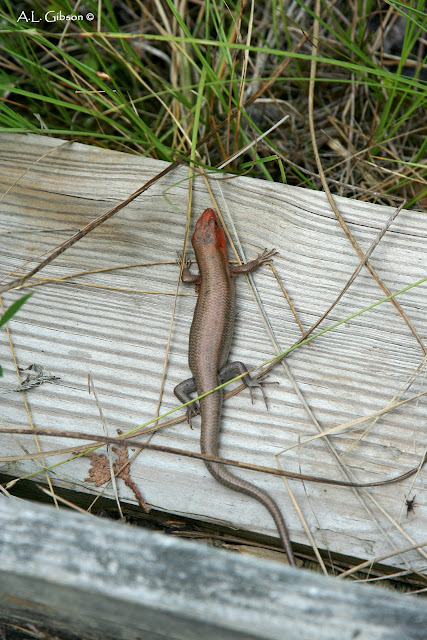
Mature male Five-lined Skink (Eumeces fasciatus) on the boardwalk.


Okay, enough of the history lesson even if I could go on and on.  Fens and their histories and biological communities fascinate me to no end and I could blab about them forever!  Now on to the main event and that magical word 'orchid' in the title that probably nabbed your attention.  But not before I share a quick tidbit about one of Cedar Bog's most frequently seen animals.  Pictured above is a critter I'm willing to guarantee just about everyone sees on their stroll down the boardwalk.  Five-lined skinks love to sun themselves on the warm wood and then go scurrying off as your footsteps approach.  Good luck trying to catch one, these guys move like lightning!  Juveniles start off black with five yellowish lines down their backs and tails of the most gorgeous electric blue you've ever seen.  The specimen above is a mature male with its copper-colored body and red face.

Orchids, orchids...I know, I know.  So without testing your patience any further I give you North America's largest terrestrial species of orchid.  An orchid that stole my heart many years ago along these very same creaky boardwalk planks and has yet to release me from its grasp.

Showy Lady's Slipper (Cypripedium reginae)

Scattered along the margins of the northern white cedar (Thuja occidentalis) of which Cedar Bog gets its name, lies one of the greatest botanical shows Ohio puts on each early June.  The showy lady's slipper (Cypripedium reginae) is the largest and last of the slipper orchids to bloom and mother nature certainly knows how to save the best for last.

An 'eat your heart out' clump of Showy Lady's Slippers (Cypripedium reginae)

This is my sixth year in a row heading to Cedar Bog to see the performance and what a spectacle they've been this time around.  While my run isn't nearly what many other local residents, botanists and orchid-lovers have going, I can say this has been the greatest year I've seen them put on in my experience and a number of  other long-time fans are voicing their agreement.  Just look at that clump above!  Nearly two dozen plants all clustered together and topping out over three feet tall under the partial shade of the cedars is a site no one is likely to forget anytime soon.

Showy Lady's Slipper (Cypripedium reginae)

Each flower's pouch or 'labellum' is about the size of a golf ball and delicately painted the most perfect shade of pastel pink to be found in nature.  Depending on what I assume to be a matter of sunlight, the labellum's pigmentation can vary greatly from soft and pale to intense and deeply saturated.  Another common name for these is the queen lady's slipper.  As the binomial nomenclature would have it, the scientific or botanical name for this species is very fitting.  The scientific epithet of reginae translates to 'queen', implicating the regal and majestic beauty of this orchid.  The lady's slippers genus name was conceived from the combination of the Greek word Kypris (for Cypris, the goddess of beauty and love) and the Latin word pedis  (meaning 'foot') as told by Michael Homoya is his brilliant book The Orchids of Indiana.


Showy Lady's Slipper (Cypripedium reginae


Taking a closer look at the inflorescence or 'slipper' of the showy ladies just magnifies their stimulating appeal.  I was happy to have coincidentally timed my visit on an overcast day right after a rain shower had passed through, giving all the slippers an aesthetically pleasing coating of water droplets.  Unfortunately their beauty is not lost on those who seek to remove them from their rightful homes.  Ignoring the heavy loss they have endured from habitat loss due to succession and destruction, these royal plants have long fought the hands and shovels of mankind.  The floral trade, ignorant digging for wildflower gardens and careless picking has removed these plants to the point of extirpation and extinction of populations throughout much of its range.  Even the botanist is to blame in some situations where avid over-collecting depleted their numbers to nothing.  This is one of the those plants that is best touched with our eyes only, despite the human urge to take the beauty home with us.

North American distribution of Cypripedium reginae (courtesty BONAP)

Looking at the distribution map for this species shows how strong an association it has with the northern Canadian provinces and Great Lakes region.  The further south you slip away from the lakes the more rare it becomes due to an increased lack of habitat availability.  Their preferred habitat of fens, northern swamp woods and glacial depressions aren't found further south than Ohio, hence their increase in frequency the further north you go.  Populations in the south, such as in the Appalachians, grow in circumneutral seeps in limestone regions where plants are few in number and locations.  The one vitally important thing an environment must support regardless of geographical location is what's called "cold-bottom" conditions.  These conditions exist when groundwater reaches the surface and saturates the soil to create a constant supply of cold water that this plant needs to survive.  This in turn allows these plants to exist and survive in more southern latitudes whose normal conditions would not otherwise support them.  In many cases where these plants have disappeared despite not much disturbance to the habitat is the result of a change in the hydrology.  It's not just the surface you have to worry about but what's going on underneath as well to keep these orchids happy and alive.

Showy Lady's Slipper (Cypripedium reginae)

An interesting piece of information about this particular species that will probably engage my entomologist readers and friends most is that the showy lady's slipper is apparently the only eastern Cpypripedium that is largely pollinated by flies and beetles rather than bees.  In any case, the insects are attracted inside the labellum by the promise of a nectar meal but are quickly disappointed to find it's a sham and they are forced to retreat back out the way they came.  Upon their exiting they (hopefully) pick up a package of pollen (pollinia in orchid-speak) from the column (the unique orchid organ comprised of fused stamens and pistil) and in a case of instant memory-loss, enter a new labellum in search for that mythical nectar and we have pollination!

Showy Lady's Slipper (Cypripedium reginae)


There truly are few other plants that I can sit in front of and admire their timeless grandeur for what seems like hours on end.  It's not everyday one sits in front of royalty like this and can have such close interaction with them.  A warning must be issued though to all who suffer with frequent bouts of skin irritation and dermatitis.  The dense pubescence of the leaves, stem and pedicels can cause a severe case of dermatitis much like that of poison ivy (Toxicodendron radicans) to those susceptible.

The incredibly early start to this year affected these plants much like the rest and saw the showy lady's slippers start blooming in late May, something I'd never seen before.  The intense heat of last week hastened the freshness of the blooms this year and the show has already passed when under normal circumstances would just be starting.  Be sure to mark late May and early June on your calender for 2013 to see these wondrous plants in action.  Don't fear, there are still many more orchid wonders Cedar Bog has in store for the future and I will be here to bring them to you when they happen!

Thursday, March 3, 2011

Exploring South Manitou Island Part I

 *Be sure to check out part two of this series by clicking RIGHT HERE!*

An ancient Chippewa Indian legend tells the tale of how the Manitou Islands came to be.  The story goes that a mother bear fled from a great forest fire in Wisconsin with her two cubs and swam across Lake Michigan to the Michigan shore for safety.  Upon reaching the shore the mother climbed a steep bluff to await her cubs arrival.  The cubs, exhausted from their long swim, were lost to the great lake and never made it ashore.  Filled with grief the mother bear waited day after day for the cubs on the steep bluff until her final breath.  The Great Spirit Manitou marked her final resting place with the Sleeping Bear Dunes and raised North and South Manitou Island from the depths of Lake Michigan in remembrance of where the two cubs perished.  Today these geological wonders still stand where the Great Spirit placed them for generations of people to come and experience the beauty and wonder of northern Michigan.
 
Located about ten miles offshore from Glen Arbor in Leelanau County, Michigan sits South Manitou Island in the chilled aqua waters of Lake Michigan.  If you are curious where exactly in Michigan this area is located here is an easy way to give you a good idea where to look on a map.  Stick out your left hand with your palm facing out.  Kinda looks like the outline of the state, right?  Focus on your pinkie fingernail, that is Leelanau County and just off the left side of the tip of your pinkie are the Manitou Islands.  Sure, you could have just jumped on Google maps and typed it in but I think my way is more fun and original.  Only a bit over 8 square miles in area, what this island lacks in size is more than made up for with its natural history and long list of incredible sights.  As mentioned in my earlier post on the Pitcher's Thistle, Leelanau County is one of my favorite summer memories from my childhood and even now as an adult.  A couple summers ago I spent two days and a night backpacking and exploring this remarkable environmental gem and would like to take you back there with me to get a first hand look at just how unique a place this is.  So make yourself comfortable and enjoy the pictures and journey this post takes you on.  Here we go!

Map courtesy of the Sleeping Bear Dunes National Lakeshore (U.S. NPS)
 
Above is a map to reference whenever I talk about a specific part of the island (don't forget to click on the pictures to see them in bigger, greater detail).

North Manitou Shoal Lighthouse
 
 An hour and a half long ferry ride from Leland, Michigan is the only way to get to the island if you do not have a capable boat of your own.  The ferry is loud and slow but with the lake breeze and warmth of the morning sun on your face along with the sights make for a bearable trip out.  Pictured above is the North Manitou Shoal Lighthouse with our destination the blob of land on the left.  Built in 1935 to help ships make the perilous voyage through the Manitou Passage safely, it now sits in solitude as a roost for numerous Gulls, Cormorants and Terns.  The Manitou Passage has long been considered one of the most dangerous areas in all of the Great Lakes.  There are over 50 known shipwreck sites in the area around the Manitous and many are popular diving spots.  As you can see from the map above the eastern side of the island curves to form the best natural bay and harbor to be found in-between Chicago and the Straits of Mackinac.  Many a ship was saved during the 19th and 20th centuries from the violent and deadly storms Lake Michigan is fabled for.

*Note*  Since this trip was made over two years ago and I never planned on writing a travel blog for it I will do my best to use what pictures I took to the best of their advantage.  If I could do it all over again I would take much more specific photographs of the different areas and features of the island to better show off what I'm talking about.

So with that said let's take our first steps into the wilderness.  I started off walking along the southern edge of the island in a general westerly direction.  This course takes you through the woods all the way to the perched dunes at the western edge of the island.   In the mid-1800's South Manitou's forests fueled the boilers for the hundreds of steamships that sailed through the area.  This heavy logging caused the island's virigin forest to be all but gone before the turn of the century in 1900.  Only a small area in the southwestern corner was never touched, but we will get to that later in the post.

American Basswood
White Birch


The island today is covered in a second growth forest that resembles in species make-up the forest that prevailed the settlers.  The flora and forest type of the island falls into the same categories as the rest of the northern Great Lake states with a few exceptions.  Under the Northern Hardwoods banner, South Manitou's forests change subtly in areas and are dominated by American Beech (Fagus grandifolia), Sugar Maple (Acer saccharum) and Eastern Hemlock (Tsuga canadensis) with a strong association of Yellow Birch (Betula alleghaniensis), White Birch (B. papyrifera), Northern White Cedar (Thuja occidentalis), American Basswood (Tilia americana), Ash (Fraxinus spp.) and the occasional Red Oak (Quercus rubra) on the interior of the island.  The coastal areas of the island have many of the aforementioned trees but also contain White Pine (Pinus strobus), Red Pine (Pinus resinosa) and Jack Pine (Pinus banksiana) with many White Birch and Quaking Aspen (Populus tremuloides) mixed in.  With the clearing of the land for cordwood for the steamers came homesteads, farms, livestock fields and orchards for the early settlers.  When the farms failed the land was allowed to succeed back to its current forested state.  Signs of their occupancy can still be seen throughout the island today.  A few houses and barns in varying stages of decay and ruin are scattered amongst the fields and forests.  Also serving as evidence of those who came before are a number of species of non-indigenous plants left to grow on the island.  American Chestnut, Mulberry, Black Walnut, Apple, Cherry and Pear can still be found growing "wild" amongst the native vegetation.

Aralia racemosa
Clintonia borealis


Despite the clearing of the original forests on South Manitou, the island still enjoys a very lush, diverse and rich aray of herbaceous species.  Some of the species many of you from our home state of Ohio would be very familiar with such as;  Large-flowered Trillium (Trillium grandiflorum), Jack-in-the-Pulpit (Arisaema triphyllum), Partridgeberry (Mitchella repens), Wild Leek (Allium triccocum), Canada Violet (Viola canadensis) and Spikenard (Aralia racemosa).  Most however are either not found in our state or are very rare like the species from the picture above; Bluebead-lily (Clintonia borealis), which is an endangered species in Ohio.  Another rare species in Ohio that is commonly found as a ground cover on the island is Canadian Yew (Taxus canadensis).  A few more species found on the island include; Northern Bush-honeysuckle (Diervilla lonicera), Snowberry (Symphoricarpos albus), Red Baneberry (Actaea rubra), Striped Maple (Acer pensylvanicum) and Bunchberry (Cornus canadensis).  I wish I had photographs of these species but there's always next time.  Many of the plants I saw were among the largest I am likely to ever see, especially those of the woody 'shrub' variety such as the three native Aralia species and Canada Yew.  The reason for this is there are no grazing mammals living on the island to eat back and keep all the new growth at bay.  White-tailed Deer were introduced to North Manitou island but never to the South which has caused the degradation to the native ground cover and herbaceous species of the North island.  Many species found on South Manitou are no longer to be found on its larger neighbor due to this unfortunate decision to release the deer several decades ago.

Eastern Garter Snake
 
Perhaps the only reptile on South Manitou Island is the Eastern Garter Snake (Thamnophis sirtalis) and boy are they everywhere.  It seems every couple of steps one would go slithering away into the underbrush.  This one was kind enough to pose for a photograph or two even if he does seem a bit perturbed.  Making your way along the southern edge of South Manitou about half way across the island is the only inland body of water, Lake Florence.

Lake Florence, the islands only interior body of water
 
According to a limnological investigation done by the University of Michigan Biological Station, Florence Lake is only 26 feet deep at its maximum and has an overall mean depth of only 10 feet.  Watermarks around the shores indicate water levels have a tendency to fluctuate.  Due to there being no inlet or outlet sources on the lake and the lake sitting at an elevation lower than that of Lake Michigan, the water level is directly controlled by the water level of Lake Michigan itself.  Another interesting fact about Florence Lake is that despite its relatively small size in area, its watershed drains nearly 50% of the islands land surface (rain/ground water runoff).  Many different species of aquatic plants grow in and along Lake Florence.  Species from the genus' Carex, Scirpus and Potogometon were the most common observed.  

The rusting wreckage of the Francisco Morazan
 
As mentioned earlier, the Manitou Passage is famous for its many shipwrecks spread throughout the area.  The most famous and noticeable of all the wrecks is the 1960 grounding of the Francisco Morazan.  After dropping off cargo and getting reloaded in Chicago, the Francisco Morazan was headed for the Netherlands when on the night of November 29th in a terrible snowstorm it ran aground on a shallow shoal just off the shore of South Manitou.  All of her crew survived and were rescued without much difficulty and the wreckage was left to rust in her shallow, watery grave.

The once prized ship is now just a roost for passing seabirds
 
After leaving the shoreline and the ghostly remains of the Francisco Morazan you are not very far away from entering the most enchanting and memorable section of the island...the Valley of the Giants.  A small, ancient virgin grove of Northern White Cedars on the southwest corner on the island contains some of the oldest and largest of their kind on the planet, including the former national champion.

Virgin White Cedar forest
Ancient White Cedar tree


While these pictures cannot truly give these mammoth and ancient trees the true justice they deserve it can give you but a small taste of one of the rarest ecosystems in the country.  It is believed that the remote location of the grove as well as the proximity to the dunes is what allowed this magnificent masterpiece of nature to survive to this day.  Sand from the dunes forever mixed into the bark and grain on the wood would quickly dull and ruin the loggers saw blades is one hypothesis or perhaps the lumberman didn't have the heart to take down all the mighty monarchs of the forest.  Whatever the reason may be, let us be forever thankful it survived.  With heights reaching 100 feet tall and girths 3-5 feet in diameter, it's not everyday you get to see a forest like this in today's world, let alone one of this type of tree.  

The fallen former national champion White Cedar

On a sad note, here is what remains of what I believe to have been the former national champion Thuja 
occidentalis.  Almost six feet in diameter and nearly 100 feet in height, I wish I could have stood next to this behemoth to give you a size comparison.  The trees of this size in this grove have been aged using a corer to count the growth rings.  The largest ones have been growing for over 500 years!  That's incredible to even think about.  I've seen 500-1,000+ year old trees out in Washington state but to see something like this back east is mind blowing.

Your blogger and a huge Cedar!
Virgin White Cedar forest


I can't wait until I get the chance to get back to this place and really explore this area of the island more.  The 40 acre virgin grove is a very well-mixed aged stand.  There are many seedlings and saplings patiently biding their time to reach the lofty goals of their ancestors as well as many cedars of a more normal size filling in the holes in the canopy.  This time-tested forest is slowly weening itself of its largest members and will one day not have the same visual affect on visitors as it does today.  Several rare and threatened species of plants make their only homes on this island in this secluded grove as well.  Walking Fern (Asplenium rhizophyllum) and Green Spleenwort Fern (Asplenium viride) are both threatened species in Michigan and are both part of very disjunct populations on South Manitou.  Green Spleenwort is not found anywhere in the lower peninsula except for South Manitou while the Walking Fern is found in only two other counties in the L.P. but both populations are well over 100 miles away.  How these ferns got to the island, who knows?  The Large Yellow Lady's Slipper (Cypripedium parviflorum var. pubescens) can also be found in the secluded haunt of the ancient cedars.

I think I have had enough for one post!  Up next is the climb up the perched dunes to the top of the island for one of the best panoramic and beautiful views I've ever seen!  Hope you have enjoyed the first part, I will be sure to post the follow up sometime in the next day or so.