Showing posts with label Flora-Quest. Show all posts

Thursday, March 27, 2014

OOS 10th Anniversary Conference in Shawnee State Forest

Spring has finally arrived and it's never too early (or late) to begin planning out how you want to spend it!  If you regularly read this blog then you have surely noticed how much time I spend in the hills and hollers of Ohio's southern-most counties of Adams and Scioto and it's no coincidence.  These two counties combine to be one of, if not the most biologically diverse area in our state and harbor many rare species of flora and fauna within.  From the limestone outcrops and cedar glades of the Edge of Appalachia preserve system to the continuous rolling forests of nearby Shawnee State Forest, you never know know what is in store for your eyes, ears, and cameras.

Shawnee State Forest in spring's full bloom

To coincide with extreme southern Ohio's dizzying diversity of plant and animal life come spring, the Ohio Ornithological Society has decided to return to the depths of Shawnee for its 10th annual conference on the weekend of April 25-27.  This phenomenal event draws birders, naturalists, and outdoor enthusiasts from all over the state and beyond to experience the luscious landscape of Shawnee and the Edge flush with returning migrating birds and spring wildflowers.  If the sound of this happens to peak your interest, and I think it might if you're still reading up to this point, then I suggest checking things out HERE and marking your calendars for the last weekend in April!

Prairie Warbler, just one of around 20 species of warbler in the area

Normally this time of year would have me plugging and encouraging readers to check out the acclaimed annual spring wildflower event Flora-Quest that takes place in Shawnee and on the Edge.  Due to the near simultaneous nature of the OOS event, Flora-Quest is doing something a bit different this May on the complete other end of state up along Lake Erie.  You can find more information HERE.

That being said, I am very happy and pleased to say that I will be reprising my role as a field trip leader/guide (usually for Flora-Quest) for the OOS event instead! My group will be out and about deep in the forests of Shawnee to see what birds and botany we can stir up.  No worries, while I know my birds better than most folks might assume a plant-geek would, we will have an accomplished and knowledgeable birder on hand in co-leader/guide Andy Jones.  To see an agenda for the programs and field trips click HERE.

Spring wildflowers waking up in a hanging prairie on the Edge

Hopefully we will see warmer temperatures finally arrive and stick around all April in order to have the typical menagerie of spring wildflowers coloring up the area's forests and prairies.  The combined botanical diversity of the Edge and Shawnee results in well over 1,000 native plant species and some plant assemblages seen nowhere else in the entire state.  The birding is on par with the plants too as over 100 species are known to nest here with rarities and curiosities like the Kentucky, Cerulean, and Worm-eating warbler, Chuck-will's-widow, blue grosbeak, red-headed woodpecker, and wild turkey calling the undulating hills of the "Little Smokies" home.

Fragrant blooms of a wild plum (Prunus spp.)

The conference is a wonderful collaboration on many people's parts from the field trips to the programs and presentations that go on throughout the weekend.  Honestly, the best thing about these kinds of events are the friends, camaraderie, and memories made over weekend with 200+ like-minded people who have a thirst and passion for the natural world.  I am looking forward to catching up with old friends and meeting new faces alike and encourage any of my readers to seek me out and personally introduce yourself!

Having done Flora-Quest for three consecutive years and spent countless days exploring the region from spring to fall, I think I can say with some authority just how mesmerizing this area of the state truly is.  I could not encourage anyone more to check out the event and website and seriously consider making yourself a participating member of what is sure to be one of the best weekends this spring!

Tuesday, May 7, 2013

Flora-Quest Weekend 2013 Rewind

Another Flora-Quest weekend has come and gone and what an exciting weekend it was!  Shawnee state forest and the nearby Edge of Appalchia preserve system played host to well over 100 people with interests ranging from wildflowers and birds to moths and amphibians in this seventh installment of the popular spring event.  It was a fantastic chance to get out into the forests for the best of southern Ohio's spring wildflower shows and soak in its beauty with others who share in my passion for the outdoors.  Even better is the camaraderie and catching up with old friends I haven't seen in some time and the opportunity to finally meet others in person for the first time.  It's just an overall incredible atmosphere your blogger is quite lucky and fortunate to be a part of.

Scenic look out across the rolling hills of Shawnee state forest 

This was my second year in a row being a trip co-leader and I couldn't have asked for a better partner in the phenomenal and well-known nature photographer, Ian Adams.  I had never met Ian before but after just one day out in the field with him, I think I can speak for the both of us that a friendship was quickly kindled.  His eye for capturing nature with the camera lens is second to none and he's quite the naturalist as well with a great depth of knowledge and understanding about our natural world.

Our group was largely made up of folks who wanted to center on photography and soak up the tips, techniques, and tricks Ian (and myself to a smaller degree) had to share.  With being a trip leader, I largely left my own camera in its case and instead wanted to focus on educating and leading my group efficiently and without the distraction.  I did however use my iPhone to snap a number of pictures of what we saw and am quite pleased with the way most of them came out.  As a result just about all the photos used in this post were taken with my phone; which goes to explain why my hands and/or fingers are in some of the shots.  The iPhone can have a hard time focusing on smaller subjects in the foreground and using your hand as a backboard can help make the sensor's focusing job that much easier.  That all being said let's jump into some of the floral highlights of Flora-Quest weekend 2013!

Flowering dogwood along a flowing stream in Shawnee state forest

First thing worth saying is what a difference a year can make.  This time last year had the forest and plants looking like late May/early June and the trees completely leafed out; which was certainly not the case this time around.  Things were all just about right on time with many of the Flora-Quest classics all present and in full bloom.  The snow white blossoms of the flowering dogwood and wild plums along with the vibrant pinkish-reds of the red bud carpeted the forest under story in their typical stunning fashion.

Dwarf crested irises (Iris cristata) in full bloom along Shawnee's roadsides

Instantly noticeable all along the forested roads of Shawnee were the regal purple carpets of dwarf crested iris (Iris cristata) in full bloom.  The underground rhizomes do their jobs well and quickly spread out to give the forest a seemingly endless supply of the short-lived flowers, perfectly timed up with our arrival.

Dwarf crested irises (Iris cristata)
Spectacular double-flowered iris


Upon closer inspection of their delicate flowers, the dwarf crested iris can truly be held among the floral elites of spring.  The soft shade of lavender they exhibit is contrasted stunningly by their petals honey yellow markings.  Our group was fortuitous enough to come across a spectacular double-flowered form that was most likely the result of some genes going a bit haywire.

Albino dwarf crested irises

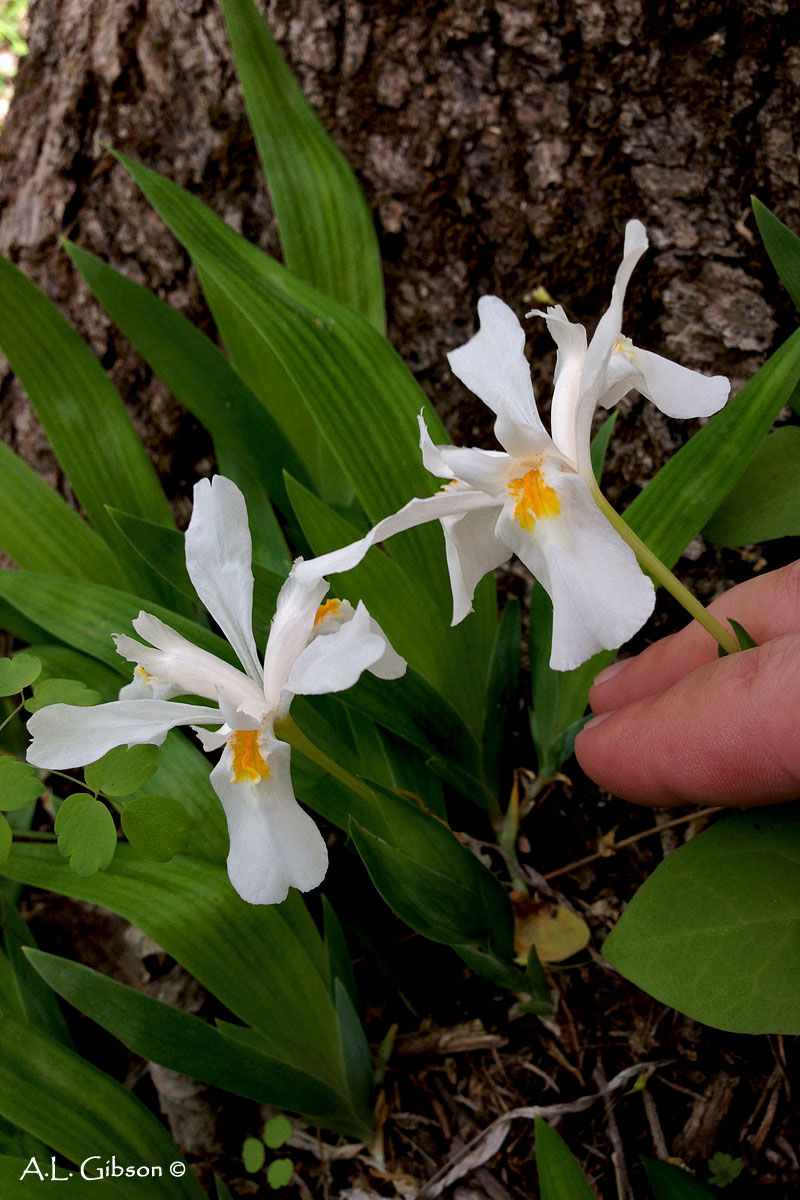
Perhaps less rare but nigh on equally pleasing were some albino forms of dwarf crested iris.  Their shades of purple had been traded in for the purest of white with only the golden markings left behind to add any accentuation.

Large yellow lady's slippers (Cypripedium pubescens)

It's nothing revolutionary in admitting the promise of wild orchids to be one of the main draws to each annual Flora-Quest event.  This year found them waking up a bit late and more slowly than in years past but still putting on as magnificent a show as ever.  Large yellow lady's slippers (Cypripedium pubescens) never fail to impress and get a group's camera shutters clicking in unison.

Spotted mandarin (Prosartes maculata)
Pawpaw flowers (Asimina triloba)


One rarity that was completely absent from last year's spectacle was the evanescent blooms of the spotted mandarin (Prosartes maculata).  Their creamy white petals are feverishly spotted with tiny purple speckles much like if it was suffering from a case of the flower chickenpox.  On the opposite end of the scarcity spectrum, the malodorous pawpaw (Asimina triloba) was putting on its own show with their charming matte scarlet blooms.

Luna moth (Actias luna)

It wasn't all wildflowers for our group when we stumbled across a feeble luna moth while out and about.  Ian hypothesized its lackadaisical attitude and out-in-the-open location was foretelling that its job of mating had been completed and its life cycle come to an inevitable close.

Black-legged tick (Ixodes scapularis)

Another invertebrate critter we encountered while in Shawnee was hardly as welcome and grandiose as the luna moth and much more sinister.  The small speck climbing up your blogger's finger is the infamous black-legged tick, which also goes by the name of deer tick.  Of the three species of tick that call Ohio home (deer, dog, and lone star) only the deer tick can carry Lyme's disease; so naturally they seem to get the most attention.  Its smaller size and orange-colored back are helpful ID characteristics.  It's becoming much more prevalent in the southern/southeastern/eastern part of the state so be on the lookout for it!

Early pink azalea (Rhododendron prinophyllum)

An instant classic and inducer of many "oohs" and "ahhs" is one of my all-time favorite woody plants: the early pink azalea (Rhododendron prinophyllum).  A completely hidden and inconspicuous plant any other time of the year, early May is this heath family member's time to shine!  If you think its looks are good, definitely take the time to give it a whiff.  Its intoxicating aroma will impress your nose as much as its perfect pink blossoms please your eyes!

Dry hillside full of vernal iris
Vernal iris (Iris verna)


In addition to the aforementioned dwarf crested iris, Shawnee is also home to the state-threatened and absolutely breathtaking vernal iris (Iris verna).  Few other wildflowers can eclipse the electric blue/purple hues and royal demeanor of its blooms.  Most iris species are associated with wet-moist soiled situations but the vernal iris is a high and dry plant that prefers the xeric, sun-drenched ridge tops and rocky outcrops of extreme southern Ohio.

Bird's foot violet (Viola pedata)

It just wouldn't be spring in Shawnee without the annual display of our state's most dazzling of violet species: the bird's foot violet (Viola pedata).  Their large, showy flowers stick out like a sore thumb against the barren ridges and dirt banks.  The ones pictured are of the bi-colored form and seem to outnumber the typically more traditional light lavender monochrome plants.

Black-edged sedge (Carex nigromarginata)

I wouldn't be a real botanist if I didn't take the time to share with my group one of my favorite sedge species now would I?  I may have had a few odd looks and some scratching their heads as I gushed over the beauty and my love for the black-edged sedge (Carex nigromarginata), but they did agree it was a rather handsome little plant.

Large, leafing out tuliptree
Showy orchis (Galearis spectabilis)


While orchids like the showy orchis (Galearis spectabilis) showed off their glamour on the ground below, high in the tree tops our group was spoiled with a diverse array of fantastic birds.  Scarlet tanager, wood thrush, worm-eating warbler, cerulean warbler, hooded warbler, ovenbird, northern parula, American redstart, and whippoorwill is just a small sampling of the feathered friends we encountered.  Our group was even so lucky as to come across a gorgeous, healthy-looking coyote deep in Shawnee during Sunday morning's outing.  It quickly disappeared into the trees but those few fleeting seconds were special indeed.

Whorled pogonia (Isotria verticillata

One of the most fun plants last year's event missed out on was thankfully just coming into its prime this time around.  I was forced to show the swelling seed pods of the whorled pogonia orchid (Isotria verticillata) to my group last season but I was much more successful this weekend!  This infrequent orchid prefers the dry, acidic upland soils of oak/pine woods; often in association with mountain laurel (Kalmia latifolia) and other members of the Ericaceae family.

Whorled pogonia (Isotria verticillata

The whorled pogonia looks like a mythical beast out of the folklore of Greece or Rome with its spreading sepals and gaping "mouth"; waiting to consume its next unassuming victim.  It may not have the same following and fan club as the next orchid species but it has always been one of my favorites for its unique and chimerical appearance.

Pink lady's slipper (Cypripedium acaule)

Growing in close proximity to the whorled pogonia and sharing in its love for the dry, acidic mixed oak forest was some impressive clumps and patches of the pink lady's slipper (Cypripedium acaule).  I've seen this particular orchid dozens of times before in years past but it just never gets old getting reacquainted with their gorgeous faces each and every spring.  There's just something about them I find irresistible and I think my group easily shared in that excitement.

Black huckleberry (Gaylussica baccata)
Hillside blueberry (Vaccinium pallidum)


Two associates of the acidic oak woodlands happened to be in full bloom this past weekend and both end up producing a delicious fruit I can never get enough of.  On the left is the red bell-shaped flowers of the black huckleberry (Gaylussica baccata) with is cousin hillside blueberry (Vaccinium pallidum) flowering right alongside it. Both are members of the heath family (Ericaceae) and very common in the mountain laurel and azalea thickets of Shawnee state forest.

There's so much more I could share and wildflower pictures worth posting but if I don't stop now, I don't know that I ever could or would!  Flora-Quest proved to be once again an incredibly well put together and organized event that I think I can safely say everyone in attendance absolutely loved.  It's a shame to see it come to a close so soon but there's always next year to look forward to.  I hope to be an integral part of it once again and be leading some field trips but we'll see what possibilities it brings.  Next up on the docket is Mothapalooza June 14-16, being held right here in Shawnee state forest and on the Edge as well.  Hope to see some of you there!

Thursday, January 24, 2013

Register Now: Flora-Quest 2013

Spring is already just around the corner and it's never too early to begin planning on how you want to spend it!  If you regularly read this blog you've surely noticed how much time I spend in the hills and hollers of Ohio's southern-most counties of Adams and Scioto.  It's no coincidence!  These two counties combine to be the most botanically diverse in our state and harbor many rare and fascinating flora (and fauna) you won't see anywhere else in the state!  From the limestone outcrops and cedar barrens of the Edge of Appalachia Preserve system to the continuous rolling forests of nearby Shawnee State Forest, you never know what's in store for your eyes, ears, and cameras!

How could you go wrong spending a weekend during the peak of spring activity with some of Ohio's most knowledgeable and passionate naturalists, birders, botanists, lepidopterists, entomologists etc. guiding you through the endless flora and fauna of these areas?  You can't!  So check your calendars and circle the weekend of May 3-5 for Flora-Quest!  This annual event takes place in the lodge and conference center deep in Shawnee state forest where you will be immersed in the diversity and history of the area by those who know it best!  I highly encourage you to peruse the Flora-Quest website for more information on events, trips, accommodations, guides, speakers etc.  Yours truly is a guide again this year and will be teamed up with well-renowned nature photographer Ian Adams for an experience in nature through the view of a camera lens.

There are plenty of other trips to choose from with out-of-this-world guides!  I know many of them personally and can guarantee an unforgettable time.  There are no wrong choices and each quest offers a unique experience with plenty of highlights and surprises.  Be sure to register soon though, as the more popular quests fill up quick.  I have attended this event two years running now and could not be more excited for my third installment; especially since being asked back as a trip leader!  A two-part blog post on last year's Flora-Quest can be found by clicking this link here for part one and here for part two.

To cap off this advertisement for what will surely be the most fun weekend you'll have this spring, here are some photographs that I think best capture what wildflowers, critters, and sights potentially await you at Flora-Quest 2013.  I hope you will check this event out further and give attending some serious thought!  I promise a great time, rain or shine!  The wildflowers, warblers, and smiles will hardly be in short supply!

Fringe Tree (Chionanthus virginicus)

Each edition of Flora-Quest has a plant species that acts as that year's sponsor.   Event organizers Cheryl Harner and Paula Harper asked me to help come up with the plant species (preferably a woody one this time around) that would grace the promotional card of the event this year.  I decided on the rare and intriguing fringe tree (Chionanthus virginicus) as the best one for the job.  It's a chance to showcase a relatively unknown species of tree that I found absolutely stunning for the brief moments it's in full flower.  Fingers crossed it will be making its prime appearance during early May this year!

Indigo Bunting

If the plant lovers are the primary draw to Flora-Quest, then the birders are a close second.  With Shawnee and the Edge of Appalachia at your doorstep you will not be disappointed in the diversity of returning migrants showing off their breeding plumage.

Rose Azalea (Rhododendron prinophyllum)

As you slowly drive down the roads in Shawnee state forest with your groups you would be hard pressed not to notice the magnificent displays of the rose azaleas (Rhododendron prinophyllum) out your windows.  You will hardly be the only creature interested in their aroma and beauty; these shrubs are constantly abuzz with bees and other pollinating insects.

Large Yellow Lady's Slipper (Cypripedium pubescens)

The real attraction and excitement that surrounds Flora-Quest for many is the promise of orchids.  Just about everyone will get the chance to lay their eyes on some of the lady's slippers, such as the large yellows featured above.  Several other orchids await those who come along for the ride!

Wood Frog (Rana sylvatica)

It's not just all plants!  You will have many chances to see a whole slew of critters that call the forests and prairies home.  Frogs, toads, snakes, lizards, salamanders...you just never know what will hop, jump, or slither past your group!

Prairie Warbler

If you love wildflowers then you're sure to love the "wildflowers" of the sky.  The warblers are one of the biggest draws for Flora-Quest and the list is long on what you may see.  Cerulean, worm-eating, prairie (shown above), Kentucky, and hooded warblers are just a handful of the ones that may get checked off your list.

Wild Columbine (Aquilegia canadensis)

Those on trips into rich, mesic woods may luck into seeing one of the most beautiful of spring's wildflowers, the columbine (Aquilegia canadensis).  They look like they belong in some exotic garden of places far away but instead call Ohio home.

Wherry's Pink Catchfly (Silene caroliniana var. wherryi)

Another striking wildflower that some groups may luck into seeing is the charming wild pink or Wherry's catchfly (Silene caroliniana var. wherryi).  This is normally a staple for a group or two's Flora-Quest experience but with the warming temperatures and faster springs it had already flowered and set to seed by the time of early May last year.

Southern Two-lined Salamander (Eurycea cirrigera)

Groups that explore and wade the cool, trickling streams in the shaded depths of Shawnee are sure to find these little guys by the handfuls.  Southern two-lined salamanders are very common under logs and rocks in small, slow-moving streams throughout southern Ohio.  I love the ticklish feel as they move across your hand.

Group of tiger swallowtails puddling

Butterfly admirers will not be disappointed either as the diversity in this area does not fall short in the insect order of Lepidoptera.  Regardless of what quest you're on you are sure to bump into some of these guys in one form or another.

Flowering Dogwood (Cornus florida)

Last but not least is the common and lovely flowering dogwood (Cornus florida) that is always putting on an amazing show come Flora-Quest.  It's just not spring in Ohio without their showy white bracts gracing the blue skies and greening trees.

Honestly the best thing about Flora-Quest is the friends, camaraderie, and memories made over the weekend.  I am looking forward to reuniting with old friends and meeting news faces!  If you attend and we have not met personally before please introduce yourself!  I hope to see you all there! :)

Tuesday, May 15, 2012

Flora-Quest 2012: Part II

Better late than never but I am back to share the second half of Flora-Quest 2012!  Clearly I wanted to get this post out and published right after the first one but sometimes life has a way of keeping you busy elsewhere and preventing some things from happening on time.  Rest assured I haven't forgotten and am still plenty excited to share the fascinating flora that Sunday bestowed upon my group's hungry eyes.

Sunday dawned bright and sunny with the promise of a great day back on the forest roads of Shawnee state forest to search out some of the gorgeous and intriguing plants blooming throughout.  As mentioned before the early spring caused some interesting changes in the usual look of the flora at this stage in the year but I was still able to secure some wildflowers and spots that were sure to wow everyone.  I'm hard pressed to have such an attentive audience this fired up about plants in my normal day to day life.  It's beer, sports and women with the guys and not that there is anything wrong with those subjects but I can't always keep my love for the botanical world bottled up and unsung.

For Sunday's excursions out into Shawnee you were welcome to join any of the leader's vans and did not necessarily have to stick with your original group from the day before.  I was very happy to see more or less my entire group climb into my van, plus a couple extras who were, like me, pretty hot for the promise of the wild orchids we were likely to see.  I think the following photographs will be quick to show just how awesome a day out in the field we had.

Albino Pink Lady's Slipper (Cypripedium acaule forma albiflora)

Probably my favorite stop and wildflower seen during our outing was the long-awaited and sought after albino pink lady's slipper (Cypripedium acaule forma albiflora).  I have had the pleasure of seeing thousands of pink ladies in my botanical wanderings but the rare and elusive all-white albino form had always eluded me; well until this weekend!  If this particular plant could have known any better it would have felt like a rock star having so many people flock around it with camera shutters clicking and flashes going off left and right.  It was well deserved if you ask me!

Pink Lady's Slipper (Cypripedium acaule)

Scattered throughout the same area as the lone albino pink lady were dozens of others in their traditionally pink garb.  These Cypripediums are also called moccasin flowers by some for their bilateral labellums (pouch) appearing much like that of a moccasin or slipper (hence the other common name for this genus).

Large Yellow Lady's Slipper (Cypripedium parviflorum var. pubescens)

Just a stone's throw away from the pink ladies flowering under the oaks and pines were a few straggling large yellow lady's slippers (Cypripedium parviflorum var. pubescens) along the gravel road.  Getting to see two of Ohio's lady's slippers almost side by side is one of the many reasons Shawnee is an incredible place during the growing season.  Some sad news does go along with these wondrous plants I'm afraid to say.  What now only numbers a few scattered plants, this specific spot once supported upwards of 40-50 flowering plants of the yellow ladies before meeting their fates not long ago at the hands of a careless road grater.  I understand and appreciate the maintenance needed to keep the roads in drivable conditions in Shawnee but practicing some foresight and carefulness is crucial in keeping some of the state forest's key residents intact.  Decades of careful growth and existence snuffed out in an instant under a ton of welded metal and steel.  With any luck these magnificent plant's underground rhizomes survived and will bounce back in the years to come.

American Columbo (Frasera caroliniensis)

For many this next plant amazes and astonishes at first sight by its height and overall size.  Some may even deem it to be an introduced species from the tropics, hardly believing that something so large and unique could even be native to Ohio's soils.  Rest assured the American columbo (Frasera caroliniensis) belongs here and is a proud member of our flora.  While I wanted the photograph above to focus on the enchanting flowers it doesn't go very far in showing the true nature of this beast.  American columbo is a monocarpic species, which means it matures until it flowers once, sets to seed and dies.  This plant can spend up to 30 years (although typically much, much less) maturing as a large rosette of basal leaves on the forest floor before suddenly shooting for the heavens as an elongated stem with up to 100 flowers branched in whorls up the main stem.  This skyscraper of a plant can reach heights over seven feet tall, which you can imagine is quite the sight when in full bloom with its greenish-white perfect flowers.

Fairy Wand ♂ (Chamaelirium luteum)

One of those interesting species not normally seen during Flora-Quest was this unparalleled member of the lily family (Liliaceae), fairy wand (Chamaelirium luteum).  Also known as devil's bit, this species is diecious, meaning it has both separate male and female plants.  The one's pictured above are both male staminate flowers and almost always greatly outnumber the females in any given population.  You aren't likely to find any other Chamaelirium species elsewhere as this is the sole member of its monotypic genus.

Trumpet Honeysuckle (Lonicera sempervirens)

As luck would sometimes have it, we stumbled onto a small population of the stunningly scarlet red flowers of the native trumpet honeysuckle (Lonicera sempervirens) vine along a select stretch of Shawnee.  While the invasive and exotic honeysuckle species of Asian decent get all the attention for all the wrong reasons it's nice and rewarding to see our native species still clinging to existence and showing off their beauty.

Early Stoneroot (Collinsonia verticillata)

Of all the flowering plants unusually ahead of schedule during this year's event, this one above was hands down my favorite of all.  The early stoneroot (Collinsonia verticillata) or otherwise known as whorled horsebalm is an endangered species in Ohio with only a few scattered locations in Shawnee state forest and that's it.  If you take the time to take a gander at a distribution map for this curious species it becomes instantly clear it has a strange and scattered range throughout the southern Appalachians, where it's not common or frequent anywhere.  Due to its strange distribution coupled with scattered and rare occurrences it was once under consideration for federal listing as a rare species.

Early Stoneroot (Collinsonia verticillata)

Taking a closer look at the unusual inflorescence of the early stoneroot it's not too hard to tell it is closely related to the much more common Yellow Horsebalm (C. canadensis).  Despite being quite similar they are easy to tell apart in several key ways.  The whorled horsebalm blooms in the late spring, has light pink to purple colored flowers that bloom along an unbranched stem while the common horsebalm blooms later in the summer and fall, has lemon-yellow flowers and can have a multi-branched inflorescence. 

Whorled Pogonia (Isotria verticillata)

Where these is victory there can also be defeat, which unfortunately is the category one would have to place this crowd-favorite orchid species in.  Normally just coming into bloom and rewarding Flora-Quest attendees with it's unique and charming dragon-mouthed flowers, the whorled pogonias (Isotria verticillata) instead greeted their seekers with maturing seed pods.

Whorled Pogonia (Isotria verticillata)

This is what these very same plants looked like just a few short weeks earlier in full, glorious bloom.  Their long, dark-colored sepals spreading out from the 'mouth', which appears ready to devour any pollinator that dares enter its space.  You can't always see it all, even at special events like Flora-Quest.  Sometimes you have to leave people wanting more and ready to come back the next year to catch what they missed this time around.

Small White Lady's Slipper (Cypripedium candidum)

I will leave you with this last photograph of the incredibly rare and endangered small white lady's slipper (Cypripedium candidum).  Only a lucky few got the chance to see this striking orchid but those that did walked away seeing what in my eyes is one of Ohio's most incredible plants.  The small white slipper is hardly bigger than the end of your pinkie finger and produces an intoxicating aroma on warm days that is an instant reward to anyone willing to take a whiff.

It was hard to tell the group to board the van and head back to the lodge to conclude another exciting Flora-Quest weekend but all good things must come to an end.  I think I can speak for my entire group that a great time was had by all and I was honored to have shared my experiences, excitement and Shawnee's secrets with each and every one of them.  I'm already looking forward to next year's installment in 2013!  When the dates are set be sure to check it out and sign up for an unforgettable weekend in extreme southern Ohio!

Wednesday, May 9, 2012

Flora-Quest 2012: Part I

What a weekend!  I knew going in from previous experience that Flora-Quest would be an exceptionally fun and educational time but even I had no idea just how engaging and memorable this event would be this time around.  It's always great when people of common passions and interests can all get together in one place and 'geek' out.  Even better was getting to see so many good friends and colleagues I hadn't seen in quite some time.  They truly are like extended family to me and make my love and passion for the natural world even more fun and worthwhile.

I was honored to have been asked by co-organizer and good friend Cheryl Harner to be a trip leader and van driver this year.  I don't think many participants expected to see a college guy in his mid-twenties as one of their co-leaders but Flora-Quest is known to be full of surprises and this year was hardly short on those.  What was even more exciting and humbling was being paired with one of North America's best and most accomplished birders, Greg Miller!  His story of traveling all over the continent seeing every bird species he possibly could during his 'Big Year' was recently chronicled in film form with personal favorite and long admired actor Jack Black portraying Greg.  I can proudly say that I have now shaken Jack's hand with only one degree of separation; probably the closest I'll ever get to that man's greatness.  I wrote a review and personal narrative for the Big Year movie last fall and for those interested it can be read right here.

I arrived early Friday afternoon at the Shawnee lodge to meet and catch up with other trip leaders and share ideas and locations for various plants in bloom before jumping in the car to spend the remaining hours of daylight out on the dirt roads of Shawnee to do some last minute scouting and investigating.  The incredibly early start to spring in March has yet to let up, causing for some interesting flowering times for many of our native plants.  Many of the typical flowers and crowd-favorites normally a guaranteed see were all but finished and done for the year but luckily that was smoothed over with an array of brand new plants never before seen during this incredible weekend in Shawnee state forest. 

Saturday dawned grey and rainy as a series of overnight storms were slow to move out of the area.  This ended up being more of a blessing than a curse as the skies dried by the time our vans headed out and the overcast conditions kept the temperature cool for most of the day.  Once my coffee was mug full, camera equipment packed and the van full of excited and anxious adventurers our excursion out into Shawnee and nearby Edge of Appalachia began!

eyes and binoculars focused on several Cerulean warblers

With Greg at our disposal and one of the most species-diverse areas for breeding birds in Ohio laid out before us it wasn't long before we found a suitable spot to stop and explore.  Shawnee's tens of thousands of acres of contiguous forest provides the well over 100 species of birds plenty of localities and niches to fill.  For someone who's attention is almost always pointed at the ground and the photosynthesizing beings that inhabit it, it was a very refreshing change to look up with my binoculars and admire those who own the sky.  Above you can see the group's attention high above their heads in the oaks above.  Several cerulean warblers put on quite the show both with their songs and colors.  One of the best moments of the day occurred moments later when a male Kentucky warbler came into view at eye level and belted out some choice tunes.  I'd never seen one before and was marveled by its black-masked face against a lemony-yellow body.

Black-and-White Warbler

Just to throw it out there, none of these photographs of birds were actually taken on the day of our field trip.  I spent most of my time sharing botanical ID's, bird sightings and conversation with my group instead of focusing on my camera.  These images are originals shot by me but at previous times and were species seen on our quest; I just wanted to add some feathered flair and bling to this post so to speak.  The black-and-white warblers were out in force with their 'squeaky wheel' songs resonating through the trees.

Hooded Warbler hanging out in the underbrush

Another black and yellow warbler commonly heard throughout the trip was the striking hooded warbler.  I wish I had better photo's of this salient little being.  The warblers truly are the orchids of the sky with their bright colors and the "ooh's" and "ahh's" they instantly produce on sight.  By the end of the weekend I had 17 species of warblers seen or heard.  Now that's a good warbler weekend if you ask me!

Eulett Center of the Edge of Appalachia preserve in Adams Co.

After several awesome and fulfilling hours of birding in the rolling, forested hills of Shawnee our group headed west to Adams county and the open spaces and prairies on the Edge of Appalachia.  You wouldn't think the spot we chose to have lunch would end up as my (and I think a lot of group's) favorite spot of the day but the Edge's offices and base of operations at the Eulett Center was just that.

Blue-winged Warbler

The air was filled with different male species singing their songs with high hopes a lady friend would hear and find their looks and voice worthy of copulation.  The occasional bee-buzz of a blue-winged warbler was joined by several zee zee zee zee zee's of the prairie warbler as we ate lunch and enjoyed the view across the Ohio Brush Creek river valley and the rolling hills stretched along its sides.

Grassy meadows and fields in the Ohio Brush Creek valley

A few people had reported that blue grosbeaks had been seen hanging out around the Eulett Center and our group had high hopes of seeing one.  We weren't disappointed as both a male and female made quick appearances before disappearing into the brush and weeds below.  I had only seen a blue grosbeak once before when riding down the bike path back near Troy, Ohio a few summers ago so it was quite the pleasure to see one again.

Avid birders give their attention to a yellow-breasted chat

Finished with our meals it was back to the spotting scopes and binoculars as we added black vulture, field sparrow, song sparrow, yellow-breasted chat, great blue heron and indigo bunting to our lists before adding the absolute best bird of the weekend, hands down.  Almost like it heard us talking about it not even five minutes earlier, someone suddenly called out "red-headed woodpecker!".  Out in the open meadow in a dead snag was one of the most amazing and attractive of Ohio's birds scaling the decaying tree looking for an insect meal or perhaps checking out a potential home site.  You know you've seen something exciting when no one makes a peep as their every ounce of attention and concentration was spent on that magnificent woodpecker.

Prairie Warbler perched in a dead limb

Piling back into the van once again it was on to one of our last stops for the day to find a bird I'd long wanted to check off my life list, the Henslow's sparrow.  This largely inconspicuous and uncommon bird resides in Ohio's open grasslands and meadows where it makes out a living staying low to the ground perched in small shrubs in the large expanse of grass.  The Henslow's sparrow has become increasingly rare throughout its range and especially in Ohio due to extensive habitat loss and natural succession.  An interesting fact about these shy birds is their preference to flee from threats by running on the ground through the grass rather than take to the air.  Unfortunately we were never able to see one, despite Greg even attempting to coax one out with a recorded call.  They did give us assurances they were there amongst the weeds and grass with their short and sweet see-lick calls.  You can listen to one here from the Cornell lab of ornthithology.

Indigo Bunting

A clear and forest stream; prime habitat for Louisiana waterthrush

With the sun starting to shift to the west and the clock ever nearing our closing time of four, we stopped at one last spot before returning to the lodge to get one of my all-time favorite birds.  In the cool, shaded hollows and valleys of Shawnee run many clear and forested streams that play home to the melodious Louisiana Waterthrush.  Despite looking more along the lines of a thrush or sparrow, they actually belong to the warblers.

Louisiana Waterthrush

Having Greg at our side all day was an incredible experience as his knowledge and mental library of bird songs, calls and facts was astounding.  You don't get to be one of the best birders in the world by not knowing your stuff and boy did he ever.  His talents and abilities were only topped by his warm and exceedingly friendly personality and demeanor.  You couldn't help but smile and laugh at the stories he told of his encounters and travels all over the country chasing birds.  As someone who does and will continue to do the same in the botanical realm I could really see the drive and passion in his eyes.  Even after doing this for years and years his spark and flame was still going strong and the love for it unblemished.  I think I speak for myself and the entire group that having Greg along for the ride was one of the most rewarding experiences I've ever had.

With a few sighs and pleas to stay out and continue the field trip, we all drove back to the lodge to meet up with everyone else to share our discoveries and stories of the day's undertakings.  It was one of the most fun days of birding I'm likely to ever experience and I can't wait to experience some field time with Greg again the future! 

While Saturday was dedicated to our avian feathered friends in the sky, Sunday belonged to the flora and my chance to really get excited and share some orchids, rare plants and other fascinating flora with my group.  Look for a post on Sunday's botanical outing tomorrow.  It's a can't miss!