Showing posts with label Castilleja coccinea. Show all posts

Wednesday, April 29, 2015

A Weekend of Birds & Botany in Shawnee State Forest

Whew.  It's been a hectic last few weeks and months for your blogger.  The necessary combination of precious free time and energy to put into new posts just hasn't materialized and is reason for the lack of activity.  I hope to rectify this going forward but for now let's catch up on a few items I'd like to make mention of.

First off, I'd like to take time to honor the life and legacy of an educator, mentor and good friend of mine whom the Ohio naturalist community recently lost.  Dennis Profant, author and publisher of the famed Field Biology of Southeastern Ohio blog and my former professor at Hocking College, unexpectedly passed away on April 15th.  He was one of the most influential professors I ever had and is a large contributor to who, what and where I am as a botanist, naturalist and human being today.  From birds and bugs, to wildflowers and trees, Dennis made learning fun with his unique wit and way of teaching things.  His mind was a walking encyclopedia on our natural world and his passion infectious.  I will always fondly remember our times in the field together or just kicking it in his office discussing everything from jazz to moths.  I'm beyond thankful to have gotten close to him in the years following my time at Hocking College and am greatly saddened to know our time together is done.  What I wouldn't do for one more foray into the woods with him...

On a more positive note, I'd like to personally thank all the kind people who took the time to say hello at the recent Ohio Botanical Symposium back in late March.  Meeting and talking to readers/fans of this website and the gracious words you have to say mean the world to me.  This blog would have slid into oblivion long ago if it wasn't for the compliments, encouragement and confirmation of interest from you all over the years.  I hope you'll continue to read and share my love for everything botanical and beyond.  And Ron G., I promise you'll have your Helianthus themed post to read and use in the next few months!

It's spring!  Taking a glance at my most recent post has this site locked in the depths of winter's chill but rest assured the wildflowers and trees have progressed anyways and thankfully so.  The last two weekends have had your blogger fulfill speaking gigs and lead field trips for the Arc of Appalachia's annual wildflower pilgrimage and Ohio Ornithological Society's annual conference, respectively. Both events were packed full of excited, eager naturalists ready to fully embrace spring's blossoming and an amazing time was had by all.  I would like to recap both events in blog form, starting with this past weekend and the OOS' invasion of Shawnee state forest.

Sunrise over Turkey Creek Lake in Shawnee State Forest

You might recall my post detailing last year's OOS event in Shawnee.  We had exquisite weather and phenomenal birding despite the botany being a bit behind.  This time around the tables were turned with excellent botany and mediocre birding.  Unseasonably cool temperatures and a steady all day rain on Saturday into Sunday kept the birds and their food sources from moving much.  A number of the usual migratory suspects seemed to be late and/or absent from this weekend but that doesn't mean it was a total washout.  The rare chance to see and catch up with old friends is one of the biggest draws for these kinds of events and in that this weekend did not disappoint in the slightest.

Winding dirt road leading through the beauty of Shawnee state forest

The cooler temperatures and rain might have quieted the birds but they did wonders for my floral friends.  Flowering dogwood, redbud, wild plums and serviceberry painted Shawnee's roadsides with their respective shades of cream, white and pink.  There's just something about the isolated, remote feeling of the forest's winding dirt roads as they take you along the ridge tops and down into the hollers.

Scarlet paintbrush (Castilleja coccinea) blooming in an Adams Co. cedar barrens

I arrived to the region early in the afternoon on Friday to do a bit of personal botanizing and birding before I was needed at the lodge.  I couldn't resist the temptation of hitting a few choice spots in Adams County for their rare and unusual inhabitants.  The globally rare dolomite cedar barrens were ablaze with scarlet paintbrush (Castilleja coccinea) in all their seasonal glory.
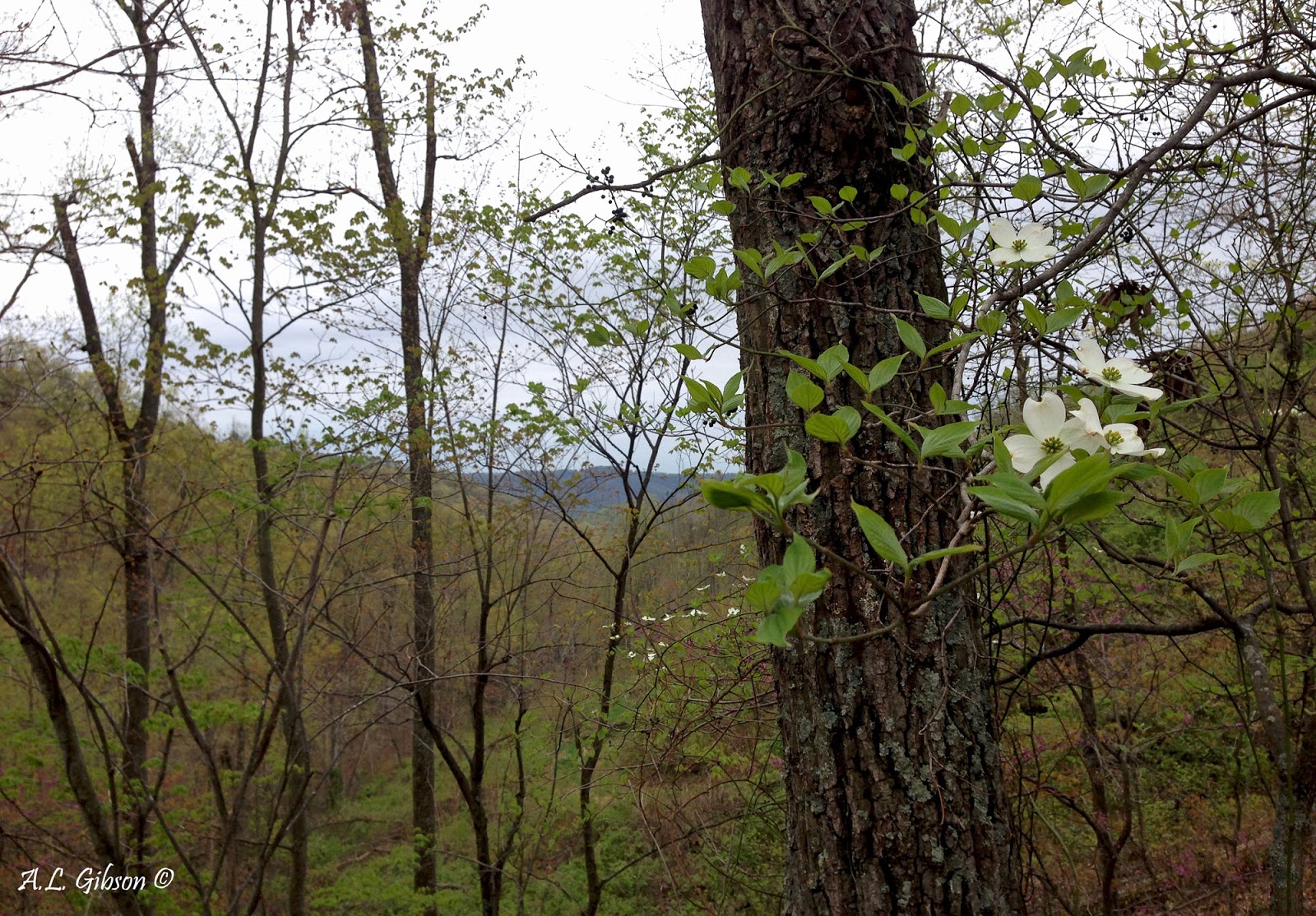
Flowering dogwood back dropped by the rolling hills of Shawnee

Don't let me fool you into thinking the birds were a complete and total bust.  Both my Saturday and Sunday field trips were rewarded with some great species and moments.  The best had to be a woman on Saturday wishing with all her might she'd get to see even a fleeting glimpse of the elusive Kentucky warbler; a long-awaited life bird for her.  Not more than five minutes later a male that had been singing from deep in the brush and tangle of the woods came out and perched himself in clear view for the entire group. Needless to say, the aforementioned woman was breathless in wonderment afterwards.  That's a sight any guide loves to see!

The rare vernal iris (Iris verna) blooming profusely along the forest's roadsides

One of the area's quintessential spring wildflowers was just starting to come online during the conference in the rare vernal iris (Iris verna).  Many folks think of summer and wetlands when irises are mentioned but this particular species loves the rocky, dry soil of Shawnee's sun-drenched ridge tops and roadsides.

Eastern Tiger Swallowtail nectaring on the ephemeral blooms of wild plum (Prunus spp.)

While cruising Shawnee's back roads during Friday's warm, sunny conditions, I came across numerous wild plums (Prunus spp.) in perfect flowering shape.  The air was heavy with their sweet scent and could be detected from hundreds of feet away with the nose alone.  I wasn't their only admirer as the plums were abuzz with dozens of bees and butterflies all looking for a taste of nectar.

Spotted Mandarin (Prosartes maculata)


Another of Shawnee's threatened floral denizens in full bloom was the delicate spotted mandarin (Prosartes maculata).  Their creamy white flowers hang like little lanterns under an emerald green umbrella.  A close look at the inside surface of their petals reveals a gorgeous smattering of magenta polka dots unlike anything else in Ohio's flora.

Pink Lady's Slipper (Cypripedium acaule)

As if the spotted mandarins and vernal irises weren't enough to wow my groups during breaks from our binoculars, Mother Nature had one more wildflower surprise up her sleeve in some pink lady's slippers (Cypripedium acaule).  I didn't expect to find any in this good of shape just yet, especially considering the last week's cooler weather but there this trio was in all their orchid splendor.  The program I gave this weekend was about Ohio's native orchids (fathom that one), so it was rewarding to be able to share these in the flesh with my group.

Sunday's group with their binoculars peeled along the forested ridge top roads of Shawnee

Sunday eventually cleared and warmed into a fine specimen of a spring day.  I had the added pleasure of close friends and phenomenal naturalists, Bob Scott Placier and Daniel Boone join me in leading this troop through Shawnee.  The birds responded accordingly to the improved conditions with better movements and vocalizations as the day waned.  Feathered highlights from the weekend included: scarlet tanager, wood thrush, purple finch, yellow-throated vireo, blue-headed vireo, sharp-shinned hawk and warblers (yellow-throated, yellow-rumped, black-throated green, cerulean, Kentucky, worm-eating, black-and-white, ovenbird, hooded, prairie, blue-winged, pine and redstart).

Birds Foot Violet (Viola pedata)

The theme of my hikes for the weekend was "Birds & Botany", so what could be better than getting the proverbial two birds with one stone in the birds foot violet (Viola pedata).  This state threatened species is arguably the most aesthetically exciting of Ohio's nearly 30 species of violet and they could not have looked better during our romp through Shawnee.

Shawnee enveloped in a steady rain

Fortunately, the rain didn't really hit and stick with us until towards the end of our time in the field on Saturday.  Regardless, I don't think I can really ever curse the rain this time of the year.  Without its life-giving powers there wouldn't be any wildflowers or birds to admire and spend the weekend chasing.  Rain is just fine by me and even gives the landscape a beauty all its own.

Female (L) and male (R) cones of the eastern hemlock

Even the minutiae of spring returning is something to behold.  Shawnee's eastern hemlocks (Tsuga canadensis) were doing their thing during our visit with their ephemeral yellow male pollen cones and adorable little female cones.  The male cones will quickly waste away after releasing their pollen, while the female cones will hang around for several years post maturity.  An interesting fact on gymnosperms is the very long temporal separation of pollination and fertilization.  It can take months for the sperm cells from the deposited pollen to reach the female cone's ovules and months more to mature into a seed.  Nature truly is all a matter of patience.

Oddly patterned common blue violets (Viola sororia) in Shawnee

Another floral oddity I enjoyed sharing with my group was a particular patch of common blue violets (V. sororia) that always display an interesting color pattern on their flowers.  I've witnessed these exact plants for several years running now and they always exhibit this strange, almost leucistic-like phenotype.  Definitely a fun twist on an otherwise common and forgettable plant.

Your blogger and the current/former* state champion yellow buckeye

I'll end this post in the same way I ended my memorable weekend down in Shawnee with one impressive specimen of a tree.  This particular yellow buckeye (Aesculus flava) has seen many winters melt into spring; so many in fact it was once (and perhaps still is?) the largest known tree for its species in the entire state.  Whether or not its title is intact is a bit moot for me.  It's a fabulous example of nature's work when given the time and opportunity to grow, grow, grow.

I can't begin to thank my hike's participants enough for their enthusiasm and thirst for the treasures of the outdoors.  Everyone's attitudes remained positive and cheerful during the entire weekend despite the weather.  I think it's safe to speak for everyone when I say we all had a great time and I'm already looking forward to future events with the OOS.

- ALG -

Wednesday, May 15, 2013

Indian Paintbrush (Castilleja coccinea)

It may come to some as a surprise that Ohio is home to its very own species of Indian paintbrush.  The vividly colored flowers of the Castilleja genus are much better known out west where just about all of North America's 100+ species occur while just a handful of them occur east of the Mississippi.  Ohio's sole species is the scarlet indian paintbrush (Castilleja coccinea), which also goes by the common name of painted-cup.

Fallow meadow with a scattering of scarlet indian paintbrush

I couldn't help but notice this stupendous display along a southern Ohio road the other day as I was out botanizing. There's some plants that require tedious examination while squinting through a hand lens to identify and there are those you can instantly ID going 60 miles an hour down the road: these are the latter.

Scarlet Indian Paintbrush (Castilleja coccinea)

The fallow meadow had several hundred plants scattered about in perfect peak bloom.  Apart from the obvious paintbrush, several other species of flowers we're blooming including: yellow star grass (Hypoxis hirsuta), white blue-eyed grass (Sisrynchium albidum), arrow-leaved violet (Viola sagittata), and lyre-leaved sage (Salvia lyrata). It certainly adds an unmistakable color to the ever-advancing spring landscape, which contrasts perfectly against the surrounding green vegetation.

Dense patch of the scarlet indian paintbrush

Indian paintbrush isn't all that uncommon in the cedar barrens, hanging prairies, and meadows of Adams county but this demonstration is the best I've yet to see.  The owner's neighbor came over while I was photographing and explained he'd seen the property go through several owners over the decades and they all appreciated the paintbrush's presence and didn't mow until well after it had set to seed.  In a world of neatly trimmed and manicured lawns, it's a welcome thing to hear of someone sparing their yard the blade in an attempt to preserve some natural beauty.

Scarlet Indian Paintbrush (Castilleja coccinea)

Taking a closer look at an individual plant you can begin to see the true workings of the flowers themselves.  The red petals you see aren't in actuality petals at all.  They are something called foliaceous bracts which are just colored ends of its leaves (much like your Christmas time poinsettias) and are used to help better attract pollinators. The actual flowers and reproductive parts are the little green protuberances in-between the vibrant scarlet bracts.

Scarlet Indian Paintbrush (Castilleja coccinea)

Being such an intense shade of red it's only natural these late-spring wildflowers would be quite the hit with the recently-returned ruby-throated hummingbirds.  It's certainly something I would call a win-win in nature when you can have both these and hummingbirds around at the same time!  I'm very thankful the owners had and continue to have the foresight to allow these wondrous plants to grow and thrive in the side and backyard.  I only hope to see this already incredible patch continue to grow in size in the years to come as I drive by on my way to see all my other favorite southern botanical treasures of early May.

Saturday, February 25, 2012

Mark Your Calendars: Flora-Quest 2012!

Spring is almost upon us and it's never too early to begin planning on how you want to spend it!  If you regularly read this blog you will notice how much time I spend in the southern-most Ohio counties of Adams and Scioto.  It's no coincidence, as these two counties are the most botanically diverse in our state and harbor many rare and interesting species you won't see anywhere else in our state!  Southern species cross the Ohio River and cling to existence in the cedar glades and barrens on the Edge of Appalachia Preserve system and the continuous rolling forests of nearby Shawnee State Forest

How could you go wrong spending a weekend with some of Ohio's most knowledgeable and passionate naturalists, birders, botanists, lepidopterists etc. guiding you through the endless flora and fauna of these areas?  You can't!  So check your calendars and circle the weekend of May 4-6 for Flora-Quest!  A weekend spent at the lodge and conference center deep in Shawnee state forest; you will spend an unforgettable time learning all about the diversity and history of the area by those who know the area best!  I highly encourage you to check out the Flora-Quest website for more information on events, trips, accommodations, guides etc.  Yours truly is a guide this year and will be teamed up with birding extraordinaire Greg Miller of The Big Year fame.  If you aren't familiar with his epic birding quest, a book-turned-movie based on his and a couple other birder's experiences was released last fall.  For a fun review check out this link here!

There are plenty of other trips to choose from with out-of-this-world guides!  There are no wrong choices and each offers a unique experience with plenty of highlights and surprises.  I attended the event last year and had the time of my life.  A blog post about my experiences from last year's Flora-Quest can be found by clicking right here.  To cap off this advertisement for surely the most fun weekend you'll have this spring, here are a handful of wildflower species you are sure to see should you attend!  I hope you will check out Flora-Quest and give attending some serious thought.  I guarantee a great time, sun or shine!  The wildflowers, warblers and smiles will all surely be in peak numbers!

Dwarf Iris - Iris verna

Last year's wildflower species sponsor was the gorgeous Dwarf Iris (Iris Verna).  This showy species is a short bloomer but can be seen on the dry, acidic ridge tops just down from the lodge.  An easy and must see!

Flowering Dogwood - Cornus florida

An instantly recognizable and crowd-pleasing favorite of spring are the cream blooms of the Flowering Dogwood (Cornus florida).  These shrubs and small trees are a dime a dozen in the area and will be a guaranteed sight all weekend.

Prairie Phlox - Phlox pilosa

Some folks will get lucky and get to experience the marvelous flowers of the Prairie Phlox (Phlox pilosa) as they grace the small prairie openings throughout the Edge and Adams county.

Large Yellow Lady's slipper - Cypripedium parviflorum var. pubescens

On the mesic slopes throughout selective hollows in Shawnee and the Edge hide the Large Yellow Lady's slipper (Cypripedium parviflorum var. pubescens) orchids.  This event times the spring-flowering woodland orchids to perfection each season!

Star Chickweed - Stellaria pubera

Blooming throughout the lower slopes and valleys is the common but still striking Star Chickweed (Stellaria pubera).  It's still worth the time to appreciate and admire the common spring bloomers as well.

Pink Lady's slipper - Cypripedium acaule

On the acidic and dry ridge tops of Shawnee and in scrubby Virginia pine stands on the Edge are the lovely and delicate Pink Lady's slippers (Cypripedium acaule).  There are few other plants that will take your breath away like this one in large numbers.

Indian Paintbrush - Castilleja coccinea

Last but certainly not least is this year's wildflower sponsor, the Indian Paintbrush (Castilleja coccinea).  These showy plants are a common sight in the prairie openings on the Edge and sure to brighten anyone's day!

I hope to see some new faces at Flora-Quest this year and encourage you to seek me out and say hello!  Hope to see you all there!

Wednesday, May 4, 2011

Little Ladies on the Prairie


I know I promised a post or two about my experiences during this past weekend's phenomenal Flora-Quest put on by the very passionate and organized Cheryl Harner (Weedpicker's Journal) and Paula Harper, and trust me they are coming!  I first wanted to do a separate and very personal post about an experience I have been waiting years to happen that finally materialized Sunday afternoon just before I was ready to head back to the Athens area.  It's experiences like this that truly allow me to feel alive and are exactly what my botanically obsessed brain craves.

Hanging prairie clinging to the edge of an Adams County hillside

I awoke early Sunday morning to the pitter-patter of rain on the cabin roof, a sound that has become all too familiar this spring season.  You won't hear me complain too much though as this unnatural deluge has provided us with an amazing bounty of wildflowers and boy have they been taking advantage; as is everything after last summer and falls excessive drought.  As luck would have it the rain subsided and left with me dry, overcast skies to do a bit of solo botanizing before I called it a weekend.

On a whim I decided to check out a series of small, secretive hanging prairies on the Edge of Appalachia preserve.  Hanging prairies, as you can see from the photograph above, seem to "hang" on the sides of the rolling hills in the foothills of the Appalachians.  This event makes for a very aesthetically pleasing view as one gazes out across the trees.  These openings in the forest are dominated by native warm season grasses such as Indian Grass (Sorghastrum nutans) and Big Bluestem (Andropogon gerardii) and sit on top of dolomite/limestone bedrock which causes some very neat and interesting plants to occur.

Castilleja coccinea - Indian Paintbrush
Phlox pilosa - Prairie Phlox


Two of the most instantly noticeable and easy to identify plants that give the still drab and brown prairie openings a dash of spring color is Ohio's very own native Indian Paintbrush (Castilleja coccinea) and the stunning Prairie Phlox (Phlox pilosa).  I'm sure most of you are familiar with the dozens of species of Castilleja out in the mountain west states but did you know Ohio has one too?  We do and it's a beauty!  Those red 'petals' you see aren't part of the flower at all.  They are in reality foliaceous bracts that help to attract passing pollinators; more or less colored ends to the leaves, very similar to your Christmas time Poinsettia's.  The actual flowers are tucked away just in-between the vibrant red bracts and aren't much of a show.  On the completely opposite end of the spectrum, Prairie Phlox's flowers will make your jaw drop.  They can vary in color a great deal and sometimes lack the striking dark magenta pattern around the inner petals.  Thankfully all the plants I saw exhibited that gorgeous ornament.

Prairie Warbler ♂
Prairie Warbler ♂


As I slowly made my way through the opening admiring the Indian Paintbrush and Phlox I heard the pleasing "zee, zee, zee, Zee, ZEE, ZEE ZEE" song of the Prairie Warbler emitting from the branches of a leafing Redbud (Cercis canadensis).  He was very photogenic and politely posed for a few shots while trying to get a better look at his curious observer.  The smell of the damp earth in the air, the pleasing ballad of the warbler and the visually stunning display of the wildflowers around me quickly put me into a state of nirvana.

As I made my way back to an even smaller patch of prairie my breathing became a bit faster and my pulse quickened in anticipation of what I may see next, the real reason I chose this specific prairie opening over the dozens and dozens of others scattered across the preserve.  As my eyes scanned the flattened weave-work of grass they spotted some small stalks of green, parallel-veined leaves ascending from the moist soil and my heart skipped a beat.

Prairie Opening
Cypripedium candidum budding


Rising from their subterranean homes was a plant I had dreamed of seeing for years and spent many a bored moment daydreaming of the day I'd make their acquaintance.  What plant could cause such a stir of emotion and bliss?  Just beginning to bud was the dainty and exceedingly charming Small White Lady's-slipper (Cypripedium candidum) orchid.  Endangered in Ohio and quickly becoming a globally rare species, this orchid is only currently found in Adams, Erie, Sandusky and Seneca counties.  As I wowed over the sight of the budding plants something in my peripheral vision caught my eye...

Small White Lady's Slipper - Cypripedium candidum

Could it possibly be?  It was!  My jaw dropped and my eyes stared unblinking ahead at the beauty looking straight back at me.  There it was in all its diminutive glory, the Small White Lady's-slipper saying hello for the first and certainly not the last time.  You remember that feeling of being five years old and it's Christmas morning?  That doesn't even compare to the pure state of euphoria I was experiencing at this moment in time.

Small White Lady's Slipper - Cypripedium candidum

I've had many flowering plants leave my breathless before but this made all those affairs seem pedestrian.  Never have I tread so softly or timidly in an area in all my life, being excruciatingly careful with each footstep as to not step on and damage a single cell of this plant.  The word small is right in their name for a reason but I think adjectives like 'tiny' or 'miniscule' are a better fit.  Take a look at my thumb next to the mature bloom of this plant.  If you've been lucky enough to see the other species of Cypripedium in Ohio (which you will see here soon enough if not!) you can begin to appreciate just how teensy-tiny these guys are.

Cypripedium candidum vs my thumb

These rarities are found growing in wet prairies, sedge meadows, calcareous fens and in this instance, limestone barrens.  One thing all these habitats have in common is ample sunlight and these plants need as much as they can get.  They are the most light-sensitive and shade intolerant species of Cypripedium in Ohio.  Management of the few existing populations of this orchid is vital to its survival and staving of extirpation from our state.  Removing any and all woody encroaching vegetation in its open habitat is key as is the potential use of fire for this method.

Small White Lady's Slipper - Cypripedium candidum

I've read where populations greatly increased in number of flowering plants the year or two following an early spring burn.  Add into the equation the fact that over 96% of this orchids habitat in Ohio was drained and plowed for agriculture and development decades ago and their very low seed/germination count, the management and preservation of this species habitat becomes even more critical.

Small White Lady's Slipper - Cypripedium candidum

Rare in just about every state and Canadian province its indigenous to now, this wasn't exactly the case 150 years ago before the degradation and destruction of its prairie habitat.  This was a rather common orchid of the Midwest's wet prairies and meadows.  I can only imagine coming to the edge of the primeval forests and looking across the wide ranging prairies with hundreds of thousands of these plants soaking up the sun in mid-May, their intoxicating aroma on the breeze tingling my nostrils.  What an transcending sight that must have been.  If I'm this mind blown about a few dozen blooming plants I can't even begin to fathom if my brain could take the sight of their original display.

Small White Lady's Slipper - Cypripedium candidum

Taking a closer look at the flower reveals its intricate and fairy-like structure.  A pure, snow white 'slipper' or in orchid talk labellum, is speckled with an array of magenta dots around the inner rim and inside the pouch itself as you can see on the photograph above left.  It's as though Mother Nature sits down with her tiny paintbrush and hand paints the remarkable detail onto this flower with painstaking precision.  The yellow column sits above the pouch and contains the fused male and female parts (stigma and anthers) of the flower.  The picture below is of a plant that for one reason or another did not produce a labellum and gives us an inside look at the inner workings of a Cypripedium orchid without causing any damage to the bloom.  I've heard where the elves of the forest use the slippers from these orchids to walk around in silence through the misty forests at night.  Perhaps that's why this plant is missing its slipper.

Cypripedium candidum

After well over an hour of sitting amongst these great rarities of our time, admiring and appreciating them for their timeless beauty and splendor it was time to pack up the camera and make for home.  I hated to leave them behind but I knew I'd be back before too long in hopes of getting to know them better and getting some more photographs.  As I drove home I could not get their image or scent out of my head and I knew this experience and day would live with me for a long, long time to come.  It's not every day I get to write off a 'life plant' of this magnitude and I certainly savored the moment for all it was worth.  It really, truly is day's like this that make me know I've found my calling and purpose in life.  Nothing ever felt so right.