Showing posts with label Road Trip. Show all posts

Tuesday, June 7, 2016

The Bruce Peninsula Part I: Intro

 *Part I* *Part II* *Part III* *Part IV* *Part V* *Part VI* *Part VII*
As mentioned in my recent posts since coming back from the blogging dead, I have more than enough topics to catch up on. The biggest one of all is my sensational week long trip up to Ontario's Bruce peninsula last early June. In fact, I was up there at exactly this time last year and figured what better time to reminisce than now? I have tons to share and have decided to break them up into a series of posts that will make them easier to digest and enjoy. I'll be sure to link each and every one at the top and bottom of each post for easy movement between them.

View from atop Cave Point on the Bruce's rugged eastern shoreline. 


This first post will set the table for the rest of the series and serve as a nice introduction. I first discovered the beauty of the Bruce peninsula, or 'the Bruce' as I'll come to call it from here on out, back in mid June 2011. I had an incredible time that only whetted my appetite for more with a promise to return sooner than later. I missed out on a number of plants I had the highest hopes of seeing and resolved to arrive earlier in the month to catch them all this time around. I certainly achieved that and so much more!

Location of the Bruce peninsula within the Great Lakes region (courtesy Google Maps)


When I mention the Bruce to most folks, their first question is usually where in the world is this place? The Bruce is an extension of the geologically significant Niagara Escarpment that helps separate Lake Huron's main body and the Georgian Bay on its southern end, as seen in the map above. The peninsula's southern end is comprised of a mostly flat landscape with some rolling hills and dominated by pasture and agriculture, while the more wild northern end is dominated by forest and countless wetlands. The Bruce provides southern Ontario with its largest remaining tracts of forest and natural habitat and contains two national parks and numerous nature reserves protecting priceless globally rare habitat.

Closer look at the Bruce and major areas of exploration during my trip marked on the map (Courtesy Google Maps)

The aforementioned Niagara Escarpment is a major geological player in the Great Lakes basin and forms the backbone of the peninsula. The escarpment's bedrock strata is comprised of dolomite limestone, much like my beloved Adams County, Ohio's prairie barrens, that is of Silurian Age in origin and laid down over 400 million years ago. Despite being thoroughly scraped and carved flat by glaciers over the millennia, the Niagara Escarpment has provided the Bruce with some stunning topography in its dramatic lakeside cliffs/bluffs, rugged shorelines, alvars, and waterfalls as you'll come to see.

Pit stop at a bog in SE Michigan to see the Dragon's Mouth orchid (Arethusa bulbosa)

The trip started with your narrator making the initial drive up to Detroit, Michigan to pick up good friend and fellow botanist/trip member, John Manion at the airport. John lives/works in Alabama and had it planned to join me for the rest of the drive up to the Bruce after flying in most of the way. It was a good thing he did, as our quick, albeit out of the way pit stop at a wonderful sphagnum bog near Ann Arbor produced a life plant for John in the mesmerizing dragon's mouth orchid (Arethusa bulbosa). It was a harbinger of amazing plants, places and things to come!
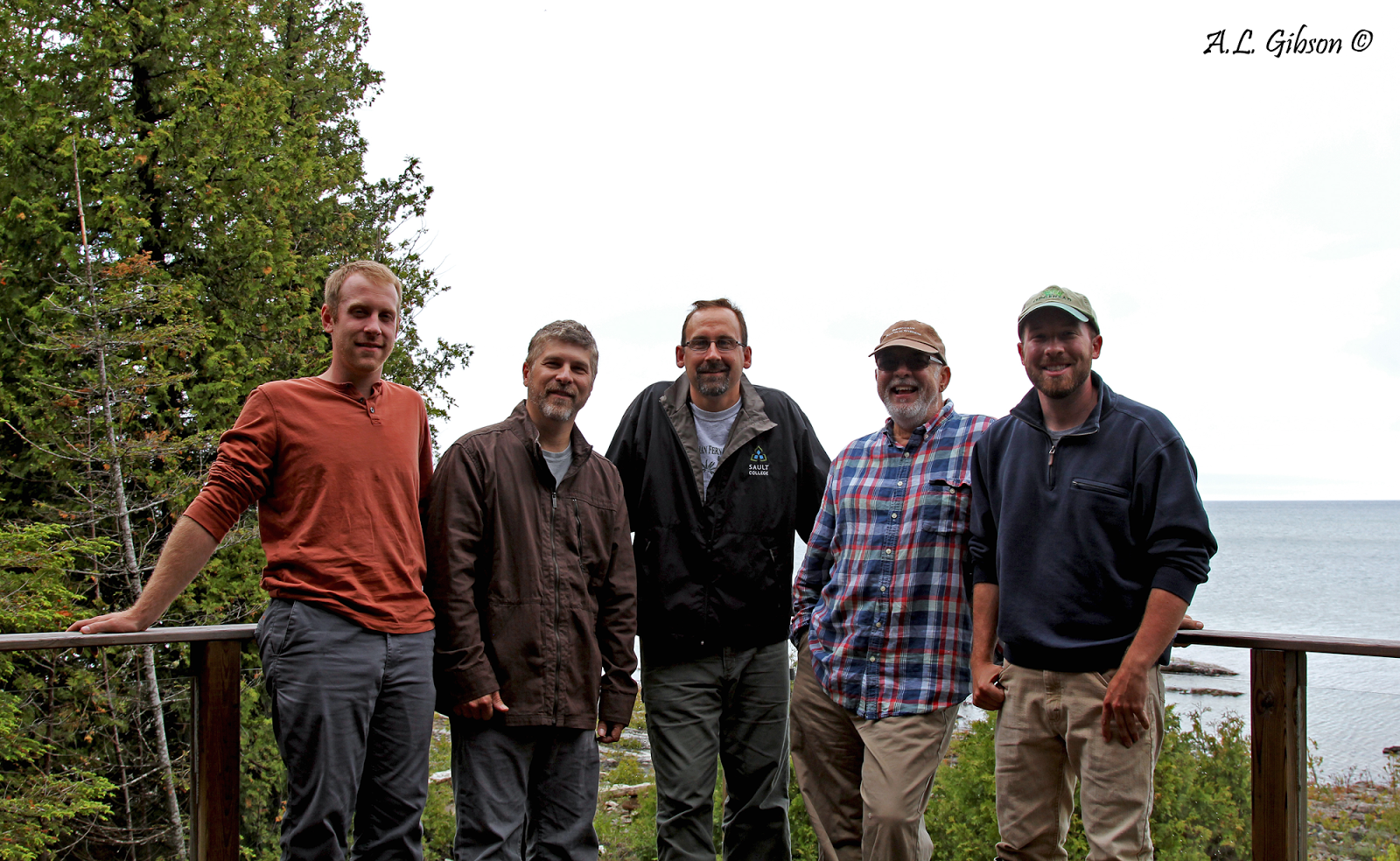
The Bruce Crew! L to R: Stefan Weber, Drew Monthie, Rob Routledge, John Manion, and your narrator


The rest of the crew met up at our lakeside cabin we'd rented for the week. All four other gentlemen were exceptional field botanists/naturalists and even better human beings! I can honestly say having the pleasure of experiencing the Bruce's splendor with all of them and the memories, laughter and camaraderie shared was second to none. Each one of us brought something unique and valuable to the table, but I must single out John's penchant for cooking as perhaps the best of all. We ate like royalty while up there and all pitched in to take his dish and meal ideas from paper to plate. I can't recall a better week of eating before or since. John, I'll never forget those honey drizzled, prosciutto-wrapped stuffed figs. Bliss!

One of our daily tributes to Jackie for being unable to join our trip due to a sudden knee injury


The only dark cloud to hang over our trip was the loss of our friend, Jackie. She was originally part of the Bruce Crew but suffered a fall and shattered her knee cap shortly before our departure that required surgery and lots of rest. Jackie is a dear, dear friend of mine whom you may recall has her own splendid blog, Saratoga Woods and Waterways. She's also graciously opened her home and favorite areas of upstate New York to me on two trips that I often still think about years later. Jackie was never far from our mind and we made sure she knew that by arranging her name in a variety of different items each day and sending her a get well email. My favorite was the one pictured above made of forget-me-not blossoms that abounded outside the cabin (no worries, it's a non-native species, so no harm done picking the plants!).

Our secluded cabin right on the Lake Huron shoreline nestled among the cedars, pine and spruce


I'd be remiss if I didn't take a moment to show off the location of our dreamy rented cabin. It resided in a secluded area on the western shorelines of the peninsula's northern end near Dorcas Bay. The interior was nicely furnished, comfy and quite spacious but nothing could beat the huge back deck and its phenomenal view. The surrounding coniferous woods and cobble shoreline was full of exciting flora and the morning serenade of warblers galore singing their hearts out outside my window is an alarm clock I'll never best or forget.

Keying out plants while drinking a beer was a favorite evening activity of mine


That gorgeous back deck saw lots of action with several nights of expert grilling by Rob; plenty of beer drinking and cigar smoking (at least for Rob and I); and provided a scenic spot to work out the day's unknown plants we collected/came across.


The Bruce Crew's combined naturalist library


Speaking of figuring unknown things out, our group was hardly in short supply of relevant literature and/or resources while up on the Bruce. Between the five of us, our combined library was impressive and came in handy. If anything, it provided a hands on chance to check out books I've yet to add to my naturalist bookshelf. In many cases, at least one of us already knew what most anything was others drew a blank on but with so many books it seemed like a lock we'd be able to nail down an ID on any mystery organism, no matter its place on the tree of life.

The adult sand hill crane is an obvious spot but can you find its little chick too?


The Bruce isn't just a botanist's dreamland but a birder's, too! I'm a casual birder at best most of the time with my attention usually fixated on the ground. It's easier to focus on plants and merely pay attention to the songs and calls filtering down from the canopy than actively seeking birds out with my binoculars. But I'd been a fool to not take advantage of the returned neo-tropical migrants and northern species rarely seen/heard in Ohio while up in Ontario. The highlight for me was stopping along a grassy meadow to observe a pair of sand hill cranes, only to realize they had two chicks with them! That was a new experience for me! Can you find the chick in the photo above?

Lake Huron sunset from the back deck of our cabin. Not too shabby, eh?

I know this wasn't the most exciting or captivating of posts but rest assured the next half dozen or so to follow will more than show just how unique and majestic a place the Bruce genuinely is. It's one of eastern North America's best kept secrets but certainly famous and popular with those who know and experienced its beauty. I hope you'll stay tuned and come back as I reminisce on one of the most fun and rewarding weeks of my life. Thanks for stopping by!

- ALG -

Wednesday, May 21, 2014

The Hunt for the Small Whorled Pogonia: one of North America's Rarest Orchids

*Part I* *Part II*

Everyone has a dream that seems just beyond the reach of reality.  It's not out of the realm of possibility per se but rather something that has been more or less relegated as a thing of daydreams and wishful thinking.  For your narrator, few, if any thing on the botanical bucket list exceeds the lust and desire to see one of North America's rarest of orchids in full, spectacular flower.  The small whorled pogonia (Isotria medeoloides) is a taxon of legend when it comes to chasing orchids and rare plants in general.  Its fickle and unpredictable flowering cycle mixed with an encompassing scarcity make it a plant lucky few have witnessed in the flesh.  In my never-ending drive to see and photograph all of Ohio's indigenous orchids, the small whorled pogonia was one I thought might haunt my goal for years to come...

Mountains on the horizon at sunset in northern Georgia

Fortunately, that's where two of my fellow orchid aficionado Flickr friends in Alan Cressler and Jim Fowler come into play.  Both are marvelous photographers and have a very in-depth knowledge of the botanical world around them.  I highly encourage you to check out Alan's work on Flickr by clicking HERE and Jim's by clicking HERE.  Jim also writes and publishes a nature blog on his travels and discoveries which is second to none and accessible by going to jfowlerphotography.com.

Around this time last year I noticed both of them publish phenomenal photos of the small whorled pogonia that I couldn't take my eyes off of nor keep myself from salivating at the computer monitor.  If anyone was going to be able to help me finally cross this monumental lifer off my list, it was them.  Fortunately, Alan, Jim, and I were able to arrange a rendezvous in northern Georgia this past weekend to see if we could find these delightful wonders in flower.  It was over a seven hour drive to the town of Ellijay on the edges of Chattahoochee National Forest for me and with each mile my excitement grew tenfold.  I arrived into town on Friday night in anticipation for our Saturday morning meet up and enjoyed a fine dinner in a local establishment where I struck up some entertaining and enlightening conversation with the bartender and a few locals.  They were pretty intrigued a Yankee would drive so far south for a plant but their interest was genuine and I enjoyed filling them in on my passion and the details of my trip.

Saturday dawned bright and cool with a clear blue sky but by the time Alan, Jim, myself, and esteemed Georgia botanist, Max Medley met up at our predesignated meeting spot, dark clouds promising rain loomed on the horizon.  I greatly prefer overcast conditions when out to specifically partake in wildflower photography but rain rarely makes a photographer's life any easier.  Luckily the only rain that ever materialized was some light drizzle or passing showers and never caused much delay or problems for us.

After packing my gear into Jim's car and Max's into Alan's, we headed out for the first of two potential sites for the small whorled pogonia deep inside the mountains and valleys of Chattahoochee National Forest.  It produced a handful of blooming individuals last year and has proved to be pretty reliable in years past so we had high hopes of finding our bounty in good shape.  After pulling off at a very nondescript spot on the road, we shouldered our loads and headed off into the woods.  I had come a long way and spent countless hours dreaming of a moment that now seemed only minutes away.  Not long into our search, Alan and Jim located the specific spot for the orchids and beckoned Max and I to them and delivered some good and bad news...

Flowering and sterile specimens of small whorled pogonia

The good news was the location had produced five flowering individuals and a number of other sterile stems but the bad news was our timing could have been a little better.  The plants were four or five days past peak with some looking better than others.  I'd be a liar if I said I wasn't at least somewhat disappointed but by the same token I'd be called a liar too if I didn't say I was still enthralled with our discovery.  Not everyone is likely to find this green orchid very attractive and some might even think, "you drove all that way for that?!", but it was priceless to me and one of the most gorgeous plants I ever have or ever will see.

Federally threatened Small Whorled Pogonia (Isotria medeoloides)

I broke out my camera equipment and proceeded to attempt to capture what freshness the flowering plants had left and found myself in constant awe of just how tiny they were.  I knew they would be small, it's in their name after all but nothing quite prepares you for seeing them with your own two eyes.  As the rain started to patter down, we decided to make for the second site where we might have better luck at finding fresher orchids due to an increase in elevation.  It was only known to harbor a few individuals in any given year but I'd come too far to not enthusiastically and confidently move forward.

Alan led us through the mountains of Chattahoochee on a dazzling route full of hemlock and rhododendron-lined streams, acidic upland oak woodlands ensconced in flame azaleas at peak flower, and forested seeps full of alluring plant life and I will bring all that to you in my next post.  For now, I want to focus on the primary goal of my journey and devote this entire post to the splendor of the small whorled pogonia.

After several hours of exploring the roadsides and accompanying forest on our way to the second site and new lifer after new lifer photographed and scribbled down on my life list, we finally pulled into what would be my last hope at seeing an orchid that I would have driven 5,000 miles to see and not just the previous day's 500.  I had no idea what to expect and my stomach was in knots as we hiked up into a white pine forest where the plants were known to occur.  In the end my worries and nervousness were for naught as Alan, Jim, Max, and I found three pogonias in unspoiled, newly-opened condition!  Alan's hunch on these being in better shape due to cooler temperatures at a higher elevation was spot on.

Federally threatened Small Whorled Pogonia (Isotria medeoloides)

The small whorled pogonia is a federally threatened species and only occurs in a select number of locations throughout eastern North America, where populations usually only exist as a handful of plants or even just a lone individual.  Its habitat of second-growth, semi-open acidic woodlands is hardly a rare occurrence throughout its range and shouldn't act as any kind of limiting factor in its scarcity.  I believe it to be genuinely rare regardless of habitat availability but am under the impression there are still quite a few unknown stations left to discover.  Being tiny, green, and flowering during the awkward floral transition of spring to summer adds up to create quite the proverbial "needle in a haystack" scenario.

Federally threatened Small Whorled Pogonia (Isotria medeoloides)

Even at first glance it's easy to see the physical similarities and relations to its brethren, the large whorled pogonia (I. verticillata).  Both have succulent-esque stems with an emerald skirt of whorled leaves and are adorned with a dragon-like inflorescence.

Small Whorled Pogonia next to a nickel

As previously mentioned, I was flabbergasted at the miniscule nature of this lime green orchid.  If anything should get across the size and dimensions of the small whorled pogonia, it's the photograph above that shows a nickel placed alongside the plant.  No photoshop trickery or sorcery here, they legitimately can be that teeny and puny.  It makes you wonder how anyone, looking or not could ever come across these things.

Can you see what Jim is photographing in this capture?

Three small whorled pogonias in flower, three photographers itching to get some lens time with them; I'd say those numbers worked out perfectly.  We took our time carefully capturing the essence and character of each pogonia and moved in a circular fashion, trading off between plants.  Above is Jim admiring the dainty pogonia before him with his camera setup. Even when you know it's there and can follow the camera's stare down to it, it's still somewhat tricky to see the orchid.  Tiny things indeed!

The small whorled pogonia is ready for its closeup 

The history of the small whorled pogonia in Ohio is a very short and relatively recent story.  It has only ever been seen within the buckeye state at two sites: one in Shawnee state forest discovered by the late orchid great Fred Case in 1985, and the other discovered a few years later in the Hocking Hills region.  Only the latter occurrence is still "extant" today but hasn't been seen since 2008 when a single sterile stem came up.  A pipe dream of mine is to stumble across a new site in Shawnee state forest one time and know I could then die happy as a successful and accomplished field botanist and naturalist.

So tiny, so rare, so absolutely beautiful

The already darkened conditions of the white pine forest combined with the sullen gray clouds overhead made for some rather tricky lighting conditions but that hardly did anything to stop the onslaught of photographs being taken by the trio of orchid obsessers.  Even though Jim and Alan had photographed these very plants just a year ago, I wasn't the least bit surprised to see them enjoying another round with the treasures.  Small whorled pogonias are notorious for being able to go dormant and disappear into a subterranean holding pattern that can last for multiple years.  It's definitely best to take advantage of every opportunity with these unpredictable orchids as you never know if or when it could be your last.

Small Whorled Pogonia
Shot of the pogonia's habitat 


Of Ohio's 48 species/varieties/hybrids of naturally-occurring orchids, I have now had the pleasure of seeing 47. Being just barely shy of 98% complete with one of my most passion-driven and desirable botanical goals is something I take a lot of personal pride and happiness in and can't believe the long awaited small whorled pogonia is no longer orchid enemy #1.  I still have the highest of hopes to see this species within Ohio's borders one day in the near or far future but seeing it in the mountains of northern Georgia is undoubtedly the next best thing and a moment I'll cherish and treasure for the rest of my life.

Small whorled pogonia dwarfed by Alan's camera setup

While the first site's orchids were well past peak flowering condition and left something to be desired, I didn't realize just how unsatisfactory they were until I made the acquaintance of the second site's blooming plants.  They were so crisp, so detailed, so richly highlighted, we hypothesized they might have broken bud within the past 24 hours or so.  In the photo above, Alan's camera set up dwarfs one of the three pogonias at the second location. If only these orchids were sentient and could sense just how famous they were to us three Orchidaceae lovers.  The stories they might be able to tell of past visitors and what exactly makes them tick is an intriguing thought.

Jim, Alan, and myself (camera pictured) all with a pogonia each, attempting to capture its essence

After hundreds upon hundreds of photographs it was time to depart the site and allow the pogonias to return to the mists of the past.  I could not have had more fun out in the field with Alan, Jim, and Max, and am forever indebted to their efforts, knowledge, and willingness to share locations and information.  I hope I can repay them in the near future by playing host for a trip up north to explore what Ohio has to offer that Georgia lacks.  The same is to be said about heading back down to visit them again sometime this year.  Despite only meeting them in person for the first time earlier that day, I walked away feeling like we'd been old friends for years and went out botanizing and photographing once a week like clockwork.  It will be a long time before I forget what happened on this memorable weekend of botany in a place I'd never been before.  There's plenty more to share and talk about so stay tuned to more from my time spent in Chattahoochee National Forest.

*Part I* *Part II*

Tuesday, June 14, 2011

Road Trip to the Bruce Peninsula

Ah, the day and the hour is near for my departure to the world famous and renowned Bruce Peninsula in Ontario, Canada.  The Bruce, as it's commonly known to locals, is a peninsula that lies between the Georgian Bay and the main basin of Lake Huron.  Only a few hours north of Toronto, the Bruce is part of the geologically significant Niagara Escarpment; a long line of limestone bedrock laid down during the Silurian age well over 400 million years ago.  On this spit of limestone is one of the most diverse and fascinating areas of southern Ontario.  Rugged and precipitous limestone cliffs, rare flora and fauna and just an overwhelming sense of adventure and wilderness has called me to the Bruce for some time now and I have finally gotten the chance to spend a week in this magical slice of heaven.

As a botanist, I am naturally most interested in the endless list of rare and incredible plants that can be found blooming during June on the Bruce Peninsula.  Known most for it's wild orchids, the Bruce has an astonishing 44 species indigenous to its small area.  June is the peak time for this and on my list is over 20 species of orchid I will be searching out.  The Ram's Head Lady's Slipper (Cypripedium arietinum), Calypso (Calypso bulbosa), Hooker's Orchid (Platanthera hookeri) and the Tall White Bog Orchid (Platanthera dilatata) are just a taste of what I hope to experience!  Also globally rare and found in this botanical wonderland is the Lakeside Daisy (Hymenoxys herbacea), Dwarf Lake Iris (Iris lacustris) and Hart's Tongue Fern (Asplenium scolopendrium).

Planned route to the Bruce.  Courtesy Google Maps

I have decided to take two days to get to the Bruce.  I plan on leaving early Tuesday (June 14) and arriving on the peninsula sometime Wednesday afternoon.  The fun doesn't start when I get to my overall destination though!  As I make my way through northeastern Ohio I plan on making several pit stops along the way at various bog and fens complexes to check out what is blooming right now.  Mid-June is one of the best times for these rare ecosystems boreal plant species to be in full swing.  I've decided to hit some of the best sites for special species of orchids and other plants currently in bloom.  Kent Bog, Karlo Fen, Gott Fen and Mantua Bog (where the endangered and exceedingly rare Dragon's-mouth Orchid, Arethusa bulbosa should be in bloom) are among my stops on day one.  The plan is to stop in the Buffalo, New York area for the night before crossing over into Canada at Niagara Falls.  Oddly enough, I've been to many great natural areas and places in North America but have yet to see Niagara Falls so I figured "when in Rome"!

Day two takes me to the falls and across the border into Ontario where I will continue north to my destination of the Bruce Peninsula!  There I will spend the better part of a week exploring Flowerpot and Cove Islands, combing the deep and ancient coniferous forests, bogs and fens and gawking at the scenic vista views of Lake Huron from the tall limestone cliffs and shorelines.  I will do my best to do a couple blog posts as time allows while up there to give you a taste of what I'm experiencing!  Hopefully the weather, Mother Nature and luck is with me and I will be rewarded with many great experiences and stories upon my return.  This may be the first trip up to the Bruce but I can already tell this won't be my last!  Stay Tuned!

Here's a link to my custom Google Maps page about my trip and the stops I plan on taking along the way.  *The map loads zoomed in to an area that has no relevance to my trip so be sure to zoom out and you will see the blue line and place markers signaling my route and trip stops!