Showing posts with label Ohio Ornithological Society. Show all posts

Wednesday, April 29, 2015

A Weekend of Birds & Botany in Shawnee State Forest

Whew.  It's been a hectic last few weeks and months for your blogger.  The necessary combination of precious free time and energy to put into new posts just hasn't materialized and is reason for the lack of activity.  I hope to rectify this going forward but for now let's catch up on a few items I'd like to make mention of.

First off, I'd like to take time to honor the life and legacy of an educator, mentor and good friend of mine whom the Ohio naturalist community recently lost.  Dennis Profant, author and publisher of the famed Field Biology of Southeastern Ohio blog and my former professor at Hocking College, unexpectedly passed away on April 15th.  He was one of the most influential professors I ever had and is a large contributor to who, what and where I am as a botanist, naturalist and human being today.  From birds and bugs, to wildflowers and trees, Dennis made learning fun with his unique wit and way of teaching things.  His mind was a walking encyclopedia on our natural world and his passion infectious.  I will always fondly remember our times in the field together or just kicking it in his office discussing everything from jazz to moths.  I'm beyond thankful to have gotten close to him in the years following my time at Hocking College and am greatly saddened to know our time together is done.  What I wouldn't do for one more foray into the woods with him...

On a more positive note, I'd like to personally thank all the kind people who took the time to say hello at the recent Ohio Botanical Symposium back in late March.  Meeting and talking to readers/fans of this website and the gracious words you have to say mean the world to me.  This blog would have slid into oblivion long ago if it wasn't for the compliments, encouragement and confirmation of interest from you all over the years.  I hope you'll continue to read and share my love for everything botanical and beyond.  And Ron G., I promise you'll have your Helianthus themed post to read and use in the next few months!

It's spring!  Taking a glance at my most recent post has this site locked in the depths of winter's chill but rest assured the wildflowers and trees have progressed anyways and thankfully so.  The last two weekends have had your blogger fulfill speaking gigs and lead field trips for the Arc of Appalachia's annual wildflower pilgrimage and Ohio Ornithological Society's annual conference, respectively. Both events were packed full of excited, eager naturalists ready to fully embrace spring's blossoming and an amazing time was had by all.  I would like to recap both events in blog form, starting with this past weekend and the OOS' invasion of Shawnee state forest.

Sunrise over Turkey Creek Lake in Shawnee State Forest

You might recall my post detailing last year's OOS event in Shawnee.  We had exquisite weather and phenomenal birding despite the botany being a bit behind.  This time around the tables were turned with excellent botany and mediocre birding.  Unseasonably cool temperatures and a steady all day rain on Saturday into Sunday kept the birds and their food sources from moving much.  A number of the usual migratory suspects seemed to be late and/or absent from this weekend but that doesn't mean it was a total washout.  The rare chance to see and catch up with old friends is one of the biggest draws for these kinds of events and in that this weekend did not disappoint in the slightest.

Winding dirt road leading through the beauty of Shawnee state forest

The cooler temperatures and rain might have quieted the birds but they did wonders for my floral friends.  Flowering dogwood, redbud, wild plums and serviceberry painted Shawnee's roadsides with their respective shades of cream, white and pink.  There's just something about the isolated, remote feeling of the forest's winding dirt roads as they take you along the ridge tops and down into the hollers.

Scarlet paintbrush (Castilleja coccinea) blooming in an Adams Co. cedar barrens

I arrived to the region early in the afternoon on Friday to do a bit of personal botanizing and birding before I was needed at the lodge.  I couldn't resist the temptation of hitting a few choice spots in Adams County for their rare and unusual inhabitants.  The globally rare dolomite cedar barrens were ablaze with scarlet paintbrush (Castilleja coccinea) in all their seasonal glory.
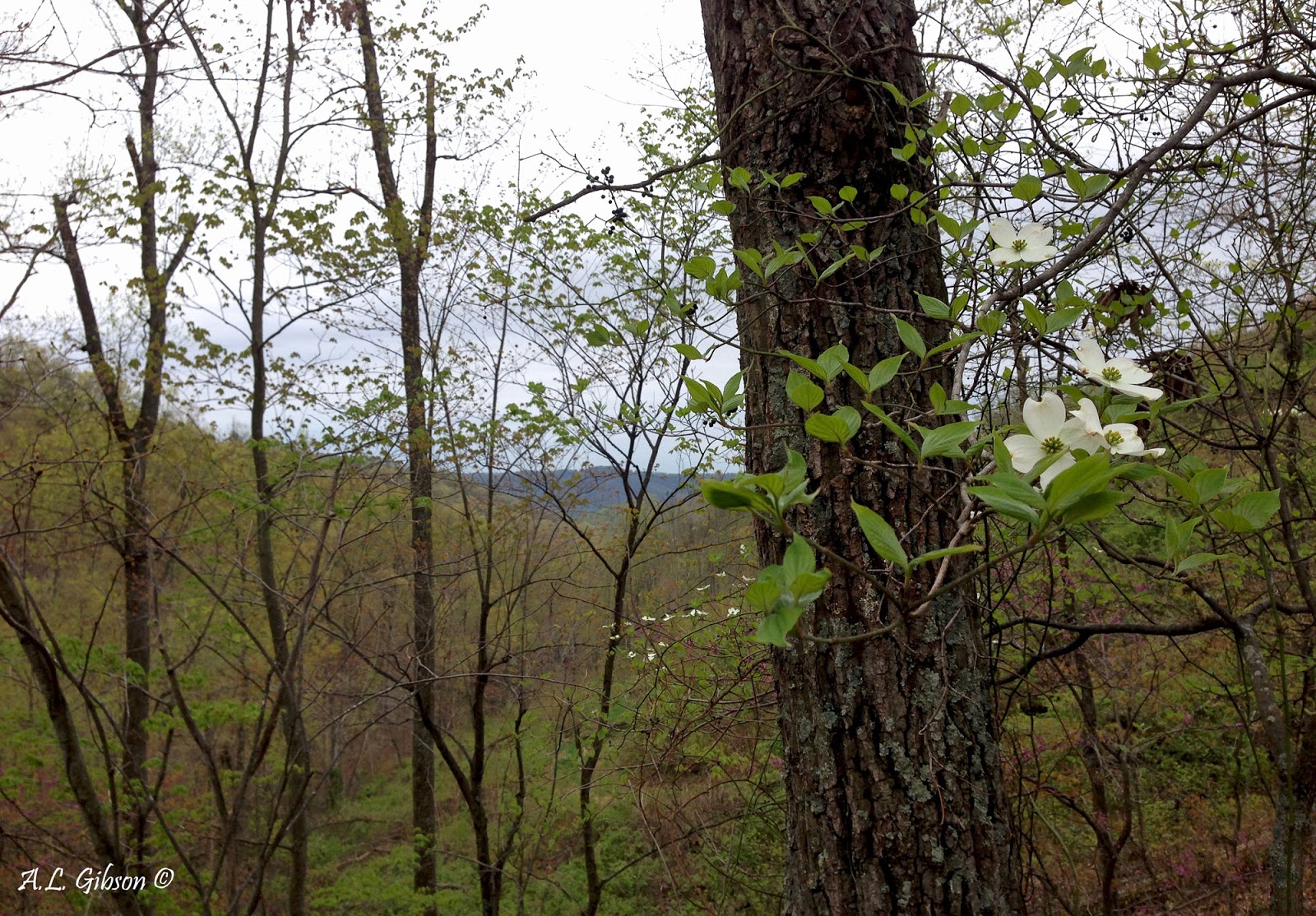
Flowering dogwood back dropped by the rolling hills of Shawnee

Don't let me fool you into thinking the birds were a complete and total bust.  Both my Saturday and Sunday field trips were rewarded with some great species and moments.  The best had to be a woman on Saturday wishing with all her might she'd get to see even a fleeting glimpse of the elusive Kentucky warbler; a long-awaited life bird for her.  Not more than five minutes later a male that had been singing from deep in the brush and tangle of the woods came out and perched himself in clear view for the entire group. Needless to say, the aforementioned woman was breathless in wonderment afterwards.  That's a sight any guide loves to see!

The rare vernal iris (Iris verna) blooming profusely along the forest's roadsides

One of the area's quintessential spring wildflowers was just starting to come online during the conference in the rare vernal iris (Iris verna).  Many folks think of summer and wetlands when irises are mentioned but this particular species loves the rocky, dry soil of Shawnee's sun-drenched ridge tops and roadsides.

Eastern Tiger Swallowtail nectaring on the ephemeral blooms of wild plum (Prunus spp.)

While cruising Shawnee's back roads during Friday's warm, sunny conditions, I came across numerous wild plums (Prunus spp.) in perfect flowering shape.  The air was heavy with their sweet scent and could be detected from hundreds of feet away with the nose alone.  I wasn't their only admirer as the plums were abuzz with dozens of bees and butterflies all looking for a taste of nectar.

Spotted Mandarin (Prosartes maculata)


Another of Shawnee's threatened floral denizens in full bloom was the delicate spotted mandarin (Prosartes maculata).  Their creamy white flowers hang like little lanterns under an emerald green umbrella.  A close look at the inside surface of their petals reveals a gorgeous smattering of magenta polka dots unlike anything else in Ohio's flora.

Pink Lady's Slipper (Cypripedium acaule)

As if the spotted mandarins and vernal irises weren't enough to wow my groups during breaks from our binoculars, Mother Nature had one more wildflower surprise up her sleeve in some pink lady's slippers (Cypripedium acaule).  I didn't expect to find any in this good of shape just yet, especially considering the last week's cooler weather but there this trio was in all their orchid splendor.  The program I gave this weekend was about Ohio's native orchids (fathom that one), so it was rewarding to be able to share these in the flesh with my group.

Sunday's group with their binoculars peeled along the forested ridge top roads of Shawnee

Sunday eventually cleared and warmed into a fine specimen of a spring day.  I had the added pleasure of close friends and phenomenal naturalists, Bob Scott Placier and Daniel Boone join me in leading this troop through Shawnee.  The birds responded accordingly to the improved conditions with better movements and vocalizations as the day waned.  Feathered highlights from the weekend included: scarlet tanager, wood thrush, purple finch, yellow-throated vireo, blue-headed vireo, sharp-shinned hawk and warblers (yellow-throated, yellow-rumped, black-throated green, cerulean, Kentucky, worm-eating, black-and-white, ovenbird, hooded, prairie, blue-winged, pine and redstart).

Birds Foot Violet (Viola pedata)

The theme of my hikes for the weekend was "Birds & Botany", so what could be better than getting the proverbial two birds with one stone in the birds foot violet (Viola pedata).  This state threatened species is arguably the most aesthetically exciting of Ohio's nearly 30 species of violet and they could not have looked better during our romp through Shawnee.

Shawnee enveloped in a steady rain

Fortunately, the rain didn't really hit and stick with us until towards the end of our time in the field on Saturday.  Regardless, I don't think I can really ever curse the rain this time of the year.  Without its life-giving powers there wouldn't be any wildflowers or birds to admire and spend the weekend chasing.  Rain is just fine by me and even gives the landscape a beauty all its own.

Female (L) and male (R) cones of the eastern hemlock

Even the minutiae of spring returning is something to behold.  Shawnee's eastern hemlocks (Tsuga canadensis) were doing their thing during our visit with their ephemeral yellow male pollen cones and adorable little female cones.  The male cones will quickly waste away after releasing their pollen, while the female cones will hang around for several years post maturity.  An interesting fact on gymnosperms is the very long temporal separation of pollination and fertilization.  It can take months for the sperm cells from the deposited pollen to reach the female cone's ovules and months more to mature into a seed.  Nature truly is all a matter of patience.

Oddly patterned common blue violets (Viola sororia) in Shawnee

Another floral oddity I enjoyed sharing with my group was a particular patch of common blue violets (V. sororia) that always display an interesting color pattern on their flowers.  I've witnessed these exact plants for several years running now and they always exhibit this strange, almost leucistic-like phenotype.  Definitely a fun twist on an otherwise common and forgettable plant.

Your blogger and the current/former* state champion yellow buckeye

I'll end this post in the same way I ended my memorable weekend down in Shawnee with one impressive specimen of a tree.  This particular yellow buckeye (Aesculus flava) has seen many winters melt into spring; so many in fact it was once (and perhaps still is?) the largest known tree for its species in the entire state.  Whether or not its title is intact is a bit moot for me.  It's a fabulous example of nature's work when given the time and opportunity to grow, grow, grow.

I can't begin to thank my hike's participants enough for their enthusiasm and thirst for the treasures of the outdoors.  Everyone's attitudes remained positive and cheerful during the entire weekend despite the weather.  I think it's safe to speak for everyone when I say we all had a great time and I'm already looking forward to future events with the OOS.

- ALG -

Monday, April 28, 2014

Ohio Ornithological Sociey Invades Shawnee State Forest

Phenomenal!  That is the one word your blogger would use to describe this past weekend in Shawnee State Forest with the Ohio Ornithological Society.  Three long but incredibly fun days down in the hills and hollers of southern Ohio full of birds, botany, and camaraderie has left me mentally and physically exhausted but sore joints and a frazzled mind full of memories has never felt so good!  I may be a "weed picker" (an affectionate name birders call us botanists) but I felt right at home and as close to my adopted birding family as I do with my typical plant people. The event itself was a whirlwind of activity and action I won't soon forget.

Being a guide and wanting to dedicate my time, energy, and focus on the needs and wants of my group, I decided to leave my camera in its bag over the weekend and was so preoccupied and engaged with my binoculars and educational moments, I didn't even utilize my phone's camera much at all either.  So very few photos of mine are in this post but I'd still love to fill you in on the details as well as share photos of some choice birds we all got to "ooh" and "ahh" over.

A very special thanks to the immensely talented and well-known Ohioan avian photographer Brian Zwiebel for allowing me to use his spectacular photos to properly illustrate just how breathtaking some of the feathered finds we made were.  You can find out and view more of Brian's work at his website Sabrewing Nature Tours and I most certainly recommend that you do.

View across the rolling hills of southern Ohio from a dolomite limestone bluff on a rainy morning

I awoke early Friday morning to the soft pitter-patter of rain on the roof of my cabin and hoped it wasn't a sign of things to come for the weekend.  As luck would have it, the rain pushed out by the afternoon and there was hardly a cloud in the sky for the rest of the weekend.  With field trips taking place on Saturday and Sunday, I wanted to get out and see what flora I could find in halfway decent shape to share with my group.  Unfortunately, things have been slow to awaken this spring with wildflowers about a week and a half or so behind.  None of the typical orchids and very few wildflowers normally exhibiting their striking colors and patterns were in bloom which made for a moment of disappointment initially.  In a way this ended up being all for the best as it allowed myself to really get lost in my binoculars and focus on my avian friends for a welcome change.  And boy did that end up being worth it!

Five in the morning on Saturday came all too soon but greeted the conference with a crystal clear sky filled with a seemingly infinite parade of stars twinkling in the predawn darkness.  A thin waning crescent moon slowly sank on the western horizon as the intriguing whip-poor-wills gave off their last calls of the night.  The sun was just beginning to pierce the highest ridges as my group piled into our van for a day full of exploration and adventure in the depths of Shawnee and nearby Edge of Appalachia.  I was fortunate to have the very knowledgeable and accomplished Andy Jones from the Cleveland Museum of Natural History as my co-leader and vital bird expert.  I'm not too shabby when it comes to my birds but Andy's understanding of not only identification but life history and biology as well was a crucial and much needed addition to the group.

Speaking of my group, I've had the pleasure of leading fantastic groups in the past and Andy and I's for the O.O.S. conference was no different.  Their passion for the natural world was as palpable as their hunger and drive to delve into what Shawnee had to offer.  I rarely get to be surrounded by so many people who share a like-minded approach and appreciation for nature and I wouldn't hesitate to say we all fed off one another's energy and good vibes.

The cool, misty morning took a while to warm up but once it did, it was like someone flicked a switch and the birds came out in full force.  The songs and calls of dozens of different species of returning tropical migrants saturated the air and was music to everyone's ears after suffering through such a trying and burdening winter.

Black-and-White Warbler (photo credit: Brian Zwiebel  www.sabrewingtours.com)

Our group slowly made our way from the moist, steep-sloped valleys to the oak dominated dry ridgetops with the birds changing as much as the plants as we ascended.  The moist, cold air hung heavy and had covered the blooms of redbuds, flowering dogwoods, and wild plums in dew but that quickly burned off as the sun rose higher into the sky.

Blue-gray Gnatcatcher (photo credit: Brian Zwiebel  www.sabrewingtours.com)

As I previously mentioned, the lack of my camera's presence was one of the best decisions of the weekend as it left my hands free to hold my binoculars up to my eyes and take in the early morning light's beauty, especially when it framed the bright colors of a passing warbler or scarlet tanager.

American Redstart (photo credit: Brian Zwiebel  www.sabrewingtours.com)

I'm always pleasantly surprised come spring when I find out I managed to retain more bird characteristics and song patterns than I thought would survive the winter.  Shaking off the rust is a must but I've long figured if I can recall and identify well over 1,000 species of vascular plants then a couple hundred birds should't be too hateful, right?  I think this speaks volumes for my ornithology professor Bob Scott Placier at Hocking College, as his tutelage and teaching methods really helped me grasp and understand the subject.

Black-throated Green Warbler (photo credit: Brian Zwiebel  www.sabrewingtours.com)

One of my favorite Shawnee forest denizens is the charming black-throated green warbler.  Its high-pitched, relatively short song echoes from the hemlocks and valley slopes with a unmistakable zee zee zee za-zee.  It's absolutely incredible to think this tiny little bird flew thousands upon thousands of miles all the way down to Central and South America only to fly back some months later for another chance at perpetuating its species.

Blue-headed Vireo (photo credit: Brian Zwiebel  www.sabrewingtours.com)

It wasn't just warblers, even though there are plenty more to come.  Some interesting and often unnoticed songsters of the spring like this blue-headed vireo were a welcome addition to our species list for the weekend that topped out at nearly 70 different birds.  The conference as a whole when pooled together saw well over 120 species!  Not too shabby for a couple days in more or less one area.

Cerulean Warbler (photo credit: Brian Zwiebel  www.sabrewingtours.com)

Easily one of, if not the most requested bird by the conference's attendees was the increasingly more and more rare cerulean warbler.  This small, iridescent blue bird is the official mascot of the O.O.S. and one of the fastest disappearing and declining species of wood warbler in North America.  This is due in large part to both logging activites and forest fragmentation in its breeding grounds here in Eastern North America as well as its tropical over-wintering grounds being deforested and turned into sun coffee plantations.  It's of the utmost importance we protect both its breeding and over-wintering grounds if we want to slow the free fall this beautiful little bird is in.  However, walking through the upper slopes of mixed oak canopy in Shawnee, you'd never guess this bird is disappearing at such an alarming rate as this area of southern Ohio is arguably one of the best remaining regions on the entire continent to still see this charmer in good numbers.

Throughout the day my group continued to have good luck with sightings like male and female scarlet tanager, yellow-throated vireo, Louisiana water thrush, wood thrush, ovenbird, prairie warbler, and indigo bunting to name but a few, however one particular bird at the end of the day was the cherry on top.

Henslow's Sparrow (photo credit: Brian Zwiebel  www.sabrewingtours.com)

The Henslow's sparrow is another Ohio resident bird who's numbers are declining throughout the region due to habitat maturation/loss and human activity.  These shy, seldom seen birds need large, unfragmented tracts of grassland with just the right amount of woody vegetation present.  Early haying activities leads to nest/chick mortality and natural succession can quickly turn an unmanaged and suitable open habitat into an unusable thicket and young forest.   As luck would have it, we timed our arrival to one of their few known sites just right and managed to catch a rare and unforgettable uninhibited look at one.  It's not very often they leave the safety of the ground and its camouflaging brush.  This was a life species for many in the group and seeing their beaming faces behind their binoculars was as much as a leader could hope to see.

A rescued/rehabbed female American Kestrel

A real treat for me was the chance at an up close and personal viewing of one of my all-time favorite birds in this American kestrel.  The Shawnee state park naturalist was kind enough to display this rescued/rehabbed female for those interested and I couldn't resist taking such a gorgeous animal's photo.  Originating from western Ohio's land of agriculture, you were hard pressed to not see these aerobatic birds of prey perched on a fence row or power line out on the country roads.

Sunday dawned as clear and beautiful as Saturday and found myself and another esteemed and knowledgeable birder in Bird Watcher Digest's assistant editor, Kyle Carlsen camped out in a particular spot in Shawnee to help guide passing solo birders and vans to what exciting species we were hearing and/or seeing in our area.

Worm-eating Warbler  (photo credit: Brian Zwiebel  www.sabrewingtours.com)

Once again the morning started off a bit slow until the air temperatures had warmed from the sun and the insects began moving which in turn caused the birds to move and feed as well.  One of the better highlights of the day was viewing two male worm-eating warblers in an intense battle over potential territory rights.  Don't let their name fool you though, they don't actually utilize worms as a food source but are rather voracious hunters of caterpillars and insects instead.

Red-breasted Nuthatch  (photo credit: Brian Zwiebel  www.sabrewingtours.com)

A rather surprising find for the morning was a red-breasted nuthatch still hanging around southern Ohio.  These little curiosities typically over-winter at our latitude before returning to their breeding grounds further north.  I guess this one decided to stick around and get a late start on its annual journey.

Yellow-rumped Warbler  (photo credit: Brian Zwiebel  www.sabrewingtours.com)

Another over-wintering bird still hanging around Shawnee in decent numbers was the quaint yellow-rumped warbler.  Most people associate warblers as migratory birds that would be fools to spend their winters in Ohio, battling the cold, harsh conditions but these little birds do just fine and move on further north once the weather makes a turn for the better.

Kentucky Warbler  (photo credit: Brian Zwiebel  www.sabrewingtours.com)

Of the 18 or so species of warbler I personally saw and/or heard over the weekend, the Kentucky warbler was one of my favorites.  This species is more often heard than seen as it prefers to stay hidden among the thickets and brush of the forest floor where it builds its nest.  Its song is excruciatingly similar to the more common Carolina wren and is something I have yet to learn to adequately differentiate.  Getting your binoculars on one leaves no doubts!

Chestnut-sided Warbler  (photo credit: Brian Zwiebel  www.sabrewingtours.com)

Another warbler?  You betcha!  Warblers are hands down one of the most popular and anticipated of spring's returning migrants for their diversity in numbers, colors, and patterns.  This particular species was one of the most exciting finds of the weekend and a species I'd never seen before in my life!  The chestnut-sided warbler is accurately named for the rich brown markings along its side and is capped with a crown of gold.  Kyle's sharp eyes certainly paid off in spotting this bird but this last one was definitely THE find of the weekend, at least in my opinion.

Blackburnian Warbler  (photo credit: Brian Zwiebel  www.sabrewingtours.com)

Right at the same time and in the same tree as the chestnut-sided warbler was another remarkable species that makes just about any other warbler I saw this weekend look tame.  This is the gorgeous Blackburnian warbler, a species that only breeds in a select few spots in northern Ohio and was passing through this area on its way north. The fact we happened to catch one of these in their fleeting moments in southern Ohio was unreal and kept my eyes glued to the binoculars with an unwavering attention span.  If this little fellow doesn't get you excited about birds and just how spectacular they can be, I really don't know what would...

In the end my weekend spent with well over 100 birders and fellow outdoors enthusiasts in one of the most diverse and mesmerizing natural areas in the entire state was a time I won't soon forget.  It was the perfect way to welcome in spring even if it is lagging behind a bit in the plant department.  More new birds are arriving each and every day and before too long the woods will be at full strength with the next generation of our winged friends well on their way.  I can't thank the Ohio Ornithological Society enough for asking me to help out and be a contributing member to such an important and memorable event.  I could never thank everyone that deserves a shout out but special mention to Jason Larson and Bill Thompson for their support, company, and guidance over the weekend.  Additional thanks to Andy Jones and Kyle Carlsen for their expertise and sharp eyes out in the field as well.  I look forward to being a part of more O.O.S. events in the future and must say this spring and summer will find me with my binoculars around my neck much more often than I typically would.  These guys will make a serious birder out of this botanist yet!  Special thanks again to Brian Zwiebel for graciously letting me use his phenomenal bird photographs that I could never begin to imagine producing on my own.  Hope everyone had an amazing time and look forward to seeing you all again!

Thursday, March 27, 2014

OOS 10th Anniversary Conference in Shawnee State Forest

Spring has finally arrived and it's never too early (or late) to begin planning out how you want to spend it!  If you regularly read this blog then you have surely noticed how much time I spend in the hills and hollers of Ohio's southern-most counties of Adams and Scioto and it's no coincidence.  These two counties combine to be one of, if not the most biologically diverse area in our state and harbor many rare species of flora and fauna within.  From the limestone outcrops and cedar glades of the Edge of Appalachia preserve system to the continuous rolling forests of nearby Shawnee State Forest, you never know know what is in store for your eyes, ears, and cameras.

Shawnee State Forest in spring's full bloom

To coincide with extreme southern Ohio's dizzying diversity of plant and animal life come spring, the Ohio Ornithological Society has decided to return to the depths of Shawnee for its 10th annual conference on the weekend of April 25-27.  This phenomenal event draws birders, naturalists, and outdoor enthusiasts from all over the state and beyond to experience the luscious landscape of Shawnee and the Edge flush with returning migrating birds and spring wildflowers.  If the sound of this happens to peak your interest, and I think it might if you're still reading up to this point, then I suggest checking things out HERE and marking your calendars for the last weekend in April!

Prairie Warbler, just one of around 20 species of warbler in the area

Normally this time of year would have me plugging and encouraging readers to check out the acclaimed annual spring wildflower event Flora-Quest that takes place in Shawnee and on the Edge.  Due to the near simultaneous nature of the OOS event, Flora-Quest is doing something a bit different this May on the complete other end of state up along Lake Erie.  You can find more information HERE.

That being said, I am very happy and pleased to say that I will be reprising my role as a field trip leader/guide (usually for Flora-Quest) for the OOS event instead! My group will be out and about deep in the forests of Shawnee to see what birds and botany we can stir up.  No worries, while I know my birds better than most folks might assume a plant-geek would, we will have an accomplished and knowledgeable birder on hand in co-leader/guide Andy Jones.  To see an agenda for the programs and field trips click HERE.

Spring wildflowers waking up in a hanging prairie on the Edge

Hopefully we will see warmer temperatures finally arrive and stick around all April in order to have the typical menagerie of spring wildflowers coloring up the area's forests and prairies.  The combined botanical diversity of the Edge and Shawnee results in well over 1,000 native plant species and some plant assemblages seen nowhere else in the entire state.  The birding is on par with the plants too as over 100 species are known to nest here with rarities and curiosities like the Kentucky, Cerulean, and Worm-eating warbler, Chuck-will's-widow, blue grosbeak, red-headed woodpecker, and wild turkey calling the undulating hills of the "Little Smokies" home.

Fragrant blooms of a wild plum (Prunus spp.)

The conference is a wonderful collaboration on many people's parts from the field trips to the programs and presentations that go on throughout the weekend.  Honestly, the best thing about these kinds of events are the friends, camaraderie, and memories made over weekend with 200+ like-minded people who have a thirst and passion for the natural world.  I am looking forward to catching up with old friends and meeting new faces alike and encourage any of my readers to seek me out and personally introduce yourself!

Having done Flora-Quest for three consecutive years and spent countless days exploring the region from spring to fall, I think I can say with some authority just how mesmerizing this area of the state truly is.  I could not encourage anyone more to check out the event and website and seriously consider making yourself a participating member of what is sure to be one of the best weekends this spring!