Showing posts with label Fens. Show all posts

Tuesday, June 7, 2016

The Bruce Peninsula Part I: Intro

 *Part I* *Part II* *Part III* *Part IV* *Part V* *Part VI* *Part VII*
As mentioned in my recent posts since coming back from the blogging dead, I have more than enough topics to catch up on. The biggest one of all is my sensational week long trip up to Ontario's Bruce peninsula last early June. In fact, I was up there at exactly this time last year and figured what better time to reminisce than now? I have tons to share and have decided to break them up into a series of posts that will make them easier to digest and enjoy. I'll be sure to link each and every one at the top and bottom of each post for easy movement between them.

View from atop Cave Point on the Bruce's rugged eastern shoreline. 


This first post will set the table for the rest of the series and serve as a nice introduction. I first discovered the beauty of the Bruce peninsula, or 'the Bruce' as I'll come to call it from here on out, back in mid June 2011. I had an incredible time that only whetted my appetite for more with a promise to return sooner than later. I missed out on a number of plants I had the highest hopes of seeing and resolved to arrive earlier in the month to catch them all this time around. I certainly achieved that and so much more!

Location of the Bruce peninsula within the Great Lakes region (courtesy Google Maps)


When I mention the Bruce to most folks, their first question is usually where in the world is this place? The Bruce is an extension of the geologically significant Niagara Escarpment that helps separate Lake Huron's main body and the Georgian Bay on its southern end, as seen in the map above. The peninsula's southern end is comprised of a mostly flat landscape with some rolling hills and dominated by pasture and agriculture, while the more wild northern end is dominated by forest and countless wetlands. The Bruce provides southern Ontario with its largest remaining tracts of forest and natural habitat and contains two national parks and numerous nature reserves protecting priceless globally rare habitat.

Closer look at the Bruce and major areas of exploration during my trip marked on the map (Courtesy Google Maps)

The aforementioned Niagara Escarpment is a major geological player in the Great Lakes basin and forms the backbone of the peninsula. The escarpment's bedrock strata is comprised of dolomite limestone, much like my beloved Adams County, Ohio's prairie barrens, that is of Silurian Age in origin and laid down over 400 million years ago. Despite being thoroughly scraped and carved flat by glaciers over the millennia, the Niagara Escarpment has provided the Bruce with some stunning topography in its dramatic lakeside cliffs/bluffs, rugged shorelines, alvars, and waterfalls as you'll come to see.

Pit stop at a bog in SE Michigan to see the Dragon's Mouth orchid (Arethusa bulbosa)

The trip started with your narrator making the initial drive up to Detroit, Michigan to pick up good friend and fellow botanist/trip member, John Manion at the airport. John lives/works in Alabama and had it planned to join me for the rest of the drive up to the Bruce after flying in most of the way. It was a good thing he did, as our quick, albeit out of the way pit stop at a wonderful sphagnum bog near Ann Arbor produced a life plant for John in the mesmerizing dragon's mouth orchid (Arethusa bulbosa). It was a harbinger of amazing plants, places and things to come!
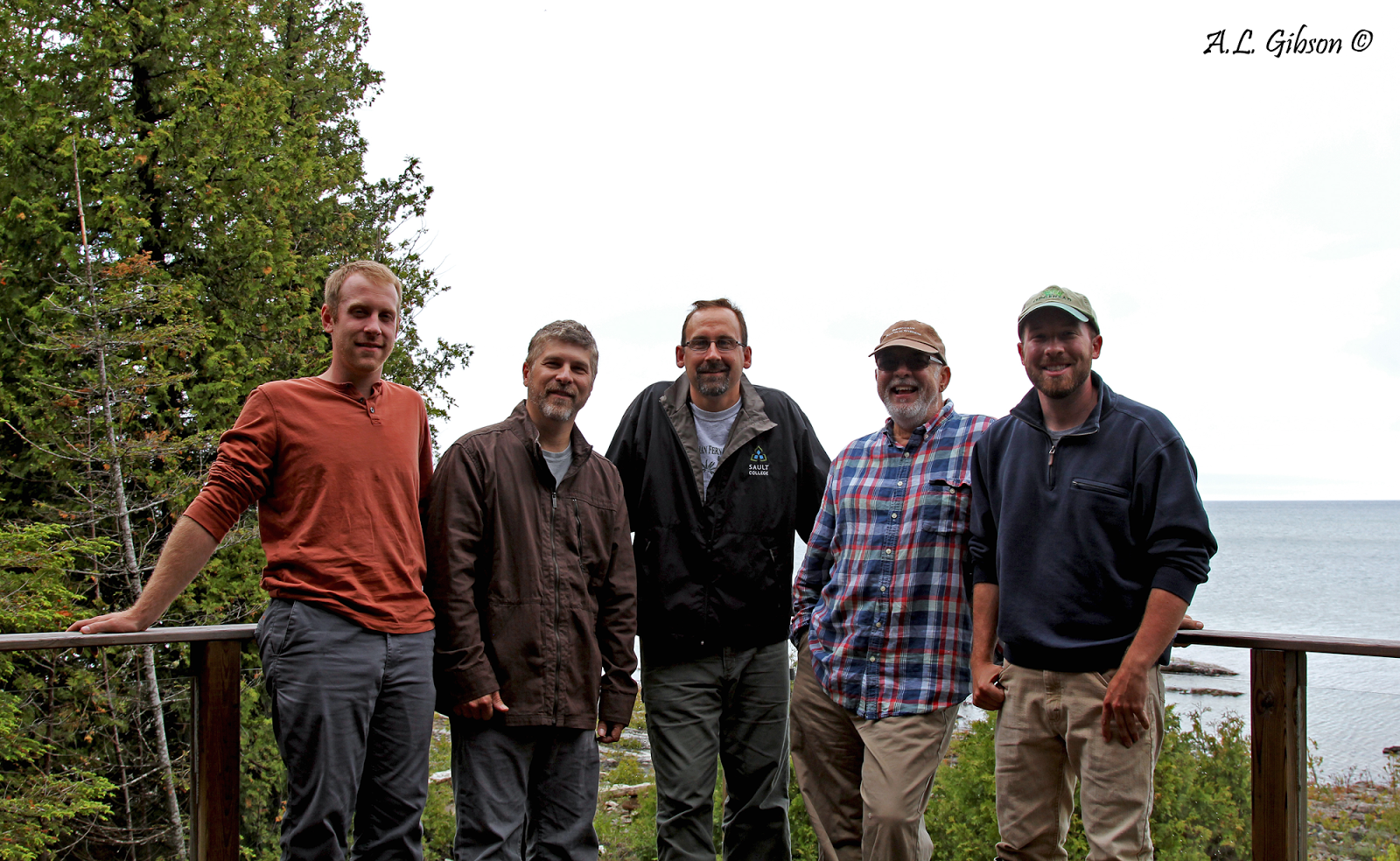
The Bruce Crew! L to R: Stefan Weber, Drew Monthie, Rob Routledge, John Manion, and your narrator


The rest of the crew met up at our lakeside cabin we'd rented for the week. All four other gentlemen were exceptional field botanists/naturalists and even better human beings! I can honestly say having the pleasure of experiencing the Bruce's splendor with all of them and the memories, laughter and camaraderie shared was second to none. Each one of us brought something unique and valuable to the table, but I must single out John's penchant for cooking as perhaps the best of all. We ate like royalty while up there and all pitched in to take his dish and meal ideas from paper to plate. I can't recall a better week of eating before or since. John, I'll never forget those honey drizzled, prosciutto-wrapped stuffed figs. Bliss!

One of our daily tributes to Jackie for being unable to join our trip due to a sudden knee injury


The only dark cloud to hang over our trip was the loss of our friend, Jackie. She was originally part of the Bruce Crew but suffered a fall and shattered her knee cap shortly before our departure that required surgery and lots of rest. Jackie is a dear, dear friend of mine whom you may recall has her own splendid blog, Saratoga Woods and Waterways. She's also graciously opened her home and favorite areas of upstate New York to me on two trips that I often still think about years later. Jackie was never far from our mind and we made sure she knew that by arranging her name in a variety of different items each day and sending her a get well email. My favorite was the one pictured above made of forget-me-not blossoms that abounded outside the cabin (no worries, it's a non-native species, so no harm done picking the plants!).

Our secluded cabin right on the Lake Huron shoreline nestled among the cedars, pine and spruce


I'd be remiss if I didn't take a moment to show off the location of our dreamy rented cabin. It resided in a secluded area on the western shorelines of the peninsula's northern end near Dorcas Bay. The interior was nicely furnished, comfy and quite spacious but nothing could beat the huge back deck and its phenomenal view. The surrounding coniferous woods and cobble shoreline was full of exciting flora and the morning serenade of warblers galore singing their hearts out outside my window is an alarm clock I'll never best or forget.

Keying out plants while drinking a beer was a favorite evening activity of mine


That gorgeous back deck saw lots of action with several nights of expert grilling by Rob; plenty of beer drinking and cigar smoking (at least for Rob and I); and provided a scenic spot to work out the day's unknown plants we collected/came across.


The Bruce Crew's combined naturalist library


Speaking of figuring unknown things out, our group was hardly in short supply of relevant literature and/or resources while up on the Bruce. Between the five of us, our combined library was impressive and came in handy. If anything, it provided a hands on chance to check out books I've yet to add to my naturalist bookshelf. In many cases, at least one of us already knew what most anything was others drew a blank on but with so many books it seemed like a lock we'd be able to nail down an ID on any mystery organism, no matter its place on the tree of life.

The adult sand hill crane is an obvious spot but can you find its little chick too?


The Bruce isn't just a botanist's dreamland but a birder's, too! I'm a casual birder at best most of the time with my attention usually fixated on the ground. It's easier to focus on plants and merely pay attention to the songs and calls filtering down from the canopy than actively seeking birds out with my binoculars. But I'd been a fool to not take advantage of the returned neo-tropical migrants and northern species rarely seen/heard in Ohio while up in Ontario. The highlight for me was stopping along a grassy meadow to observe a pair of sand hill cranes, only to realize they had two chicks with them! That was a new experience for me! Can you find the chick in the photo above?

Lake Huron sunset from the back deck of our cabin. Not too shabby, eh?

I know this wasn't the most exciting or captivating of posts but rest assured the next half dozen or so to follow will more than show just how unique and majestic a place the Bruce genuinely is. It's one of eastern North America's best kept secrets but certainly famous and popular with those who know and experienced its beauty. I hope you'll stay tuned and come back as I reminisce on one of the most fun and rewarding weeks of my life. Thanks for stopping by!

- ALG -

Monday, July 1, 2013

A Rare Orchid on the Prairies

Late June.  When the heightened humidity begins to make your clothes stick and the hum of annual cicadas rings in your ears; when the sun seems to hang motionless in the western sky and the raspberries are just about ripe, I know it's time to make my annual pilgrimage to a very special slice of Ohio.

E. Prairie Fringed Orchid (Platanthera leucophaea)

In a wet sedge meadow that seems no different than the rest but for a few short weeks each summer lives one of North America's most rare and spectacular of orchids: the eastern prairie fringed orchid (Platanthera leucophaea). I've posted on this site and species in years past but it deserves a breath of fresh air and some more attention as one of your blogger's most treasured of plants.

Lone orchid among the sea of sedges, forbs, and willows

In the past few years a few willow species (Salix discolor, S. eriocephala, and S. interior) have aggressively invaded and taken over the previously woody-free meadow.  This added competition combined with the stress from heat and drought of summers past had the prairie fringed orchids bloom much less vigorously than in previous seasons.  What two years ago was a profusion of blooming orchids, this section had only one flowering plant that I could locate.

E. Prairie Fringed Orchid (Platanthera leucophaea)

That being said there was still quite a few specimens in stupendous shape if you knew where to look.  Finding and enjoying their beauty pre-settlement wouldn't have been too hard a task throughout the fen and wet prairie regions of Ohio and the mid west/great lake states.  Being a life long fan of Big Ten football and basketball, I nicknamed this the "Big Ten orchid" for almost its entire geographical range occurring within states that are home to a conference's campus.

Closer look at their charming individual flowers

Within its wet prairie/meadow/marsh, fen, and shoreline habitats, prairie fringed orchid can grow upwards of four feet tall and contain well over 20 greenish-cream flowers spiraled around its stalk.  Each individual flower is about the size of a quarter and has its lower lip (labellum) deeply cut in a fringed fashion; almost as if the wind had shred and tattered tissue paper.  Their scent is light and faintly detectable by day but intensifies at night when its hawk and sphinx moth pollinators are most active and in the hunt for a nectar snack.

Handful of orchids peaking out above the sedges and grasses

I could witness these wondrous summer rarities every summer for the next 50 years and each meeting would be as precious and held dear as the last.  For your blogger nothing beats the sight of the prairie fringed orchids dancing in the warm summer breezes and their cream, waxy flowers gleaming in the sunlight.  There's little comparable to seeing their conspicuous wands contrasted against the surrounding green vegetation and brilliant sapphire sky.

A lovely pair of prairie fringed orchids

It may be hard to believe but the plant on the left in the photograph above could very well be older than I am. Fred Case, a brilliant botanist and master of North America's orchids recorded some plants eclipsing 30 years in age as an individual.  That's a lot of time, energy, and luck that has gone into an orchid that has evaded and escaped drought, flood, disease, browsing, and any kind of negative habitat change.  Just another reason to respect and appreciate these orchids not just for their looks but for their brawn as well.

E. Prairie Fringed Orchid (Platanthera leucophaea)

One of the more fun aspects to writing and publishing this blog is the opportunity to bring rare and unusual plants and habitats/ecosystems (like the prairie fringed orchid) home to those who cannot see or experience it for themselves.  I do my best to bring these topics and photos to life on your computer monitors and have you travel vicariously into the field with me; especially at sites and places as sensitive and secret as the prairie fringed orchids.

Orchid hiding alongside a spotted joe-pye weed (Eupatoriadelphus maculatus)

It really does seem like just the other day I was alongside these very orchids, admiring their physical charm and ghostly appearance like I am again a year later.  Even more difficult to believe is July is upon us again with so many more wonderful wildflowers and orchids to grace our landscape with their presence.  But you can't have July before you have the prairie fringed orchids knocking on the summer solstice's door once more...

Monday, March 11, 2013

Shoreline Fens of the Bruce Peninsula

I wonder if it's perhaps time to start rethinking the name of this blog.  With the amount of out-of-state traveling and botanizing I do throughout the surrounding states and regions, I feel like it has as much to do with the natural treasures of those places as it does with home sweet Ohio.  I'm only thinking out loud and have no real intentions of tackling the matter but it does stand to reason this blog is much more than just the fine buckeye state!  Recent times have seen focus on some of those extended forays; such as upstate New York and the southern Adirondacks, as well as the cranberry glades of West Virginia.  All were quite tardy and well past due but still worth the time to produce and share.  That being said, your blogger has decided to keep with that theme and travel back in time even further to catch up on some old business!  What better way to waste away the last days of winter with some warming tales of summers past?

A couple years ago during the summer of 2011 found myself wandering the botanical and geological masterpiece that is the Bruce peninsula in Ontario, Canada.  I began to weigh in on my travels and findings a ways back but lost track and it unfortunately got lost in the shuffle.  I'd like to dive back in and finish up my tales of the Bruce before spring fully awakens and my blogging switches back to more relevant topics.

Large shoreline fen complexes the Bruce peninsula is widely known for

One of the most spectacular aspects to this limestone derived slab of the Niagara escarpment are its huge expanses of shoreline fen complexes.  Unlike the small, isolated fens that pocket west-central and northeast Ohio, these graminoid dominated ecosystems stretch on as far as the eye can see in some places and are hundreds of acres in size.  Lake Huron's adjacent nippy waters play a direct role in the hydrology of these fens and keep their soils saturated and thriving with spike rushes (Eleocharis spp.), sedges (Carex spp.), and other fascinating flora characteristic of this habitat-type.  Areas of the Bruce such as Dorcas Bay, Petrel Point, Oliphant, and Red Bay claim prime examples of these shoreline wetlands and their associating plants; some of which are exhibited below.

Northern Pitcher Plant (Sarracenia purpurea)

My mid-June visit happened to coincide with the en masse blooming of the fen's most noticeable occupant: the northern pitcher plant.  Literally thousands of its large, blood-red flowers were suspended over the stunted pitchers growing below in the nutrient-poor and mucky soil.  The wetland almost seemed to suffer from an aggressive case of the chickenpox due to the mass-flowering of pitcher plants.

N. Pitcher Plant (Sarracenia purpurea)


The chilled, water saturated muck and marl soil of fens rarely hold any appreciable amount of nutrients (most specifically nitrogen) and require some plants to find ulterior methods for fulfilling their nutritional needs.  For the pitcher plants, sundews (Drosera spp.), and bladderworts (Utricularia spp.) that grow and persist in these fens, that other tactic is being insectivorous.

Linear-leaved Sundew (Drosera linearis)

Linear-leaved sundew's (Drosera linearis) glistening, enticing leaves intermingled with the pitcher plants across the swathe of fen and established an intimidating web of death for any winged insect.  Upon capture through a plant's own unique practices, the insects are broken down by the plant's natural enzymes and converted into a usuable form and ingested.  Speaking from experience itself, I don't see how these plants could ever go hungry with the unlimited number of mosquitoes, midges, and biting flies etc. that abound.

Fen orchid (Liparis loeselii)


Naturally, my main draw to the Bruce was its famous flora and most specifically its orchid diversity.  At the conclusion of my week spent there, I found no less than 20 species of orchid at one stage of its seasonal life cycle or another.  One of the most exciting of orchid discoveries occurred while scanning the drier hummocks of Oliphant fen for anything unusual.  The appropriately named fen orchid or Loesel's twayblade (Liparis loeselii) may pale in comparison to the physique of the forthcoming orchids in this post but their intricate lime-green flowers don't fail to impress.

Large expanse of shoreline fen on the Bruce peninsula

Gazing out across the open meadows allows your mind to soak in the details and impressive size of the Bruce's shoreline fens.  Come July these wetlands come alive with a pink/purple sea of rose pogonia (Pogonia ophioglossoides) and grass pink (Calopogon tuberosus) orchids that would make even the least botanically-interested stop and take notice.

Cotton Grass (Eriophorum viridicarinatum)


My visit was a few weeks too early for the orchid fireworks show and I was instead greeted with the conspicuous fruiting stalks of cotton grass (Eriophorum viridicarinatum) gently weaving in the cool breezes off Lake Huron.

Labrador tea (Ledum groenlandicum)


Another strikingly white and easily discernible plant showing off its seasonal charm throughout the fens was Labrador tea (Ledum groenlandicum).  This was a huge get for your blogger and provided a very satisfying opportunity to photograph and mark off another predominant life species; not to mention finally experience the spicy and refreshing aroma of its crushed foliage.

Shrubby, wooded borders of the fen complexes

Surrounding the large fen complexes were cool, mossy coniferous swamp forests comprised of white cedar (Thuja occidentalis), balsam-fir (Abies balsamea), tamarack (Larix laricina), and black spruce (Picea mariana) that allowed for even more fascinating plant life to mesh at their margins.

Showy Lady's Slippers (Cypripedium reginae)

The most exciting of those plants utilizing the forested margins of the fen meadows was easily the showy lady's slippers (Cypripedium reginae).  I was lucky enough to feel the adrenaline of coming across a flowering clump of these majestic orchids twice during my stay on the Bruce.

Showy Lady's Slippers (C. reginae)


I'd seen this species many times before back home in Ohio but the chance encounters here were not taken for granted and still sit high on my list of most exciting and appreciable finds.  The contrasting pink and white of their remarkable flowers is set perfectly against the vivid greens of the cedars and surrounding vegetation; it's hard to think they could ever really hide from anyone with such a loud display.

Sage-leaved Willow (Salix candida)
Shining Willow (Salix lucida)


It's not only the fen's herbaceous plant life that is endlessly diverse and intriguing but its woody plant compositions and associations as well.  While walking through a shrubbier section of the Dorcas Bay complex I came across many species of willow (Salix spp.) either already in fruit or just breaking bud.  One of the most noticeable was the accurately named sage-leaved willow (S. candida) with its silver-green foliage reminiscent of the western state's sagebrush (Artemisia tridentata) plant.  Another shrubby willow in the fen's thickets and borders was the shining willow (S. lucida) just coming into flower.  The above photo on the right exhibits the shining willow's golden staminate flowers.

Wet area of the sedge meadow full of bladderwort (Utricularia spp.) flowers

In the soupier, more saturated parts of the fens grew a host of weird and unusual plants, including another of the Bruce's numerous carnivorous species.  The speckling of yellow flowers in the water-logged area above belong to the flat-leaved bladderwort (Utricularia intermedia).  The bladderwort's "roots" have a series of bladders that pull in water and its accompanying tiny invertebrates to digest and break down in a similar fashion to the aforementioned sundews and pitcher plants.

Tall White Bog Orchid (Platanthera dilatata)

Just beginning to break bud among the bladderworts was a species of orchid I had never laid eyes on before and was pleasantly surprised to find in flower.  Tall white bog orchid (Platanthera dilatata) has been found and recorded in Ohio's northern surrounding states but never Ohio itself, despite some habitat existing during pre-settlement times.

Tall White Bog Orchid (P. dilatata)


Also known as white bog candles, this orchid ranges clear across the continent in its northern boreal habitat and additionally in the higher elevations of the mountain west.  Throughout its range taxonomists have separated it into three varieties depending on the size comparisons between the inflorescence's spur and lip.  Here on the Bruce and the rest of the eastern half of the continent only the typical variety (P. dilatata var. dilatata) occurs.

Buckbean (Menyanthes trifoliata) in fruit
Small Cranberry (Vaccinium oxycoccos)


Not all is fair in botany though; the success of a find is often followed by the sting of defeat.  I had hopes of seeing a major lifer, the buckbean (Menyanthes trifoliata) in flower but as it turned out the sole time I came across some the flowers were long gone and the fruits swelling with maturity.  I'll just have to return earlier in the season to catch their sensational flowers scattered throughout the wet meadows.  Certainly something you wouldn't have to pull my hair to get me to do!  On the opposite side of the flowering spectrum the small cranberries (Vaccinium oxycoccos) were just beginning to get going and carpeted small areas of the fens with their reddish-white, nodding blossoms.

Northern Leopard Frog

My time spent on the Bruce may be approaching two years in the past but I still often times find myself reminiscing on my experiences and discoveries with aspirations of returning sooner than later.  I've been fortunate to have done quite a bit of traveling across our continent in my life thus far and while many places are worth remembering, it's spots like the Bruce peninsula that you leave a piece of year heart behind upon your return home.  There is still plenty to share on the Bruce's wonders and I hope to get to them.  No matter how delayed they may be, their song deserves to be sung for all to hear.

Friday, October 5, 2012

Fringed Gentians at Betsch Fen

The other day I was going back through some older posts I had published in previous years when one particular topic caught my eye and reminded me I had a certain fen complex to pay a visit to before the growing season was done.  About this exact same time last fall I wrote about the stunning lesser fringed gentians (Gentianopsis virgata); an Ohio rarity that graces a small number of the state's fen complexes and sedge meadows.  Reading back through I noticed I make specific mention of wanting to return to this site the following autumn and experience their electric blue beauty all over again.  I owed myself that much to cap off another wildly entertaining and successful year of botanizing my revered home state.

Lesser Fringed Gentians  ~  Gentianopsis virgata

Wednesday's tend to be my least busy day and with the weather forecast calling for a gorgeous day I decided it was now or never to see gentians this time around.  I asked my good friend and fellow nature blogger, Michael Whittemore to accompany me because places like this deserve to be shared and experienced by others who love and appreciate the natural world as much as myself.  Ecosystems and habitats like Betsch fen are disappearing every day at the likes of mankind's destructive hands and nature's natural succession to forest.

I picked Mike up just as the sun was rising for the hour drive to the fen from the Athens area.  The warm, golden glow of the first rays illuminated the rolling hills of southeastern Ohio and splashed the changing trees with its warm light.  The fire oranges and deep scarlets of the chlorophyll drained leaves contrasted sharply against the sapphire blue skies and all combined into a gorgeous country drive that Mike and I could not have enjoyed more.  Upon arriving we slid on our rubber boots and away we went into the open expanse of alkaline fen.

Lesser Fringed Gentians  ~  Gentianopsis virgata

We followed the deer paths through the sea of browning Indian grass (Sorghastrum nutans) and out into the primary fen opening where I remembered seeing the most gentians from the previous visit.  It wasn't long before blue patches began to appear, glowing with droplets of dew in the intensifying morning light.  I immediately noticed there seemed to be a lot more gentians compared to last year.  In fact they were everywhere and easily numbered in the hundreds of plants!  I could tell from the look on Mike's face he was happier than ever to have tagged along.

Lesser Fringed Gentians  ~  Gentianopsis virgata

The primary reason for our early start that morning wasn't for naught as we found the gentians still tightly bundled and waiting for the warmth of the sun to unfurl their fringed perfection and beckon the day's first pollinators to come pay it a worthwhile visit.  This opening and closing feature allows for two distinct and equally exquisite 'stages' of the flower and will keep your camera shutter clicking all morning long.

Lesser Fringed Gentians  ~  Gentianopsis virgata

The recent history of Betsch fen is quite the success story and an example of what exciting results can be acheieved from proper and active management of the habitat.  The open fen meadows had filled in with woody vegetation over time and had almost fully choked out the gentians when the site was first bought by the Ohio chapter of the Nature Conservancy years ago.  As the woody vegetation was removed and the sunlight restored to full strength over the newly cleared meadow, back came the brilliant blue wildflowers of the fall.

Mike admiring and photographing a patch of lovely gentians

While the fringed gentians were certainly the object of our desire, they weren't the only wildflowers to still be blooming in the wet fen meadow.  The honey-yellow, flat-topped flower heads of Ohio goldenrod (Oligoneuron ohioense) and their accompanying clumps of green basal leaves are easily visible in the photograph above.  Bog goldenrod (Solidago uliginosa) and rough-leaved goldenrod (S. patula) also intermittently occurred throughout and were all just about done flowering.  A few other wildflowers still hanging on were the purple-stemmed (Symphyotrichum puniceum) and willow-leaved (S. praealtus) asters; Canadian burnet (Sanguisorba canadensis); and purple false foxglove (Agalinis purpurea).

Lesser Fringed Gentians and Nodding Ladies-tresses (Spiranthes cernua)

Another exciting realization was the increased number of flowering stalks of the nodding ladies'-tresses (Spiranthes cernua) orchid in select areas of the fen.  In some cases one could enjoy both exciting species growing side-by-side.

Nodding Ladies'-tresses  ~  Spiranthes cernua

The nodding ladies'-tresses is a frequent associate of our fens and wet meadows, prairies, fields, and thickets throughout the Great Lakes and eastern North America.  Their snow white, crystal-like flowers stand out immediately against their more bleak surroundings.  Determining you have a Spiranthes species of orchid in front of you isn't too hard a conclusion to come to but which one can make you scratch your head and create tedious judgement decisions on varying similar characteristics.  I've found the more time I spend with this genus in the field and its taxa, the more confident and qualified I feel I've become at making an ID.  Spiranthes cernua can be identified by its pure white, two-ranked inflorescences; lack of fragrance; and calcareous fen habitat.  This species is notoriously variable throughout its range but here in Ohio the above characteristics seem to hold pretty true.

Nodding Ladies'-tresses  ~  Spiranthes cernua

The nodding ladies'-tresses comes from a complex group of excruciatingly similar species that until recently were all lumped into S. cernua and considered mere varieties of a single taxon.  Since then at least four different taxa (S. cernua, S. magnicamporum, S. ochrolueca, and S. odorata) have been split out and elevated to full species status.  It doesn't stop there though, as some botanists and taxonomists recognize a handful of forms strictly within S. cernua.  Some may pull their hair out at the sound of it but I consider it a reason to investigate and a topic that deserves further study and research.

Lesser Fringed Gentians  ~  Gentianopsis virgata

Not long after our arrival and the sun's energy having been diffused across the landscape, the gentians were fully opened and exhibiting their sublime fringed petals of the most astonishing blue you'll ever seen in a wildflower.  No tricks or changes, no need to check your monitor's settings; the fringed gentians really are that vibrant and staggering.

Gentianopsis virgata distribution map: courtesy BONAP

Looking at the overall distribution and range of the lesser fringed gentian you can see that south-central Ohio is about as far south this species ever ventures.  Its presence at Betsch fen and the rest of the state is owed to the last glacial period and the immense ice sheets that carried it down from the north.  The cold, seeping groundwater and calcareous conditions of the fen have been just the trick to keep them around.

Lesser Fringed Gentians  ~  Gentianopsis virgata

Ohio is home to two native species of fringed gentian: the presented lesser fringed and another taxon called the greater fringed gentian (G. crinita).  Both are strikingly similar but can be told apart by taking a look at the leaves.  The greater fringed has shorter, more wide lanceolate leaves; while the lesser fringed exhibits long, much more narrow (almost linear) leaves.  The amount of fringing around the end of the petals (as suggested by their names) can be used but is not very consistent and a very variable feature.

Lesser Fringed Gentians  ~  Gentianopsis virgata

After a couple hours thoroughly exploring the fen and filling our memory cards with photographs of the charming gentians, Mike and I decided to head back to the car and return to civilization for some breakfast. With my stomach growling as we tromped out of the fen I took one last glance out across the grasses and wildflowers and smiled knowing I'd be back a year later to spend another memorable autumn morning with one of my favorite botanical beauts.  I don't think I'd have to ask Mike twice to come back either.  There's just a certain lure these plants have on the willing, a siren's call that this botanist can't ignore and quite frankly has no desire to.