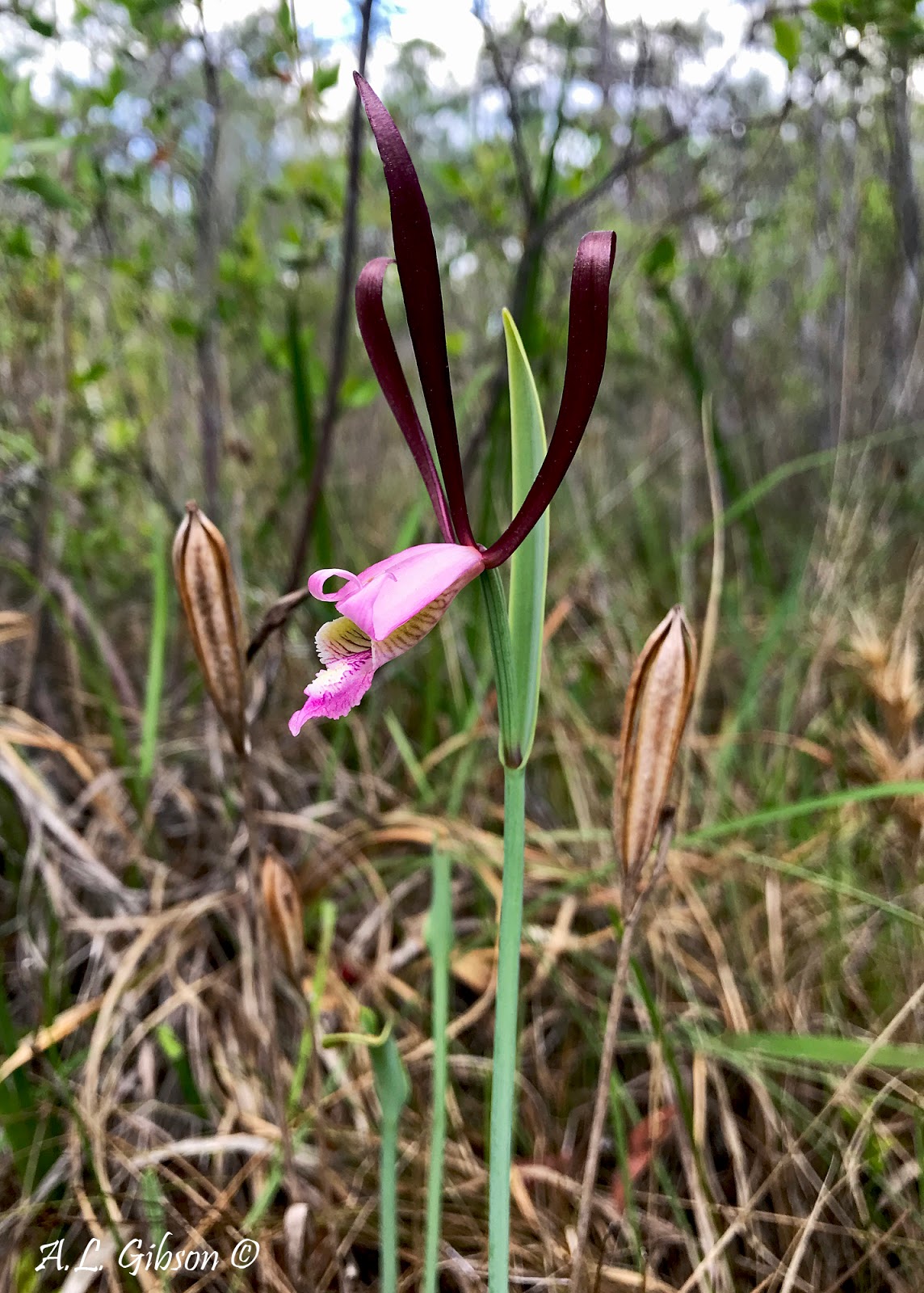
Showing posts with label Florida Panhandle. Show all posts

Friday, February 22, 2019

Top Ten Life Plants of 2018

Hello? Tap, tap, tap...this thing on? Whew, it's been a minute since I've been on here. Just over a year, actually. Definitely the longest hiatus since this blog's inception back in the fall of 2010. Speaking of which, I can't believe its been eight years since I sat down and wrote my first post. It seems so much shorter and longer ago at the same time. Weird how time works isn't it?

A quick update on things before we dive into the subject matter at hand. First off, I got married to my long time partner, Kara early last year! Definitely the highlight of 2018 for me! We also moved to Columbus this past summer after nearly a decade of living down in the rolling hills of southeast Ohio. I miss the Athens area and all my favorite haunts but it's nice to be centralized and enjoying my own office in the ODNR headquarters in town. Happy to report I'm still working as a field botanist and ecologist for the Ohio Division of Natural Areas & Preserves and loving most every minute of it. That pretty much catches you, my ever-patient and faithful readers (I mean, how many of you are actually left these days anyways haha?) up on the major happenings in the Buckeye Botanist's life.

I'd also like to take this time to dedicate this post to Keith Board, a good friend of mine and spirited fan of my writing and photography. Keith passed away last month after an extended illness. He was only 58. Keith was a sensational and accomplished botanist and naturalist in the northern Indiana and Chicago region and he will be greatly missed by countless individuals who's lives he touched. He was the most positive and encouraging person you could hope to know. Rest in peace, Keith.

Back to business. It's that time again to sit down and write up what's come to be a yearly favorite of mine and a post I'll always make time for: this past year's top ten life plants! It's a wonderful way to reminisce on a growing season's worth of discovery and adventure and 2018 had plenty.

2018 was an eventful year with exciting happenings both in my home state of Ohio and outside her borders. My aforementioned work kept me busier than ever with some noteworthy discoveries that I certainly hope to share on here one day. I also made treks down to the Florida panhandle back in early May, as well as a once-in-a-lifetime loop trip around the entirety of Lake Superior in July! I'd love to document both excursions, especially the Superior trip in blog form one day, too. Both adventures provided countless unforgettable botanical moments and finds. Honestly, all ten species you'll see below come from those two forays. I made acquaintances with my fair share of new Ohio flora this year but none managed to make the list this time around. All this made for the most difficult top ten list I've had to put together in the 4-5 years I've been doing this post.

All that being said let's begin the countdown of my favorite life plants from a memorable spring, summer, and fall of botanizing throughout eastern North America...


#10  "Red" Yellow Pitcher Plant (Sarracenia flava var. rubricorpora)


Longleaf Pine savanna community near Sumatra, Florida

2018 life plant #10 takes us down to Apalachicola National Forest on the Florida panhandle. My wife and I took a belated honeymoon down to the beach in early May for a week of lazy cocktail drinking and seafood eating. However, she knows who she married and I had to get out into the wild from time to time; she was even a good enough sport to come with one day! In one particular longleaf pine savanna community was an extra diverse display of flora and home to plant #10...

Sarracenia flava var. rubricorpora

I love any and all of North America's native pitcher plants but there's something about this very rare and beautiful red form of the yellow pitcher plant (Sarracenia flava var. rubricorpora) that really speaks to me. Legend has it this unique color morph only occurs in the wild on the Florida panhandle. It's a highly sought-after variety in the carnivorous plant trade, which makes seeing it actually out in the wild an extra special thing. I'd had the luck of seeing typical yellow pitcher plants on several occasions, including countless times on this trip but these blood red beauties stole the show!


#9  Cahaba Paintbrush (Castilleja kraliana) &
Alabama Pinkroot (Spigelia alabamensis)


Ketona Dolostone glades of the Bibb County Glades in central Alabama

2018 life plant(s) #9 take us to a quick stop in central Alabama to see a site I've drooled over for many years. The famed Bibb County Glades deserve and will get their own dedicated post one day but for now this very brief introduction and appetizer will have to do. This fascinating habitat sits on a unique form of dolostone that is extra pure and allowed for some remarkable plant evolution to take place. In fact, eight species of plants to be found in these glade complexes occur nowhere else in the world! Two of which are featured below. And, no, I couldn't decide on just one.

Cahaba Paintbrush (Castilleja kraliana) G2
Alabama Pinkroot (Spigelia alabamensis) G1


Kara and I stopped at the Bibb County Glades on our way down to Florida to check things out, even if for only a precious and hurried few hours. We managed to catch a number of things either still hanging on or just starting to bloom as the season transitioned from spring to summer. That included the two endemics featured here. On the left is Cahaba paintbrush (Castilleja kraliana). It's closely related to the widespread scarlet paintbrush (C. coccinea) but diverged from it in this unique scenario and developed different pollinator/pollen vectors due to its changes in bract coloration. On the right is Alabama pinkroot (Spigelia alabamensis), and perhaps the glade's most famous denizen. Like the paintbrush, it evolved in this specialized habitat and only occurs in these glades and nowhere else on Earth. It was just starting to bloom and open its corollas during our visit. If it looks vaguely familiar to you it may be because you saw it on the side of a U-Haul truck! Can't say any other plant I'll feature on this blog has that same distinction. I saw so, so much more in these glades and will share it all in their own post one day. Hopefully...


#8  Coastal Plain Spreading Pogonia (Cleistesiopsis oricamporum)


Coastal Plain Spreading Pogonia (Cleistesiopsis oricamporum)

It wouldn't be a proper "top ten life plants" countdown without an orchid's first appearance. And if you know me even a little bit you'll also know this is hardly the last orchid that will appear on this list. Coming in at #8 is the coastal plain spreading pogonia (Cleistesiopsis oricamporum). It's another Florida panhandle discovery but the last time we'll be in this amazing botanical paradise on this countdown.


Coastal Plain Spreading Pogonia (Cleistesiopsis oricamporum)


If I had a dollar for every one of these orchids I saw in the open longleaf pine savanna communities I was botanizing in, I'd be retiring much earlier than planned. They were quite common and an especially nice find when growing in large colonies of pitcher plants, as seen in the above left photo. An additional wow factor from this orchid was its deliciously sweet fragrance that was reminiscent of vanilla to my nose.


#7  Intermediate Sedge (Carex media)


Intermediate Sedge (Carex media) on the rocky north shore of Lake Superior

If orchids are my favorite plants then it would only be right to have #7 represent my other favorite plant family: the sedges! On my incredible Lake Superior loop trip we came across well over 100 species of sedge, quite a few of which were lifers that I'd never seen before. The best and most anticipated of all was this little fella. The intermediate sedge (Carex media) is a circumboreal species found throughout the northern hemisphere but quite the rarity as far south as the northern shorelines of Lake Superior. Yes, you heard that right. This plant considers that to be the "south".


Closeup view of the fruiting spike of intermediate sedge (Carex media)

Intermediate sedge was the number one Cyperaceae life species I wanted to come across. Our group managed to cross it off the list on the precarious rocky shorelines of Superior in the Grand Marais, Minnesota region. It's a dainty thing but has a lot of charm and character in its light green coloration contrasted by dark pistillate scales. It reminds me of a micro version of Buxbaum's sedge (C. buxbaumii), which happens to be one of my most beloved sedges. This one may not make many other folk's top life plant list but it was a no-brainer for me!


#6  Common Moonwort (Botrychium lunaria)


Common Moonwort (Botrychium lunaria)

Much like orchids and sedges, this countdown wouldn't be complete without a fern making an appearance. No fern made a bigger splash with me in 2018 than #6 and the common moonwort (Botrychium lunaria). When it comes to moonworts you're dealing with tiny plants and endless frustration. They are a painfully difficult group to get a handle on due to so many looking so similar to one another. However, the common moonwort stands out with its unique crescent moon-like leaves on the tropophore (sterile blade).


Common Moonwort (Botrychium lunaria)

Speaking of small, I think the photo above with one of these moonworts framed against my hand shows just how tiny we're talking here. The common moonwort is found throughout the world but is most frequent in the northern latitudes. Our Lake Superior crew came across this moonwort and 2-4 other species in a sterile, sandy habitat along an old railroad up on the north shore. The exact number and identity of all the moonworts we found at this spot remains unknown and very aggravating!


#5  Oval-leaved Milkweed (Asclepias ovalifolia)


Oval-leaved Milkweed (Asclepias ovalifolia)

We've reached the halfway point on my countdown of 2018's top ten life plants. I hope you've enjoyed the list thus far. It's only going to get more interesting and aesthetic from here, at least in my opinion. Dropping in at #5 on the list is the oval-leaved or dwarf milkweed (Asclepias ovalifolia). Not to sound like a broken record or someone who loves everything but the milkweeds are another group that hold a special place in my heart. This species was the prime target during a stop at a sand barrens community in northern Wisconsin, where this milkweed is getting to be exceedingly rare.


Closer look at the flowers of the Oval-leaved Milkweed (Asclepias ovalifolia)

The sand barrens we visited and thankfully found our target in has an interesting recent story. It resides on state land and was planted to red pine several decades ago for future timber. As the pines came in they shaded out the barrens flora and pushed them into the seed bank. Flash forward to a handful of years ago and the state logged this pine plantation and opened the habitat back up. With the sudden lack of suppression from the pines the barrens flora, including this milkweed sprang forth and had their day in the sun once more. Unfortunately, the site has been replanted to pine and the milkweeds and other sun-loving plants are once again getting pushed back.


#4  Encrusted Saxifrage (Saxifraga paniculata)


Encrusted saxifrage (Saxifraga paniculata)

When I first laid eyes upon #4 I knew I was witnessing a remarkable plant. I'd never even heard of encrusted saxifrage (Saxifraga paniculata) before but was instantly taken by its beauty and tenacious nature. This stunning wildflower is an alpine and subarctic specialist that barely makes it far south enough to occur along the rugged, unforgiving north shore of Lake Superior. It's much more common in NE Canada, as well as in Greenland, Iceland, and Norway. That's one tough plant!


Succulent-like basal leaves of encrusted saxifrage (Saxifraga paniculata)
Encrusted saxifrage (Saxifraga paniculata) on its rocky shoreline home 


The fleshy, off-white colored petals of their flowers are delicately polka-dotted with black flecks and the first thing that drew my attention. However, it was their succulent-like basal rosettes growing right off the rocks that won me over. The tips are tinged white from their pores secreting lime taken in from their calcareous substrate, hence the name 'encrusted'. I'm amazed they survive the brutally cold and ice-covered winters on their shoreline habitat but life always finds a way!


#3  Cahaba Lily (Hymenocallis coronaria)


Cahaba Lily or Shoals Spider-lily (Hymenocallis coronaria)

We're down to the final three most meaningful finds and they all bring back very fond memories. At #3 is the globally rare Cahaba lily or shoals spider-lily (Hymenocallis coronaria). This was another stop of Kara and I's on our way down to the Florida panhandle and fortuitously very close to the Bibb County Glades. These wonders occur in the shallow flats of the Cahaba River National Wildlife Refuge and were just starting to bloom during our visit. A month or so later and countless thousands bloom en mass at this location.


Cahaba Lily or Shoals Spider-lily (Hymenocallis coronaria)


Getting out to the lilies was a bit treacherous and involved careful wading. The rocks were slick as snot and the deeper channels acted as a maze I had to solve. Kara was fine with admiring them from the shorelines and was waiting for me to slip and fall in the river haha. The Cahaba lily is only known from few watersheds in Alabama, Georgia, and South Carolina where it has severely declined due to dam construction flooding out its required specific habitat. I certainly hope to get back down to see this wildflower at its peak one day but I'll settle for the blooms I did see without complaint for now!


#1B  Small Round-leaved Orchid (Amerorchis rotundifolia)


Small Round-leaved Orchid (Amerorchis rotundifolia)

I'll right off the bat say that the final two plants on this list are interchangeable. There's no real way I could decide between the two and finally seeing both with my own two eyes meant everything to me plant-wise in 2018. That being said at #1B is the mythical, the magical, the marvelous small round-leaved orchid (Amerorchis rotundifolia). I've been chasing wild orchids for almost a decade now and seen 90+ of North America's native species but this one...this was one of my holy grails. One I'd spent hours daydreaming about seeing. So when this Lake Superior trip was put together this was near or at the top of everyone's list. I'll be sharing and detailing a lot more about this species when I do my Superior series as there's a lot more than meets the eye about this spot and orchid...


Small Round-leaved Orchid (Amerorchis rotundifolia)


I finally made acquaintances with this long desired orchid within the depths of a secluded rich cedar swamp in Sleeping Giant Provincial Park, Ontario. There, our group came across hundreds in perfect flower and it was like being in a lucid dream. We'd found them the day before at a site further north and inland but the recent heat wave had cooked them and they were well past prime shape. Fortunately, Lake Superior acts as a refrigerator around the Sibley Peninsula and kept the orchids at  this site in perfect shape for our visit! They were simply unbelievable and the long, slow-moving bushwhack to see them along with the liter of blood I lost to the black flies, deer flies, and mosquitoes was completely worth it. Words fail me how excited I was to witness this rarity of the northern woods.


#1A  Sparrow's Egg Lady's Slipper (Cypripedium passerinum)


Sparrow's Egg Lady's Slipper (Cypripedium passerinum)

And then there was one. We've come at last to my number one life plant of 2018 and, of course it's another orchid. In fact, every year but last year (2017) the top spot has gone to one of my beloved orchids. My Lake Superior loop trip gave me more botanical bliss than any trip I've been on before and its greatest gift of all was the sparrow's egg lady's slipper (Cypripedium passerinum). It's a tiny little plant with the delicate slipper about the size of its namesake sparrow egg. It also goes by the common names of Franklin's or spotted lady's slipper.


Sparrow's Egg Lady's Slipper (Cypripedium passerinum)


Within Pukaskwa National Park on Ontario's north shore they grew in scattered clumps on the mossy, juniper-covered stabilized dunes under pine/spruce a ways back from the active shoreline. The cool, refrigerator-like air coming off Superior helps provide a microclimate for this northern disjunct arctic orchid and how they've managed to persist so far south. This is more or less the only spot in the entire Great Lakes region this orchid still occurs. You have to travel hundreds of miles north and/or west to find them again. Interestingly, the sparrow's egg lady's slipper is self-pollinating (see: autogamous), which is unusual for a Cypripedium. You can see the ovaries already swelling/maturing with the flowers in peak shape in the accompanying photos. The photo above right shows just how miniscule the slippers and plants are! It's such an incredible orchid and one that brought long-awaited tears of joy to my eyes. I can still months later hardly believe I got the opportunity to witness their perfection in such a special place.


I hope you've enjoyed this look back on my favorite finds and life plants of 2018. I'll be curious to hear from you all on which ones were your favorites; species you have on your life lists; or experiences with them yourselves. I hope I've warmed your spirit and computer screens even a little bit as Ohio's winter trudges on. Spring is nigh, though! I heard my first red-winged blackbird singing yesterday and already seen skunk cabbage in bloom. Thanks for tuning in and reading and I hope to be back with more content in 2019!

~ ALG ~

Monday, August 4, 2014

Botanizing the Florida Panhandle: Blackwater River State Forest

*Part I* *Part II* *Part III* *Part IV*

It's hard to believe it has been nearly a month since I returned from the Florida panhandle.  It might be even harder to believe I've been able to get all four posts on the trip published in a week's time!  Your narrator will be the first to admit it can take longer than preferred to get things online.  This fourth and final topic will deal with my short visit to nearby Blackwater River State Forest in the western panhandle. 

Longleaf pine forest after a recent forest fire (more than likely prescribed and purposely set)

The day started out a bit later than planned and was then spent dodging thunderstorms and the smoldering aftermath of numerous forest fires within the state forest.  Blackwater River is known for its contiguous stands of longleaf pine and accompanying wetlands that represent what much of the region looked like pre-settlement. These ecosystems evolved to have an intimate relationship with naturally-occurring and/or man-made wildfires and relied on them to remain healthy and intact.  So it was no surprise to see so much fire management at work and turned out to be a unique opportunity to see the forests in their immediate post-fire charred condition.  Fire doesn't benefit just the flora but the fauna as well in fire-dependent species such as the gopher tortoise, Bachman's sparrow and northern bobwhite.

Pineland Milkweed (Asclepias obovata)

While traversing the sandy roads of Blackwater, I noticed some type of oddly-colored milkweed beginning to bloom among the pines and open sand.  It turned out to be the aptly-named pineland milkweed (Asclepias obovata), a species restricted to the sandy pine forests of the western panhandle.

American Beautyberry (Callicarpa americana)


Another easily noticed plant along the roadsides was the flowering shrub American beautyberry (Callicarpa americana) with its pink tufts of axillary flowers.  Similar to the Venus fly traps or pitcher plants from the first couple posts, the beautyberry is a plant more distinguished and well-known for its non-flowering state; specifically its stunning bright purple-pink fruit clusters.

Gopherweed (Baptisia lanceolata)

Learning the distinguishing characteristics of a particular plant family/genera is a helpful accessory to have in your botanical tool belt no matter where your travels take you.  Despite never seeing it before, the three-parted leaves and unique seed pods of the pineland false indigo or gopherweed (Baptisia lanceolata) stood out as something from the Baptisia genus and allowed for a quick sort through Florida's respective species.

Tall Ironweed (Vernonia angustifolia)


The soaring purple-topped stalks of tall ironweed (Vernonia angustifolia) were just beginning to break bud during my foray and was another plant genera easily recognized by its similarity to its Ohio brethren.  The ironweeds are some of my favorite late summer wildflowers and this particular taxon was one I'd only ever seen as mounted specimens in a handful of different herbaria.  The flowers look nearly identical to our tall or common ironweed (V. gigantea) but the southern tall ironweed's narrow, needle-like leaves definitively set it apart.

Spurred Butterfly Pea (Centrosema virginianum)

Much like my experiences in Apalachicola National Forest, the spurred butterfly pea (Centrosema virginianum) was a common associate to the pineland's understory and speckled the landscape in soft purple splotches when found in exceptionally nice tangles.

Water tupelo swamp and emergent vegetation

Throughout Blackwater River state forest were pockets of shallow wetlands dominated by water tupelo swamps and the occasional bog.  Much of the emergent vegetation I didn't recognize but numerous beak-sedges (Rhynchospora spp.), nut-sedges (Cyperus spp.), umbrella-sedges (Fuirena spp.), rushes (Juncus spp.), yellow-eyed grass (Xyris spp.), fragrant water lilies (Nymphaea odorata) and watershield (Brasenia schreberi) were intermixed at the swamp's margins.

Ten-angled Pipewort (Eriocaulon decangulare

In select spots of one particular tupelo swamp was the unmistakable flowering stems and blooms of the ten-angled pipewort (Eriocaulon decangulare), also known as bog buttons.  They seem almost alien to me and unlike anything else in the plant world, whether in Ohio or Florida.

Ten-angled Pipewort (Eriocaulon decangulare
Whitehead Bogbuttons (Lachnocaulon anceps)


I'd seen the much smaller common pipewort (E. aquaticum) in upstate New York a couple years before and had no idea other members of the genus got so big.  Growing intermixed with the true pipeworts was the very similar and tiny whitehead bogbuttons (Lachnocaulon anceps); which only managed to cause for more confusion while in the field.  Ohio can only claim one species of Eriocaulon (the aforementioned E. aquaticum) while Florida has a handful of species from both Eriocaulon and Lachnocaulon.

Carolina Redroot (Lachnanthes carolina)

As mentioned many times before in this series, it's fascinating to explore an environment and region so utterly different and separated from your own that plants growing like weeds are something you've never encountered before.  A fuzzy and very eccentric looking wildflower that would come to be known as Carolina redroot (Lachnanthes carolina) was one of those plants and turned some stretches of roadside white with their flowers.  It hails from the predominately southern hemisphere bloodwort family (Haemodoraceae) and was hands down one of the strangest plants I encountered.

Banana Spider or Golden Silk Orb-Weaver (Nephila clavipes)

Speaking of the strange, while exploring the margins of the tupelo swamp from earlier in the post, I about walked face first into the single largest spider I've ever laid eyes on.  Literally.  The banana spider or golden silk orb-weaver (Nephila clavipes) is a frequent species of the Southeast and on into the Caribbean and tropics.  This particular specimen was a female, which is much larger than its male counterpart.  Their "bark" is a lot worse than their bite which is said to hurt less than a bee sting.  I don't think I'll be putting that to the test anytime soon.

Banana Spider or Golden Silk Orb-Weaver (Nephila clavipes)

The spider's markings of brown/yellow/orange/black were quite engrossing and I couldn't help but move in as close as I dared to get a good photo.  I've had my fair share of spiderwebs and their residents end up on my face or clothing and deal with them just fine but this mighty specimen would definitely send me for a loop and screaming in a much higher voice than normal!  This female was every bit of four to four and a half inches long from top to bottom in the photo(s) above.

Thus ends what I have to share on my time on the endlessly charming Florida panhandle.  I barely scratched the surface of the few places I managed to visit but that shallow scrape did enough to thoroughly entice me to return for more.  There are so many other places on my list such as Wakulla Springs, Tate's Hell state forest, Tarkiln Bayou etc. to name but a few.  I hope you enjoyed this look in and found exploring its contents as unfamiliar and captivating as I did writing it!

*Part I* *Part II* *Part III* *Part IV*

Thursday, July 31, 2014

Botanizing the Florida Panhandle: Apalachicola National Forest Part 2

*Part I* *Part II* *Part III* *Part IV*

Let's move on into part two of my time spent exploring the longleaf pine savannas and sandhills of Apalachicola National Forest.  Hopefully you enjoyed part one, which you can read right here and will find this second half just as engaging!

Longleaf Pine stand set against a beautiful blue Florida sky

Not to reiterate what was already said in the previous post but there was something truly magical about the longleaf pines of the coastal plain.  Their cinnamon brown trunks come out of the lush green ground straight as an arrow and are topped with crowns of green tufts of the longest needles of any North American pine.  They were easily one of the most, if not the most handsome pine I've ever seen.

Saw Palmetto (Serenoa repens) out on the savanna

If longleaf pine was the quintessential species of the canopy, then its counterpart on the savanna floor was the saw palmetto (Serenoa repens).  Its tropical look was right at home on the panhandle and provided an aesthetic touch to the landscape unlike anything your blogger had seen before.  The white wildflowers scattered around the palmettos belong to the thistle-leaved aster (Eurybia eryngiifolia), a species featured back in the first installment.

Impressive clump of yellow pitcher plants (Sarracenia flava)

Patches of yellow pitcher plants (Sarracenia flava) seemed to greet the eye at every turn and their highlighter-yellow glow never wore on this botanist.  During the growing season yellow pitcher plants put out their characteristic carnivorous pitcher leaves but come fall begin to produce non-carnivorous phyllodia, which are essentially flat, "regular" leaves.  Lower light levels and a scarcity of active insects makes the effort and energy of creating more pitchers seem futile during the winter months it would seem.

Sand Bog Death Camas (Zigadenus glaberrimus)


If any plant really put my car's breaks to the test, it was the tall wands of the sand bog death camas (Zigadenus glaberrimus) beginning to bloom along the roadside.  Despite having never seen the plant before, its large succulent flowers had the same look and feel of Ohio's white wand lily (Anticlea elegans) only on steroids, so it wasn't too hard to put a name to their face.  The genus Zigadenus formerly had well over a dozen species in it but recent taxonomic work has placed all but the sand bog death camas in different genera.

Slender Bog Club Moss (Pseudolycopodiella caroliniana

From the stately and showy to the tiny and hidden, there wasn't a nook or cranny of the savanna that didn't have something to share.  Even the lilliputian world of open sand under the grasses and sedges was colonized by fascinating plants such as the delicate evergreen stems of slender bog clubmoss (Pseudolycopodiella caroliniana) and nearly microscopic basal leaves of the dwarf sundew (Drosera brevifolia).

Dwarf Sundew (Drosera brevifolia) and the largest dime you've ever seen

Plants can be given some pretty bizarre and/or unfitting common names but I think dwarf sundew (D. brevifolia) hits the nail on the head.  On second thought, dwarf seems a bit too conservative for these puny sundews.  There's no trickery in the photograph above, those are fully grown mature specimens and not the world's largest dime. Admittedly this photo was taken last year in southern Kentucky and not Florida but the species remains the same.

Longleaf Pine saplings in the understory 

It must truly be a love affair if we're back to the longleaf pines.  Trees were my first botanical love and I can remember reading about the famed pine lands of the coastal plains when I was first learning my species/eco-regions and how magical they sounded.  The longleaf saplings seemed like small fireworks exploding in a frozen frame of emerald needles; which one can get a much better grasp and understanding of while at eye level.

Slim-leaved Pawpaw (Asimina angustifolia)


When someone says they've found a pawpaw here in Ohio, there's not much guesswork to be done on what specific species it is.  For us buckeyes and most of the eastern U.S., the only species we have is the common pawpaw (Asimina triloba).  But traveling down into Florida sees one potential species turn into nine different possibilities; including two state endemics.  I happened to catch this slim-leaved pawpaw (A. angustifolia) still in bloom while ambling under the pines and was immediately smitten with its long-petaled flowers.

Narrow-leaved Phoebanthus (Phoebanthus tenuifolius

Without the repeated and cataclysmic interruptions of the North's glacial events, the South has fortuned in having its flora around and evolving for a very long period of time which has spawned some pretty interesting specialties and endemics.  One of those species flew right under my radar while in the field in this DYC (damn yellow composite) I would come to identify as the pineland false sunflower (Phoebanthus tenuifolius).  It was dirt common in many of the areas of Apalachicola I explored and figured it wasn't anything special until I learned it occurred in only five counties in the central panhandle and that was it worldwide.  Glad I thought to at least snap an iPhone photo to help with the future ID!

Rhynchospora corniculata
Fuirena breviseta


Everything is bigger down south, including their beak-sedges (Rhynchospora spp.).  I was quite taken aback by the size of the diffuse inflorescence of the short-bristled horned beak-sedge (R. corniculata) swaying in the warm savanna breeze.  That's one I wouldn't mind calling Ohio home.  Another exciting Cyperaceae find was the presence of another umbrella-sedge in Fuirena breviseta.  That one, or any Fuirena honestly, I really wish would call Ohio home!

Savanna Meadow-beauty (Rhexia alifanus)

One of the first wildflowers I noticed blooming along the roads was the towering pink blossoms of the savanna meadow-beauty (Rhexia alifanus).  I feel like a broken record talking about how much more diverse a particular genus is down south when compared to Ohio and the meadow-beauties were no exception.

White Maryland Meadow-beauty
Rhexia mariana var. exalbida


Another stunning meadow-beauty blooming on the savanna was the white Maryland meadow-beauty (Rhexia mariana var. exalbida).  They apparently have no shame in flaunting their private parts for all the world to see in their generously-sized golden stamens.  It certainly catches the eye and is a hard aspect to ignore!

American Bluehearts (Buchnera americana)

Familiar faces were hard to come by so far south but a few did occur throughout Apalachicola, including the unmistakable purple-blue blooms of the American bluehearts (Buchnera americana).  A state-threatened rarity in Ohio that only occurs in a handful of extreme southern counties, bluehearts can be found just about anywhere in Florida.

Cross-leaved Milkwort (Polygala cruciata)
Coastal False Asphodel (Triantha racemosa)


Another Ohio rarity that was unequivocally more common in Apalachicola was the bubblegum pink cross-leaved milkwort (Polygala cruciata).  The actual flowers to this species are tiny and inconspicuously placed between the pink bract-like wings that get all the attention.  Only a few flowers bloom at a time at the apex of the stem and leave behind their bracts, making the flower look like it's a lot more "busy" than it really is.  Coastal false asphodel (Triantha racemosa) was like a weed throughout the savanna with many specimens in perfect shape as well.  If you'll remember, this is the same species that occurred in the bog with the Venus fly trap and white pitcher plants.

Wonderful longleaf pine stand

It pained me to see the sun start to wane in the afternoon sky and know my time in Apalachicola National Forest had come to a close.  I could have easily spent all week in its depths continuing to explore and see what I could find.  The three hour drive back to where we stayed went by fast as visions of longleaf pine, lilies, and pitcher plants danced in my head.  I'm incredibly fortunate to be as well-traveled as I am and have experienced so many unforgettable places, so it's hard to sufficiently rank them but it should be said that Apalachicola instantly inserted itself near the top.  I sincerely hope to revisit this place at least a few more times in my life, even if to only gaze upon those longleaf pines again.

That wraps up my posts on Apalachicola!  I have one more topic to share on my time in Blackwater River State Forest to complete this Florida panhandle saga and hope you'll tune back in soon to check it out!

*Part I* *Part II* *Part III* *Part IV*