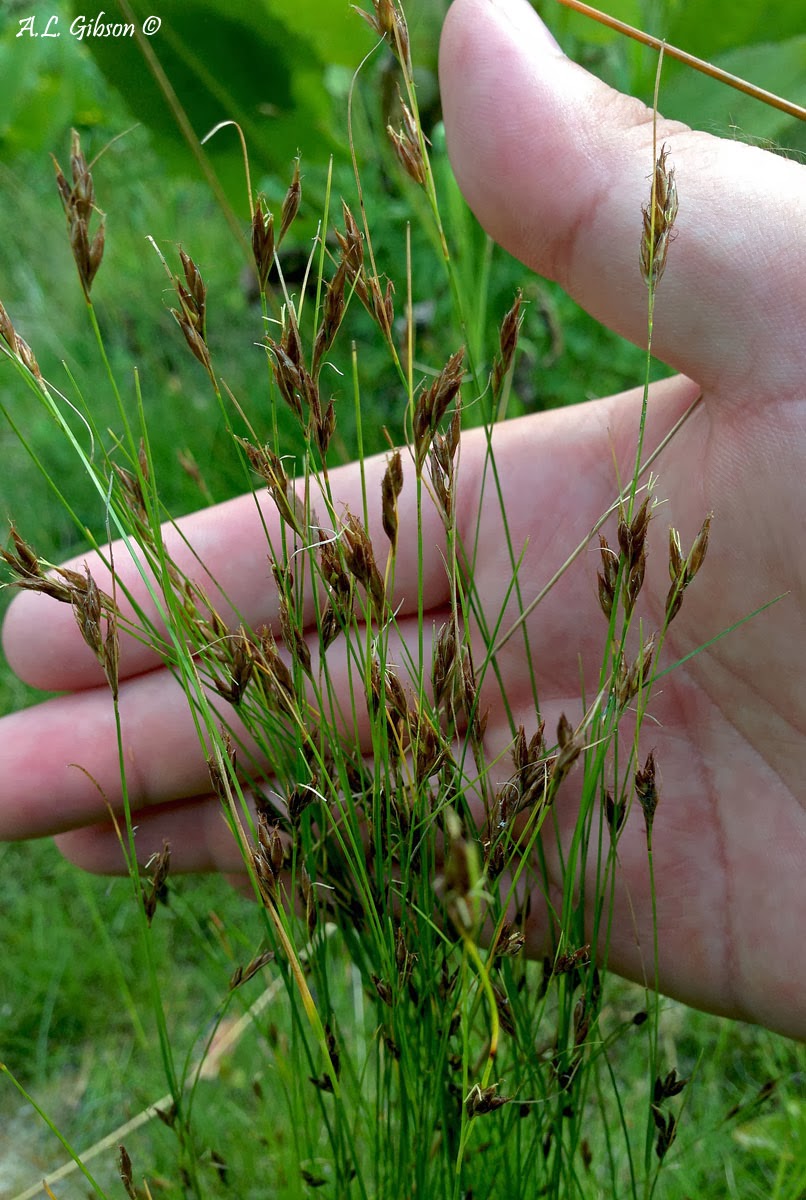
Sedges. The mere mention of this monocotyledonous group can make even the most enthusiastic of plant lovers furrow their brow. That comes as no surprise as the complexity and excruciatingly similar characteristics of the family is well known and subsequently shunned by some. They typically aren't for botanical greenhorns but can quickly become a fevered obsession to some. Don't fear though! This post is geared towards the artistic and aesthetic aspect of the family and its respective genera/species with some basic information. I don't want to overdue it and drown my readers in a deep treatment full of botanical jargon and drool-inducing paragraphs; even if it sounds like fun to me! I'm one of the aforementioned folks with the hots for this family.
 |
| Carex sartwellii among the Virginia irises in a west-central Ohio fen meadow |
The
Cyperaceae family is arguably the largest (grasses in the
Poaceae could have more, I've never counted and compared) in Ohio with 250+ species in 15-16 different genera. Sedges come in all shapes and sizes. Some are so minute you need a hand lens to accurately inspect the plant, while others can be taller than you and/or occur in large, sprawling colonies. Despite many species appearing very similar, they all display a unique and sometimes fascinating arrangement, look, and/or feel to them. Many species are downright beautiful and architectural works of wonder as you'll soon see. Fair warning: most sedges don't have common names and only go by their Latin botanical names. If all else fails, just glance at the photos and admire these all-too-frequently overlooked plants!
 |
| Carex communis flowering in the early spring |
The largest and most diverse of the
Cyperaceae's genera are the true sedges from the
Carex genus. Ohio is home to over 160 different species and account for a nice chunk of our botanical biodiversity. The photograph above shows the delicate pollen-laden staminate (male) flowers and the clear, thread-like pistillate (female) flowers on the flowering culms of
Carex communis in early spring.
 |
| Display of associate sedge species from a calcareous fen meadow |
All
Carex have three-ranked (triangular) leaves/culms and their achenes (seeds) each individually encased in a papery sack called a perigynium (perigynia plural). the perigynia make up the spikelet (fruit) and are hands down the most attention-grabbing part of a sedge. Above is a lineup of some
Carex species typically found in west-central Ohio's calcareous fen meadows. From left to right:
C. stricta,
C. buxbaumii,
C. viridula,
C. sterilis,
C. flava,
C. leptalea,
C. suberecta, and
C. hystericina.
Next are a handful of different
Carex species I find visually appealing and worth an extra look at. Admittedly, they also happen to be some of the species I've managed to remember to photograph. With so many wildflowers and trees around, it's sometimes hard to focus your lens on such small botanical bounties.
 |
| Carex grayi |
 |
| Carex lurida |
 |
| From R to L: Carex frankii, C. crus-corvi, C. lupulina, C. lupuliformis, C. grayi, C. comosa, and C. crinita |
 |
| Carex hyalinolepis |
 |
| Carex utriculata |
 |
| Carex buxbaumii |
Of all of Ohio's indigenous sedges, this one may be my favorite. Buxbaum's sedge (
C. buxbaumii) has perigynia of a spectacularly distinct green color that is contrasted brilliantly by its dark pistillate scales. This uncommon species is most frequently found in Ohio's calcareous fen meadows but also occurs in marshes, wet flatwoods, and other wet, open habitats.
 |
| Carex squarrosa |
 |
| Carex aurea |
An interesting note about
Carex aurea (pictured above right), is the fact its achenes are edible and have somewhat of a nutty taste to them. I gave it a try after snapping the picture above with my iPhone and wasn't displeased at their taste. Not too bad!
 |
| Comparison between C. comosa on L and C. pseduocyperus on R |
An example of two similar species can be seen above with
C. comosa on the left and the very rare, state-endangered
C. pseudocyperus on the right. Careful examination and measurement of the perigynia and their beaks is essential in this particular case!
 |
| Sea of Carex intumescens growing in the deep shade of a wet, acidic flatwoods in southwestern Ohio. |
Now it's time to move away from the diverse
Carex genus and explore a number of other genera in the
Cyperaceae family and some of their representative species.
 |
| Browning clump of woolgrass (Scirpus cyperinus) growing alongside a pond. |
The
Scirpus (bulrushes) genus is represented by eight species in Ohio, with the photographed woolgrass (
Scirpus cyperinus) being one of the most frequent species. Bulrushes are vital food sources for waterfowl and other aquatic critters. The bulrushes tend to be the largest/tallest of the
Cyperaceae members as well.
 |
| Eleocharis obtusa |
Eleocharis (spike rushes) is a diverse and notoriously difficult genus that requires careful study of their tiny achenes and other inconspicuous characteristics to identify them down to species level. Spike rushes have small terminal spikelets and culms with extremely reduced leaves (blades often absent). There are 16 taxa native to Ohio with many being rather rare, or at least overlooked.
 |
| Rhynchospora capillacea |
 |
| Rhynchospora capitellata |
Rhynchospora (beak rushes) are named for the tiny "beak" or tubercle that caps each achene in this genus. Their spikelets occur terminally and are arranged in glomerules, or compacted clusters. Here in Ohio we only have a handful of species (including the two photographed above) but further to the south/east this genus is represented by dozens of species.
 |
| Eriophorum viridicarinatum |
Eriophorum (cotton grass) is one of the most immediately-recognizable and distinguishable
Cyperaceae genera for its woolly perianth bristles that are quick to catch the eye. Unlike the aforementioned
Rhynchospora genus whose range is primarily in the southeast; this genus is predominately found in the boreal north's fens and bogs. Ohio is home to only three species and all three are quite rare in their limited distribution.
 |
| Cladium mariscoides |
Cladium (twig rush) is a small genus of only three North American species and only one member in Ohio. Our sole species,
C. mariscoides occurs in calcareous fen meadows, marly mud flats, and marshy shorelines. A relative of our twig rush,
C. mariscus in the south is known as sawgrass for its hard, serrated edges that can easily slice open mammalian skin.
 |
| Schoenoplectus purshianus |
 |
| Schoenoplectus saximontanus |
Schoenoplectus (naked-stemmed bulrushes) is a relatively new genus split out from
Scirpus and still goes by the common name of bulrush. This genus has species that can be have either triangular or round stems in cross-section; which can cause for some confusion. However, its small, clustered spikelets accompanied with an erect, non-leafy proximal bract (looks like a continuation of the stem) can help them stand out.
 |
| Scleria triglomerata |
Scleria (nutrushes) might be my favorite genus out of all the
Cyperaceae. There are only four species to be found in Ohio but their very artistic achenes definitely set them apart. The achenes turn bleach white when mature and have a unique pattern and/or combination of characters that help identify them to the species level. I definitely plan to delve into our state's four taxa in their own dedicated post in the near future.
 |
| Dulichium arundinaceum |
Dulichium (three-way sedge) is a monotypic genus, meaning only one species (
D. arundinaceum) represents the entire genus. This unique plant does an excellent job of displaying the three-ranked leaves trait when looking straight down from above. The thin, needle-like structures are this species' achene-bearing spikelets. It occurs sporadically throughout the state in wet-moist, open soiled situations.
 |
| Lipocarpha drummondii |
Lipocarpha (dwarf bulrush, halfchaff sedge) is one of the most dainty and unique of the
Cyperaceae genera in Ohio. Only two species occur in our state and both are extremely rare and only occur in a few places. The plants are small, densely tufted annuals with very thin culms that bear equally small spikelets near the apex. Keep an eye out for this genus in northwest Ohio's flat, sparsely-vegetated sand plains and swales.
 |
| Trichophorum alpinus |
Trichophorum (club rush) is a weird but charming genus that physically looks very similar to the spike rushes (
Eleocharis) with a single, small, and terminal spikelet; however
Trichophorum spp. culms have reduced, but noticeable leaf blades. This particular species,
T. alpinum pictured does not occur in Ohio but has the added bonus of perianth bristles reminiscent of the cotton grasses (
Eriophorum); which this species is sometimes placed in. In Ohio, we only have a single species found in upland, dry oak forests called
T. planifolium.
 |
| the native annual Kyllinga pumila (L) sitting next to the invasive, non-native and rhizomatous K. gracillima |
Kyllinga (greenhead-sedge, spike sedge) is last but certainly not least. This often overlooked and diminutive native sedge is quite charming and handsome in its own right. Our native species,
K. pumila is an annual with a fibrous root system (seen on left above) and can easily be told apart from the newly-invading, non-native Asian species,
K. gracillima, which is a perennial with a rhizomatous habitat.
There are a handful of genera I currently do not have photographs of (
Bolboscheonus, Bulbostylis, Cyperus, and
Fimbristylis) that I hope to add to this post sometime in the future. If anything, I hope you've discovered that between the diversity and difficulty of this family, there is an awful lot of beauty. You only have to look a little harder, sometimes with the aid of a hand lens to see it!