Showing posts with label Carex crus-corvi. Show all posts

Friday, September 20, 2013

Rare Sedge Discovery at Lawrence Woods

My job this summer with the Ohio Division of Natural Areas and Preserves (DNAP) allowed your blogger the pleasure of visiting and working in nearly 50 of our fine state's nature preserves, state parks, state forests, and metroparks.  Each and every one was unique and special in its own way with some being unequaled in the rest of the state.  I could easily spend all fall and winter writing and sharing many of my adventures from the past few months (and plan to!).  It's a shame so many people fail to see the charm and splendor of Ohio's natural landscape and think of us as a flat, boring hunk of real estate.  Few things could be further from the truth!

Lawrence Woods state nature preserve in southern Hardin county

One of those unrivaled gems I spent a number of hot, muggy, and buggy days in was Lawrence Woods state nature preserve in southern Hardin county.  This nearly pristine, somewhat old-growth woodland has a mixture of different forest types ranging from drier oak-hickory to inundated buttonbush swamp and tops out at over 1,000 acres in size.  Huge, ancient bur, red, white, and chinkapin oaks tower into the emerald canopy with beech, ash, maple, and hickory mixed in with impressive specimens as well.  Perhaps the most precious denizen of this sprawling wet woods is the state's largest population of the endangered and very rare heart-leaved plantain (Platango cordata); which also happens to grow intermixed with the largest population of the uncommon northern tubercled orchid (Platanthera flava var. herbiola) I've ever seen.

Northern Leopard Frog

It's not just the flora that is worthy of attention but the diversity of fauna as well.  White-tailed deer, wild turkey, fox squirrels, dozens and dozens of species of nesting birds, and plenty of amphibians call this large tract of mixed forest types home.  This gorgeous northern leopard frog is just one example of the wildlife waiting for those willing to enter its dim, mosquito-filled depths.

Swamp Rose (Rosa palustris)

However, this particular time I was there with sedges on my mind.  In a select spot near the southern edge of the preserve sits a low-lying, swampy area full of a rather scarce and unusual member of the Cpyeraceae family.

Inundated swamp forest full of the rare raven's foot sedge (Carex crus-corvi)

This summer's fortune of rain had the ground inundated with about a foot of water and in prime condition for the rarity I had my eyes set on finding.  Pin oak, swamp white oak, green ash, and red maple of various sizes abounded with a scattering of swamp rose (Rosa palustris), buttonbush (Cephalanthus occidentalis), and swamp dogwood (Cornus obliqua) growing out of the saturated, mucky soil.
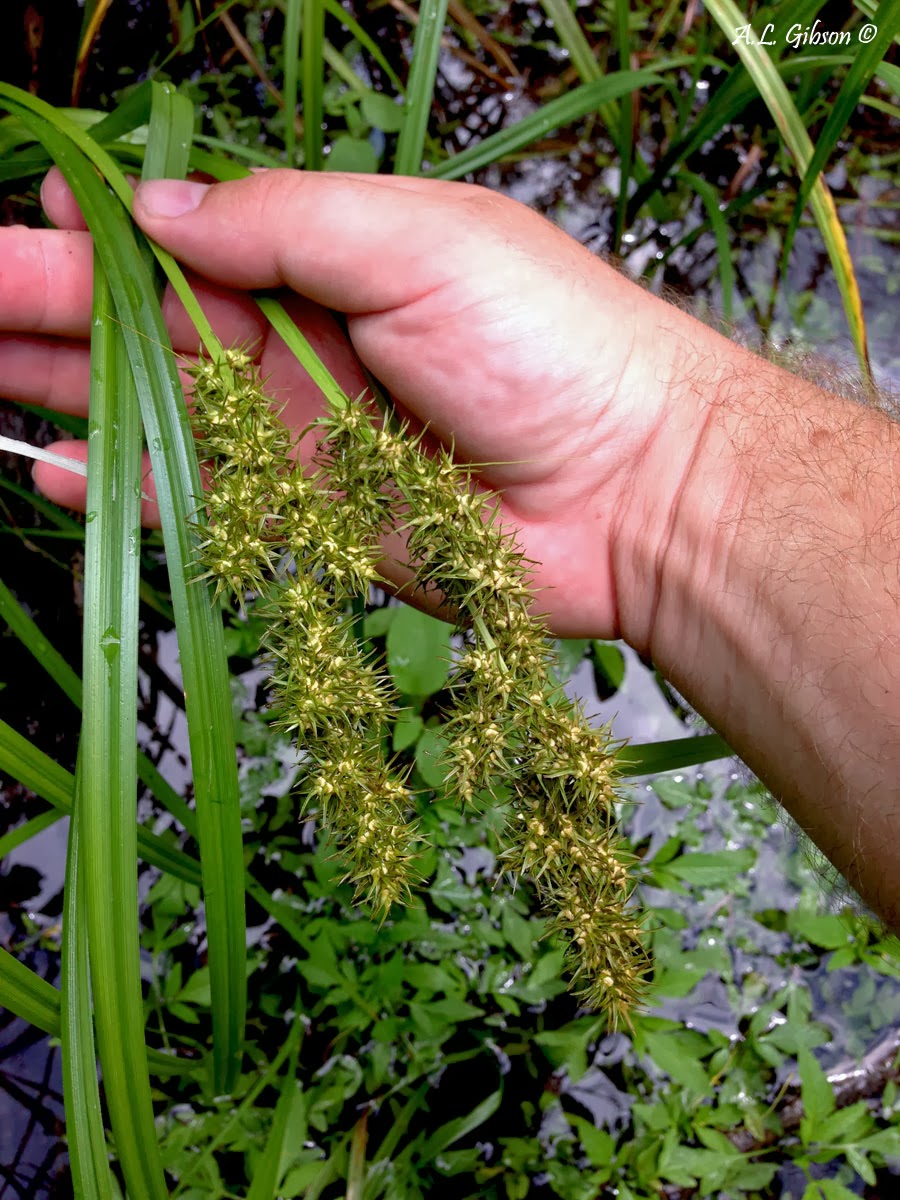
Raven's Foot Sedge (Carex crus-corvi)


It didn't take too long to spot the long, spiky fruit clusters of the state-threatened raven's foot sedge (Carex crus-corvi) growing in large, dense clumps throughout the water-logged swamp forest.  Of the 160+ species of Carex in Ohio, I think this one could take the cake for being the most conspicuous and attention-grabbing.  It almost looks like a flail-like weapon from medieval times to me!

An intriguing, suspicious sedge among the wetland plants

As I continued to wade through the water, keeping a census count of each clump of Carex crus-corvi I came across, I noticed an intriguing and suspicious looking sedge that just didn't look quite right.  The other typical sedges were there: C. frankii, C. crinita, C. lupulina, and C. comosa respectively; but this one just seemed to stand out.

A closer look at the suspicious sedge

It certainly looked similar to the abundant hop sedge (C. lupulina) growing throughout the swamp but its narrower, more elongated perigynia clusters and lime-green color had me scratching my head if this could indeed be the rare and painfully similar false hop sedge (C. lupuliformis).  In a flurry of excitement and suspicion, I plucked a perigynium off the cluster and ripped open the inflated, papery bladder to unveil the achene (seed); the best and most consistent way to differentiate the two species.

Carex lupuliformis perigynia and achene (L) compared to the same of C. lupulina (R)

What I was hoping to see was the mature achenes of the mystery sedge have conspicuous and clearly-defined knobby, pointy protuberances (umbonate in nerdy Latin talk) on the sides of the seed.  As luck would have it, the achenes showed off the desired trait beautifully and confirmed its identity as Carex lupuliformis.  In the photograph above you can see side-by-side comparisons of both the fruiting structures and individual achenes of C. lupuliformis on the left and C. lupulina on the right.  Notice the knobby protrusions on the C. lupuliformis achenes (creating an almost diamond outline) while C. lupulina has more rounded and elongated achenes.

Even better was the realization that this rare sedge had never been recorded for Lawrence Woods or Hardin county.  Another rare sedge find is always a great way to spend a day out in the field!  I collected a few specimens for pressing and after finishing my survey of the now two rare sedges growing under the oaks and ash, made the long trek back to my car with a satisfied smile on my face.  Not even the hoard of mosquitoes above my head and the ounce or two of blood I lost to their tenacious nature could break the happy mood I was in.  Serendipitous finds like these are always the cherry on top to any field botanist's work!

From L to R: C. frankii, C. crus-corvi, C. lupulina, C. lupuliformis, C. grayi, C. comosa, and C. crinita

Lawrence Wood's size and wonderfully intact and diverse plant communities certainly hold more secrets and surprises to find, I have little doubt about that.  With more exploration and time who knows what other goodies could be lying in wait.  I know I'll be back for more in the coming months and years; it's just the kind of place that's hard to stay away from for all the right reasons.

Friday, June 21, 2013

St. Marys River Wetlands

Last week I had the pleasure of having my job take me up to an area in northern Mercer county known as the St. Marys River wetlands.  It's slated to be dedicated sometime this summer as Ohio's newest state nature preserve; a very fitting and deserving recognition as I would come to find out!

Aerial view of the preserved wetlands via Google Maps

Being a botanist for the Ohio Division of Natural Areas and Preserves (DNAP) has opened the door to many of our state's most unique and interesting ecosystems and habitats and this place was no different.  Within the 69 acres of the preserve is river frontage, riparian floodplain forest, and adjacent flat woods with an abandoned river channel and accompanying button bush swamp.  Naturally, with that kind of territory comes mosquitoes and boy were they thick!  In the sections of the swamp woods with standing water it become necessary to breathe through your nose.  Trying to breathe with your mouth only resulted in the inhaling, and subsequent choking on the blood-sucking nuisances.

In the aerial photo above you can make out the standing pools of water in the old river channel as the darker botches and the St. Marys river itself as the northern border of the preserve.  It's incredible this riparian community stills exists today when you see the surrounding sea of agriculture.  Mercer county isn't exactly known as a nature-friendly area with some of the most heavily-farmed land in this section of the state.  That makes this preserve all the more valuable and worth protecting!

Panoramic view of the swamp flat woods full of sedges and other botanical goodies

Joining me that day was Ohio's chief botanist Rick Gardner and a number of other DNAP employees and volunteers with our task to update a couple rare plant records and continue a biological inventory of the preserve.  Being on the job, I never take my camera gear with me into the field so I make due with my iPhone's camera, of which all these shots were taken on.  I'm consistently impressed with its capabilities and good quality captures.

Canada anenome - Anenome canadensis

One of the first things to grab our attentions was a lovely display of Canada anenome (Anenome canadensis) in full flower on the edges of the forest.  This plant is sometimes used in cultivation for its fast-spreading ground cover foliage and lovely white flowers.  Just be sure to keep an eye on it as its aggressive rhizomes can and will quickly take over an area.

Carex muskingumensis
Carex grayi


For the sedge-loving members of the group like Rick, who is an expert in this intimidating and tricky group, and I, the preserve was heaven on earth.  Being a high-quality wetlands it should come as no surprise that the sedge diversity would be quite large.  Music to my ears!  Even better was the amount of personal favorites that called the swamp woods home such as: Carex grayi, C. crus-corvi, C. muskingumensis, C. typhina, C. squarrosa, C. lacustris, and C. lupulina.


Raven's Foot Sedge - Carex crus-corvi

In fact, one of the main reasons we were there was to check up on and update the occurrence of the state-listed raven's foot sedge (Carex crus-corvi).  Its gorgeous, large fruiting heads full of sharply pointed perigynia accompanied with the blue-green foliage weren't too hard to notice walking through the sea of other sedges and vegetation.  This particular sedge is threatened in the state of Ohio and only occurs in a handful of counties in high-quality swamps and floodplain woodlands.

Virginia Iris - Iris virginica

Beauty is certainly in the eye of the beholder and while I find the raven's foot sedge to be absolutely stunning, I think most others would be more interested in these flowering monocots instead.  Scattered throughout the open understory was the delicate and short-lived Virginia iris (Iris virginica) that certainly stood out against the surrounding greens.

Green Carrion-flower - Smilax pulverulenta

Despite being arguably the least-attractive of our finds that day, this species was hands down the most meaningful and exciting of them all.  After some careful examination and consideration it was decided (and later confirmed) this is the incredibly rare green carrion-flower (Smilax pulverulenta); an endangered species in Ohio and one with a confusing history in our state.  Of the eight species of Smilax native to Ohio, three are woody, spined perennials (e.g. S. rotundifolia, hispida, and glauca) and the most frequently encountered while the remaining five are more uncommon and herbaceous annuals that lack prickles/spines.  The latter group can be confusing and hard to tell apart with tedious differences.

Previously S. pulverulenta was a variety of S. herbacea along with S. lacioneura before both were given full species status.  S. pulverulenta can be differentiated from S. lacioneura (which was present in the area as well) by its lustrous, abaxially dark green leaves; hemispheric (one-sided) flower umbels; and black, non-glaucous mature fruit. Our specimen showed all these signs except for the mature fruit since the plant was still flowering.  Rick mentioned all the specimens in Ohio's herbaria labeled S. pulverulenta were mis-identified and were actually S. lacioneura; meaning as far as he or anyone else knew, this lone plant in front of us was the only known and confirmed site and specimen of the green carrion-flower in the state.  Pretty darn cool if you ask me!

Rough-Leaved Dogwood - Cornus drummondii

Ok, enough of the botanical jargon and nerd talk; even if I could go on and on.  A frequent shrub and/or small tree of the open swamp understory in full bloom was the rough-leaved dogwood (Cornus drummondii).  It certainly blends in with the half dozen or so other thicket-forming, shrubby dogwood species outside the obvious and more-showy flowering dogwood (C. florida) but with a quick touch it's not too hard to tell apart.  The top and bottom surfaces of the leaves have a scratchy, rough feel to them (hence the name) from their dense covering of wooly, rough hairs.  This species also has very showy white berries on red pedicels come late summer and autumn.

Baby bowfin (or dogfish) found in the shallow standing pools of water

After our exciting botanical discovery I suppose it's only appropriate we make another one; only this time it was of the ichthyological kind!  As our group passed through the area of the abandoned river channel, we took notice of the water 'boiling' with hundreds of little fish in the shallow waters of the buttonbush pools.  Rick scooped out the little fellow pictured above and we all scratched our heads at its identity.  As it turned out it was a baby bowfin (Amia calva), the sole surviving species of an ancient order of long extinct fish!  Also known as dogfish, the bowfins were a very unexpected surprise that caught all of us off guard.  I would assume a heavy flooding event isolated the adults from the main channel of the St Marys river into the swamp forest's pools sometime in the past.  We did observe large fish swimming around further out in the water but assumed they were carp but looking back now I believe them to have been adult bowfins!  How else would there have been so many fingerlings?

American Sweet Flag - Acorus americanus

Walking past the sunnier margins of a swamp woods or marshy area many would probably see this plant and pass right by thinking they were simply cattails.  How wrong they would be and why taking a closer look is never a bad idea!  This is the rare American sweet flag (Acorus americanus); a species of concern in Ohio that grows in scattered wetlands throughout the northern half of the state.  It can be told apart from the much more common introduced European species (A. calamus) by looking at the veins in the leaves and flowering/fruiting material.  Our native species has a raised midvein plus an additional two or so more raised veins, while the European species only has a single, obvious raised midvein.  The American species is also a fertile, flowering diploid versus the sterile triploid Europen taxa.

From L to R: Carex lupulina, C. squarrosa, C. lacustris, C. crus-corvi, C. typhina, and C. muskingumensis

All in all, I left the St. Marys River Wetlands very impressed with its botanical diversity, intact and pristine swamp forest habitat, and of course all the sedges!  I'm very thankful this gem of a place is in good hands and will see a long future of protection and management for myself and future generations to enjoy and hike through; if they aren't drained dry by all the mosquitoes that is haha.  I'd certainly like to visit at other times of the year to see what goodies and secrets this place still has to share.  Once dedicated and open to the public, I highly recommend getting out and experiencing its charm and sights for yourself!