As I continue to brainstorm, write and work on future posts for the upcoming year I would like to take some time to reminisce on a number of my favorite experiences from 2011. There was hardly a shortage of excitement and feelings of euphoria at any point and every month had a special memory to share. I encourage you to scroll down through the corresponding photos and synopsis' and clink the links provided to read the specifics of each adventure. Some posts you may remember while others may be getting your attention for the first time but each possesses a special moment in time and space in my heart and mind. I hope you enjoy this look back at what a memorable and exhilarating year 2011 was!
 |
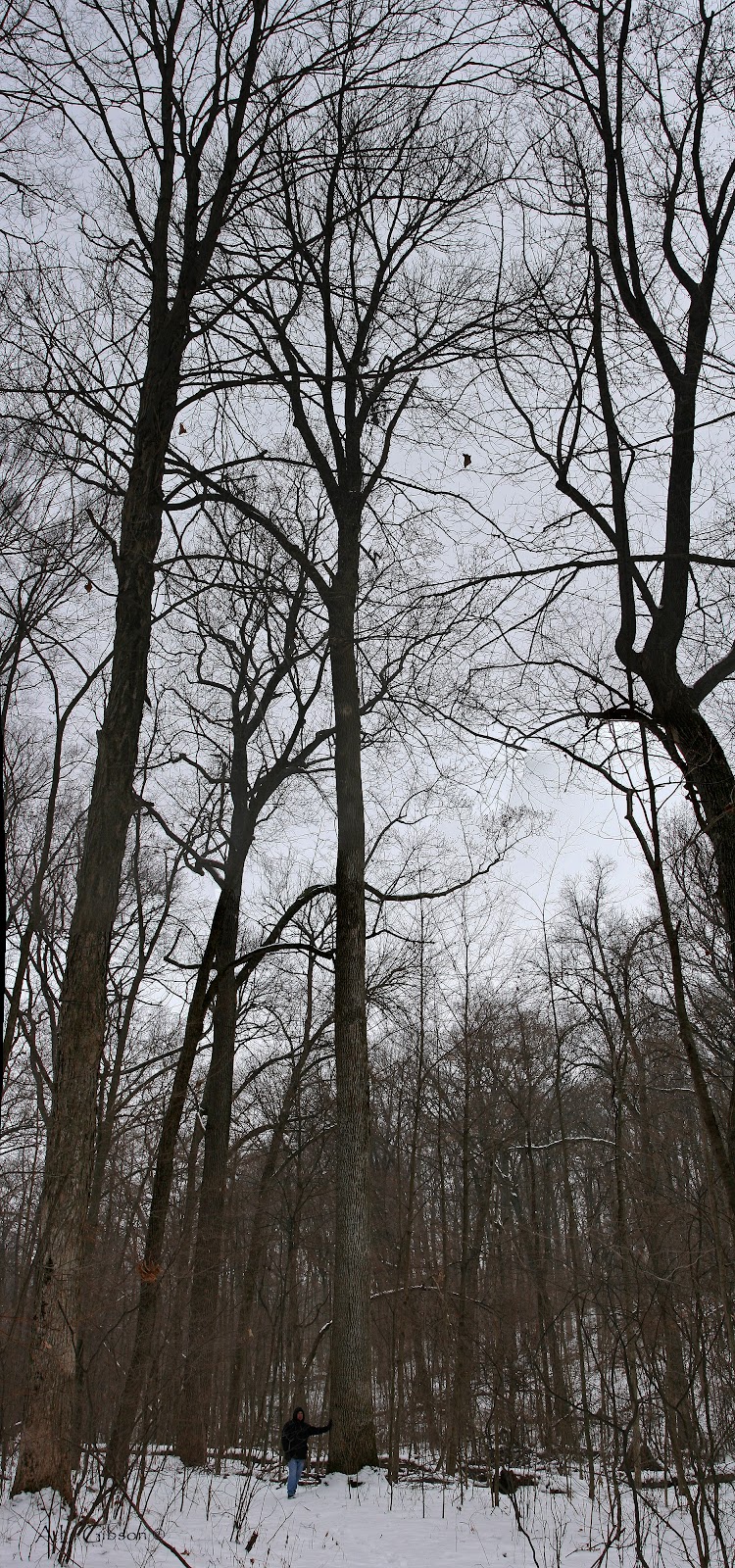
| A grove of old-growth Tulip-poplars in Davey Woods nature preserve |
JANUARY brought in 2011 with plenty of snow, ice and frigid temperatures to my home state of Ohio. I can remember snow being on the ground from the beginning of December all the way to the end of February. Despite the low temperatures I could not resist getting out into the snow to explore one of my favorite ecosystems. Old-growth forests are an incredible experience 365 days out of the year but to get the best grasp on their detail and magnificence one needs to see them in their winter state. Davey Woods nature preserve outside Urbana, Ohio is a close-to-home answer for myself and worth a trip from any corner in Ohio. Above you can see your blogger's father standing with a grove of large Tuliptrees within the preserve. You can read more about our walk through this old-growth wonderland by clicking this link here.
 |
| Skunk Cabbage (Symplocarpus foetidus) emerging in a swamp woods |
As the snow continued to fall and the temperatures kept their bitter grip on into FEBRUARY my mind began to crack under the weight of winter. I knew if I could just hold on for a few more weeks my botanically-deprived mind would be rewarded with the annual blooming of Ohio's first native wildflower. In the last week of February I made my yearly pilgrimage to a swamp woods not too far away from my home to witness the Skunk Cabbage's (Symplocarpus foetidus) emergence from their winter slumber. Being the first species to bloom is not the only cool thing these fascinating plants are known for. If interested in learning more about these fowl-smelling blossoms click this link here!
 |
| State-endangered Goldenstar-lily (Erythronium rostratum) |
Finally! MARCH arrived and the botanical floodgates started to open, releasing their bounty of beauty and color back into the natural world. All the old faces and cherished favorites began to awaken and bloom as the sun ever waxed in the sky above their heads. Trout-lilies (Erythronium spp.), Bloodroot (Sanguinaria canadensis), Hepaticas (Hepatica spp.) and even the Snow Trillium (Trillium nivale) greeted 2011 in a glorious display that could not have come any sooner. The best waited until last with the stunning and surprising discovery of the state-endangered Goldenstar-lily (Erythronium rostratum) on the Edge of Appalachia preserve. Only known from one locality in Ohio, this marks the first time this remarkable spring ephemeral had ever been found outside the Rocky Fork area. I could not believe my luck on being there on the day and moment of discovery and documented the occasion which can be read right here! Easily one of the top moments of the year!
 |
| Tribbett Woods nature preserve |
The discovery of the Goldenstar-lily was certainly one amazing way to launch into 2011 and by APRIL I was already in full-swing as mother nature continued to awaken in greater diversity and detail. On an incredible warm and sunny day in early April, my botanical mentor and dear friend Dan Boone and I decided to pay a visit to southeastern Indiana to see some early spring flora and explore a rare and breathtaking old-growth wet flatwoods. Tribbett Woods ended up being one of the most exceptionally undisturbed and impressive old-growth forests I'd ever stepped foot in. Enormous Beech, Sweetgun and Swamp Chestnut Oak trees towered well over 100 feet above my head as their canopies danced in the wind. To see some of the most impressive trees you're likely to ever see in such a unique forest community be sure to check the post out right here.
 |
| Male Black and White Warbler perched in a Sycamore tree |
April and the other months of spring are not only cherished by myself and other like-minded individuals for the return of the plants and wildflowers but the migrating birds as well! While my passion is clearly devoted mostly to the flora of our world I still consider myself a well-rounded naturalist with numerous loves to accompany my plants. Birds are one of those 'other loves' and I had a delightful time this spring watching and photographing as many of my winged friends as I could, especially the warblers. If you'd like to get to know a couple of our most colorful species then head on over here!
The days begin to grow longer come MAY as the birds began to sing and couple, the leaves unfurl to cover the tree's naked canopies and most importantly to me the orchids begin to wake up! If you are even a semi-regular reader of this blog you know my deep-rooted love for our native orchids never runs thin on here. I attended Flora Quest on the first weekend of May and was overwhelmed with orchids, irises and other rare plants in Adams and Scioto counties. Be sure to check out the Flora Quest webpage to get information on how to sign up for this year!
 |
| Kentucky Lady's-slippers (Cypripedium kentuckiense) |
None of the orchids intrigue me more or make my heart beat faster than the lady-slippers (Cypripedium spp.). I made it a goal in 2011 to see if I could find, photograph and enjoy all the eastern Cypripedium species and varieties of North America and had the pleasure to start with the one above (I did end up achieving that goal!). The Kentucky Lady's slipper (Cypripedium kentuckiense) stole my heart and the show in early May as I traveled to Lewis county, Kentucky in search of them. To read more about this fascinating orchid and see more photographs jump over to this page. If you love orchids even half as much as I do check out one of my other favorite posts regarding my time with the Small White Lady's slippers as well!
 |
| Aqua waters of Lake Huron on the Bruce peninsula, Ontario, Canada |
If May was a tornado of botanical activity and excitement then JUNE was a category five hurricane! More happened in June than I could ever even begin to retell but it climaxed with my road trip and week-long stay on the botanical and geological wonder world of the Bruce Peninsula. I had dreamed for years of experiencing the ancient cedar forests, alvars, fens and sheer limestone cliffs overlooking the gorgeous blue hues of the Georgian Bay and it exceeded every expectation tenfold! You can find the first half of my road trip and time on the Bruce HERE, HERE and HERE. This was truly the trip and experience of a lifetime and one I will cherish until my last breath. I plan on finishing up the next set of posts to complete this saga in the next month or so stay tuned!
 |
| Eastern Prairie Fringed orchid (Platanthera leucophaea) |
I could never close the book on June without re-sharing probably the greatest single-moment experience of 2011 with you. Not even an hour after I returned home from Canada and I was back on the road to see something I had dreamed of seeing more than just about anything else. In a wet meadow somewhere in Clark county, Ohio the federally threatened Eastern Prairie Fringed orchid (Platanthera leucophaea) was in perfect bloom and beckoned me to come pay it a once-in-a-lifetime visit. I do my best to instill feelings of emotion and excitement in all my posts but I feel like non had the charge of this one on the Eastern Prairie Fringed orchid. Enjoy!
 |
| Michigan Monkeyflower (Mimulus michiganensis) |
June melted into JULY and the prairies and fens began to come to life as as the warm-season grasses and accompanying wildflowers display their colors and charm. However, it was my week-long annual summer vacation to Leelanau county, Michigan with the family that took the honor for best July moment in botany. I had long heard of a mysterious and globally rare wildflower that graced the secretive shorelines of Glen Lake and a select few other places in this area of Michigan and decided it was time to make its acquaintance. With some help from a local botany professor I was turned onto one of the very few remaining populations of this mega-rarity, the Michigan Monkeyflower (Mimulus michiganensis). If you have an affinity or taste for the interesting and rare then I highly encourage you to read the post dedicated to the daily battle this federally endangered curiosity has to bear by clicking right here!
 |
| Three-birds Orchid (Triphora trianthophora) in perfect bloom |
It just wouldn't be a normal post if I didn't include a bit more focus on my orchid favorites now would it? Once the calender hits AUGUST it was time to start checking on the secretive and fickle populations of one of Ohio's most intriguing of plants. The Three-birds orchid (Triphora trianthophora) is a thing of beauty and nature's perfection. These truly are more finicky and tricky to catch in sublime bloom than almost any other plant in Ohio. A million thanks still goes out to Cheryl Harner who kept me in the loop on these plants and shared them with me when they couldn't have been any better! Truly a day worth reading about by following this link!
 |
| Yellow Fringed Orchid (Platanthera ciliaris) |
Speaking of August and orchids, if you want to see some of the most photogenic species of wildflowers Kentucky has to offer than I would love to point you in the direction of my post on four species of Platanthera orchids in the humid confines of southern Kenutcky!
 |
| Big Bluestem (Andropogon gerardii) in an Adams county prairie |
Gradually the humidity softens and the winds begin to cool as fall approached Ohio. SEPTEMBER is one of my favorite times of the year as it means football is back (even if my Ohio State Buckeyes and Indianapolis Colts had quite sub-par seasons worth forgetting...) and the leaves will soon be changing. September also brings a flux of special flora into the prairies, fens, fields and meadows. I spent much of my sun-waned days exploring Ohio's prairie and fen ecosystems. The feel of the drying grasses on my bare skin and the breeze on my face all mixed with that distinct blue hue to the sky makes for an infinite supply of intrinsic moments come this time of year, as fleeting as it is. I started a series on these fascinating places and plants with the bluegrass region and prairies openings of Adams county, Ohio. Look for the remainder posts to be published in the future!
 |
| Lesser Fringed Gentian (Gentianopsis virgata) |
Seemingly as quickly as they came the flame orange and reddened leaves fell from the trees and the sunlight begun to hang low in the sky as OCTOBER and NOVEMBER arrived. The time of the flowering plants was once again coming to an end and another exciting season was expiring. Of course, there is one last gasp of color and life before the end as select fens show off their end-of-the-year fireworks display of blue. The Lesser Fringed Gentians (Gentianopsis virgata) are a sight to behold as the sun's low rays catch their fringed petals just right to enhance their vivid blues. Although, they too faded into oblivion as winter's chill once again hung in the air and I found myself bound in patience and anticipation for spring 2012...
I hope you enjoyed this look back on 2011 and that all of you had a very happy holiday season and an even better new years! Here's to 2012 and the natural treasures of Ohio and beyond that I will be sharing with you! Happy New Year!