Showing posts with label Orchid. Show all posts

Monday, July 1, 2013

A Rare Orchid on the Prairies

Late June.  When the heightened humidity begins to make your clothes stick and the hum of annual cicadas rings in your ears; when the sun seems to hang motionless in the western sky and the raspberries are just about ripe, I know it's time to make my annual pilgrimage to a very special slice of Ohio.

E. Prairie Fringed Orchid (Platanthera leucophaea)

In a wet sedge meadow that seems no different than the rest but for a few short weeks each summer lives one of North America's most rare and spectacular of orchids: the eastern prairie fringed orchid (Platanthera leucophaea). I've posted on this site and species in years past but it deserves a breath of fresh air and some more attention as one of your blogger's most treasured of plants.

Lone orchid among the sea of sedges, forbs, and willows

In the past few years a few willow species (Salix discolor, S. eriocephala, and S. interior) have aggressively invaded and taken over the previously woody-free meadow.  This added competition combined with the stress from heat and drought of summers past had the prairie fringed orchids bloom much less vigorously than in previous seasons.  What two years ago was a profusion of blooming orchids, this section had only one flowering plant that I could locate.

E. Prairie Fringed Orchid (Platanthera leucophaea)

That being said there was still quite a few specimens in stupendous shape if you knew where to look.  Finding and enjoying their beauty pre-settlement wouldn't have been too hard a task throughout the fen and wet prairie regions of Ohio and the mid west/great lake states.  Being a life long fan of Big Ten football and basketball, I nicknamed this the "Big Ten orchid" for almost its entire geographical range occurring within states that are home to a conference's campus.

Closer look at their charming individual flowers

Within its wet prairie/meadow/marsh, fen, and shoreline habitats, prairie fringed orchid can grow upwards of four feet tall and contain well over 20 greenish-cream flowers spiraled around its stalk.  Each individual flower is about the size of a quarter and has its lower lip (labellum) deeply cut in a fringed fashion; almost as if the wind had shred and tattered tissue paper.  Their scent is light and faintly detectable by day but intensifies at night when its hawk and sphinx moth pollinators are most active and in the hunt for a nectar snack.

Handful of orchids peaking out above the sedges and grasses

I could witness these wondrous summer rarities every summer for the next 50 years and each meeting would be as precious and held dear as the last.  For your blogger nothing beats the sight of the prairie fringed orchids dancing in the warm summer breezes and their cream, waxy flowers gleaming in the sunlight.  There's little comparable to seeing their conspicuous wands contrasted against the surrounding green vegetation and brilliant sapphire sky.

A lovely pair of prairie fringed orchids

It may be hard to believe but the plant on the left in the photograph above could very well be older than I am. Fred Case, a brilliant botanist and master of North America's orchids recorded some plants eclipsing 30 years in age as an individual.  That's a lot of time, energy, and luck that has gone into an orchid that has evaded and escaped drought, flood, disease, browsing, and any kind of negative habitat change.  Just another reason to respect and appreciate these orchids not just for their looks but for their brawn as well.

E. Prairie Fringed Orchid (Platanthera leucophaea)

One of the more fun aspects to writing and publishing this blog is the opportunity to bring rare and unusual plants and habitats/ecosystems (like the prairie fringed orchid) home to those who cannot see or experience it for themselves.  I do my best to bring these topics and photos to life on your computer monitors and have you travel vicariously into the field with me; especially at sites and places as sensitive and secret as the prairie fringed orchids.

Orchid hiding alongside a spotted joe-pye weed (Eupatoriadelphus maculatus)

It really does seem like just the other day I was alongside these very orchids, admiring their physical charm and ghostly appearance like I am again a year later.  Even more difficult to believe is July is upon us again with so many more wonderful wildflowers and orchids to grace our landscape with their presence.  But you can't have July before you have the prairie fringed orchids knocking on the summer solstice's door once more...

Monday, July 9, 2012

Fate and a Tiny Orchid


A few summers ago I headed out on a seemingly routine hike through one of my favorite areas of Zaleski state forest in Athens county.  Comprised of nearly 27,000 acres, Zaleski is choked full of interesting habitats and flora with a few hidden rarities and surprises within its borders.  The particular spot I decided to explore is a nameless, deep hollow that branches off from a small stream valley and splits two parallel-running ridges; each with its own unique plant communities and diverse species compositions.  I opted to follow a lightly-worn deer path along the upper slopes of the southwest-facing ridge to scout out what summer wildflowers were in bloom and perhaps come across something new.  I'd walked the same expanse of mature deciduous forest many times before and had quickly grown to appreciate and love its undisturbed appearance and peaceful atmosphere.

I slowly weaved my way through the mixed forest of chestnut, black and white oaks, sourwood, serviceberry, and red maple; keeping my eyes carefully peeled for anything out of the ordinary.  The ground was covered in a surprisingly rich mosaic of vegetation accustomed to the xeric and acidic underlying soils.  Reindeer lichen and an assortment of moss species carpeted the ground, cushioning my light footsteps as they fell.  The waning late-afternoon sun filtered through the canopy and dappled the forest floor in intense beams of warm light.  Not even the thick air, heavy with humidity could spoil the tranquility of the place.

I eventually came to notice that one of my boot laces had come undone sometime during the hike and decided to stop and take care of the matter.  I slide my camera equipment off my back and knelt down to re-tie the laces when out of my peripheral vision I noticed an intriguing sprig of green growing  a few feet away in a large patch of moss just at the edge of the rock ledge.  It was quite small, only four or five inches in height but different enough to have caught my eye.  I leaned in closer and with a shocked smile realized I had made quite the fateful discovery.

Green Adder's-Mouth Orchid  -  Malaxis unifolia

That little green sprig turned out to be the relatively rare and minuscule green adder's-mouth orchid (Malaxis unifolia).  I sat back in disbelief at the randomness of the find and couldn't help but ponder the odds of choosing that very spot and moment to fix my laces.  These orchids are already notoriously hard enough to see and locate under the darkened canopy and overgrown ground cover in its early July woodland home, let alone their green color and miniature size.  Not the best of combinations for discovery but the increasing difficulty makes it all the more exciting!

Green Adder's-Mouth Orchid  -  Malaxis unifolia

It may come as little surprise then that this particular orchid is listed as potentially-threatened in Ohio with a limited number of collections and populations throughout the eastern half of the state.  I suspect it could be a lot more common and frequent than current records or knowledge indicates, considering its preferred habitat of dry, acidic mixed deciduous forest is readily available in our state.  Add in its tiny stature, color, and odd blooming time and you have the perfect set up for a vastly overlooked plant.

Each plant rises from a fleshy subterranean corm and produces a single stem topped with a raceme made up of dozens of puny inflorescences gradually maturing and elongating from the terminal cluster.  The scientific epithet of uniflora refers to the single leaf that sheathes the lower half of the stalk.  Despite the numerous individual flowers each plant produces, typically only one or two are successfully pollinated and quickly swell with microscopic seeds.  Looking at the photograph above you can see a single maturing capsule located  along the middle left side of the raceme.

Green Adder's-Mouth Orchid  -  Malaxis unifolia

The green adder's-mouth orchid has the distinction of being Ohio's smallest indigenous species of orchid (in terms of flower size) but that doesn't necessarily translate into little worth or interest.  I find it to be a rather charming and refined species of plant that few are lucky enough to lay eyes on and appreciate first hand.  Next time any of you reading this are hiking in the eastern half of Ohio and find yourself in a dry, acidic mixed oak or upland woods during the mid-summer months keep an eye out for this orchid.  You never know what you may luck into.

In the summers following my initial stumble onto this lone specimen of orchid I have journeyed back each year to get reacquainted with it and spend some more time admiring its unique design and appearance.  I'm happy to report this has been the fourth year in a row it has broken ground and flowered in the same exact spot as year's past.  With a bit of luck this little guy will be around to greet me as an old friend for many summers to come and I can enjoy its company under the mighty oaks and reminisce of our fateful chance encounter on that hot and muggy afternoon in early July...

Thursday, June 7, 2012

The Showy Lady's Slippers of Cedar Bog

Cedar Bog.  Few places in the Midwest, let alone Ohio, have as much botanical wonder, biodiversity, and history stored inside than the white cedar swamp forests, fen sedge meadows, and tall grass prairie habitat here.  Owned and operated by the Ohio Historical Society since 1942, it was the first Ohio nature preserve to be purchased with state monies and is on the national natural landmarks register to boot.  Located in south-central Champagin county, Cedar Bog currently preserves well over 400 acres of original habitat and is home to nearly 100 rare species of flora and fauna.  It's a good thing this gem was saved and preserved because Ohio's intact, naturally-occurring wetlands are a very rare thing today.  Around 90% of Ohio's wetlands no longer exist and are gone forever. From over 5,000,000 acres pre-settlement to just a tiny fraction of that in under 300 years is depressing but that's what makes places like Cedar Bog so precious and vital to our biodiversity.  If you want a fact to really drive the nail home on our wetland habitat loss: California is the only state that has lost a larger percentage of its original wetlands than Ohio.  Click this link here for more on the matter.

Don't be fooled by the name however.  Cedar Bog is not a bog but in fact a fen.  What's the difference?  Bogs are non-flowing acidic environments associated with accumulated masses of sphagnum moss while fens have internal flowing groundwater that seeps to the surface and is usually rich in magnesium and calcium, making for a neutral to alkaline environment.  Just remember "fens flow"!

View out across the fen sedge meadow of Cedar Bog

When the early pioneers first started to settle the Mad River valley they found countless tracts of wet, marly fields and meadows full of mosquitoes and curious plants that didn't make for good farm land.  Quickly and with prejudice, the land was drained and transformed to support their agricultural ways while the natural landscape slipped into memory.  The 450+ acres Cedar Bog currently preserves was once a fen complex over 7,000 acres in size.  Imagine 7,000 acres of pristine fen habitat choked full of fascinating flora, massasauga rattlesnakes, spotted turtles, swamp metalmarks, and indigenous brook trout.  I can't fault the settlers for their lack of foresight or preservation but what a sight that must have been.

The Mad River valley was host to a seemingly infinite supply of fen complexes and wetland habitat pre-settlement that served as a reminder to the area's icy past.  Over 12,000 years ago as the Wisconsin glacier receded to the north it left behind a barren landscape of melted ice, glacial till, and boreal plant species from the northern climates.  The previous period's ancient river valleys were filled with gravel and saturated with melt water, which today comprises west-central Ohio's natural aquifers.  In spots where this cold, calcareous groundwater percolates and bubbles to the surface is where these incredible fen communities persisted for thousands of years after the glaciers left, leaving behind the plants and animals you won't see anywhere else in the state today.
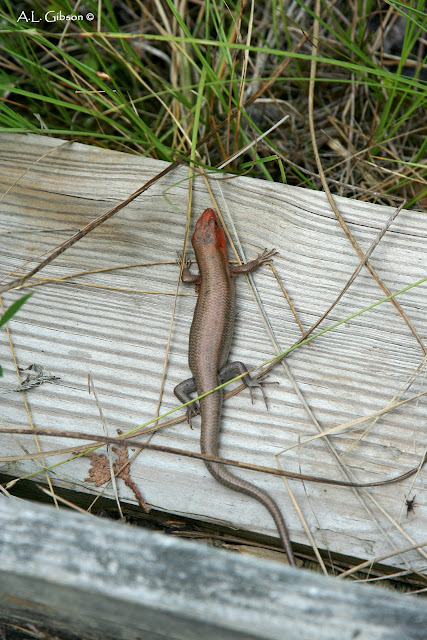
Mature male Five-lined Skink (Eumeces fasciatus) on the boardwalk.


Okay, enough of the history lesson even if I could go on and on.  Fens and their histories and biological communities fascinate me to no end and I could blab about them forever!  Now on to the main event and that magical word 'orchid' in the title that probably nabbed your attention.  But not before I share a quick tidbit about one of Cedar Bog's most frequently seen animals.  Pictured above is a critter I'm willing to guarantee just about everyone sees on their stroll down the boardwalk.  Five-lined skinks love to sun themselves on the warm wood and then go scurrying off as your footsteps approach.  Good luck trying to catch one, these guys move like lightning!  Juveniles start off black with five yellowish lines down their backs and tails of the most gorgeous electric blue you've ever seen.  The specimen above is a mature male with its copper-colored body and red face.

Orchids, orchids...I know, I know.  So without testing your patience any further I give you North America's largest terrestrial species of orchid.  An orchid that stole my heart many years ago along these very same creaky boardwalk planks and has yet to release me from its grasp.

Showy Lady's Slipper (Cypripedium reginae)

Scattered along the margins of the northern white cedar (Thuja occidentalis) of which Cedar Bog gets its name, lies one of the greatest botanical shows Ohio puts on each early June.  The showy lady's slipper (Cypripedium reginae) is the largest and last of the slipper orchids to bloom and mother nature certainly knows how to save the best for last.

An 'eat your heart out' clump of Showy Lady's Slippers (Cypripedium reginae)

This is my sixth year in a row heading to Cedar Bog to see the performance and what a spectacle they've been this time around.  While my run isn't nearly what many other local residents, botanists and orchid-lovers have going, I can say this has been the greatest year I've seen them put on in my experience and a number of  other long-time fans are voicing their agreement.  Just look at that clump above!  Nearly two dozen plants all clustered together and topping out over three feet tall under the partial shade of the cedars is a site no one is likely to forget anytime soon.

Showy Lady's Slipper (Cypripedium reginae)

Each flower's pouch or 'labellum' is about the size of a golf ball and delicately painted the most perfect shade of pastel pink to be found in nature.  Depending on what I assume to be a matter of sunlight, the labellum's pigmentation can vary greatly from soft and pale to intense and deeply saturated.  Another common name for these is the queen lady's slipper.  As the binomial nomenclature would have it, the scientific or botanical name for this species is very fitting.  The scientific epithet of reginae translates to 'queen', implicating the regal and majestic beauty of this orchid.  The lady's slippers genus name was conceived from the combination of the Greek word Kypris (for Cypris, the goddess of beauty and love) and the Latin word pedis  (meaning 'foot') as told by Michael Homoya is his brilliant book The Orchids of Indiana.


Showy Lady's Slipper (Cypripedium reginae


Taking a closer look at the inflorescence or 'slipper' of the showy ladies just magnifies their stimulating appeal.  I was happy to have coincidentally timed my visit on an overcast day right after a rain shower had passed through, giving all the slippers an aesthetically pleasing coating of water droplets.  Unfortunately their beauty is not lost on those who seek to remove them from their rightful homes.  Ignoring the heavy loss they have endured from habitat loss due to succession and destruction, these royal plants have long fought the hands and shovels of mankind.  The floral trade, ignorant digging for wildflower gardens and careless picking has removed these plants to the point of extirpation and extinction of populations throughout much of its range.  Even the botanist is to blame in some situations where avid over-collecting depleted their numbers to nothing.  This is one of the those plants that is best touched with our eyes only, despite the human urge to take the beauty home with us.

North American distribution of Cypripedium reginae (courtesty BONAP)

Looking at the distribution map for this species shows how strong an association it has with the northern Canadian provinces and Great Lakes region.  The further south you slip away from the lakes the more rare it becomes due to an increased lack of habitat availability.  Their preferred habitat of fens, northern swamp woods and glacial depressions aren't found further south than Ohio, hence their increase in frequency the further north you go.  Populations in the south, such as in the Appalachians, grow in circumneutral seeps in limestone regions where plants are few in number and locations.  The one vitally important thing an environment must support regardless of geographical location is what's called "cold-bottom" conditions.  These conditions exist when groundwater reaches the surface and saturates the soil to create a constant supply of cold water that this plant needs to survive.  This in turn allows these plants to exist and survive in more southern latitudes whose normal conditions would not otherwise support them.  In many cases where these plants have disappeared despite not much disturbance to the habitat is the result of a change in the hydrology.  It's not just the surface you have to worry about but what's going on underneath as well to keep these orchids happy and alive.

Showy Lady's Slipper (Cypripedium reginae)

An interesting piece of information about this particular species that will probably engage my entomologist readers and friends most is that the showy lady's slipper is apparently the only eastern Cpypripedium that is largely pollinated by flies and beetles rather than bees.  In any case, the insects are attracted inside the labellum by the promise of a nectar meal but are quickly disappointed to find it's a sham and they are forced to retreat back out the way they came.  Upon their exiting they (hopefully) pick up a package of pollen (pollinia in orchid-speak) from the column (the unique orchid organ comprised of fused stamens and pistil) and in a case of instant memory-loss, enter a new labellum in search for that mythical nectar and we have pollination!

Showy Lady's Slipper (Cypripedium reginae)


There truly are few other plants that I can sit in front of and admire their timeless grandeur for what seems like hours on end.  It's not everyday one sits in front of royalty like this and can have such close interaction with them.  A warning must be issued though to all who suffer with frequent bouts of skin irritation and dermatitis.  The dense pubescence of the leaves, stem and pedicels can cause a severe case of dermatitis much like that of poison ivy (Toxicodendron radicans) to those susceptible.

The incredibly early start to this year affected these plants much like the rest and saw the showy lady's slippers start blooming in late May, something I'd never seen before.  The intense heat of last week hastened the freshness of the blooms this year and the show has already passed when under normal circumstances would just be starting.  Be sure to mark late May and early June on your calender for 2013 to see these wondrous plants in action.  Don't fear, there are still many more orchid wonders Cedar Bog has in store for the future and I will be here to bring them to you when they happen!

Tuesday, May 29, 2012

Southern Kentucky and the Rosebud Orchid

Roasted, toasted, and fried to a crisp.  That about sums up your blogger after spending a day botanizing the steamy hot and humid southern Kentucky county of Laurel this past memorial day weekend.  With high temperatures topping out in the mid 90's and a sticky, saturated feel and look to the air, it wasn't the most pleasant of atmospheres or experiences on the body but boy did the wildflowers make up for any physical discomfort.  I'll be the first to boast about the diverse arrangement of plants my beloved home state supports but any chance to head south into its different habitats, ecosystems, and flora should be quickly taken advantage of.

I made the four hour one-way drive down to the Laurel Lake region with the high hopes of successfully searching out and photographing a species of wild orchid that had slipped through my grasp last year.  While orchid hunting for some other summer-blooming species last July I fortuned upon some specimens of the Rosebud orchid (Cleistes bifaria) in a power line cut within Daniel Boone National Forest.  Unfortunately I was greeted with maturing fruit capsules instead of their highly unique and tropical-looking flowers, so I knew a bit of patience would be needed before being rewarded with their exquisiteness the following May and June.  Fast forward to this past weekend and it was time to give it a go and see what luck nature would bestow upon me this time around.

I decided it would be wise to explore and seek out some other intriguing southern species while in the area and spent the first part of my day slowly driving along some gravel forested roads within the national forest.  The feel was quite similar to my countless experiences within Shawnee state forest or Wayne national but a distinct difference in the plant community's composition is evident; especially when my eye's caught the day's first botanical beauty.

Cumberland Azalea (Rhododendron cumberlandense)

Hiding under the shadows of the leafed-out canopy were the burnt-orange colored flowers of the Cumberland Azalea (Rhododendron cumberlandense).  This was the first time I'd ever laid eyes on this wondrous native shrub and it swiftly made quite an impression on me for its stunning beauty and delicate appearance.  At first glance many are probably tempted to place this under the banner of the flame azalea (R. calendulaceum) for it's comparatively orange-colored blossoms but luckily several characteristics help to distinguish the two.  Cumberland azalea's flowers are smaller and darker colored than the flame azalea's, ranging from burnt orange to blood red.  The Cumberland azalea's leaves are also completely leafed out during antithesis against the flame's leaves just starting to appear.  Notice the flowering time as well to separate the two.  Flame azalea blooms in April through early May while Cumberland azalea typically doesn't flower until early June and into July.

Cumberland Azalea (Rhododendron cumberlandense)

The Cumberland azalea gets its name from its restricted natural distribution to the Cumberland Plateau of Kentucky and Tennessee.  It is hardly found elsewhere outside this region with some isolated populations in the northern mountains of Alabama and Georgia as well as western North Carolina and Virginia where it grows on ridges and upland mixed deciduous forest.  It was a real treat to see this uncommon and delightful species just starting to bloom and was a pleasure to add to my growing list of native azalea's I've come across.

White Milkweed (Asclepias variegata)

Growing frequently alongside the forest roads were the showy umbels of the white milkweed (Asclepias variegata) coming into bloom.  Relatively rare and state-listed as potentially-threatened in Ohio at the northern fringe of its range; this southeastern species of the Appalachians and coastal plain becomes much more common the further south you travel.

White Milkweed (Asclepias variegata)

This species is easily one of the most attractive milkweeds with its diagnostic purple ring around the snow white corolla of each inflorescence.  I just wish it was as common an occurrence here in Ohio as it is to the south.  Its habitat preference of rocky, dry upland woods, roadsides and thickets sounds right at home in southern Ohio where it still hangs on in select pockets and locations.

Carolina Thistle (Cirsium caroinianum)

As I made my way to the selective spot for the rosebud orchids, I noticed some tall, aggressive-looking plants topped with purple flowers that one rarely sees back home.  The purple flower heads belonged to the Carolina Thistle (Cirsium carolinianum), a threatened species in Ohio that much like the aforementioned white milkweed, becomes more common the further south you are.  The thistles can be a pain to differentiate and identify to species but the early blooming time; sticky, white-tipped phyllaries; and spineless peduncles helps set this one apart.

Power line cut choked full of botanical goodies

I finally arrived to my premiere destination and reluctantly exited my air conditioned car to hike a shrubby and sun-drenched power line cut choked full of botanical goodies.  Late last summer I posted about the white fringeless orchid (Platanthera integrilabia) in a sphagnum seep in this very same location, so it's no surprise it would be home to another fascinating member of Orchidaceae.  

The sun beat down on me as beaded sweat dripped down my back and face; sawbrier (Smilax rotundifolia) clawed and ripped at my shins and pesky clouds of flies and gnats annoyingly buzzed overhead.  They all did their best to break my careful concentration at the vegetation around me, my eyes scanning back and forth in hopes that a blip of pink would catch my gaze.  Was I too late again?  Did the extremely hot temperatures and early start to the year already fry my bounty?  I pushed on as my camera equipment weighed heavier and heavier in the heat with no shade to be had in the open swath of grasses and shrubs.  Suddenly my peripheral vision caught something suspect and my attention narrowed to see that I had indeed lucked out and found the unrivaled splendor of my foray.

Rosebud Orchid (Cleistes bifaria)

Surrounded by taller, maturing vegetation was a small scattering of the rosebud orchids (Cleistes bifaria) in varying degrees of freshness and color.  I slipped off my backpack and sank to my knees to get a closer look and appreciation for this long awaited find.  Of the over 50 taxon of native orchids I've had the pleasure of seeing, none share the same bewildered looks of the rosebud orchid.

Rosebud Orchid (Cleistes bifaria)

Similar to other orchids, the rosebud seems to suggest a beast of myth or legend opening its mouth and waiting for an unassuming victim to come too close.  Looking into the 'throat' of the orchid shows off a gorgeous and delicate display of pink, cream, and yellow lines and shading with the greenish pollinia tucked away inside.  The spreading sepals curl back and vary in color from honey gold to dark brown, adding a fitting crown to this king's head.

Rosebud Orchid (Cleistes bifaria)

The plants only rise about a foot off the ground and can be quite difficult to see among the taller, competing vegetation.  The rosebud orchid prefers well-drained acidic soils in meadows, savannas, and openings in upland mixed oak or pine forests in Kentucky.  It is known to respond well to fires and prescribed burns which help to keep the open and sunny habitat it needs; such as this managed power line cut.  Another species of Cleistes, the larger spreading pogonia (C. divaricata) can be found further towards the Atlantic on the coastal plains in lowland savannas.  It differs from the featured lesser spreading pogonia by having larger flowers that also feature a light fragrance.

Closeup look at the Rosebud Orchid (Cleistes bifaria)

Even sitting in the open under a blistering sun and suffocating humidity wasn't enough to draw my attention away from this remarkable orchid I had long dreamed of seeing in person.  There's just something about the complex beauty and design of these impossibly cool plants that just pushes my botanical buttons like nothing else.  It's just an insatiable drive and passion in searching out and seeing these plants in their natural habitat that keeps me going and I don't see it stopping anytime soon.

Rosebud Orchid (Cleistes bifaria)

After a couple hours getting to know my new friends stunning faces and capturing their portraits with my camera, I slowly sauntered back to my car and proceeded to let the air conditioning blast my face and down a couple bottles of water in an attempt to recover from the southern Kentucky heat.  It was worth the burden indeed as I marked off yet another wild orchid on my list.  I can never get enough of that feeling of accomplishment and wish myself many more in the near and distant future.

Tuesday, May 8, 2012

Kentucky Lady's Slippers Redux

What a weekend!  Flora-Quest 2012 was a complete success and thoroughly enjoyed by all who attended.  I have a couple blog posts forth coming to share the flora, birds and experiences had by myself and those lucky enough to be along for the ride.  The incredibly early start to spring has yet to slow down and caused for some interesting changes for this year's event.  Most of the traditional regulars and favorites were largely passed or done completely but one low was equaled by the high of having numerous plants never before seen at Flora-Quest in bloom.  I will get into all that here shortly.

I had a hunch Sunday as I packed up to head back to Athens that perhaps I should check on the progression and condition of one of North America's most recently described and most gorgeous native orchids.  Of course it's an orchid; what else could it be if I love it that much right?  I'm thankful I did as I found them in picture-perfect full bloom and begging for my camera's attention.  For my devotees you may remember I did a post on the Kentucky Lady's Slipper (Cypripedium kentuckiense) last spring.  That being said I'm not going to rehash and repeat what can easily be read by clicking right here.  What I would like to do is share a series of photographs I took of these regal and impressive orchids.  If I can't take you there physically then some pictures are the next best thing.

Kentucky Lady's Slippers (Cypripedium kentuckiense)

First up is an aesthetically pleasing group shot of the sensational Kentucky lady's slippers.  This population along a sandy stream in Lewis county, Kentucky is the northern-most known station for these rare plants in the world.  Six plants total broke the soil this year with one bearing two flowers; something new for this year as no plants were double-bloomed last year.

Kentucky Lady's Slippers (Cypripedium kentuckiense)

A shot of the double-flowering stem.  I'd imagine that this is a good sign this particular plant is in good health to use the extra energy in putting forth a second flower.  I couldn't be happier and more thankful that it did.

Kentucky Lady's Slippers (Cypripedium kentuckiense)

Zoomed out shot of four of the plants.  These have the largest flowers of any other North American Cypripedium and can grow up to three feet tall.  They were long thought to be another variety to the C. parviflorum complex by many botanists but size, slight morphological differences and especially habitat choice sets this apart.

Kentucky Lady's Slippers (Cypripedium kentuckiense)

Close up side profile of the inflorescence.  It's not hard to see how this genus of plants got its common name of lady's slippers.  A quick whiff inside the labellum presents your olfactories with a light and pleasing fragrance reminiscent of something sweet.

Kentucky Lady's Slippers (Cypripedium kentuckiense)

Also called the southern lady's slippers for their largely southeastern and gulf states distribution.  The scientific epithet of kentuckiense hails from the first plants being discovered and described from a Kentucky population.  Those first specimens were actually found along the same stream as these pictured here.

Kentucky Lady's Slippers (Cypripedium kentuckiense)

One last look at the soft lemony-yellow flowers of the Kentucky lady's slippers.  I anxiously awaited another chance to sit down and spend some time with these natural beauties since my last visit with them.  That's the beauty of plants in many ways.  They are like an old friend you see but once a year and have to make the most of it when the time is right.  In the short few years we've known each other our bond has become strong and I look forward to coming back to these plants year after year and catching up with them

Thursday, April 26, 2012

Showy Orchis (Galearis spectabilis)

I can still distinctly remember my first experience finding and observing a wild species of orchid out in the field.  I had long admired their beauty and unequaled physique in pictures from wildflower books and the internet but had never tangibly witnessed one with my own eyes.  It was four years ago on a warm and sunny afternoon in mid-May as I slowly weaved my way between the large tuliptrees, yellow buckeye and beech of a mature, mixed-mesophytic forest deep in Zaleski state forest.  The sun streamed through the closing emerald canopy and scattered in a patchwork fashion amongst the carpet of wildflowers and ferns below, while the newly arrived migrating birds whistled and warbled above.  I wasn't looking for anything specific other than to soak in the scenery and atmosphere of my new home here in the rolling, unglaciated hills of southeastern Ohio.  My casual gaze was caught by an exceptionally large yellow buckeye tree with a scattering of thick, succulent leaves emerging from the loamy soil; each with a short raceme of unusual pinkish-purple and cream colored flowers.  My heart skipped a beat as the realization slowly sank in that I was standing in front of my first orchid, the Showy Orchis (Galearis spectabilis).

Showy Orchis (Galearis spectabilis)

 After that initial experience my fate was sealed and I quickly became passionately obsessed with searching out and finding as many native wild orchids as I possibly could.  Only a short four years later has resulted in over 50 species of North American orchid (even one naturalizing European taxon) from all over the eastern United States and even parts of Canada.  My goal of seeing all 46 indigenous species to Ohio's soil currently stands at 39 with high hopes of crossing a few more off this season.  We'll see what mother nature has in store for me in the near future!

Showy Orchis distribution map courtesy of BONAP

The showy orchis is one of eastern North America's most well-distributed species ranging from the Great Lake states south to the Ozarks of Missouri and Arkansas; east across the Piedmont and southern Appalachians then continuing up through New England.  In Ohio it occurs throughout a majority of the state, only being absent in the northwest quarter.  Galearis spectabilis is diagnostic of mesic forests and woodlands with both acidic and calcareous situations.  It especially prefers north-facing slopes and well-drained ravine bottoms that have an accompanying diverse display of spring ephemeral wildflowers.  I have witnessed it in a variety of woodland sites but it seems to prefer and thrive in more mature, undisturbed forests rather than young and cut over stands.  In southeastern Ohio I seem to almost always find it in close association with the aforementioned yellow buckeye (Aesculus flava); which is an excellent indicator of its mixed-mesophytic/Appalachian cove home.

Showy Orchis (Galearis spectabilis)

Plant taxonomy is an ever-changing and evolving science and despite what others may say, it's never safe to get too comfortable with a plant's name.  Originally put under the Orchis genus banner by Linnaeus well over 200 years ago, it was separated and put into a new genus (Galearis) by botanist and overall Renaissance man Constance Rafinesque in an effort to set it apart from the Old World Orchis taxa.  Some botanists and taxonomists still refer to it as an Orchis but I do my best to stay up with the latest nomenclature and stick with Galearis; which in turn is a very fitting name.  Derived from the Greek word galea, meaning 'hood', Galearis refers to the confluence of the lateral petals and sepals that form a hood over the column and lower lip.  G. spectabilis is the only North American taxon of the genus with Asia's G. cyclochila being the only other member worldwide.

Showy Orchis (Galearis spectabilis)

It's always an excellent idea to take a closer look at this stunning orchid if for nothing else than to get a whiff of its intoxicating fragrance.  The charming 'hood' colored in soft pink or purple mixes nicely with the snow white lower lip, giving off an overall appearance of an opening mouth waiting to devour its pollinators.  There are two accepted color forms of the showy orchis: forma gordinierii which exhibits all-white flowers and forma willeyi which has entirely pink flowers.  I've yet to have the pleasure to see either form in person but have high hopes of doing so in the future!

Showy Orchis (Galearis spectabilis)

An even closer examination of the hood's underside reveals the sophisticated reproductive parts of the orchid.  Pollinators are attracted to the flowers by the long nectar-filled spur that protrudes out the back of the inflorescence.  Upon landing on the lower lip or 'runway', the insect probes the spur for a nectar meal and hopefully in the process picks up one of the two pollinia (special packages of pollen in orchid-speak) which are located within a sleeve-like structure under the hood.  Once finished with that particular individual inflorescence it's off to the next where it deposits the pollinia into the column (fused pistil and stamen of orchids) of the new flower.

Showy Orchis (Galearis spectabilis)

A side shot of the raceme of the showy orchis better reveals the hood, lower lip, and nectar spur.  Your blogger has a hard enough time keeping his nose away from the enchanting aroma of these flowers so I can only imagine the insatiable drive of its insect pollinators to get a taste of the equally delicious nectar.  Such an amazing symbiotic relationship insects and wildflowers share; a simple and perfectly evolved 'I'll scratch your back if you scratch mine'.  The insect gets a nutritious nectar and/or pollen meal while the plant gets pollinated and can set to seed; hopefully supplying the forest with future plants for other fellow orchid lovers and appreciators to find.