Showing posts with label Pink Lady's Slipper. Show all posts

Thursday, May 14, 2015

Orchid Hike for the Cincinnati Wildflower Preservation Society

This past weekend your blogger had the pleasure of leading a hike for the Cincinnati Wildflower Preservation Society.  I've given presentations at their monthly meeting several times before but this was the first time we'd taken to the field together.  My talk for the society this past January dealt with Ohio's native orchids so it seemed appropriate to go from the projector to seeing them in person. Over 25 eager and excited participants, including quite a few familiar faces and friends joined me in the Edge of Appalachia and Shawnee State Forest region of extreme southern Ohio for quite the botanical foray.

I'd like to make specific mention of and say thanks to three special people who made the trek all the way from Ontario, Canada to spend the weekend and especially Saturday botanizing, birding, herping etc. with me.  It was a pleasure to meet and spend time with Bob Curry, Glenda Slessor and John Lamey and share the natural treasures of the Edge and Shawnee with them on Friday and Saturday. They had their sights especially set on seeing a particular orchid or two but I'll get to that later.  All in all, I think I can speak for them in saying they walked away impressed and mesmerized by southern Ohio's beauty and a strong friendship was kindled between them and myself.

Photo of the hike's participants courtesy CWPS member and treasurer, Randy Johnson

Someone must have flicked the switch for July because the week leading up to the hike and the day of was a scorcher.  Temperatures in the area reached highs near 90 and made the early May date seem like a mistake.  Thankfully, the orchids and numerous other plants seemed to take the stress in stride and largely looked great for our eyes and cameras.


Dwarf Crested Iris (Iris cristata)


Davis Memorial state nature preserve in Adams County was our first stop for the day. Its rich forest slopes and dolomite limestone rock features are home to countless spring wildflowers and several species of orchid.  The regal looking dwarf crested iris (Iris cristata) was looking especially nice in the dappled shade.


Showy Orchis (Galearis spectabilis)

It wasn't long before we had the first orchid on our day's list with the showy orchis (Galearis spectabilis).  Most everyone remembers their important "firsts" and the showy orchis will forever be close to my heart as the first wild orchid I ever saw in bloom.  I've seen it countless times since but I never tire of its unique appearance.  Davis Memorial proved to be a favorable spot for this species as we came across upwards of a dozen plants of varying aesthetics and stature.


Wild Columbine (Aquilegia canadensis)


Davis Memorial is of special geological interest as well with its exposed dolomite limestone cliffs and gorge walls.  Dolomite contains more magnesium than your average limestone, which allows for a sweeter soil composition upon weathering.  Many plants do exceptionally well in said soils and why this region of the county is known for its stupendous spring wildflower displays.  Wild columbine (Aquilegia canadensis) is just one species that loves to grow from the rock face's cracks and small soil accumulations.


Large Yellow Lady's Slipper (Cypripedium pubescens)

The next orchid on this most orchid-y of days was the large yellow lady's slipper (Cypripedium pubescens).  We went on to see it at several more sites but it never failed to be a showstopper, especially when in large, many-flowered clumps.


Large Yellow Lady's Slipper (Cypripedium pubescens)


Most of the photos in this post I took during my scouting and personal botanizing time the day before leading the hike.  I like to take my time when engaging these remarkable, highly evolved plants and I knew that would be at a minimum during the hike.  It's also important to me I give my full attention to the questions, curiosities and concerns of my group.  For many this was the first time seeing orchids such as the large yellows, while I've been spoiled with dozens of encounters and hopefully dozens more to come.


Spring in Shawnee State Forest

I could honestly spend all day, every day in Shawnee during the spring.  There's a feel to its wild depths unlike anything else in the state. Bobcats to cerulean warblers, timber rattlesnakes or the goldenstar lily, Shawnee has it all.  There's few places better for orchids in the state either with Shawnee claiming over a dozen species throughout the year.


Pollinated and wilting large whorled pogonia (Isotria verticillata)

As I mentioned at the beginning of this post, Bob, Glenda and John came all the way from Ontario with one specific orchid in mind: the large whorled pogonia (Isotria verticillata).  While relatively common in the acidic, upland oak forests of eastern unglaciated Ohio, the large whorled pogonia is excruciatingly rare in Ontario.  In fact, it's believed to be extirpated and hasn't been seen above ground in quite some time.  Unfortunately, the unseasonably hot temperatures ushered this notoriously short bloomer into flower and quickly out by the time of their arrival.  They took Mother Nature's curveball in stride though and were beyond happy to see the plant even in a wilted state.


Rose Azalea (Rhododendron prinophyllum)

It wouldn't be the peak of spring in Shawnee without the vibrant blossoms of the rose azalea (Rhododendron prinophyllum).  They litter the roadsides on the forest's higher and drier slopes in an assortment of dark and light pinks.


Pink Lady's Slipper (Cypripedium acaule)


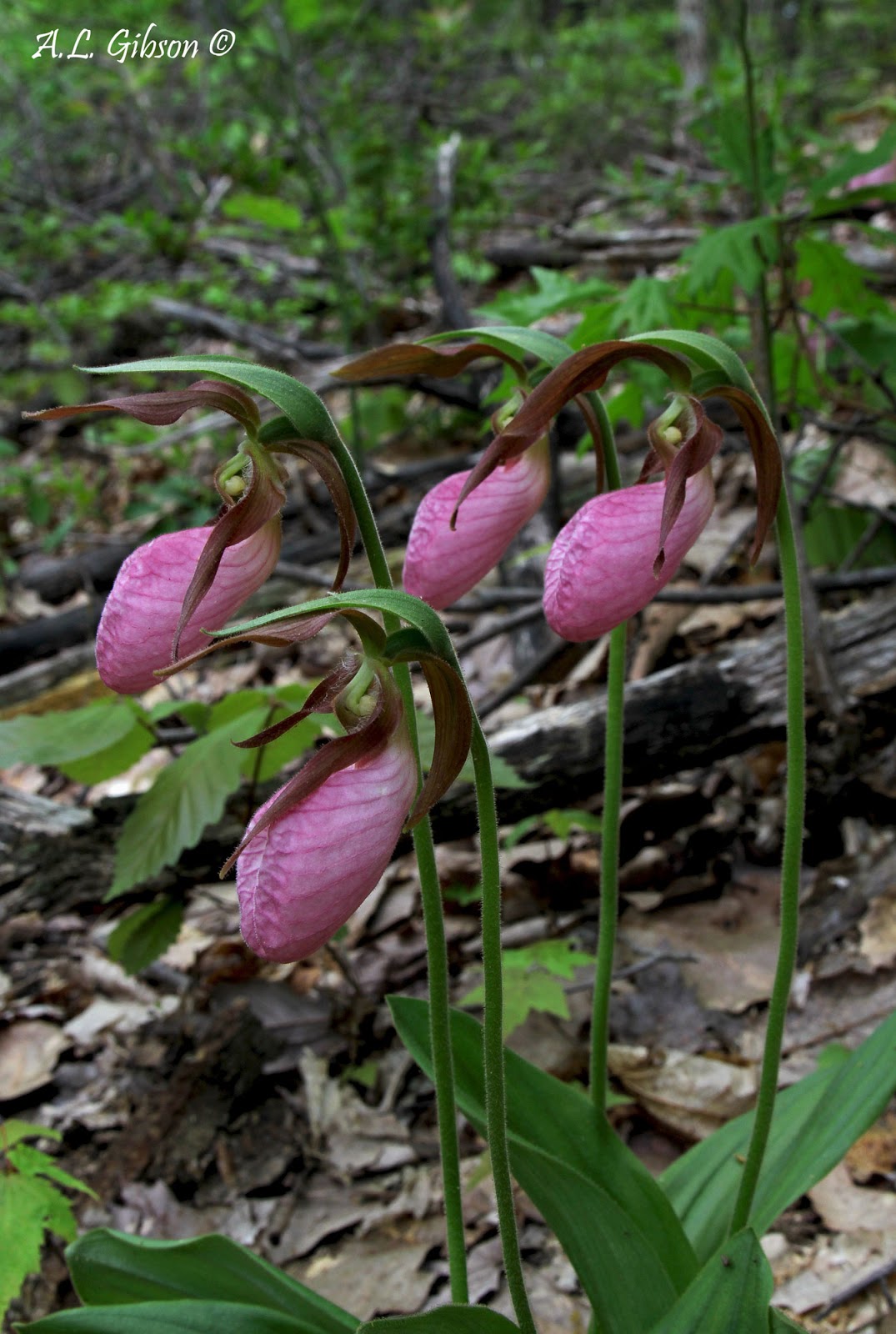
Speaking of pink colored flowers, I'd be remiss if I didn't make mention of the always exciting pink lady's slippers (Cypripedium acaule). This was a superb year for this orchid as most of my known sites had an exemplary number of flowering plants.  Each labellum or slipper looks like a big wad of chewing gum someone deposited atop a green stem to my eyes.


White-colored Pink Lady's Slipper


And then there's the case when someone is chewing peppermint flavored gum and leaves a white blob instead. I've observed this white-flowered pink lady's slipper for a handful of years running now and never get tired of its unusual charm.  I would hesitate to acknowledge this as a true case of albinism due the the dorsal/lateral sepals and column lacking the typical lime green coloration of an albino.  This seems to simply be a case of a white labellum only.


Rock Fir Moss (Huperzia porophila)

With so many pairs of eyes observing the landscape few things of interest are likely to slip past detection.  One fun item that stood out was large colonies of rock fir moss (Huperzia porophila) amassed on some steep sandstone slopes.  Lycopods to mycology, just about every aspect of our natural world is discussed and/or represented on a hike like this and makes for an educational experience for everyone involved.


Crossvine (Bignonia capreolata)
Umbrella Magnolia (Magnolia tripetala)


Other Shawnee oddities gracing our hike with their floral presence was the rare umbrella magnolia (Magnolia tripetala) and crossvine (Bignonia capreolata).  Both are plants much more common further south and just barely make it into southern Ohio.  They certainly have a southern or 'tropical' feel/look to them.  Just another feather in Shawnee's hat if you ask me!

Earlier on Friday during my solo foray, I decided to make my annual pilgrimage to a special and treasured site on the Edge of Appalachia preserve.  As incredible a site as it is, it's one that's too remote and too sensitive to bring a group of even respectful, well-mannered wildflower admirers to.


Hanging prairie on the Edge of Appalachia and one of my favorite views in the entire state

Of all the impressive views I've gazed out across in the Buckeye state, I'd have to say the one photographed above is on my very short list of the best.  This hanging prairie clings to the side of a hill; an island of rare grassland plants overlooking a rolling sea of contiguous forest.  No roads, no buildings, no people or anything to break the sounds of nature.  It's rare to get that kind of purity with no noise pollution and only adds to the splendor of the place.  Within its depths is a slew of prairie plants like scarlet paintbrush (Castilleja coccinea), prairie phlox (Phlox pilosa), hoary puccoon (Lithospermum canescens), heart-leaved golden alexanders (Zizia aptera), yellow star grass (Hypoxis hirsuta), white blue-eyed grass (Sisyrinchium albidum), arrow-leaved violet (Viola sagittata) and one very rare, very stunning orchid: the endangered small white lady's slipper (Cypripedium candidum).


Prairie phlox, scarlet paintbrush, hoary puccoon etc. in full, spectacular bloom


Small White Lady's Slipper (Cypripedium candidum)


Scarlet Paintbrush (Castilleja coccinea)

Hanging prairie is a true slice of botanical heaven and one I can't wait to visit each early May.  It's never disappointed in the past, it didn't disappoint this time around and I don't dare doubt it will break that streak any time soon.  I could dedicate an entire post of this length to the site and perhaps I will one day.

Needless to say the hike was a resounding success and everyone involved had a helluva time immersed in southern Ohio's spring bounty of wildflowers, orchids and birds.  Leading hikes never fails to leave me physically exhausted by mentally revitalized and freshened.  It's such a fun way to share my passion and knowledge for orchids, Ohio and our natural world as a whole.  I'll be leading two additional hikes for the Cincinnati Wildflower Preservation Society later this year in August and September, respectively.  Take a look on the left side of my blog for my events section for more details.  Special thanks to the Christine Hadley for helping me put this together and for asking me to lead this hike!  I/we certainly had an amazing time!

- ALG -

Wednesday, April 29, 2015

A Weekend of Birds & Botany in Shawnee State Forest

Whew.  It's been a hectic last few weeks and months for your blogger.  The necessary combination of precious free time and energy to put into new posts just hasn't materialized and is reason for the lack of activity.  I hope to rectify this going forward but for now let's catch up on a few items I'd like to make mention of.

First off, I'd like to take time to honor the life and legacy of an educator, mentor and good friend of mine whom the Ohio naturalist community recently lost.  Dennis Profant, author and publisher of the famed Field Biology of Southeastern Ohio blog and my former professor at Hocking College, unexpectedly passed away on April 15th.  He was one of the most influential professors I ever had and is a large contributor to who, what and where I am as a botanist, naturalist and human being today.  From birds and bugs, to wildflowers and trees, Dennis made learning fun with his unique wit and way of teaching things.  His mind was a walking encyclopedia on our natural world and his passion infectious.  I will always fondly remember our times in the field together or just kicking it in his office discussing everything from jazz to moths.  I'm beyond thankful to have gotten close to him in the years following my time at Hocking College and am greatly saddened to know our time together is done.  What I wouldn't do for one more foray into the woods with him...

On a more positive note, I'd like to personally thank all the kind people who took the time to say hello at the recent Ohio Botanical Symposium back in late March.  Meeting and talking to readers/fans of this website and the gracious words you have to say mean the world to me.  This blog would have slid into oblivion long ago if it wasn't for the compliments, encouragement and confirmation of interest from you all over the years.  I hope you'll continue to read and share my love for everything botanical and beyond.  And Ron G., I promise you'll have your Helianthus themed post to read and use in the next few months!

It's spring!  Taking a glance at my most recent post has this site locked in the depths of winter's chill but rest assured the wildflowers and trees have progressed anyways and thankfully so.  The last two weekends have had your blogger fulfill speaking gigs and lead field trips for the Arc of Appalachia's annual wildflower pilgrimage and Ohio Ornithological Society's annual conference, respectively. Both events were packed full of excited, eager naturalists ready to fully embrace spring's blossoming and an amazing time was had by all.  I would like to recap both events in blog form, starting with this past weekend and the OOS' invasion of Shawnee state forest.

Sunrise over Turkey Creek Lake in Shawnee State Forest

You might recall my post detailing last year's OOS event in Shawnee.  We had exquisite weather and phenomenal birding despite the botany being a bit behind.  This time around the tables were turned with excellent botany and mediocre birding.  Unseasonably cool temperatures and a steady all day rain on Saturday into Sunday kept the birds and their food sources from moving much.  A number of the usual migratory suspects seemed to be late and/or absent from this weekend but that doesn't mean it was a total washout.  The rare chance to see and catch up with old friends is one of the biggest draws for these kinds of events and in that this weekend did not disappoint in the slightest.

Winding dirt road leading through the beauty of Shawnee state forest

The cooler temperatures and rain might have quieted the birds but they did wonders for my floral friends.  Flowering dogwood, redbud, wild plums and serviceberry painted Shawnee's roadsides with their respective shades of cream, white and pink.  There's just something about the isolated, remote feeling of the forest's winding dirt roads as they take you along the ridge tops and down into the hollers.

Scarlet paintbrush (Castilleja coccinea) blooming in an Adams Co. cedar barrens

I arrived to the region early in the afternoon on Friday to do a bit of personal botanizing and birding before I was needed at the lodge.  I couldn't resist the temptation of hitting a few choice spots in Adams County for their rare and unusual inhabitants.  The globally rare dolomite cedar barrens were ablaze with scarlet paintbrush (Castilleja coccinea) in all their seasonal glory.
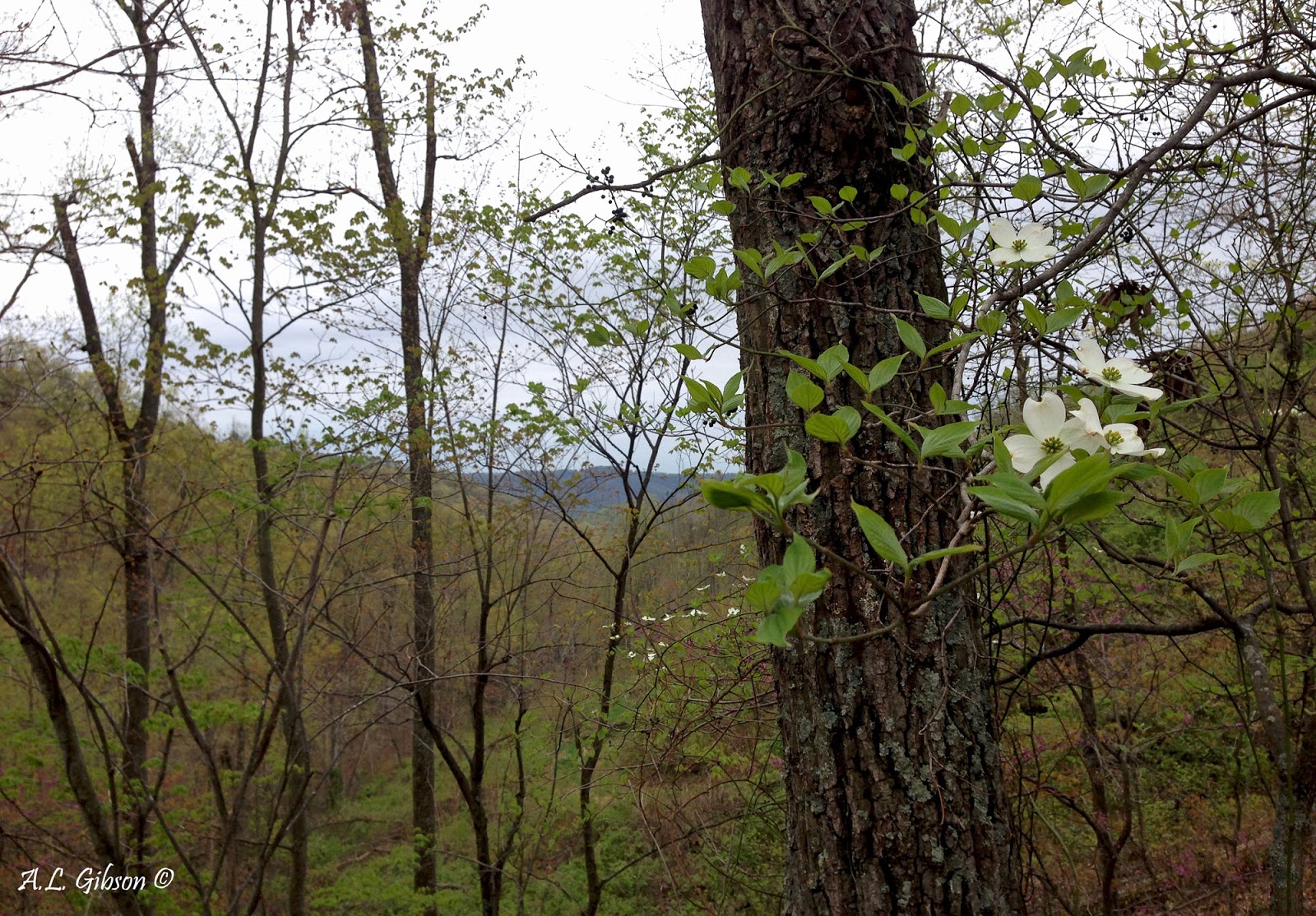
Flowering dogwood back dropped by the rolling hills of Shawnee

Don't let me fool you into thinking the birds were a complete and total bust.  Both my Saturday and Sunday field trips were rewarded with some great species and moments.  The best had to be a woman on Saturday wishing with all her might she'd get to see even a fleeting glimpse of the elusive Kentucky warbler; a long-awaited life bird for her.  Not more than five minutes later a male that had been singing from deep in the brush and tangle of the woods came out and perched himself in clear view for the entire group. Needless to say, the aforementioned woman was breathless in wonderment afterwards.  That's a sight any guide loves to see!

The rare vernal iris (Iris verna) blooming profusely along the forest's roadsides

One of the area's quintessential spring wildflowers was just starting to come online during the conference in the rare vernal iris (Iris verna).  Many folks think of summer and wetlands when irises are mentioned but this particular species loves the rocky, dry soil of Shawnee's sun-drenched ridge tops and roadsides.

Eastern Tiger Swallowtail nectaring on the ephemeral blooms of wild plum (Prunus spp.)

While cruising Shawnee's back roads during Friday's warm, sunny conditions, I came across numerous wild plums (Prunus spp.) in perfect flowering shape.  The air was heavy with their sweet scent and could be detected from hundreds of feet away with the nose alone.  I wasn't their only admirer as the plums were abuzz with dozens of bees and butterflies all looking for a taste of nectar.

Spotted Mandarin (Prosartes maculata)


Another of Shawnee's threatened floral denizens in full bloom was the delicate spotted mandarin (Prosartes maculata).  Their creamy white flowers hang like little lanterns under an emerald green umbrella.  A close look at the inside surface of their petals reveals a gorgeous smattering of magenta polka dots unlike anything else in Ohio's flora.

Pink Lady's Slipper (Cypripedium acaule)

As if the spotted mandarins and vernal irises weren't enough to wow my groups during breaks from our binoculars, Mother Nature had one more wildflower surprise up her sleeve in some pink lady's slippers (Cypripedium acaule).  I didn't expect to find any in this good of shape just yet, especially considering the last week's cooler weather but there this trio was in all their orchid splendor.  The program I gave this weekend was about Ohio's native orchids (fathom that one), so it was rewarding to be able to share these in the flesh with my group.

Sunday's group with their binoculars peeled along the forested ridge top roads of Shawnee

Sunday eventually cleared and warmed into a fine specimen of a spring day.  I had the added pleasure of close friends and phenomenal naturalists, Bob Scott Placier and Daniel Boone join me in leading this troop through Shawnee.  The birds responded accordingly to the improved conditions with better movements and vocalizations as the day waned.  Feathered highlights from the weekend included: scarlet tanager, wood thrush, purple finch, yellow-throated vireo, blue-headed vireo, sharp-shinned hawk and warblers (yellow-throated, yellow-rumped, black-throated green, cerulean, Kentucky, worm-eating, black-and-white, ovenbird, hooded, prairie, blue-winged, pine and redstart).

Birds Foot Violet (Viola pedata)

The theme of my hikes for the weekend was "Birds & Botany", so what could be better than getting the proverbial two birds with one stone in the birds foot violet (Viola pedata).  This state threatened species is arguably the most aesthetically exciting of Ohio's nearly 30 species of violet and they could not have looked better during our romp through Shawnee.

Shawnee enveloped in a steady rain

Fortunately, the rain didn't really hit and stick with us until towards the end of our time in the field on Saturday.  Regardless, I don't think I can really ever curse the rain this time of the year.  Without its life-giving powers there wouldn't be any wildflowers or birds to admire and spend the weekend chasing.  Rain is just fine by me and even gives the landscape a beauty all its own.

Female (L) and male (R) cones of the eastern hemlock

Even the minutiae of spring returning is something to behold.  Shawnee's eastern hemlocks (Tsuga canadensis) were doing their thing during our visit with their ephemeral yellow male pollen cones and adorable little female cones.  The male cones will quickly waste away after releasing their pollen, while the female cones will hang around for several years post maturity.  An interesting fact on gymnosperms is the very long temporal separation of pollination and fertilization.  It can take months for the sperm cells from the deposited pollen to reach the female cone's ovules and months more to mature into a seed.  Nature truly is all a matter of patience.

Oddly patterned common blue violets (Viola sororia) in Shawnee

Another floral oddity I enjoyed sharing with my group was a particular patch of common blue violets (V. sororia) that always display an interesting color pattern on their flowers.  I've witnessed these exact plants for several years running now and they always exhibit this strange, almost leucistic-like phenotype.  Definitely a fun twist on an otherwise common and forgettable plant.

Your blogger and the current/former* state champion yellow buckeye

I'll end this post in the same way I ended my memorable weekend down in Shawnee with one impressive specimen of a tree.  This particular yellow buckeye (Aesculus flava) has seen many winters melt into spring; so many in fact it was once (and perhaps still is?) the largest known tree for its species in the entire state.  Whether or not its title is intact is a bit moot for me.  It's a fabulous example of nature's work when given the time and opportunity to grow, grow, grow.

I can't begin to thank my hike's participants enough for their enthusiasm and thirst for the treasures of the outdoors.  Everyone's attitudes remained positive and cheerful during the entire weekend despite the weather.  I think it's safe to speak for everyone when I say we all had a great time and I'm already looking forward to future events with the OOS.

- ALG -

Wednesday, May 14, 2014

Spectacular Spring Orchids

As promised, I'm here to deliver on some of the botanical treats I went searching for this past weekend during my foray into the famed and ever-mentioned Adams and Scioto counties in southern Ohio.  I've decided to dedicate this post purely to my cherished and timeless orchids I spend so much time admiring and photographing.  I've seen all the featured species on this post plenty of times but there's just something about them that draws me back in with each reawakened spring.  The anticipation and rush never wanes as I glance upon them for the first time, like old friends I only get to spend time with a handful of times a year.

Large Yellow Lady's Slipper (Cypripedium pubescens)

If I've seen the large yellow lady's slippers (Cypripedium pubescens) once, I've seen them dozens and dozens of times but that has done nothing to dull the excitement of discovery.  Their golden glow set against the shadowed greenery of its newly lush forest habitat is a sight for sore eyes after a long winter.

Trio of large yellow lady's slippers
An uncommon double-bloomed plant on the R


While not state-listed and occasionally locally common in select areas of the state, large yellow lady's slippers' numbers have dwindled in recent decades as poachers and logging activities negatively affect this slow-growing and fickle plant.  It can take upwards of a decade for these and many other orchids to reach flowering maturity and some are highly sensitive to even moderate levels of disturbance.

Showy Orchis (Galearis spectabilis)

Showy orchis (Galearis spectabilis) was the very first wild orchid I ever saw in flower and from that moment on it cemented itself as one of my favorites for carrying that distinction.  I tend to see this species reach its best numbers in mature mixed mesophytic woods on mesic N-NE-E facing slopes where yellow buckeye, beech, sugar maple, and tuliptree are common associates.  While I love to enjoy these orchids with my eyes only, the same cannot be said for white-tailed deer.  Showy orchis is like candy to them and observing large, impressive specimens is always a special find due to high levels of predation.

Pink Lady's Slippers (Cypripedium acaule

Pink lady's slippers (Cypripedium acaule) are the black sheep of Ohio's indigenous lady's slipper orchids in both habit and habitat.  All other Ohio Cypripediums have leaves occurring on their flowering stems, however pinks have a leafless scape that arises from an equally unique pair of basal leaves.  In terms of habitat preference, pinks utilize dry upland oak/pine/hemlock forests with an acidic substrate while our other species all have an affinity and/or requirement for more moist, basic-calcareous soils.

Pair of pink lady's slippers in a Virginia pine stand
Rare white-flowered form of C. acaule


The venation pattern on the front of the "slipper" or "moccasin" acts as a visual nectar guide for passing bumblebees to notice and buzz over to for an inspection.  A sweet smell hints at the promise of a reward inside but the bumblebee only finds an empty, air-filled pouch it must now back out of and hopefully pick up some granular pollen in the process.  With any luck the bumblebee will visit another flower in a vain attempt at a meal and cross-pollination/fertilization will occur.  As with many other orchids and species of wildflowers, pink lady's slippers are known to occur in rare white-colored forms as pictured above.

Spring Coralroot (Corallorhiza wisteriana)

Perhaps the least visually appealing of the early orchids, the spring coralroot (Corallorhiza wisteriana) is nonetheless charming in its own right.  If you take the time to carefully inspect each individual flower's lip you'll find a snow-white surface splotched with magenta polka dots in quite the artistic display.  This species is saprophytic and relies entirely on its relationship with mycorrhiza fungi in the soil for sustenance and cannot photosynthesize due to its complete lack of chloroplasts (hence why there's no green to it at all).

Small White Lady's Slipper (Cypripedium candidum

If there's any species of spring blooming orchid I look forward to the most and refuse to miss out on, it's the state-endangered and very rare small white lady's slippers (Cypripedium candidum).  These tiny wonders are only known to occur in a handful of high-quality prairie remnants in the extreme north and south parts of our state.  These particular plants are from a secluded dolomite limestone barrens in the depths of Adams county.

Small white lady's slippers with your narrators hand for scale

The word 'small' is in their common name for a reason as this lady's slippers' slipper is only about the size of the end of your thumb.  Their waxy white labellums are ringed with magenta dots and accompanied by yellowish-green dorsal and lateral sepals.  A soft but sweet fragrance is emitted from the bloom as well and gives the nose as much a reason to love them as the eyes.

Small White Lady's Slipper (Cypripedium candidum

Their miniscule stature takes by breath away every time I see them even though I know what to expect.  Each is so delicately designed and a one-of-a-kind masterpiece.  I could see these beauties for the next 50 years consecutively and I'd love them that much more on visit number 51.

Large Whorled Pogonia (Isotria verticillata)


Large whorled pogonias (Isotria verticillata) almost seem to be a floral ode to a mythical beast long lost to the past.  It appears like a dragon, ready to breathe fire and devour any prey foolish enough to come too close.  This orchid prefers more or less the same habitat conditions as the aforementioned pink lady's slippers and often times will even occur together in their acidic upland oak/pine woods.  It's common to see a population of dozens of sterile plants with (if you're lucky) one or a few blooming individuals mixed in.

Kentucky Lady's Slippers (Cypripedium kentuckiense) beginning to bud up

To end my day of plentiful orchids in peak bloom, I decided to cross the mighty Ohio River and check on a site for the rare Kentucky lady's slippers (Cypripedium kentuckiense) I've photographed and shared on this blog before. The typical eight plants were present and just beginning to bud up with one starting to get some color and open slightly.  Another week or so and they should be in peak shape and worth another visit.