Showing posts with label Asplenium scolopendrium. Show all posts

Tuesday, April 4, 2017

The Bruce Peninsula Part V: Rare Ferns and an Elusive Orchid

 *Part I* *Part II* *Part III* *Part IV* *Part V* *Part VI* *Part VII*

The magical run continues as your blogger is back again for yet another post on the majestic spring time wonder of Ontario's Bruce peninsula! I hope no one is getting too burned out on the topic as we've gone past the halfway point with this fifth of seven posts. To be frank, I'm not sure how anyone could get bored or apathetic about the Bruce. I know the posts have been marathons but there's just an overwhelming amount to share and most everything is honestly too memorable, aesthetic, and/or interesting to not make the cut. So if you're still here and excited for more then I know just how to help out.

With that being said, I'd like to dedicate this next post to a couple sites on the southern end of the Bruce and the intriguing botanical rarities that occupy them. Not to mention the lovely landscapes and geology of them, too!

Inglis Falls outside the town of Owen Sound on the southern end of the Bruce peninsula

Inglis Falls. The scene above should be more enough to grab your attention and renew your interest in this incredible region of the Great Lakes if it was beginning to wane! Inglis Falls is the peninsula's largest, most attractive, and thus most visited waterfall. It's formed by the Sydenham River as it flows north and tumbles 60 feet over the limestone edge of the Niagara Escarpment. The falls will often slow to a trickle during the summer and fall months but the spring rains had it roaring and audible from the parking lot.


Northern White Cedars (Thuja occidentalis) around the rim of Inglis Falls

With the falls flowing over the natural rim of the Niagara Escarpment, much of its surrounding area is dry, rocky woodland and bluffs. Interestingly, all around the falls was a near monoculture of northern white cedar (Thuja occidentalis) growing in the thin soils and often on/over the limestone rocks and boulders. Some were quite large and make you ponder just how old they are to have attained their dimensions in such a harsh habitat.


Looking north from the fall's rim towards the Georgian Bay

The Sydenham River continues its course north through an impressive labyrinth of riffles and limestone blocks below the falls. It's not much further before it empties into the Georgian Bay at the Owen Sound harbor.


Northern white cedar growing out from a limestone slump rock

Making your way down from the bluffs and rim of the Niagara Escarpment takes you past some interesting works of geological and botanical art. I found this eroded block of limestone to be especially worth a photo. Standing here in the present day it's hard to believe these fractured layers of dolomite were laid down 400+ million years ago at the bottom of a warm, shallow tropical sea. Almost equally hard to believe is the tenacity of the white cedars to grow literally out of the rock and form into twisted, gnarled specimens.


Northern Holly Fern (Polystichum lonchitis)

As pretty as Inglis Falls is, and it most certainly is that, I wasn't there to see the falls itself as much as what grows below it. More specifically the rare ferns that grow below it. One of those pteridophytes on my radar was the northern holly fern (Polystichum lonchitis). Related to the ubiquitous Christmas fern (P. acrostichoides), the northern holly fern is much more erect in growth but similar with its truly evergreen fronds. The veins of the pinnae conspicuously end in a sharp, bristly point and give the structure a rather holly-like appearance, hence its common name.


Northern Holly Fern (Polystichum lonchitis)


It's much more widespread and frequent out in the Mountain West and Pacific Northwest states but curiously persists in a very limited and local fashion here on the Bruce and nearby Upper Peninsula of Michigan. Other than that you're very hard pressed to see this fern east of the Rockies. It's exclusive to exposed dolomitic limestone in the region and Inglis Falls, not coincidentally abounds with it. A healthy percentage of Ontario's occurrences of this western disjunct occur within the Bruce and its adjacent islands, making it a phenomenal spot to mark this plant of one's life list.


Another portrait of the beauty of Inglis Falls

As I soaked in the beauty and views of Inglis Falls, I couldn't help feel a strange sense of tropical-ness to it. There was just something about the way it looked with its moss-covered boulders surrounding/within the falls and vegetation clinging to every nook, cranny and crevice all around its rim and cliff faces that suggested a location much closer to the equator. Perhaps I'm alone in that thought but regardless of your disagreement it's a phenomenal waterfall to take in!


Below and just downstream of Inglis Falls

Moving further down the eroded gorge below the falls, the habitat and landscape quickly changes from the dry, sparsely-vegetated upper rim and bluffs. Below, the woods becomes much cooler, shaded, humid and rich with an explosion of plant life created by the site's microhabitat. Once again, I was hot on the trail of a fern, but this one much more rare and enticing.


Clumps of the very rare Hart's tongue fern (Asplenium scolopendrium var. americanum)

Before my first foray onto the Bruce back in 2011, I'd heard the curious story of one of North America's more rare pteridophytes in the Hart's tongue fern (Asplenium scolopendrium var. americanum). I searched and searched for it but never had any luck and swore the next time I wouldn't fail. Had I just known about Inglis Falls, I'd have been guaranteed some fantastic face time with this most excellent of spore producers!


Hart's Tongue Fern (Asplenium scolopendrium var. americanum)

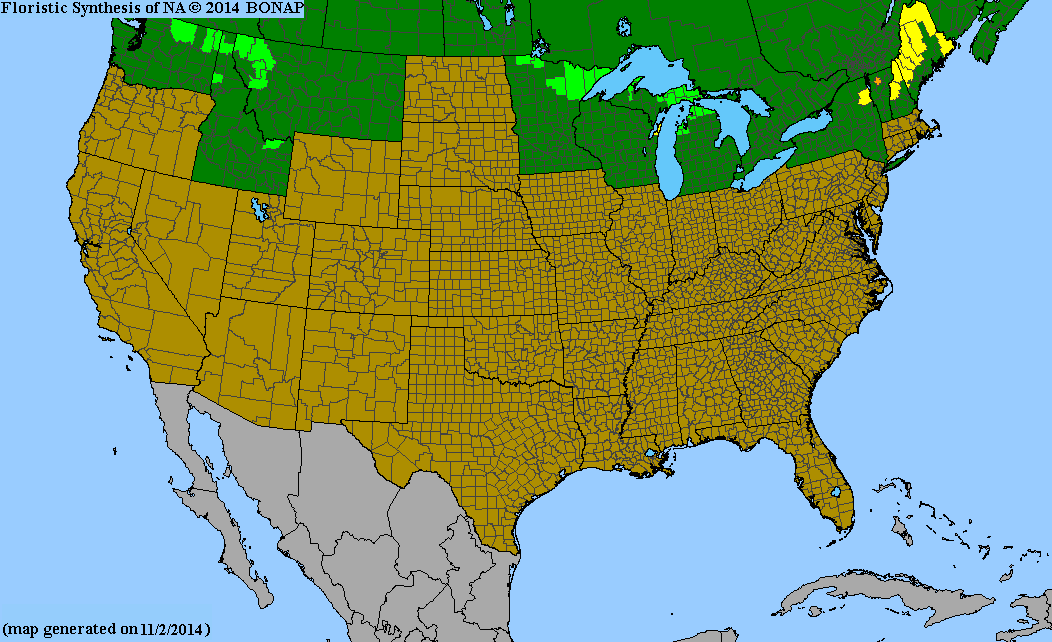
What makes Hart's tongue fern such an exciting find and plant for many botanists, naturalists etc. is its very odd distribution and localities in North America. While much more common across the pond in Europe, it is only known to occur in very sporadic, very local places in Ontario and the eastern United States. In fact, other than the Bruce, Hart's tongue fern can only be found in the Straits of Mackinac region of Michigan, central New York, and a few counties in eastern Tennessee and northern Alabama. From what I can gather it sounds like the Bruce and central New York are the best of those locations.


Hart's Tongue Fern (Asplenium scolopendrium var. americanum)


Much like the aforementioned northern holly fern, Hart's tongue is restricted to moist, shaded dolomite limestone; often times associated with waterfalls and deep stream ravines. It looks unlike any other fern you'll run into with thick, leathery, sword-like fronds and linear sori on the undersides. Due to such scarcity in North America it's listed as a federally threatened species in the United States, and an 'at risk' species of concern in Canada. For readers who enjoy the more taxonomic side of botany, the North American Hart's tongue plants are considered a separate variety (var. americanum) to Europe's. The physical differences between the two are minute and split based on polyploidy: North America's being a tetraploid (four sets of chromosomes) to Europe's diploid (two sets). When it comes to ferns polyploidy can really make a difference.


A northern holly fern and Hart's tongue fern growing together

With both the Hart's tongue and northern holly ferns calling Inglis Falls home, it was little surprise to find the two growing literally side-by-side on a few occasions and made for a fun photo opportunity. Not everyday not just one but two major life fern species can be captured in the same frame!

After enjoying the pteridophyte bliss of Inglis Falls and already being on the southern end of the peninsula, the decision was made to swing over to a section of woodland outside Sauble Beach for a most elusive orchid. At least it was elusive to me! Luckily, I had my Ontario friend and excellent naturalist, Bob Curry with me to help out. I had originally met Bob in the spring of 2015 when he and his wife came all the way down to Adams County, Ohio for an orchid hike I was leading. When I told him I'd be on the Bruce a month later, he said it was a must that he return the favor and take me out for some orchids! It should be noted that Bob was the one to share Inglis Falls and the ferns with me as well. Needless to say Bob is a swell guy and one of my favorites.


Bob with the rare Hooker's orchid (Platanthera hookeri).

Looking at the photo featured above and following the stare of Bob's camera it can still be quite hard to make out just what the heck he's taking a photo of. With sharp eyes you can just make out the pair of round, prostate leaves on the ground and green raceme of green flowers directly above. Green is the name of the game with the rare Hooker's orchid (Platanthera hookeri) and it puts the 'pro' in professional at blending in. Fortunately, the wooded stabilized dune just off Lake Huron had plenty of the orchid to share and find them we did.


Hooker's Orchid (Platanthera hookeri)

It's a given that your blogger is an orchid freak and it should also be well-known that they don't have to be the showy, pretty kind to get my heart racing. As previously stated, the Hooker's orchid isn't much to get excited about for the lay man but the sugar maple/beech/paper birch forest it resided in at Sauble Beech was most hallowed ground to this botanist. I had previously only seen this orchid once before out in the Adirondack's of New York back in 2013. I had made the 12 hour journey almost solely for it and was rewarded with a single plant just barely starting to flower. Even so, it was a very special and memorable trip but I'd be lying if the dozens of Hooker's orchid in perfect flower on the Bruce didn't just make my heart melt.


Hooker's Orchid (Platanthera hookeri)


Hooker's orchid gets the elusive tag from me by the fact it's long been extirpated from Ohio's borders and not seen/collected since the 1890's. In fact, it's been disappearing at a fast rate throughout the entirety of the southern half of its distribution. Acid rain, warming soil temperatures, and other effects of climate change and habitat alteration are not doing this orchid any favors. I certainly hope this prime population I visited here can withstand the pressures and continue to persist.


Hooker's Orchid (Platanthera hookeri)


Even being one of the 'blander' all-green Platanthera orchids, Hooker's orchid has some exquisite details to be had from its architecture. The curvature of its labellum and long nectar spur are often colored a more yellowish-green than the rest of the plant and can really stand out in extra spectacular specimens. I think the photo above with an orchid contrasted nicely against my hat really shows off that color difference. Seeing a lot of large-flowered trillium (Trillium grandiflorum) mixed in with the orchids was extra nice, even if the trillium were mostly all well-past peak stage. If it wasn't for the storms and heavy rain quickly closing in on us, I could have hung out in this woods and its Hooker's orchids all day.


With that I think I'll call it quits on this fifth of seven installments on my botanical foray onto the Bruce peninsula in June 2015. If you're still enjoying what you're seeing and reading, I encourage you to come back soon as I wrap things up with two more posts! I've definitely saved some of the best for last and hope to have your readership at the conclusion of it all. Thanks as always for tuning in!

- ALG -

Thursday, October 22, 2015

Top Ten Life Plants of 2015

It's hard to believe yet another year has come and gone. Spring and summer flew by in a blur your narrator can hardly comprehend, with autumn currently in its own hurry as well. Despite its rush, the 2015 field season was one to remember. There's never enough time to see and do everything on your list during a calendar year but then that's what makes each and every new experience you do have all the more memorable. For a botanist, or at least this botanist, one of the most rewarding tasks at the conclusion of the growing season is updating the life list. As time goes on and I become more and more acquainted with my local and regional flora, the frequencies of making new floral friends decreases. This makes each additional life species marked off the list feel just a bit more gratifying than the last. All the more reason to travel further outside one's botanical comfort zone, I say.

With our first frosts already in the past, I'd like to reminisce on my personal top ten favorite "lifers" from 2015's botanical forays. Just about all of them came outside Ohio's borders this year from places like Ontario, Wyoming or West Virginia. All ten plants were species I'd never had the pleasure of seeing in the flesh before; many only dreamily through a computer monitor or from the pages of my extensive botanical library. Some I specifically set out to see, others I came across by complete chance. Each one aroused emotions of excitement and disbelief, often erasing years of anxious desire. Many a tear of joy was shed while looking upon these featured wildflowers, which only served to reaffirm my passion and ambition for seeking out these often-times rare and magnificent wonders.

All that being said, let's begin the countdown of my favorite life plants from an unforgettable spring, summer and fall of botanizing throughout North America...


Rocky Mountain Fringed Gentian (Gentianopsis thermalis). Wyoming, Early August

Starting off the countdown at number ten is the Rocky Mountain fringed gentian (Gentianopsis thermalis). Its electric blue petals graced many wet alpine meadows, fen-like stream sides and groundwater seeps during my time out in the Wind River Range of western Wyoming this past August. I've seen two of its closely related and equally stunning brethren (G. crinita and G. virgata, respectively) back in Ohio, but the surrounding scenery for these delicate beauties put them on another level of spectacular.


Northern Comandra (Geocaulon lividum). Bruce Pen., Ontario, June.


The criteria for how a plant species ends up making this most esteemed of lists goes much deeper than physical beauty. If that was the lone requirement, I hesitate to think lifer number nine would have even sniffed the final cut. What northern comandra (Geocaulon lividum) may lack in showiness, it more than makes up for in rarity and uniqueness. It's only known to occur sparingly in less than a dozen states; all bordering Canada, where it's much more common. It grows in cold coniferous forests on stabilized dunes and on rare occasions in bogs/fens in the Great Lakes region. It's much more conspicuous in fruit when it trades its small green axillary flowers for a striking orange-red drupe. When I came across this while up on Ontario's Bruce peninsula back in June, I was ecstatic to finally makes its acquaintance. I instantly recognized its unusual appearance and giddily wrote its name down on the day's plant list. Even better was the lush carpet of moss and reindeer lichen it emerged from, often times side-by-side with ram's head lady's slippers (Cypripedium arietinum).


Linear-leaved Gentian (Gentiana linearis). Dolly Sods Wilderness, WV, October.

The linear-leaved gentian (Gentiana linearis) comes in at number eight on the countdown of 2015's best life plants. It was just a couple weekends ago during an autumn backpacking trip to West Virginia's Dolly Sods Wilderness that I finally got to see this procrastinator of a wildflower. The Sods plateau's boggy meadows and muskegs contained hundreds upon hundreds of these gentians but only a literal few still held corollas exhibiting their sky blue color. The pair photographed above were the best to be seen, glowing like sapphire beacons among a sea of browning vegetation and overcast skies.


Green Spleenwort (Asplenium trichomanes-ramosum). B.P., Ontario, June
Limestone Oak Fern (Gymnocarpium robertianum). B.P., Ontario, June


The decision making process in putting this list together can be as difficult as it is fun. And since I make the rules, I decided to call number seven a tie between two ferns that were growing literally only yards apart. The aforementioned Bruce peninsula in Ontario is a true botanical wonderland known the world around for its plethora of odd and disjunct ferns. The two celebrated spore-producers seen here are the green spleenwort (Asplenium trichomanes-ramosum) and limestone oak fern (Gymnocarpium robertianum). Both are well outside their normal, albeit already limited distributions on the Bruce's narrow spit of limestone. Their high-quality alvar habitat was full of other fascinating plant life but more on that in a future post.


Great Lakes Iris (Iris lacustris). Bruce Peninsula, Ontario, June

Moving onto life plant number six has us staying on the Bruce for one of the most dainty wildflowers I've yet seen. The Great Lakes iris (Iris lacustris) was one I missed during my initial visit to the region four years earlier and managed to catch still in flower upon my return this past June. This tiny iris' size is lost without scale in the photo but each blossom is the size of a silver dollar! They are a globally rare, federally threatened species endemic to northern Lake Michigan and Lake Huron's cobbled, sandy shorelines. These occurred just about everywhere the habitat was suitable along our section of Lake Huron, even blooming just outside the cabin's door.


Hart's Tongue Fern (Asplenium scolopendrium). Bruce Pen., Ontario, June

If it's not broke, don't fix it. I think that's a good line of advice and since the Bruce isn't broke, let's stick with it for life plant number five. As I mentioned earlier, the Bruce is widely known for its abundance of unusual fern taxa, with perhaps none as sought after as the hart's tongue fern (Asplenium scolopendrium). While somewhat common across the pond in Europe, it only occurs as a local anomaly in a handful of places in the entirety of North America (AL, TN, NY, nMI and Ontario). I made sure to visit the cool, moist, rocky terrain beneath gorgeous Inglin Falls outside Owen Sound for this phenomenal fern and was not disappointed. It was yet another missed lifer during my first stint up on the Bruce I was proud to check off.


Southern Monkshood (Aconitum uncinatum). Scioto Brush Creek, OH October

Ohio is only represented once on this year's list but what a plant it is! Number four was one of my most unexpected discoveries, as well as one of the most breathtaking. Southern monkshood (Aconitum uncinatum) is one of the state's most imperiled and endangered of wildflowers; growing only in a select few locations along Scioto Brush Creek, arguably Ohio's finest and most intact waterway. Southern monkshood typically blooms from late August into September, so I wasn't expecting much when I gave one of the known sites a hike through earlier this month. As luck would have it a single plant still bore a few blossoms in superb photogenic shape! A species of the southeastern US, this location marks one of only a handful of known sites north of the Ohio River. Long may it persist along this spectacular stretch of water.


Southern Small Yellow Lady's Slipper (Cypripedium parviflorum var. parviflorum).
Lewis Co., Kentucky, May.

Back in May, I posted on here an account of arguably the most serendipitous orchid find of my life thus far in the southern small yellow lady's slipper (Cypripedium parviflorum var. parviflorum). Myself and good friend and very knowledgeable botanist, Roger Beadles were poking around in northern Kentucky for the rare Kentucky lady's slipper (C. kentuckiense) when we stumbled across this small patch of 2015's life plant number three. It was a complete surprise and the last of eastern North America's lady's slipper orchids I needed to see. You can read all about that experience by following this link here. Later in the year, myself and some others came across an intriguing patch of pretty darn small lady's slipper plants on a preserve in Adams Co., Ohio. It was late August and the plants essentially vegetative only but they definitely sparked my interest and have earned a future visit this upcoming May. I have my hopes they could be the first documented occurrence of the southern small yellows on Ohio soil. Adding a new orchid to the state's flora is a dream bucket list item to be sure! Stay tuned...


Hooded Ladies'-tresses (Spiranthes romanzoffiana). Green River Lakes, WY, August

Speaking of orchids and bucket list items, it brings me a lot of pride and joy to have this next wildflower be number two on my countdown of 2015's best lifers. For those that know me personally and/or follow this blog with any regularity assuredly knows I'm obsessed with wild orchids. It's been a major life goal to see and photograph all 47 species indigenous to Ohio, and I've been sitting painfully close at 46 for over a year now. Not any more! The hooded ladies'-tresses (Spiranthes romanzoffiana) was the last to elude me and was a complete and utter surprise find while out in the mountains of western Wyoming this August. Dozens of them lined the banks of pristine rushing mountain streams and their adjacent meadows, glistening like a jewel in the bright sunlight. It's incredible to think I've now seen all 47 species, even if some haven't been within Ohio...yet. Just seeing them regardless of location has been special enough. More on these and this trip later!


Calypso (Calypso bulbosa). Bruce Peninsula, Ontario, June

If orchids won silver and bronze in this countdown they might as well make it a clean sweep with the gold as well. 2015's most exceptional and emotional life plant was none other than the elusive calypso or fairy slipper (Calypso bulbosa). If I returned to the Bruce to see any one thing, it was this reclusive orchid of the northern woods. I could barely contain my excitement on the hike back to its known location on Flowerpot Island with butterflies in my stomach. Was it still blooming? Would I even find it? What if I was too late like last time? I needn't worry as a dozen or so calypsos were in pristine flower under the dense shade of its coniferous haunt. I spent a long time sitting in front of them in silence and stillness, admiring their miniscule appearance packed with delicate detail and color. It was a moment nearly a decade in the making from the first time I saw this species in one of my first wildflower books. The calypsos were still wet from the previous night's rain, or maybe it was from the tears that fell from finally laying eyes on these most astonishing orchids. Much, much more on this trip and moment in future posts!

I hope you've enjoyed this look back onto my favorite finds and life plants of 2015. I'll be curious to hear from you, my readers if any of these are on your life lists or plants you've had the honor of coming into contact with before. If anything I hope I've warmed your spirits even a wee bit as the reality of another wildflower season come and gone sinks in. If 2016 is anything like my 2015, it will be full of fantastic finds, exciting discoveries and more memories made soaking in the natural world's beauty and diversity. As I mentioned earlier, many of these plants/moments have their own blog posts forth coming, so I hope you'll look forward to that as winter sets in and we all begin anew the dream of spring.

- ALG -