Showing posts with label Alvar. Show all posts

Friday, April 7, 2017

The Bruce Peninsula Part VI: An Alvar Wonderland

 *Part I* *Part II* *Part III* *Part IV* *Part V* *Part VI* *Part VII*

One of the Bruce peninsula's most remarkable and noteworthy of natural treasures is its abundance of a unique habitat known as an alvar. I've mentioned the term and habitat type a number of times during this series but now it's time to dive head first into this globally rare occurrence and dedicate some much deserved attention to its botanical wonders.

Alvar pavement complex on the northern Bruce peninsula

As mentioned, alvars are a globally rare habitat and only occur in the Great Lakes of North America, and the Scandinavian/Baltic region of northwest Europe. It's a habitat characterized by flat, exposed limestone/dolostone bedrock with very little soil accumulation. Really, it looks like an immense parking lot with patches of accumulated soil, plants, mosses and lichens. The previous glacial epoch scoured this landscape clean of organic material and often left signs of its presence as long gashes, grooves, scrapes etc. in the bedrock. Ohio's Kelley's Island in Lake Erie is well known for this stunning geological feature. 

Ontario is the official alvar headquarters of North America with 85% of the continent's remaining habitat. The Great Lakes region's alvar can be organized into five general categories: pavement, grassland, savanna, shrubland, and shoreline. We've seen shoreline alvar previously at both Singing Sands and Halfway Log Dump; most of this post will deal with the pavement sub-type. It's taken nature literally thousands of years to reclaim the landscape and soil to accumulate enough to support plant life again.

And plant life has definitely returned! Alvars naturally result in a grassland-type ecosystem, and a unique one at that. The landscape is punished nearly year round by the elements and makes for a harsh place to live. The winters are bitterly cold and snow-filled; the summers bake the landscape to a dry crisp. This, along with the very shallow, if any soil accumulation does a great job of keeping trees at bay and the alvars open. Spring, however is the alvar's time to shine, at least botanically. The melted snows and seasonal rains fill the alvar's shallow depressions and fissures with water and creates a stunning rock garden of epic proportions. The botanical diversity is surprisingly impressive and even offers some evolved specialists that only call this limestone parking lot home as you'll come to see.


Large Yellow Lady's Slippers (Cypripedium pubescens)

One of the most obvious and conspicuous of wildflowers to colonize the alvars in the Bruce region is the large yellow lady's slipper (Cypripedium pubescens). Back in Ohio this species is largely restricted to high-quality woodlands with rich, fertile soil but up here they are much more of a generalist and grow just about anywhere. The dry, shallow, gravelly soils of the roadsides and alvars seem to be their favorite haunts, though.


Rob inspecting an alvar fissure for the rare fern we were after

Walking out onto the Bruce's alvar pavement is like stepping onto another world. Some places are literally nothing more than pure limestone bedrock with the only life being tiny pockets of moss and lichen that can eek out a precarious existence. Large cracks and fissures aren't an uncommon sight and provide a small habitat niche for many plants, especially some of the area's rare ferns we were after.


Green spleenwort (Asplenium trichomanes-ramosum)


If any theme keeps resurfacing during this series, it's the fact that the Bruce and adjacent areas seem to be a nexus for western disjunct species to thrive. Yet another example of this is the green spleenwort (Asplenium trichomanes-ramosum) (also see: A. viride). Green spleenwort is an uncommon species in North America but mostly found in the Mountain West and scattered locations in the Great Lakes and Northeast. Our group managed to come across a handful of sites for it, with my favorite being this clump growing literally out of the rock within a crack in the alvar pavement.


Maidenhair Spleenwort (Asplenium trichomanes)

For the few times we found the green spleenwort, we were tricked a dozen more by the common look-a-like maidenhair spleenwort (A. trichomanes). It would often grow right alongside its rarer kin and offered a great chance to see the distinguishing features: the best of which being green spleenwort's distinctly green rachis versus the maidenhair's black rachis.


Scarlet paintbrush out on the open alvar pavement

One of the alvar pavement's most distinguished of wildflower denizens is the unmistakable scarlet paintbrush (Castilleja coccinea). It occurs just about everywhere there's enough moisture and light on the Bruce and in the most pristine of areas can carpet the landscape with its brilliant color. 


Limestone Oak Fern (Gymnocarpium robertianum)

Another of the Bruce's more rare pteridophytes on my radar during our botanical foray was a big life species for me and with the help of Bob Curry, you'll remember him from my previous post on Inglis Falls and the Hooker's orchid, it quickly had a check next to its name on my list. In an isolated complex of alvar pavement was a small fissure that has housed a colony of the limestone oak fern (Gymnocarpium robertianum) for decades. If you come to the Bruce for the orchids, you should stay for the ferns! Both are in great supply on this tiny spit of the Niagara Escarpment.


Limestone Oak Fern (Gymnocarpium robertianum)


It's never a bad thing to have such a trustworthy and consistent spot for such a rare plant, and I, for one was very thankful Bob was willing to share it. Limestone oak fern is a rarity throughout its limited range in the northern Midwest and western Great Lakes, and is at about its easternmost known locality on the northern tip of the Bruce peninsula. Its appearance is very similar to the rest of its oak fern ilk but for the glandular nature of its rachis and stipe. This gives the plant a silvery sheen at close inspection and is a bit sticky to the touch, too.


Spring makes the alvars come alive with wildflowers!

The alvars are snow and ice-covered all winter and dried to a crisp of little else but drought-tolerant grasses, sedges, mosses and lichens come summer. But that small window of opportunity in the spring makes them truly come alive! Late May into mid June allows for an explosion of wildflowers unlike little else I've seen. Our arrival was just a bit too late for the peak bloom of thousands upon thousands of the globally rare lakeside daisy (Tetraneuris herbacea) but the scenery was still spectacular.


Lakeside Daisy (Tetraneuris herbacea)


Earlier on in this series I gave a brief preview of this remarkable wildflower on the alvar shorelines of Halfway Log Dump and mentioned it was hardly the best place to see them. Hopefully the photos in this post prove I was right! You'd never know the yellow blossoms of this daisy was so rare or special if all you knew was its presence on the Bruce. Lakeside daisy is an alvar specialist and is only known to occur on alvar in select areas of the Great Lakes. It was isolated long ago during the series of glacial events and evolved into its own unique being to color the limestone pavement come late May.


Blue Flag Iris (Iris brevicaulis)

It's an interesting contrast to see pure bedrock covered in millennia of accumulated moss and lichen crust and then literally right next to it see a fissure full of a wetland species like blue flag iris (Iris brevicaulis). The Bruce's alvars go a long ways in showing that no one and nothing is a finer gardener or landscape artist than Mother Nature herself.


Nodding Trillium (Trillium cernuum)


I couldn't help but share one of my absolute favorite of wildflower finds during my time up north, even if its not an alvar species. After exploring a particularly awesome complex of alvar remnants, we came to a woodland stream that was flush with vegetation. All along its banks was a trillium I'd only had the pleasure of seeing once before in the nodding trillium (Trillium cernuum). It's a genuine species of the northern woods and is quickly disappearing from its southern range for reasons not fully known. It looks nearly identical to the more southern drooping trillium (T. flexipes) but for its anther's filament length. Nodding trillium's anthers hang well outside the whorl of petals on long filaments; drooping trillium's anthers are tucked back against the base of the ovary on very short, often unseen filaments.


Purple Cliffbrake (Pellaea atropurpurea)

A surprise fern find while out on the alvars was a familiar face to this Ohio botanist but yet another great rarity for the Bruce. The purple cliffbrake (Pellaea atropurpurea) isn't all that uncommon in Ohio, where it's restricted to vertical limestone cliff faces, but to occur so far north is another testament to the Bruce's affinity for fern diversity. As mentioned, I've only ever seen this species growing in a vertical fashion so it was quite the shock to see it happy as could be in the full sun on the horizontal alvar pavement.


Alvar pavement landscape


Lakeside Daisy (Tetraneuris herbacea)
Yellow and red never looked so swell together


A few more scenes of the Bruce's springtime wildflower wonder on the alvars never hurt anyone! I could spend a lot more time delving deeper into the alvar's flora. Hell, I could do an entire post on the dozens of exciting sedges that call it home, but I'll end things here and hope it's inspired you to experience this globally rare and exciting habitat for yourselves one day. I'd love to get back up there during the early summer months to experience the Bruce in a whole new way. I have one last post to share before I call this series done and I think I've saved the best for last! So check back soon and leave your thoughts and comments below. Thanks again for taking the time read and hopefully enjoy this incredible world!

- ALG -

Friday, March 31, 2017

The Bruce Peninsula Part III: Rugged Shores of the Georgian Bay

 *Part I* *Part II* *Part III* *Part IV* *Part V* *Part VI* *Part VII*

I hope my previous post on the phenomenal Singing Sands at Dorcas Bay was enough to whet your appetite for more of the Bruce peninsula because this series is just getting started. The region is such a memorable and botanically, geologically, ecologically etc. fascinating place that I'd be doing it a genuine disservice to not share an in-depth look at it. Plus, I'll be honest and say that this is a bit personal and a fun way to reminisce on one of the more exciting weeks of my life. Really, I can't sell the perfection of the Bruce enough!

Crystal clear aqua water and rough shorelines of the Halfway Log Dump area

Part III on this series takes us to the opposite side of the northern Bruce's shoreline. While Dorcas Bay and the western shores have been worn and weathered away, the eastern side sits in the calmer, more protected Georgian Bay. This makes for a rather dramatic landscape complimented by boulder-strewn beaches and breathtaking cliffs as you'll come to see. Your blogger is of the opinion that these stretches of coast are as gorgeous and scenic as you'll find in the entire Great Lakes region. In this post we'll stick to an area locally known as Halfway Log Dump and the botanical treasures that reside within.


Twinflower (Linnaea borealis)


The drive through the interior of the peninsula to its eastern shores takes you through a mosaic of wetlands, coniferous forest, marsh, and alvar pavement. Next to no development; just preserved and undisturbed wilderness. The northern flora takes full advantage of this with plants like the charming twinflower (Linnaea borealis) a common sight on the hike to Halfway Log Dump's aqua waters.


Striped Coral-root (Corallorhiza striata var. striata)

The Bruce is perhaps best known to plant folks for its staggering diversity of native orchids in such a small geographic area. It shouldn't come as any surprise that this fact was the catalyst for my initial visit years ago. Some species are so locally common that you'd have a harder time not coming across them, like the striped coral-root (Corallorhiza striata var. striata). Also known as peppermint stick orchid, this striking myco-heterotroph loves to appear in the drier upland coniferous woodlands bordering the Bruce's wetlands. Striped coral-root ranges widely throughout the Mountain West but persists in a disjunct, rare fashion in the Great Lakes.


Dewey's Sedge (Carex deweyana)
Balsam Poplar (Populus balsamifera)


The walk through the woods to the Georgian Bay's shoreline was very fruitful and gave me the opportunity to enjoy plants I'd never get to see back home. Looking down along the trail I noticed Dewey's sedge (Carex deweyana), a species long extirpated from Ohio's soils; and then looming directly above it was the Ohio endangered balsam popular (Populus balsamifera). Both won't get much of a look from local botanists but to a 'southerner' like me they were plants to cherish!


Bleached limestone cobble along the aqua waters of the Georgian Bay

Upon breaking out of the forest and onto the coast you are rewarded with a sight like something out of a dream. An endless beach of bleached limestone cobble melts into the most pristine crystal clear water for as far as the eye can see.


Perfect waters of the Georgian Bay

If you didn't know any better you'd seriously think someone transported you to the equatorial waters of the Caribbean or Indonesia looking out across the Georgian Bay. The aqua shallows quickly dive into the dark blues of deep water just off the coast in a fashion similar to continental shelves in the oceans. This becomes much more apparent when viewed at a higher elevation as photos to come will show.


Halfway Log Dump along the shores of the Georgian Bay

Halfway Log Dump always gets a bit of a chuckle out of me when I read, hear and/or see the name, especially considering just how beautiful the landscape is. The name comes from the beach being used as a 'dump' or staging area for lumber during the late 19th and early 20th centuries. It was much easier to amass cut timber here and float the logs up and down the coast to mills for processing. There's no evidence of this practice left, at least as far as I could tell but the name stuck.


Northern Bog Violet (Viola nephropylla)
Ancient white cedar


The harsh conditions of the beach do a good job of preventing much plant growth overall with sun-baked summers and ice-covered winters but a number of species manage to do just fine. The most noticeable and distinguished are the ancient white cedars (Thuja occidentalis) growing from the cobble and cracks in the limestone pavement. More on them and their incredible story in a future post! On a smaller and much more ephemeral scale is the northern bog violet (Viola nephrophylla). It grew in just about every seepy crack and crease on the beach.


Halfway Log Dump with Cave Point in the distance

The further north you explore along the shores of Halfway Log Dump, the larger and larger the boulders become with some reaching house-sized proportions. In places the beach is a literal labyrinth of limestone and a challenge to successfully navigate. This draws rock climbers from all over and makes this beach one of the region's most popular bouldering areas. But be careful where you do your climbing because a stretch of this shoreline is off limits as it hosts one of the continent's more rare wildflowers.


Huge boulder polka-dotted with Lakeside Daisies
The federally threatened Lakeside Daisy (Tetraneuris herbacea)


If you know where to look and time it right you might see some of the larger boulders polka-dotted yellow with the globally rare and federally threatened Lakeside Daisy (Tetraneuris herbacea). It's endemic to select spots of the Great Lakes' alvar habitat and currently only known from The Bruce; nearby Manitoulin Island; Ohio's Marblehead peninsula; and the Straits of Mackinaw area of Michigan. It curiously occurred in the past in a couple limestone gravel barrens in NE Illinois, too.


The federally threatened Lakeside Daisy (Tetraneuris herbacea)

Halfway Log Dump is hardly the only, nor the best spot on the Bruce to see this stunning bloomer in early June but it's hard to beat these particular plant's view of the Georgian Bay atop their boulder homes. Stay tuned to a future post where I'll share the alvar pavement ecosystem of the Bruce and the sensational displays of lakeside daisy they produce.


Incredible view north across the Georgian Bay and Cave Point

As incredible as the shorelines of Halfway Log Dump are to explore and botanize, you'd never get the full experience of the place without making your way to the top of the coast's dramatic cliffs. The views are unbeatable and give as good a representation of the Niagara Escarpment as can be seen. Recall how flat and tame Dorcas Bay was? Hardly the same situation here! And how about that water now? It's even more vivid and blue in person. At the back of the photograph above is Cave Point, which I think I recall reading is the tallest vertical cliff to be found on the peninsula at nearly 300' above the waters.


View from atop Cave Point looking back the way I came

Above is the view from Cave Point looking exactly back where the last photo was taken. The famous Bruce Trail winds its way along the bluff tops at this location and allows for numerous unbelievable vista views across the landscape. Mind your step, though! It's a long way to the bottom and a bit too close and personal a relationship with that perfect water.


Rock Sandwort (Minuartia michauxii)

As mesmerizing as the scenery and views are from the top of the Niagara Escarpment's bluffs you can't forget to look down. The botany is exciting up here as well! The dainty and fairy-like rock sandwort (Minuartia michauxii) thrives in the dry, sunny conditions and literally clings to existence at the very edge of the bluffs.


Northern Comandra (Geocaulon lividum)


In fact, the botany along the bluffs of Halfway Log Dump is so exciting that one of my favorite and best plant finds of the entire trip occurred there. It may look lame and the epitome of unmemborable to many but what northern comandra (Geocaulon lividum) may lack in showiness it more than makes up for in rarity and uniqueness. It's only known to occur sparingly in less than a dozen states; all bordering Canada, where it's more frequent. It grows in cold coniferous forests on stabilized dunes and bluffs, and on rare occasions in bogs/fens in the Great Lakes region. It's much more conspicuous in fruit when it trades its small green axillary flowers for a striking orange-red drupe. 


Wider view from Cave Point looking southeast towards Cabot Head

I'll end this post with one more look down the coast from atop Cave Point. Even if you aren't much of a plant person, I think this blog has shown what else the Bruce has to offer and how it's worth anyone's time who's interested in the wild, untamed beauty of the Great Lakes. Speaking of untamed beauty, amazing botany and geology, and the Georgian Bay's aqua bliss, stay tuned for my next post dealing with the magical Flowerpot Island. Seriously, there's nothing and nowhere else like it on Earth! Thanks for reading and come back soon!

- ALG -

Tuesday, June 7, 2016

The Bruce Peninsula Part I: Intro

 *Part I* *Part II* *Part III* *Part IV* *Part V* *Part VI* *Part VII*
As mentioned in my recent posts since coming back from the blogging dead, I have more than enough topics to catch up on. The biggest one of all is my sensational week long trip up to Ontario's Bruce peninsula last early June. In fact, I was up there at exactly this time last year and figured what better time to reminisce than now? I have tons to share and have decided to break them up into a series of posts that will make them easier to digest and enjoy. I'll be sure to link each and every one at the top and bottom of each post for easy movement between them.

View from atop Cave Point on the Bruce's rugged eastern shoreline. 


This first post will set the table for the rest of the series and serve as a nice introduction. I first discovered the beauty of the Bruce peninsula, or 'the Bruce' as I'll come to call it from here on out, back in mid June 2011. I had an incredible time that only whetted my appetite for more with a promise to return sooner than later. I missed out on a number of plants I had the highest hopes of seeing and resolved to arrive earlier in the month to catch them all this time around. I certainly achieved that and so much more!

Location of the Bruce peninsula within the Great Lakes region (courtesy Google Maps)


When I mention the Bruce to most folks, their first question is usually where in the world is this place? The Bruce is an extension of the geologically significant Niagara Escarpment that helps separate Lake Huron's main body and the Georgian Bay on its southern end, as seen in the map above. The peninsula's southern end is comprised of a mostly flat landscape with some rolling hills and dominated by pasture and agriculture, while the more wild northern end is dominated by forest and countless wetlands. The Bruce provides southern Ontario with its largest remaining tracts of forest and natural habitat and contains two national parks and numerous nature reserves protecting priceless globally rare habitat.

Closer look at the Bruce and major areas of exploration during my trip marked on the map (Courtesy Google Maps)

The aforementioned Niagara Escarpment is a major geological player in the Great Lakes basin and forms the backbone of the peninsula. The escarpment's bedrock strata is comprised of dolomite limestone, much like my beloved Adams County, Ohio's prairie barrens, that is of Silurian Age in origin and laid down over 400 million years ago. Despite being thoroughly scraped and carved flat by glaciers over the millennia, the Niagara Escarpment has provided the Bruce with some stunning topography in its dramatic lakeside cliffs/bluffs, rugged shorelines, alvars, and waterfalls as you'll come to see.

Pit stop at a bog in SE Michigan to see the Dragon's Mouth orchid (Arethusa bulbosa)

The trip started with your narrator making the initial drive up to Detroit, Michigan to pick up good friend and fellow botanist/trip member, John Manion at the airport. John lives/works in Alabama and had it planned to join me for the rest of the drive up to the Bruce after flying in most of the way. It was a good thing he did, as our quick, albeit out of the way pit stop at a wonderful sphagnum bog near Ann Arbor produced a life plant for John in the mesmerizing dragon's mouth orchid (Arethusa bulbosa). It was a harbinger of amazing plants, places and things to come!

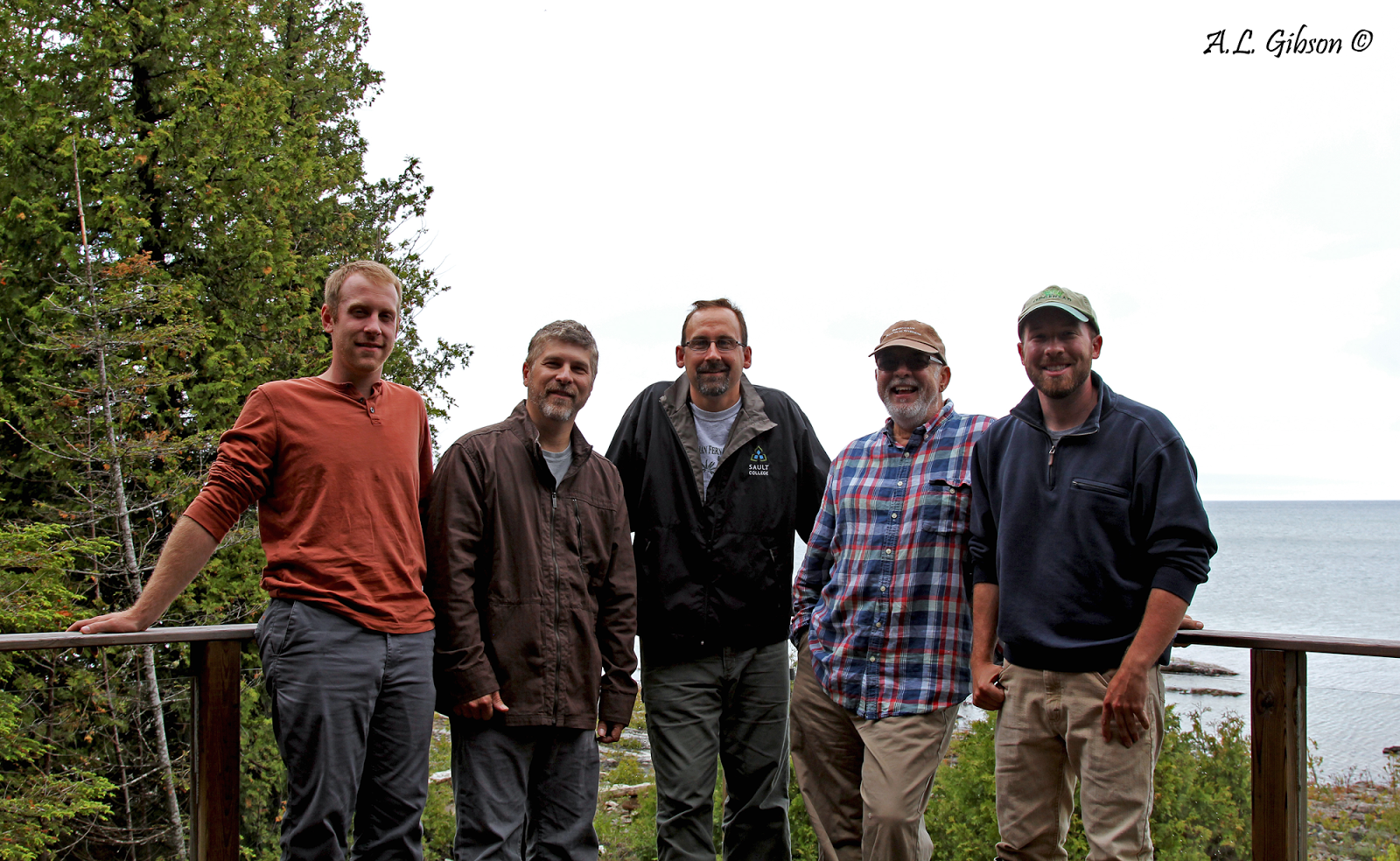
The Bruce Crew! L to R: Stefan Weber, Drew Monthie, Rob Routledge, John Manion, and your narrator


The rest of the crew met up at our lakeside cabin we'd rented for the week. All four other gentlemen were exceptional field botanists/naturalists and even better human beings! I can honestly say having the pleasure of experiencing the Bruce's splendor with all of them and the memories, laughter and camaraderie shared was second to none. Each one of us brought something unique and valuable to the table, but I must single out John's penchant for cooking as perhaps the best of all. We ate like royalty while up there and all pitched in to take his dish and meal ideas from paper to plate. I can't recall a better week of eating before or since. John, I'll never forget those honey drizzled, prosciutto-wrapped stuffed figs. Bliss!

One of our daily tributes to Jackie for being unable to join our trip due to a sudden knee injury


The only dark cloud to hang over our trip was the loss of our friend, Jackie. She was originally part of the Bruce Crew but suffered a fall and shattered her knee cap shortly before our departure that required surgery and lots of rest. Jackie is a dear, dear friend of mine whom you may recall has her own splendid blog, Saratoga Woods and Waterways. She's also graciously opened her home and favorite areas of upstate New York to me on two trips that I often still think about years later. Jackie was never far from our mind and we made sure she knew that by arranging her name in a variety of different items each day and sending her a get well email. My favorite was the one pictured above made of forget-me-not blossoms that abounded outside the cabin (no worries, it's a non-native species, so no harm done picking the plants!).

Our secluded cabin right on the Lake Huron shoreline nestled among the cedars, pine and spruce


I'd be remiss if I didn't take a moment to show off the location of our dreamy rented cabin. It resided in a secluded area on the western shorelines of the peninsula's northern end near Dorcas Bay. The interior was nicely furnished, comfy and quite spacious but nothing could beat the huge back deck and its phenomenal view. The surrounding coniferous woods and cobble shoreline was full of exciting flora and the morning serenade of warblers galore singing their hearts out outside my window is an alarm clock I'll never best or forget.

Keying out plants while drinking a beer was a favorite evening activity of mine


That gorgeous back deck saw lots of action with several nights of expert grilling by Rob; plenty of beer drinking and cigar smoking (at least for Rob and I); and provided a scenic spot to work out the day's unknown plants we collected/came across.


The Bruce Crew's combined naturalist library


Speaking of figuring unknown things out, our group was hardly in short supply of relevant literature and/or resources while up on the Bruce. Between the five of us, our combined library was impressive and came in handy. If anything, it provided a hands on chance to check out books I've yet to add to my naturalist bookshelf. In many cases, at least one of us already knew what most anything was others drew a blank on but with so many books it seemed like a lock we'd be able to nail down an ID on any mystery organism, no matter its place on the tree of life.

The adult sand hill crane is an obvious spot but can you find its little chick too?


The Bruce isn't just a botanist's dreamland but a birder's, too! I'm a casual birder at best most of the time with my attention usually fixated on the ground. It's easier to focus on plants and merely pay attention to the songs and calls filtering down from the canopy than actively seeking birds out with my binoculars. But I'd been a fool to not take advantage of the returned neo-tropical migrants and northern species rarely seen/heard in Ohio while up in Ontario. The highlight for me was stopping along a grassy meadow to observe a pair of sand hill cranes, only to realize they had two chicks with them! That was a new experience for me! Can you find the chick in the photo above?

Lake Huron sunset from the back deck of our cabin. Not too shabby, eh?

I know this wasn't the most exciting or captivating of posts but rest assured the next half dozen or so to follow will more than show just how unique and majestic a place the Bruce genuinely is. It's one of eastern North America's best kept secrets but certainly famous and popular with those who know and experienced its beauty. I hope you'll stay tuned and come back as I reminisce on one of the most fun and rewarding weeks of my life. Thanks for stopping by!

- ALG -