Showing posts with label Cedar Bog. Show all posts

Wednesday, January 29, 2014

Plant Quiz Solved: Prairie Valerian (Valeriana ciliata)

Congratulations to Michael Fitts and Bob Glotzhober for correctly identifying this mystery plant as the very rare and state-endangered swamp valerian (Valeriana ciliata).  This late-spring bloomer only occurs in two fen meadows in the west-central part of Ohio and that's it statewide.  Its leaves are reminiscent of an elaborate trident-like weapon with silvery margins that really stand out on sunny days.  The small, nondescript flowers won't be quick to catch the eye but upon closer inspection, one might recognize them as similar to the large-flowered valerian (Valeriana pauciflora).

Thanks to all those who played along on here, on Facebook, and though email!  Keep your eyes out for another plant quiz in the future; maybe one not so tricky!

Prairie Valerian flowers
Prairie Valerian leaf


Time for another plant quiz!  Take a gander at the accompanying photograph of the plant in question and leave your answers/responses in the comment section below.  Note: the plant is the yellow/green specimen in the foreground on the right.  Thanks to all those who decide to play along and best of luck!

Do you recognize the plant in the foreground on the right?

Sunday, June 9, 2013

Showy Lady's Slippers at Cedar Bog!

My previously promised series on my time in the Adirondacks of upstate New York are in the works and will be arriving this week.  I just wanted to take this time to get a quick public service announcement out there to all interested parties that the showy lady's slippers (Cypripedium reginae) are nearing peak bloom at Cedar Bog now! I wrote about them in much greater detail last year in a post that can be found right here.   I was too busy to publish the post before/during their flowering period last year and wanted to correct that this time around!

Showy Lady's Slipper Orchid - Cypripedium reginae)

If you've never seen these beauties in person before, I couldn't recommend some time spent with them more.  It's worth the drive from any corner of Ohio to see our largest and arguably "showiest" orchid in perfect bloom.  Your blogger was there earlier last week to do a census count on the population; something that had apparently never been done and I was more than happy to take the time to do so.  The final count was almost 500 flowering plants.  That's almost 500 gorgeous reasons to get in your car and make the drive to Cedar Bog sometime this week.  There's plenty more to see than just these so make sure to walk all around the boardwalk trail and see what other fascinating plants and habitats it has in store.

Just please be sure to remain on the boardwalk at all times; each year it seems to get worse with trampled "livestock" paths off the boardwalk to the best clumps of these orchids.  These rare plants take up to a decade or more to reach flowering maturing and can live for decades more as they grow into larger, double-flowered specimens.  No one wants to see all that time and potential lost because of our own over-eager attempts to see them closer and more personally.  So if you have telephoto lenses or good zooms on your camera utilize them and not your feet!

Cedar Bog is located near Urbana, Ohio in Champaign county.  You can check out their website for directions and more information here: http://www.cedarbognp.org/.

Saturday, February 9, 2013

Small Purple Fringed Orchid

There are few things better than slipping on your knee-high rubber boots and getting in deep with the mosquitoes all under the hot June sun for this nature lover.  Perhaps many of you read that with the taste of sarcasm but I assure you there is none!  I know Swamp forests aren't very high on most people's list of places to visit during the summer months but most people aren't in pursuit for one of our state's most stunning wildflowers.

Boardwalk through the swamp forest at Cedar Bog

This particular hardwood swamp forest in west-central Ohio is one of the finest in the state and home to a number of curiosities.  The forest canopy is dominated by black ash (Fraxinus nigra) and red maple (Acer rubrum) with pumpkin ash (F. profunda), green ash (F. pennsylvanica), swamp white oak (Quercus bicolor), American elm (Ulmus americana), and tuliptree (Liriodendron tulipifera) mixed in, while the shrub layer consists largely of spicebush (Lindera benzoin) and winterberry (Ilex verticillata).  The ever-advancing onslaught of emerald ash borer puts woods comprised of this much ash in great jeopardy.  My hopes and wishes are probably in vain but with any luck and human-intervention perhaps this patch will be spared.

Black ash and red maple swamp forest

Despite the air oozing with humidity and the price paid in blood, swamp forests are worth the troubles for those willing to explore their depths during even the most unfavorable of times.  The shaded and moist conditions of the forest provide excellent growing conditions for many obligate wetland plants that carpet the mucky ground in a thick, brilliant emerald carpet.  Along the boardwalk at Cedar Bog you're sure to see many of these swamp forest associate species such as: Michigan lily (Lilium michiganense), Virginia iris (Iris virginica), fringed loosestrife (Lysmachia ciliata), jewelweed (Impatiens pallida), purple-stemmed angelica (Angelica atropurpurea), swamp thistle (Circium muticum), crested wood fern (Dryopteris cristata), sensitive fern (Onoclea sensibilis), fowl mannagrass (Glyceria striata), and Carex bromoides.


Early spring in the swamp forest

In early spring the thawed mucky soil comes alive with a sea of charming golden flowers from the marsh marigolds (Caltha palustris) that seem to never end as you gaze out across the swamp.  Mixed in with the marsh marigolds during this time are hundreds of skunk cabbage (Symplocarpus foetidus) plants unfurling their leaves for the spring.  Skunk cabbage in its own right is a fascinating and unique plant that you can read up on from an earlier post HERE.

Come June the marsh marigolds and skunk cabbage blooms are long gone, replaced by maturing seed pods that will ensure this swamp isn't lost of their beauty any time soon.  But as those plants yearly life cycle's are winding to a close another is just getting ready to really get going and reveal its rare beauty to the few who seek it.

Small Purple Fringed Orchid - Platanthera psycodes

In a particular spot within Cedar Bog's highly diverse swamp forest lives one of the summer's most splendid of floral treats: the small purple fringed orchid (Platanthera psycodes).  About two dozen plants grace the dappled shade under the ash and maple, their wands of lacy inflorescences painted the most majestic of purple. In other part's of its range it's not uncommon to see more pink/rose colored specimens.

Small Purple Fringed Orchid - Platanthera psycodes

Unfortunately, like many of its orchid kin, this species is rather scarce in Ohio and is currently listed on our state's rare species list as potentially-threatened.  Its habitat of pristine, undisturbed swamp forest becoming such an uncommon occurrence is largely to blame.  Just about all of Ohio's wetlands, no matter the type were drained and converted to agriculture or development early on, leaving very little left intact today.  It's not all doom and gloom though!  Last February I sat in on the rare plant meeting that discusses and evaluates the status of Ohio's rare flora and it was decided after additional discoveries of this plant that it should be downgraded from threatened to potentially-threatened. It's certainly not out of the woods by any stretch but I'll take even the smallest of good news when I can.

Small Purple Fringed Orchid - Platanthera psycodes

There is little doubt this orchid is one of the more stunning examples mother nature has to offer.  I've always thought of the Platanthera genus of orchids as the one's who love to dance.  Each individual inflorescence appears like a petite angel caught in the middle of an elegant performance.  While beggars can't be choosers, I wish to someday make it up to areas in Michigan and Wisconsin where this orchids fills roadside ditches and wet meadows with their splendor by the hundreds!

Small Purple Fringed Orchid - Platanthera psycodes

You would think a plant so vivid and tastefully colored would be an easy eye-catcher in the field but that's rarely always the case.  Even when you know where to look these orchids have an uncanny ability to hide in plain sight among the shadows and vegetation.  Upon coming across this population in Cedar Bog to do a population assessment my eyes only caught a few flowering stems at first but after adjusting my sight and focus I found plenty more in varying sizes and stages of blooming.

Small Purple Fringed Orchid - Platanthera psycodes

An even closer look makes the flowers materialize into little purple faces accompanied by frilly beards and two unblinking eyes.  Of course these aren't 'eyes' at all but rather little packages of pollen called pollinia in orchid-speak.  The primary pollinators of many, if not most Platanthera orchids are diurnal and nocturnal members of the insect order Lepidoptera, or butterflies and moths.  When a moth probes the flower's long nectar-filled spur for a sugary treat it accidentally comes into contact with the pollinia.  With any luck the package of pollen attaches itself to the passing pollinator and is off to the next flower/plant for depositing and pollination!

Small Purple Fringed Orchid - Platanthera psycodes

The 'small' aspect of this flower's name comes by the way of another similarly purple-flowered species of Platanthera known as the, you guessed it...large purple fringed orchid (P. grandiflora).  Living in Ohio you'd be the luckiest botanist in recent memory to have the need to differentiate the two as only the small species is still extant within our borders.  The larger taxon was only seen a handful of times in the extreme northeast corner and not for nearly 100 years.  I plan to eventually do a post on my trip to the cranberry glades area of West Virginia this past summer to see and photograph the large purple fringed orchid.  Until then those interested in a photograph of it for comparative reasons can click here for an image on my Flickr page.

Aerial view of the Small Purple Fringed Orchid 

I'll wind down with this image taken from above of a purple fringed orchid.  The alignment and symmetry is incredibly and a true work of nature's art if you ask me.  I encourage more people to feel  adventurous and brave the mosquitoes and humidity by sloshing around their nearest swamp or wet woods.  If your timing is right and with a little luck on your side you never know what you may stumble across!  Places like this are rarely explored that time of year and leave plenty to the imagination on what lies inside...


Wednesday, January 23, 2013

Plant Quiz Solved! Bog Birch (Betula pumila)

Congrats to Jim, Pete, and Dennis for correcting identifying this plant as bog birch (Betula pumila).  This photograph was taken in mid-May at Cedar Bog nature preserve in Champaign Co., Ohio.  Bog birch is a northern disjunct here in Ohio and survives in a select few fens and bogs in the state.  Due to its rarity it is considered a threatened species here in Ohio.  In fact, the population at Cedar Bog is one of the most southern stations for this plant in North America.  The latest period of glaciation brought this species south into Ohio when the environment and climate was more supportive of the birch and its northern associate plants.

Bog birch is also known as swamp birch and the smallest member of the birches native to Ohio.  It rarely grows taller than 10-15' and commonly forms shrubby thickets on the margins of fens, bogs, and wooded swamps.  Apart from the leaves the maturing fruit bodies on the shrub in the photograph should have helped in narrowing this down to a member of the Betulaceae family.

Thanks to those who played along and I look forward to posting more plant quizzes in the near future!

I've been getting back into the blogging mindset and attitude recently and while I'm organizing and writing I thought I'd throw in an appetizer-like plant quiz post in the mean time.  Check out the photograph below and see what you think and comment with your guesses and/or answers.  Best of luck!

Do you recognize this plant?

Thursday, June 7, 2012

The Showy Lady's Slippers of Cedar Bog

Cedar Bog.  Few places in the Midwest, let alone Ohio, have as much botanical wonder, biodiversity, and history stored inside than the white cedar swamp forests, fen sedge meadows, and tall grass prairie habitat here.  Owned and operated by the Ohio Historical Society since 1942, it was the first Ohio nature preserve to be purchased with state monies and is on the national natural landmarks register to boot.  Located in south-central Champagin county, Cedar Bog currently preserves well over 400 acres of original habitat and is home to nearly 100 rare species of flora and fauna.  It's a good thing this gem was saved and preserved because Ohio's intact, naturally-occurring wetlands are a very rare thing today.  Around 90% of Ohio's wetlands no longer exist and are gone forever. From over 5,000,000 acres pre-settlement to just a tiny fraction of that in under 300 years is depressing but that's what makes places like Cedar Bog so precious and vital to our biodiversity.  If you want a fact to really drive the nail home on our wetland habitat loss: California is the only state that has lost a larger percentage of its original wetlands than Ohio.  Click this link here for more on the matter.

Don't be fooled by the name however.  Cedar Bog is not a bog but in fact a fen.  What's the difference?  Bogs are non-flowing acidic environments associated with accumulated masses of sphagnum moss while fens have internal flowing groundwater that seeps to the surface and is usually rich in magnesium and calcium, making for a neutral to alkaline environment.  Just remember "fens flow"!

View out across the fen sedge meadow of Cedar Bog

When the early pioneers first started to settle the Mad River valley they found countless tracts of wet, marly fields and meadows full of mosquitoes and curious plants that didn't make for good farm land.  Quickly and with prejudice, the land was drained and transformed to support their agricultural ways while the natural landscape slipped into memory.  The 450+ acres Cedar Bog currently preserves was once a fen complex over 7,000 acres in size.  Imagine 7,000 acres of pristine fen habitat choked full of fascinating flora, massasauga rattlesnakes, spotted turtles, swamp metalmarks, and indigenous brook trout.  I can't fault the settlers for their lack of foresight or preservation but what a sight that must have been.

The Mad River valley was host to a seemingly infinite supply of fen complexes and wetland habitat pre-settlement that served as a reminder to the area's icy past.  Over 12,000 years ago as the Wisconsin glacier receded to the north it left behind a barren landscape of melted ice, glacial till, and boreal plant species from the northern climates.  The previous period's ancient river valleys were filled with gravel and saturated with melt water, which today comprises west-central Ohio's natural aquifers.  In spots where this cold, calcareous groundwater percolates and bubbles to the surface is where these incredible fen communities persisted for thousands of years after the glaciers left, leaving behind the plants and animals you won't see anywhere else in the state today.
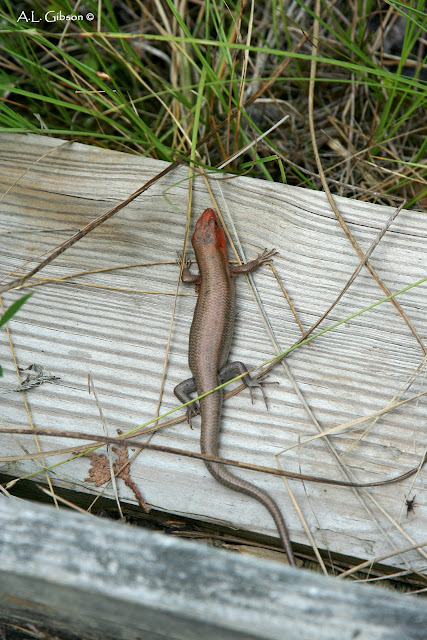
Mature male Five-lined Skink (Eumeces fasciatus) on the boardwalk.


Okay, enough of the history lesson even if I could go on and on.  Fens and their histories and biological communities fascinate me to no end and I could blab about them forever!  Now on to the main event and that magical word 'orchid' in the title that probably nabbed your attention.  But not before I share a quick tidbit about one of Cedar Bog's most frequently seen animals.  Pictured above is a critter I'm willing to guarantee just about everyone sees on their stroll down the boardwalk.  Five-lined skinks love to sun themselves on the warm wood and then go scurrying off as your footsteps approach.  Good luck trying to catch one, these guys move like lightning!  Juveniles start off black with five yellowish lines down their backs and tails of the most gorgeous electric blue you've ever seen.  The specimen above is a mature male with its copper-colored body and red face.

Orchids, orchids...I know, I know.  So without testing your patience any further I give you North America's largest terrestrial species of orchid.  An orchid that stole my heart many years ago along these very same creaky boardwalk planks and has yet to release me from its grasp.

Showy Lady's Slipper (Cypripedium reginae)

Scattered along the margins of the northern white cedar (Thuja occidentalis) of which Cedar Bog gets its name, lies one of the greatest botanical shows Ohio puts on each early June.  The showy lady's slipper (Cypripedium reginae) is the largest and last of the slipper orchids to bloom and mother nature certainly knows how to save the best for last.

An 'eat your heart out' clump of Showy Lady's Slippers (Cypripedium reginae)

This is my sixth year in a row heading to Cedar Bog to see the performance and what a spectacle they've been this time around.  While my run isn't nearly what many other local residents, botanists and orchid-lovers have going, I can say this has been the greatest year I've seen them put on in my experience and a number of  other long-time fans are voicing their agreement.  Just look at that clump above!  Nearly two dozen plants all clustered together and topping out over three feet tall under the partial shade of the cedars is a site no one is likely to forget anytime soon.

Showy Lady's Slipper (Cypripedium reginae)

Each flower's pouch or 'labellum' is about the size of a golf ball and delicately painted the most perfect shade of pastel pink to be found in nature.  Depending on what I assume to be a matter of sunlight, the labellum's pigmentation can vary greatly from soft and pale to intense and deeply saturated.  Another common name for these is the queen lady's slipper.  As the binomial nomenclature would have it, the scientific or botanical name for this species is very fitting.  The scientific epithet of reginae translates to 'queen', implicating the regal and majestic beauty of this orchid.  The lady's slippers genus name was conceived from the combination of the Greek word Kypris (for Cypris, the goddess of beauty and love) and the Latin word pedis  (meaning 'foot') as told by Michael Homoya is his brilliant book The Orchids of Indiana.


Showy Lady's Slipper (Cypripedium reginae


Taking a closer look at the inflorescence or 'slipper' of the showy ladies just magnifies their stimulating appeal.  I was happy to have coincidentally timed my visit on an overcast day right after a rain shower had passed through, giving all the slippers an aesthetically pleasing coating of water droplets.  Unfortunately their beauty is not lost on those who seek to remove them from their rightful homes.  Ignoring the heavy loss they have endured from habitat loss due to succession and destruction, these royal plants have long fought the hands and shovels of mankind.  The floral trade, ignorant digging for wildflower gardens and careless picking has removed these plants to the point of extirpation and extinction of populations throughout much of its range.  Even the botanist is to blame in some situations where avid over-collecting depleted their numbers to nothing.  This is one of the those plants that is best touched with our eyes only, despite the human urge to take the beauty home with us.

North American distribution of Cypripedium reginae (courtesty BONAP)

Looking at the distribution map for this species shows how strong an association it has with the northern Canadian provinces and Great Lakes region.  The further south you slip away from the lakes the more rare it becomes due to an increased lack of habitat availability.  Their preferred habitat of fens, northern swamp woods and glacial depressions aren't found further south than Ohio, hence their increase in frequency the further north you go.  Populations in the south, such as in the Appalachians, grow in circumneutral seeps in limestone regions where plants are few in number and locations.  The one vitally important thing an environment must support regardless of geographical location is what's called "cold-bottom" conditions.  These conditions exist when groundwater reaches the surface and saturates the soil to create a constant supply of cold water that this plant needs to survive.  This in turn allows these plants to exist and survive in more southern latitudes whose normal conditions would not otherwise support them.  In many cases where these plants have disappeared despite not much disturbance to the habitat is the result of a change in the hydrology.  It's not just the surface you have to worry about but what's going on underneath as well to keep these orchids happy and alive.

Showy Lady's Slipper (Cypripedium reginae)

An interesting piece of information about this particular species that will probably engage my entomologist readers and friends most is that the showy lady's slipper is apparently the only eastern Cpypripedium that is largely pollinated by flies and beetles rather than bees.  In any case, the insects are attracted inside the labellum by the promise of a nectar meal but are quickly disappointed to find it's a sham and they are forced to retreat back out the way they came.  Upon their exiting they (hopefully) pick up a package of pollen (pollinia in orchid-speak) from the column (the unique orchid organ comprised of fused stamens and pistil) and in a case of instant memory-loss, enter a new labellum in search for that mythical nectar and we have pollination!

Showy Lady's Slipper (Cypripedium reginae)


There truly are few other plants that I can sit in front of and admire their timeless grandeur for what seems like hours on end.  It's not everyday one sits in front of royalty like this and can have such close interaction with them.  A warning must be issued though to all who suffer with frequent bouts of skin irritation and dermatitis.  The dense pubescence of the leaves, stem and pedicels can cause a severe case of dermatitis much like that of poison ivy (Toxicodendron radicans) to those susceptible.

The incredibly early start to this year affected these plants much like the rest and saw the showy lady's slippers start blooming in late May, something I'd never seen before.  The intense heat of last week hastened the freshness of the blooms this year and the show has already passed when under normal circumstances would just be starting.  Be sure to mark late May and early June on your calender for 2013 to see these wondrous plants in action.  Don't fear, there are still many more orchid wonders Cedar Bog has in store for the future and I will be here to bring them to you when they happen!