Showing posts with label Whorled Pogonia. Show all posts

Thursday, May 14, 2015

Orchid Hike for the Cincinnati Wildflower Preservation Society

This past weekend your blogger had the pleasure of leading a hike for the Cincinnati Wildflower Preservation Society.  I've given presentations at their monthly meeting several times before but this was the first time we'd taken to the field together.  My talk for the society this past January dealt with Ohio's native orchids so it seemed appropriate to go from the projector to seeing them in person. Over 25 eager and excited participants, including quite a few familiar faces and friends joined me in the Edge of Appalachia and Shawnee State Forest region of extreme southern Ohio for quite the botanical foray.

I'd like to make specific mention of and say thanks to three special people who made the trek all the way from Ontario, Canada to spend the weekend and especially Saturday botanizing, birding, herping etc. with me.  It was a pleasure to meet and spend time with Bob Curry, Glenda Slessor and John Lamey and share the natural treasures of the Edge and Shawnee with them on Friday and Saturday. They had their sights especially set on seeing a particular orchid or two but I'll get to that later.  All in all, I think I can speak for them in saying they walked away impressed and mesmerized by southern Ohio's beauty and a strong friendship was kindled between them and myself.

Photo of the hike's participants courtesy CWPS member and treasurer, Randy Johnson

Someone must have flicked the switch for July because the week leading up to the hike and the day of was a scorcher.  Temperatures in the area reached highs near 90 and made the early May date seem like a mistake.  Thankfully, the orchids and numerous other plants seemed to take the stress in stride and largely looked great for our eyes and cameras.


Dwarf Crested Iris (Iris cristata)


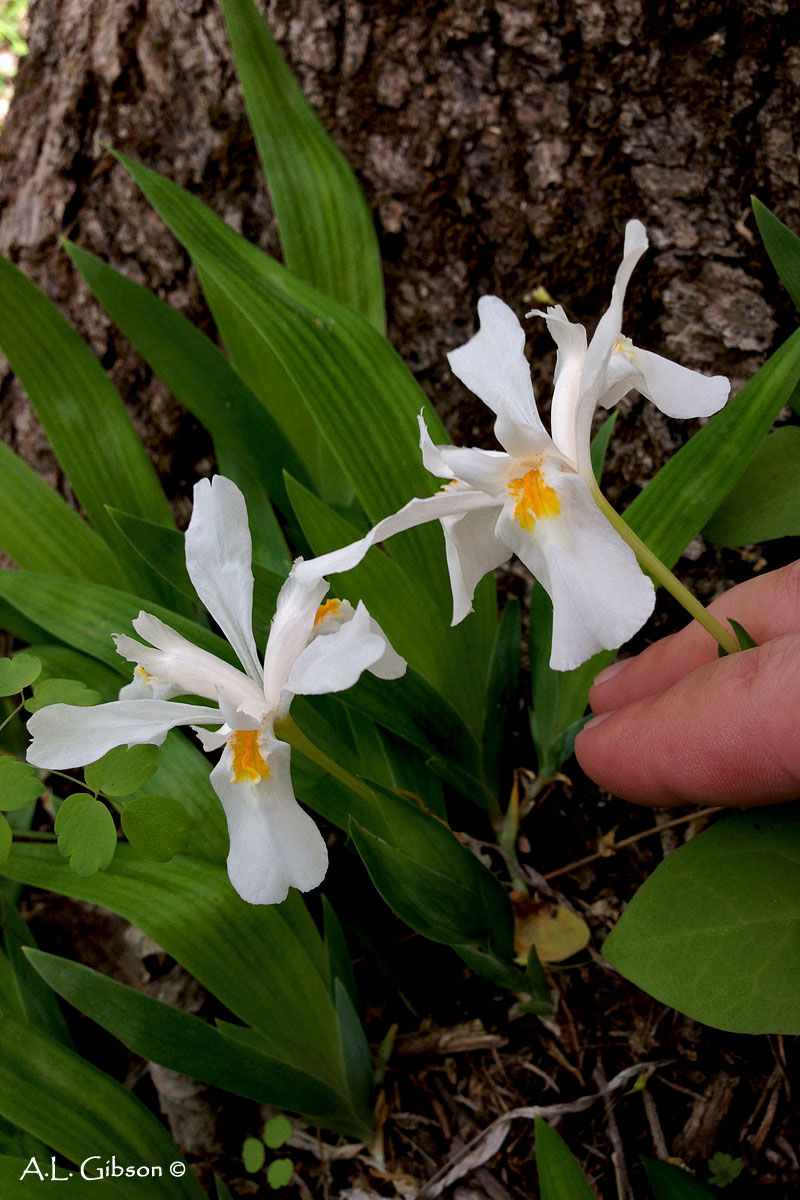
Davis Memorial state nature preserve in Adams County was our first stop for the day. Its rich forest slopes and dolomite limestone rock features are home to countless spring wildflowers and several species of orchid.  The regal looking dwarf crested iris (Iris cristata) was looking especially nice in the dappled shade.


Showy Orchis (Galearis spectabilis)

It wasn't long before we had the first orchid on our day's list with the showy orchis (Galearis spectabilis).  Most everyone remembers their important "firsts" and the showy orchis will forever be close to my heart as the first wild orchid I ever saw in bloom.  I've seen it countless times since but I never tire of its unique appearance.  Davis Memorial proved to be a favorable spot for this species as we came across upwards of a dozen plants of varying aesthetics and stature.


Wild Columbine (Aquilegia canadensis)


Davis Memorial is of special geological interest as well with its exposed dolomite limestone cliffs and gorge walls.  Dolomite contains more magnesium than your average limestone, which allows for a sweeter soil composition upon weathering.  Many plants do exceptionally well in said soils and why this region of the county is known for its stupendous spring wildflower displays.  Wild columbine (Aquilegia canadensis) is just one species that loves to grow from the rock face's cracks and small soil accumulations.


Large Yellow Lady's Slipper (Cypripedium pubescens)

The next orchid on this most orchid-y of days was the large yellow lady's slipper (Cypripedium pubescens).  We went on to see it at several more sites but it never failed to be a showstopper, especially when in large, many-flowered clumps.


Large Yellow Lady's Slipper (Cypripedium pubescens)


Most of the photos in this post I took during my scouting and personal botanizing time the day before leading the hike.  I like to take my time when engaging these remarkable, highly evolved plants and I knew that would be at a minimum during the hike.  It's also important to me I give my full attention to the questions, curiosities and concerns of my group.  For many this was the first time seeing orchids such as the large yellows, while I've been spoiled with dozens of encounters and hopefully dozens more to come.


Spring in Shawnee State Forest

I could honestly spend all day, every day in Shawnee during the spring.  There's a feel to its wild depths unlike anything else in the state. Bobcats to cerulean warblers, timber rattlesnakes or the goldenstar lily, Shawnee has it all.  There's few places better for orchids in the state either with Shawnee claiming over a dozen species throughout the year.


Pollinated and wilting large whorled pogonia (Isotria verticillata)

As I mentioned at the beginning of this post, Bob, Glenda and John came all the way from Ontario with one specific orchid in mind: the large whorled pogonia (Isotria verticillata).  While relatively common in the acidic, upland oak forests of eastern unglaciated Ohio, the large whorled pogonia is excruciatingly rare in Ontario.  In fact, it's believed to be extirpated and hasn't been seen above ground in quite some time.  Unfortunately, the unseasonably hot temperatures ushered this notoriously short bloomer into flower and quickly out by the time of their arrival.  They took Mother Nature's curveball in stride though and were beyond happy to see the plant even in a wilted state.


Rose Azalea (Rhododendron prinophyllum)

It wouldn't be the peak of spring in Shawnee without the vibrant blossoms of the rose azalea (Rhododendron prinophyllum).  They litter the roadsides on the forest's higher and drier slopes in an assortment of dark and light pinks.


Pink Lady's Slipper (Cypripedium acaule)


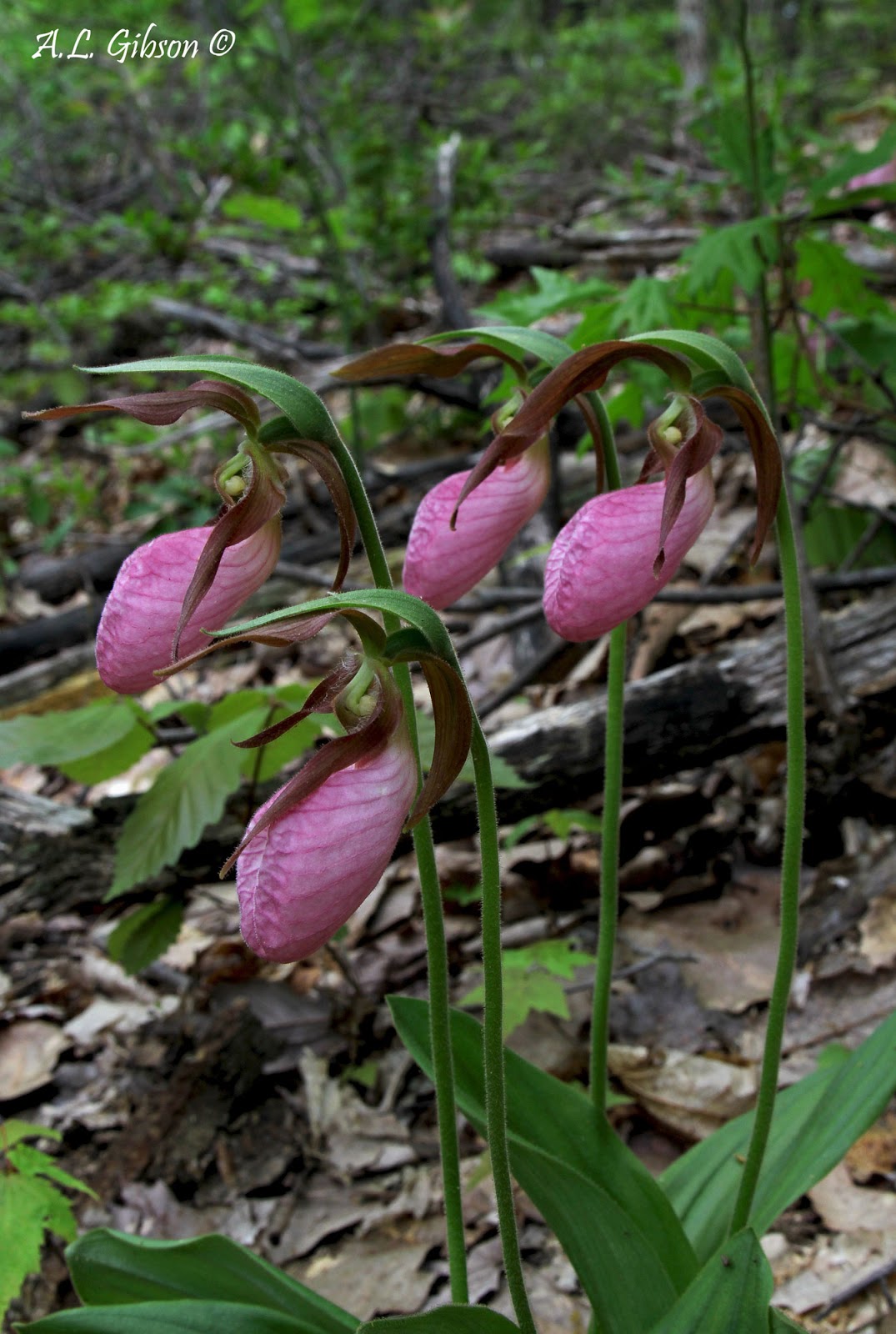
Speaking of pink colored flowers, I'd be remiss if I didn't make mention of the always exciting pink lady's slippers (Cypripedium acaule). This was a superb year for this orchid as most of my known sites had an exemplary number of flowering plants.  Each labellum or slipper looks like a big wad of chewing gum someone deposited atop a green stem to my eyes.


White-colored Pink Lady's Slipper


And then there's the case when someone is chewing peppermint flavored gum and leaves a white blob instead. I've observed this white-flowered pink lady's slipper for a handful of years running now and never get tired of its unusual charm.  I would hesitate to acknowledge this as a true case of albinism due the the dorsal/lateral sepals and column lacking the typical lime green coloration of an albino.  This seems to simply be a case of a white labellum only.


Rock Fir Moss (Huperzia porophila)

With so many pairs of eyes observing the landscape few things of interest are likely to slip past detection.  One fun item that stood out was large colonies of rock fir moss (Huperzia porophila) amassed on some steep sandstone slopes.  Lycopods to mycology, just about every aspect of our natural world is discussed and/or represented on a hike like this and makes for an educational experience for everyone involved.


Crossvine (Bignonia capreolata)
Umbrella Magnolia (Magnolia tripetala)


Other Shawnee oddities gracing our hike with their floral presence was the rare umbrella magnolia (Magnolia tripetala) and crossvine (Bignonia capreolata).  Both are plants much more common further south and just barely make it into southern Ohio.  They certainly have a southern or 'tropical' feel/look to them.  Just another feather in Shawnee's hat if you ask me!

Earlier on Friday during my solo foray, I decided to make my annual pilgrimage to a special and treasured site on the Edge of Appalachia preserve.  As incredible a site as it is, it's one that's too remote and too sensitive to bring a group of even respectful, well-mannered wildflower admirers to.


Hanging prairie on the Edge of Appalachia and one of my favorite views in the entire state

Of all the impressive views I've gazed out across in the Buckeye state, I'd have to say the one photographed above is on my very short list of the best.  This hanging prairie clings to the side of a hill; an island of rare grassland plants overlooking a rolling sea of contiguous forest.  No roads, no buildings, no people or anything to break the sounds of nature.  It's rare to get that kind of purity with no noise pollution and only adds to the splendor of the place.  Within its depths is a slew of prairie plants like scarlet paintbrush (Castilleja coccinea), prairie phlox (Phlox pilosa), hoary puccoon (Lithospermum canescens), heart-leaved golden alexanders (Zizia aptera), yellow star grass (Hypoxis hirsuta), white blue-eyed grass (Sisyrinchium albidum), arrow-leaved violet (Viola sagittata) and one very rare, very stunning orchid: the endangered small white lady's slipper (Cypripedium candidum).


Prairie phlox, scarlet paintbrush, hoary puccoon etc. in full, spectacular bloom


Small White Lady's Slipper (Cypripedium candidum)


Scarlet Paintbrush (Castilleja coccinea)

Hanging prairie is a true slice of botanical heaven and one I can't wait to visit each early May.  It's never disappointed in the past, it didn't disappoint this time around and I don't dare doubt it will break that streak any time soon.  I could dedicate an entire post of this length to the site and perhaps I will one day.

Needless to say the hike was a resounding success and everyone involved had a helluva time immersed in southern Ohio's spring bounty of wildflowers, orchids and birds.  Leading hikes never fails to leave me physically exhausted by mentally revitalized and freshened.  It's such a fun way to share my passion and knowledge for orchids, Ohio and our natural world as a whole.  I'll be leading two additional hikes for the Cincinnati Wildflower Preservation Society later this year in August and September, respectively.  Take a look on the left side of my blog for my events section for more details.  Special thanks to the Christine Hadley for helping me put this together and for asking me to lead this hike!  I/we certainly had an amazing time!

- ALG -

Wednesday, May 14, 2014

Spectacular Spring Orchids

As promised, I'm here to deliver on some of the botanical treats I went searching for this past weekend during my foray into the famed and ever-mentioned Adams and Scioto counties in southern Ohio.  I've decided to dedicate this post purely to my cherished and timeless orchids I spend so much time admiring and photographing.  I've seen all the featured species on this post plenty of times but there's just something about them that draws me back in with each reawakened spring.  The anticipation and rush never wanes as I glance upon them for the first time, like old friends I only get to spend time with a handful of times a year.

Large Yellow Lady's Slipper (Cypripedium pubescens)

If I've seen the large yellow lady's slippers (Cypripedium pubescens) once, I've seen them dozens and dozens of times but that has done nothing to dull the excitement of discovery.  Their golden glow set against the shadowed greenery of its newly lush forest habitat is a sight for sore eyes after a long winter.

Trio of large yellow lady's slippers
An uncommon double-bloomed plant on the R


While not state-listed and occasionally locally common in select areas of the state, large yellow lady's slippers' numbers have dwindled in recent decades as poachers and logging activities negatively affect this slow-growing and fickle plant.  It can take upwards of a decade for these and many other orchids to reach flowering maturity and some are highly sensitive to even moderate levels of disturbance.

Showy Orchis (Galearis spectabilis)

Showy orchis (Galearis spectabilis) was the very first wild orchid I ever saw in flower and from that moment on it cemented itself as one of my favorites for carrying that distinction.  I tend to see this species reach its best numbers in mature mixed mesophytic woods on mesic N-NE-E facing slopes where yellow buckeye, beech, sugar maple, and tuliptree are common associates.  While I love to enjoy these orchids with my eyes only, the same cannot be said for white-tailed deer.  Showy orchis is like candy to them and observing large, impressive specimens is always a special find due to high levels of predation.

Pink Lady's Slippers (Cypripedium acaule

Pink lady's slippers (Cypripedium acaule) are the black sheep of Ohio's indigenous lady's slipper orchids in both habit and habitat.  All other Ohio Cypripediums have leaves occurring on their flowering stems, however pinks have a leafless scape that arises from an equally unique pair of basal leaves.  In terms of habitat preference, pinks utilize dry upland oak/pine/hemlock forests with an acidic substrate while our other species all have an affinity and/or requirement for more moist, basic-calcareous soils.

Pair of pink lady's slippers in a Virginia pine stand
Rare white-flowered form of C. acaule


The venation pattern on the front of the "slipper" or "moccasin" acts as a visual nectar guide for passing bumblebees to notice and buzz over to for an inspection.  A sweet smell hints at the promise of a reward inside but the bumblebee only finds an empty, air-filled pouch it must now back out of and hopefully pick up some granular pollen in the process.  With any luck the bumblebee will visit another flower in a vain attempt at a meal and cross-pollination/fertilization will occur.  As with many other orchids and species of wildflowers, pink lady's slippers are known to occur in rare white-colored forms as pictured above.

Spring Coralroot (Corallorhiza wisteriana)

Perhaps the least visually appealing of the early orchids, the spring coralroot (Corallorhiza wisteriana) is nonetheless charming in its own right.  If you take the time to carefully inspect each individual flower's lip you'll find a snow-white surface splotched with magenta polka dots in quite the artistic display.  This species is saprophytic and relies entirely on its relationship with mycorrhiza fungi in the soil for sustenance and cannot photosynthesize due to its complete lack of chloroplasts (hence why there's no green to it at all).

Small White Lady's Slipper (Cypripedium candidum

If there's any species of spring blooming orchid I look forward to the most and refuse to miss out on, it's the state-endangered and very rare small white lady's slippers (Cypripedium candidum).  These tiny wonders are only known to occur in a handful of high-quality prairie remnants in the extreme north and south parts of our state.  These particular plants are from a secluded dolomite limestone barrens in the depths of Adams county.

Small white lady's slippers with your narrators hand for scale

The word 'small' is in their common name for a reason as this lady's slippers' slipper is only about the size of the end of your thumb.  Their waxy white labellums are ringed with magenta dots and accompanied by yellowish-green dorsal and lateral sepals.  A soft but sweet fragrance is emitted from the bloom as well and gives the nose as much a reason to love them as the eyes.

Small White Lady's Slipper (Cypripedium candidum

Their miniscule stature takes by breath away every time I see them even though I know what to expect.  Each is so delicately designed and a one-of-a-kind masterpiece.  I could see these beauties for the next 50 years consecutively and I'd love them that much more on visit number 51.

Large Whorled Pogonia (Isotria verticillata)


Large whorled pogonias (Isotria verticillata) almost seem to be a floral ode to a mythical beast long lost to the past.  It appears like a dragon, ready to breathe fire and devour any prey foolish enough to come too close.  This orchid prefers more or less the same habitat conditions as the aforementioned pink lady's slippers and often times will even occur together in their acidic upland oak/pine woods.  It's common to see a population of dozens of sterile plants with (if you're lucky) one or a few blooming individuals mixed in.

Kentucky Lady's Slippers (Cypripedium kentuckiense) beginning to bud up

To end my day of plentiful orchids in peak bloom, I decided to cross the mighty Ohio River and check on a site for the rare Kentucky lady's slippers (Cypripedium kentuckiense) I've photographed and shared on this blog before. The typical eight plants were present and just beginning to bud up with one starting to get some color and open slightly.  Another week or so and they should be in peak shape and worth another visit.

Tuesday, May 7, 2013

Flora-Quest Weekend 2013 Rewind

Another Flora-Quest weekend has come and gone and what an exciting weekend it was!  Shawnee state forest and the nearby Edge of Appalchia preserve system played host to well over 100 people with interests ranging from wildflowers and birds to moths and amphibians in this seventh installment of the popular spring event.  It was a fantastic chance to get out into the forests for the best of southern Ohio's spring wildflower shows and soak in its beauty with others who share in my passion for the outdoors.  Even better is the camaraderie and catching up with old friends I haven't seen in some time and the opportunity to finally meet others in person for the first time.  It's just an overall incredible atmosphere your blogger is quite lucky and fortunate to be a part of.

Scenic look out across the rolling hills of Shawnee state forest 

This was my second year in a row being a trip co-leader and I couldn't have asked for a better partner in the phenomenal and well-known nature photographer, Ian Adams.  I had never met Ian before but after just one day out in the field with him, I think I can speak for the both of us that a friendship was quickly kindled.  His eye for capturing nature with the camera lens is second to none and he's quite the naturalist as well with a great depth of knowledge and understanding about our natural world.

Our group was largely made up of folks who wanted to center on photography and soak up the tips, techniques, and tricks Ian (and myself to a smaller degree) had to share.  With being a trip leader, I largely left my own camera in its case and instead wanted to focus on educating and leading my group efficiently and without the distraction.  I did however use my iPhone to snap a number of pictures of what we saw and am quite pleased with the way most of them came out.  As a result just about all the photos used in this post were taken with my phone; which goes to explain why my hands and/or fingers are in some of the shots.  The iPhone can have a hard time focusing on smaller subjects in the foreground and using your hand as a backboard can help make the sensor's focusing job that much easier.  That all being said let's jump into some of the floral highlights of Flora-Quest weekend 2013!

Flowering dogwood along a flowing stream in Shawnee state forest

First thing worth saying is what a difference a year can make.  This time last year had the forest and plants looking like late May/early June and the trees completely leafed out; which was certainly not the case this time around.  Things were all just about right on time with many of the Flora-Quest classics all present and in full bloom.  The snow white blossoms of the flowering dogwood and wild plums along with the vibrant pinkish-reds of the red bud carpeted the forest under story in their typical stunning fashion.

Dwarf crested irises (Iris cristata) in full bloom along Shawnee's roadsides

Instantly noticeable all along the forested roads of Shawnee were the regal purple carpets of dwarf crested iris (Iris cristata) in full bloom.  The underground rhizomes do their jobs well and quickly spread out to give the forest a seemingly endless supply of the short-lived flowers, perfectly timed up with our arrival.

Dwarf crested irises (Iris cristata)
Spectacular double-flowered iris


Upon closer inspection of their delicate flowers, the dwarf crested iris can truly be held among the floral elites of spring.  The soft shade of lavender they exhibit is contrasted stunningly by their petals honey yellow markings.  Our group was fortuitous enough to come across a spectacular double-flowered form that was most likely the result of some genes going a bit haywire.

Albino dwarf crested irises

Perhaps less rare but nigh on equally pleasing were some albino forms of dwarf crested iris.  Their shades of purple had been traded in for the purest of white with only the golden markings left behind to add any accentuation.

Large yellow lady's slippers (Cypripedium pubescens)

It's nothing revolutionary in admitting the promise of wild orchids to be one of the main draws to each annual Flora-Quest event.  This year found them waking up a bit late and more slowly than in years past but still putting on as magnificent a show as ever.  Large yellow lady's slippers (Cypripedium pubescens) never fail to impress and get a group's camera shutters clicking in unison.

Spotted mandarin (Prosartes maculata)
Pawpaw flowers (Asimina triloba)


One rarity that was completely absent from last year's spectacle was the evanescent blooms of the spotted mandarin (Prosartes maculata).  Their creamy white petals are feverishly spotted with tiny purple speckles much like if it was suffering from a case of the flower chickenpox.  On the opposite end of the scarcity spectrum, the malodorous pawpaw (Asimina triloba) was putting on its own show with their charming matte scarlet blooms.

Luna moth (Actias luna)

It wasn't all wildflowers for our group when we stumbled across a feeble luna moth while out and about.  Ian hypothesized its lackadaisical attitude and out-in-the-open location was foretelling that its job of mating had been completed and its life cycle come to an inevitable close.

Black-legged tick (Ixodes scapularis)

Another invertebrate critter we encountered while in Shawnee was hardly as welcome and grandiose as the luna moth and much more sinister.  The small speck climbing up your blogger's finger is the infamous black-legged tick, which also goes by the name of deer tick.  Of the three species of tick that call Ohio home (deer, dog, and lone star) only the deer tick can carry Lyme's disease; so naturally they seem to get the most attention.  Its smaller size and orange-colored back are helpful ID characteristics.  It's becoming much more prevalent in the southern/southeastern/eastern part of the state so be on the lookout for it!

Early pink azalea (Rhododendron prinophyllum)

An instant classic and inducer of many "oohs" and "ahhs" is one of my all-time favorite woody plants: the early pink azalea (Rhododendron prinophyllum).  A completely hidden and inconspicuous plant any other time of the year, early May is this heath family member's time to shine!  If you think its looks are good, definitely take the time to give it a whiff.  Its intoxicating aroma will impress your nose as much as its perfect pink blossoms please your eyes!

Dry hillside full of vernal iris
Vernal iris (Iris verna)


In addition to the aforementioned dwarf crested iris, Shawnee is also home to the state-threatened and absolutely breathtaking vernal iris (Iris verna).  Few other wildflowers can eclipse the electric blue/purple hues and royal demeanor of its blooms.  Most iris species are associated with wet-moist soiled situations but the vernal iris is a high and dry plant that prefers the xeric, sun-drenched ridge tops and rocky outcrops of extreme southern Ohio.

Bird's foot violet (Viola pedata)

It just wouldn't be spring in Shawnee without the annual display of our state's most dazzling of violet species: the bird's foot violet (Viola pedata).  Their large, showy flowers stick out like a sore thumb against the barren ridges and dirt banks.  The ones pictured are of the bi-colored form and seem to outnumber the typically more traditional light lavender monochrome plants.

Black-edged sedge (Carex nigromarginata)

I wouldn't be a real botanist if I didn't take the time to share with my group one of my favorite sedge species now would I?  I may have had a few odd looks and some scratching their heads as I gushed over the beauty and my love for the black-edged sedge (Carex nigromarginata), but they did agree it was a rather handsome little plant.

Large, leafing out tuliptree
Showy orchis (Galearis spectabilis)


While orchids like the showy orchis (Galearis spectabilis) showed off their glamour on the ground below, high in the tree tops our group was spoiled with a diverse array of fantastic birds.  Scarlet tanager, wood thrush, worm-eating warbler, cerulean warbler, hooded warbler, ovenbird, northern parula, American redstart, and whippoorwill is just a small sampling of the feathered friends we encountered.  Our group was even so lucky as to come across a gorgeous, healthy-looking coyote deep in Shawnee during Sunday morning's outing.  It quickly disappeared into the trees but those few fleeting seconds were special indeed.

Whorled pogonia (Isotria verticillata

One of the most fun plants last year's event missed out on was thankfully just coming into its prime this time around.  I was forced to show the swelling seed pods of the whorled pogonia orchid (Isotria verticillata) to my group last season but I was much more successful this weekend!  This infrequent orchid prefers the dry, acidic upland soils of oak/pine woods; often in association with mountain laurel (Kalmia latifolia) and other members of the Ericaceae family.

Whorled pogonia (Isotria verticillata

The whorled pogonia looks like a mythical beast out of the folklore of Greece or Rome with its spreading sepals and gaping "mouth"; waiting to consume its next unassuming victim.  It may not have the same following and fan club as the next orchid species but it has always been one of my favorites for its unique and chimerical appearance.

Pink lady's slipper (Cypripedium acaule)

Growing in close proximity to the whorled pogonia and sharing in its love for the dry, acidic mixed oak forest was some impressive clumps and patches of the pink lady's slipper (Cypripedium acaule).  I've seen this particular orchid dozens of times before in years past but it just never gets old getting reacquainted with their gorgeous faces each and every spring.  There's just something about them I find irresistible and I think my group easily shared in that excitement.

Black huckleberry (Gaylussica baccata)
Hillside blueberry (Vaccinium pallidum)


Two associates of the acidic oak woodlands happened to be in full bloom this past weekend and both end up producing a delicious fruit I can never get enough of.  On the left is the red bell-shaped flowers of the black huckleberry (Gaylussica baccata) with is cousin hillside blueberry (Vaccinium pallidum) flowering right alongside it. Both are members of the heath family (Ericaceae) and very common in the mountain laurel and azalea thickets of Shawnee state forest.

There's so much more I could share and wildflower pictures worth posting but if I don't stop now, I don't know that I ever could or would!  Flora-Quest proved to be once again an incredibly well put together and organized event that I think I can safely say everyone in attendance absolutely loved.  It's a shame to see it come to a close so soon but there's always next year to look forward to.  I hope to be an integral part of it once again and be leading some field trips but we'll see what possibilities it brings.  Next up on the docket is Mothapalooza June 14-16, being held right here in Shawnee state forest and on the Edge as well.  Hope to see some of you there!