Showing posts with label Bog. Show all posts

Monday, July 28, 2014

Botanizing the Florida Panhandle: Venus Fly Traps, Pitcher Plants,Sundews and more in Hosford Bog

*Part I* *Part II* *Part III* *Part IV*

A few weeks ago I had the pleasure of accompanying my partner and her family down to the Florida panhandle for a lazy week on the Gulf coast.  It felt great to sit around and relax with little to do but bury my nose in a book and relish the never ending supply of fresh seafood.  I'd been down to the sunshine state on several occasions as a child but those are all approaching a couple decades ago and well before any legitimate interest or passion for the outdoors had taken root in me.  So needless to say this time around had me salivating at the idea of what botanical treasures awaited my arrival.  I knew travelling so far south into such a contrasting region from my own would result in countless new life plants and unexpected surprises and I was not disappointed!

I managed to get out and about for two of the days we spent down there and the following few posts are dedicated to the ecosystems and flora/fauna I found most interesting and memorable.  Even if I had been able to dedicate every waking moment of my week to exploring the wonders of the central panhandle, I'd still only been able to scratch the surface of the diversity to be had.  Regardless, I'm thankful and pleased with what I was able to come across and hope you enjoy this look back at one of the more fascinating botanical forays I've yet experienced.

Power line cut full of insectivorous plants

In the days, weeks leading up to the trip, I sent out requests to my extended botanical family in the south for good sites and places worth a visit while in the area.  They came through in marvelous fashion and a majority of their suggestions I had to put on the shelf for the next time around as there was no way I could fit everything into the very finite amount of time available.  However, one place I knew I had to prioritize above all else came from Flickr friend and brilliant botanist/photographer Alan Cressler - you might recall his name from back in May when he was kind enough to share with me the small whorled pogonia (Isotria medeoloides) in northern Georgia - so of course I was all ears when he had some killer suggestions.  The place was called Hosford bog and within was a plant species that I'd only ever dreamed of seeing.

Venus fly trap and other insectivorous plant species

The Venus fly trap (Dionaea muscipula) is a plant of legend and one damn near every single person you talk to would know and/or recognize.  It always amazes people to learn this seemingly exotic species only naturally occurs in a small geographic area of North and South Carolina and that is it worldwide.  Not the jungles of Borneo, not the Amazon or the depths of the Congo but the good ol' U. S. of A.  The fact the hundreds of clumps of insect-eating horror before me weren't indigenous to the site but rather transplants from years ago did nothing to quell my excitement.  I'm sure I'll see them on their home turf someday but this would most definitely suffice for now.

Venus Fly Trap (Dionaea muscipula

I was too late to catch the fly traps in bloom but once again I was hardly disappointed, as in this unique case the vegetative state of the plant is the main draw.  Many of the plants exhibited a striking contrast between green and red on their modified leaves while others remained purely lime-colored.  You can gaze at all the online images of this plant you want, these included but nothing can prepare you for seeing their charm in the flesh.


All lime-green Venus fly trap (Dionaea muscipula)

Venus fly trap's "jaws" are modified leaves that have their inner surfaces covered in tiny trigger hairs that allow the plant to know when to snap shut with the hope of a meal inside.  Multiple trigger hairs must be touched in a relatively rapid succession for the plant to react and close in mere tenths of a second.  This prevents false captures from happening and precious energy being wasted should only one hair be moved by things such as raindrops or debris.

This brings up the topic of the morality of getting Venus fly traps to close as a means of entertainment.  You have to contemplate the amount of energy it must take for this plant to respond with such a rapid movement and then get nothing to replenish those stores.  It would be no different than playing a long game of fetch with your dog and then refusing it food and water afterwards.  Sure, it's just a plant but it's a pet peeve of mine to see people buy these in those humid plastic cubes at the local home improvement store only to have the plant dead and forgotten a week or two later.  

Venus Fly Trap (Dionaea muscipula


Even standing in front of them with the camera, I still felt like the Venus fly traps were plastic molds and not a real, living plant that had evolved over the countless millennia to be such a unique and fascinating being.  An interesting tidbit I would come to find out is the name "fly" trap is a bit of a misnomer in the fact it rarely utilizes flying insects as prey.  Ants, spiders, beetles, and other crawling arthropods are the dominate prey and something this specialized species has come to utilize most often.

Pink Sundew (Drosera capillaris) and Lycopodiella spp.

As fascinating as the Venus fly traps were, they were hardly the sole species of insectivorous plant to call the bog home.  The round scarlet clumps of basal leaves of the pink sundew (Drosera capillaris) were everywhere in the muckier, more saturated parts of the bog; their spatulate leaves glistening with insidious dew.  

Wet, open part of the bog with the endangered white pitcher plant (Sarracenia leucophylla)

If I came for the Venus fly traps then let it be said that I stayed for the white pitcher plants (Sarracenia leucophylla). The dry hummocks dotting the landscape of standing water were lined with their green-scarlet-white goodness and it was quite the task trying to take your eyes off their elegance.

White Pitcher Plant (Sarracenia leucophylla)

Back in Ohio, only one species of pitcher plant (S. purpurea) can call our state home and its diminutive stature and comparatively tame coloration is no match for its white-headed brethren.  Also known as scarlet pitcher plant, this taxon is listed as endangered in the state of Florida and currently under consideration for federal listing. Habitat loss/degradation, illegal picking/digging, and a very restricted geographic distribution all go hand-in-hand to make this gorgeous bug-eater a species on the brink.

White Pitcher Plant (Sarracenia leucophylla)


It's almost as if an artist with surgical hands and infinite patience took each blank green pitcher and meticulously painted its head with a delicate scarlet venation over the snow white background.  Each pitcher was like a fingerprint in that no two were exactly the same, every one a unique pattern and individual work of art.

White Pitcher Plant (Sarracenia leucophylla)

Much like the Venus fly traps, the white pitcher plants were done blooming for the year and had their respective flower stalks in various stages of decay and desiccation.  Once again, the real value lay in the leaves rather than the flowers so it was another none issue.


Coastal Plain Yellow-eyed Grass (Xyris ambigua)


An interesting aspect to pay attention to when traveling around is how the diversity of certain genera waxes and wanes depending on the region you're in.  For instance, the yellow-eyed grasses (Xyris spp.) are a pretty easy group to get under your belt in Ohio with our whopping two species.  But travel down to the Southeast and you're greeted by over 20 different taxa; including this robust and vigorous species I believe to be coastal plain yellow-eyed grass (X. ambigua).  It was quite prevalent throughout the bog and by far the showiest yellow-eyed grass I'd ever seen.

Mucky, saturated area of the bog with Drosera tracyi and Triantha racemosa

Despite the bog being rather small and long/narrow in shape, it was interesting to see how the plant associations changed with the level of saturation and water depth.  The open clay pans where shallow water flowed over it was always ensconced with dense clumps of Tracy's sundew (Drosera tracyi) and scatterings of white wands belonging to coastal false asphodel (Triantha racemosa).

Tracy's Sundew (Drosera tracyi)

You'd be hard pressed to find a more impressive sundew in North America than Tracy's.  Its long, green linear leaves seem to be on steroids and have to be the stuff of nightmares for any small insect.  Until recently it was regarded as a variety to the filiform sundew (D. filiformis) but was given full species status and can be told apart by its predominately-pure green color and super-sized appearance.


Coastal False Asphodel (Triantha racemosa)


Despite having never seen this specific wildflower before, I knew right away the snow-white stalks hiding among the enormous sundews on the clay flats belonged to the Triantha genus.  The coastal false asphodel (T. racemosa) looks almost identical to the sticky false asphodel (T. glutinosa) that calls Ohio's high-quality fen meadows home and is separated by technical differences in the styles and fruit capsules.  Since the two species' ranges don't overlap it's a pretty easy split, with T. racemosa being a coastal plains species and T. glutinosa an interior and northern occurrence. 

Fringed Meadow Beauty (Rhexia petiolata)

In a case similar to the aforementioned yellow-eyed grasses, the Southeast and especially Florida is a hot bed of diversity for the meadow beauties (Rhexia spp.).  Of the handful of species I saw while on the panhandle, I think my favorite was the fringed meadow beauty (R. petiolata) blooming in the bog with the sundews, pitcher plants, and Venus fly traps.  Most meadow beauties tend to show off their reproductive parts proudly with over-sized stamens but the fringed meadow beauty was a much more shy and conservative species.


Carex glaucescens
Fuirena squarrosa


A sedge-head in Ohio is a sedge-head anywhere and everywhere, so it should come as little surprise I'd keep an eye out for some new and unusual Cyperaceae finds.  Oddly enough, the Southeast is hardly a breeding ground for Carex diversity and of the handful or so of species I found, the southern waxy sedge (C. glaucescens) was by far the best.  Making up for the lack of Carex was the presence of a sedge genus I'd long wanted to come across but never had the chance to living/working in Ohio.  The umbrella sedges (Fuirena spp.), or pineapple sedges as I came to affectionately call them are an oddball group that look like spiky footballs.  Doing my best to follow along through the keys, I believe this one to be the hairy umbrella sedge (F. squarrosa).


Orange Milkwort (Polygala lutea)

I went into my panhandle forays with little expectations or demands on what I wanted to see and figured just about everything would be new in one way or another and equally exciting.  However, one wildflower I had my fingers crossed on was the orange milkwort (Polygala lutea) and as luck would have it I got plenty of chances to soak in its charm.  The plants at Hosford bog seemed to grow in a more prostrate manner than is typical but that did nothing to take away from their delicious-looking, creamsicle appearance.

Black-and-Yellow Garden Spider (Arigope spp.)

As if the sundews, pitcher plants, and fly traps weren't enough, the bog was littered with black-and-yellow garden spiders (Arigope spp.) biding their time on the edges of their webs, waiting for a fly lucky enough to escape death-by-plant to run out of said luck and get caught in its stickiness.

I could easily go on about the wonders within Hosford bog, but this seems as good a place as any to call it quits for now and pick back up on another Florida panhandle botanical foray in the very near future.  The next couple posts will deal with the wondrous longleaf pine savannas of Apalachicola National Forest and the slew of phenomenal wildflowers that come with them.  Stay tuned!

*Part I* *Part II* *Part III* *Part IV*

Tuesday, June 24, 2014

Brown's Lake Bog State Nature Preserve

"There are few habitats I love to explore and delve into more than the peaty goodness that is a sphagnum bog". Those words were written down a mere two weeks ago to open a post on a spectacular bog in southeastern Michigan and your narrator meant every word.  So while up in northern Ohio this past weekend with botanical companions Daniel Boone and Tanner Morris to see the previously shared round-leaved orchids at Clear Fork Gorge state nature preserve, it was an easy decision to make the most of our time in the area by making a short additional drive to do some boggin'.

Sphagnum vegetation mat at Brown's Lake Bog state nature preserve

Brown's Lake Bog state nature preserve is located in Wayne county and one of the best remaining sphagnum bogs in the entire state.  Its millennia-old floating vegetation mat on the margins of the open kettle pond is home to a slew of typical bog associates and acidophiles, many of which are quite rare and state-listed species found in few other places.  The bog itself has been on conservationists radars for decades and has been under the protection and stewardship of the Ohio chapter of the Nature Conservancy for almost 50 years and is a designated National Natural Landmark.

Surrounding swamp forest at Brown's Lake Bog

The bog and open kettle pond are surrounded by a lush swamp forest that is the result of previous bog habitat reaching its climax community.  The open nature of the floating sphagnum mat is only a temporary chapter in the life of any bog and gradually fills in with peat and woody vegetation as the forces of natural succession chug along. Given enough time and no intervention, the kettle pond at Brown's Lake Bog will eventually look identical to the photo above and give little evidence it ever existed in its current form.

Red maple, silver maple, and ash make up the majority of the swamp's canopy at Brown's Lake with spicebush (Lindera benzoin), winterberry (Ilex verticillata), smooth alder (Alnus serrulata), cinnamon fern (Osmundastrum cinnamomeum), crested wood fern (Dryopteris cristata), sensitive fern (Onoclea sensibilis), and bluejoint grass (Calamagrostis canadensis) occurring throughout its lush understory.

Water Pennywort (Hydrocotyle americana)


One of the more interesting and certainly inconspicuous wildflowers to thrive in the mucky, acidic soils of the swamp woods is the American water pennywort (Hydrocotyle americana).  Its creeping habit can form dense colonies in suitable conditions, where you're much more likely to notice its round, scalloped leaves and completely overlook the tiny flower clusters located in the leaf axils.

Open water of the kettle pond behind a stand of swamp loosestrife

Breaking out of the perimeter swamp forest finds the ever-shrinking 7-acre kettle pond and its surrounding bog mat.  Succession has done a good job of crowding out most open areas of the mat with woody plants like poison sumac (Toxicodendron vernix) and highbush blueberry (Vaccinium corymbosum) along with dense clumps of cinnamon fern but some small, yet significant areas remain free enough to support a diversity of plant life that requires the space and sunlight.

Sphagnum moss is ready for its closeup

Sphagnum moss is the backbone of any bog and a large reason why they exist in the first place.  This genus of moss has the amazing ability to hold exponentially more water weight than the dry weight of the moss itself; in some cases as much as 26 times its dry weight.  Due to the presence of phenolic compounds in the moss's cell walls and the natural anaerobic conditions of a bog, decay and decomposition hardly takes place and instead the moss accumulates on itself as it grows and dies and creates "peat".  As the dead organic matter builds up, further acidification takes places as the peat takes up cations from the environment (such as calcium and magnesium) and releases hydrogen in the process.  This all adds up to create the very specialized habitat conditions required for many bog species to occur and persist.

Scattering of Rose Pogonia (Pogonia ophioglossoides) orchid

One of those species is the spectacular bubblegum pink rose pogonia orchid (Pogonia ophioglossoides).  A dense display of these orchids can be seen on the bog mat at Brown's Lake each mid-June and is well worth the trip.

Rose Pogonia (Pogonia ophioglossides)

Also known as the snake-mouth orchid, rose pogonia is a threatened species in Ohio that only occurs in a handful of sites where its habitat requirement of an acidic substrate and constant water supply can be met.  It's no wonder then that this species does so well on the bog mat at Brown's Lake.

Rose Pogonia (Pogonia ophioglossides)

The orchids only occur on the most open and wet parts of the vegetation mat where competition from other plants is the lowest.  They are easily displaced as shade and cramped conditions increase and are at the mercy of any management team responsible for keeping their habitat cleared and open.

Rose Pogonia (Pogonia ophioglossides)


Not many of our wild orchids seem to bother with being fragrant but the rose pogonia apparently missed the memo on that point.  They emit a refreshing and pleasantly sweet aroma that is reminiscent of raspberries, making them a worthwhile discovery for not only your eyes but your nose as well.

Northern Pitcher Plants
Pitcher with its meal


No bog is complete without the presence of the quintessential pitcher plant among the orchids, sedges, and sphagnum.  Brown's Lake is home to not only the carnivorous northern pitcher plant (Sarracenia purpurea) but another bug-eater in the round-leaved sundew (Drosera rotundifolia) as well.

Large Cranberry (Vaccinium macrocarpon)

Another acidophile no bog should be without is the cranberry (Vaccinium macrocarpon).  This trailing woody vine is adorned with tiny white flowers come summer which are then replaced by tart cranberries a few months later. They are edible but be forewarned: they are quick to make you pucker even when ripe.

Pod Grass (Scheuchzeria palustris)

Of all the vascular plants to call the bog mat at Brown's Lake home, this next taxon has to be the weirdest and most rare of them all.  Scattered among the rose pogonias and pitcher plants is something called pod grass or simply Scheuchzeria (Scheuchzeria palustris), a monocot that is the only member of its genus and family (Scheuchzeriaceae).  It occurs throughout the northern hemisphere in cold, boggy habitats and is currently listed as an endangered species in Ohio with Brown's Lake being one of the very last places it occurs.  Most would hardly take the time or opportunity to notice it and I suppose I can't blame them but I find its unique and strange nature too quirky to ignore.

Prickly Bog Sedge (Carex atlantica var. atlantica)

It wouldn't be a proper bog blog post without some recognition of the Cyperaceae members present within the sphagnum paradise, now would it?  Sedges are largely shunned and ignored by most for their inherent difficulty to identify to species and dizzying diversity but I'm helplessly fascinated and interested in them.  The one pictured above is the nicely named prickly bog sedge (Carex atlantica var. atlantica).

Woolly Fruit Sedge (Carex lasiocarpa)
Mud Sedge (Carex limosa)


The woolly fruit sedge (C. lasiocarpa) is a potentially-threatened sedge species that can be found in both fen and bog habitats despite their respective pH differences and is one rarely seen in fruit for one reason or another.  In fact, this visit was the first time I've ever seen it with intact perigynia.  The mud sedge (C. limosa) should look familiar as it was featured on the Michigan bog post as well but being an endangered species in Ohio and this site being one of its last, it was worth another mention.

Arrow Arum (Peltandra virginica)

Like the aforementioned American water pennywort and its much more conspicuous leaves, the arrow arum's (Peltandra virginica) flowers can be easily ignored or overlooked.  Most botanically-savvy people should recognize this species as belonging to the arum family (Araceae) for the presence of a spadix and spathe, much like its related jack-in-the-pulpit (Arisaema triphyllum) and skunk cabbage (Symplocarpus foetidus) brethren.

Arrow Arum (Peltandra virginica)

This is about as open and "showy" as the arrow arum flowers get with their spadices almost fully enclosed within the protective spathe.  Despite containing calcium oxalate crystals like many other members of the arum family, the Native Americans used to utilize its rhizomes for food but only after many hours of cooking and repeated water changes to leach out the crystals.

I wish Brown's Lake bog wasn't so far away from where I live, as I would love to explore this site at different points in the year and experience the changing seasons and plants as the months roll by.  June is the only time your narrator has ever visited to specifically coincide with the peak bloom of the rose pogonias but fingers crossed a late summer or fall trip can be arranged to catch this wondrous place in a whole new light.


Wednesday, August 22, 2012

Upstate New York I: Sphagnum Bogs and the White Fringed Orchid, Hudson Ice Meadows, and Orchids Galore!

*Part I* *Part II* *Part III*

Better late than never!  Life and its priorities have recently kept me away from the computer and the time and energy necessary to sit down and write.  I've always kept this blog as something extracurricular and a fun way to share my travels, experiences, and discoveries and sometimes I just need a break to spend more time out in the natural world than at the keyboard.  Rest assured the mood and free time has struck me and I'm here to deliver on my blissful and majestic time spent in the Adirondacks!

Note: it's a lengthy post but that's more to blame on the photos than the writing.  I did my best to keep it short and sweet and allow the pictures to do the talking!

Upstate New York.  What a transcendent place to escape to for a few days during the summer months.  I certainly didn't mind trading the suffocating heat and humidity of Ohio for the comfortable days and crisp, cool nights of the Saratoga Springs area.  My friend and fellow nature blogger Jackie Donnelly was extremely gracious in opening up her home to me and was incredibly hospitable to someone she'd never personally met before.  I've been a passionate follower of her blog, and her mine, the past couple years and inevitably a friendship was kindled by the mutual respect and admiration we both shared for the outdoors.  If you don't already read her flowing words or gaze endlessly at her vivid photographs then you need to get over to Saratoga Woods and Waterways right now!  Well, after you read this post of course.  For her detailed account of my stay and our forays check out this link here!

It was an 11 hour drive from my hometown to Saratoga Springs and a large majority of it was rather forgettable.  Fortunately, I had plenty of podcasts of my favorite sports talk shows (yes, I'm one of those guys) downloaded which really helped to break up the monotony.  The stretch along Lake Erie in Pennsylvania and New York coming into Buffalo was scenic as were the large, rolling green hills of eastern New York on the thruway once I passed Utica.  Speaking of the I-90 thruway, that has to be the closest thing to a North American autobahn I've yet experienced.  I'm not much for speed to begin with but when you're cruising at 80 mph and still feel like you're going too slow as cars zip and fly past you, you'll white-knuckle grip the steering wheel too.  I arrived at Jackie's in the afternoon after a thankfully uneventful drive and was treated to a delicious dinner and the week's itinerary before calling it a night early to get some sleep and recharge for the exciting events sure to unfold tomorrow.


Large expanse of tamarack and black spruce bog near Lake George

The next morning dawned clear and dewy with a crisp chill to the air I hadn't felt in months.  I knew just walking out the door it was going to be a day to remember.  With our gear in the car we were off for my first taste of an entirely new region and ecosystem(s).  Our first stop of the day was a secretive sphagnum bog near the southern tip of Lake George that was the primary reason for my visit and held something I had dreamed of seeing for years.  What could lie within that kept me on pins and needles the entire drive there?  Only one of the most stunning and intricately-designed orchids I'll ever have the honor of laying eyes on.

White Fringed orchid (Platanthera blephariglottis)

We parked nearby and met Jackie's friend and naturalist, Sue Pierce before proceeding on to the margins of a vast and seemingly endless grounded sphagnum bog comprised of tamarack and black spruce.  Our feet squished into the cold, saturated mat of ruby red sphagnum as we started out into the bog.  It wasn't long before our eyes were greeted with the brilliant snowy wands of the white fringed orchid (Platanthera blephariglottis), the crowned jewel of the north.
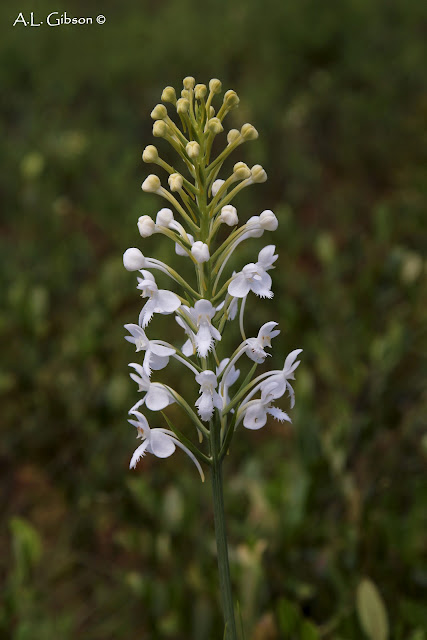

White Fringed orchid (Platanthera blephariglottis)

Most of the orchids were still in bud throughout the bog but luckily a few dozen specimens were in fine shape, showing off their delicately fringed flowers and long nectar spurs.  Back here in Ohio the white fringed orchid is an endangered species, only currently known from one bog in the northeastern part of the state where it was discovered in 1983; the first sighting in the state in nearly 50 years.  Whether or not it flowers from year to year is an incredibly fickle cycle, which helps to complicate the situation of seeing it.  When I saw Jackie post a blog last summer sharing a place where these grow by the hundreds I knew I had to make a pilgrimage the next year to finally make their acquaintance face to face.  I challenge someone to find a more pure and vivid white flower anywhere else in the plant kingdom.


Your blogger photographing the white fringed orchids: courtesy Jackie

Jackie and Sue disappeared off into the spruce and tamaracks to further explore the bog while I spent some long awaited camera time with the white fringed orchids.  With it being just a wee bit tricky to photograph one's self in action, I was very thankful Jackie took the time to capture the above image.  Being able to look back and relive this momentous occasion through this photograph means a lot.


White Fringed orchid (Platanthera blephariglottis)

A close look at the individual inflorescences reveal the evolutionary masterpiece that is this astounding orchid.  Each lip (labellum) hangs below the eye-like pollinia with its wispy fringing around the margins.  They seem to imitate little white birds bursting into flight with the long nectar spur trailing behind.  I noticed Jackie was wearing black pants and asked her to stand behind the raceme of blooms to give a background that would really make those 'birds' pop.  Like many other members of the Platanthera genus, the white fringed orchid is pollinated by nocturnal species of moths that are attracted to the sweet-smelling scent of the nectar at the end of the long spur.  As they probe the spur with their equally long proboscis their eyes incidentally come into contact with the pollinia.  With any luck the pollinia will attach themselves to the moth's eye and be carried to another flower/plant where it can be deposited and pollinate the flower.


White Fringed orchid (Platanthera blephariglottis)

The brilliant orchids really stood out against the sapphire blue sky and reds/greens of the bog.  A large portion of the photo shoot really came down to patience in waiting for a cloud to roll across the sun and cast some shade onto the bog.  I'll never complain about a gorgeous sunny day but when I'm out specifically for photography I'll take a lightly overcast day every time.


Bog Rosemary (Andromeda polifolia)

The white fringed orchids were hardly the only plants worth noticing or getting excited about growing throughout the sphagnum.  Scattered all around were small shrubs of bog rosemary (Andromeda polifolia), a unique boreal species of bogs and cold peatlands.  The bluish-green linear, evergreen leaves help give its identity away.  It hasn't been seen in Ohio in over 80 years and is more than likely permanently extirpated from the state due to habitat loss combined with never being a frequent species to begin with.  I had only ever seen it before in northern Michigan, on the Bruce peninsula in Ontario, and at its curiously disjunct, southernmost population in the cranberry glades botanical area of West Virginia.


Black Huckleberry (Gaylussacia baccata)

Almost as equally awesome as the white fringed orchids in the bog were the infinite amounts of perfectly ripened black huckleberries (Gaylussacia baccata) and highbush blueberries (Vaccinium corymbosum) everywhere.  It's not everyday you can gorge yourself on blueberries and huckleberries free and fresh from the bush as you are surrounded by a pristine and spectacular ecosystem.  I took full advantage of the situation and stuffed my face throughout my time there.  Snap a photograph or two, hand full of berries, and repeat!


Habitat shot of the sphagnum bog

Just about all of Ohio's sphagnum bogs and peatland was drained and removed years ago during settlement and the conversion to agriculture.  All that's left are small, scattered kettle ponds and bogs restricted to the northeastern quarter of the state.  Having the freedom and ability to walk through the endless expanse of bog and labyrinth of vegetation was a dream come true.  I always find myself wishing I could travel back in time and see just what Ohio's different habitats and ecosystems were like pre-settlement.  Not to say the native Americans didn't have any influence or affect on the land but certainly not at the scale of the white Europeans.


Northern Pitcher Plant (Sarracenia purpurea)

A whole slew of interesting and rare-to-me plant species such as the bog rosemary, white fringed orchids, arrow arum (Peltandra virginica), sweet gale (Myrica gale), northern pitcher plant (Sarracenia purpurea), grass pink orchid (Calopogon tuberosus), swamp loosestrife (Decodon verticillatus), tawny cottongrass (Eriophorum virginicum), and black chokeberry (Photinia melanocarpa) filled the bog and kept my mind racing and camera shutter clicking all morning.


Grass Pink orchid (Calopogon tuberosus)

Surprisingly still in bloom along the margins of the bog were numerous grass pink orchids (Calopogon tuberosus).  Their interesting architecture and design combined with the bright purplish-pink coloration make them a hard sight to miss contrasting against the green sphagnum.  I was pleased to have seen two orchids that early in the day but I had no idea just how many more awaited me later!  With my task finished and the white fringed orchids freshly pressed in my mind we tromped out of the bog and decided to grab lunch along the sparkling blue waters of Lake George in the nearby village.  I could hardly wait to continue on to the day's next spot we were headed to.

A particular stretch of shoreline on the Hudson River north of Saratoga Springs is home to one of the most diverse and fascinating habitats in the entire state of New York and a place I had seen Jackie blog about countless times accompanied with exciting photographs of rare and unusual plants.


The botanically-diverse ice meadows of the Hudson River

Dubbed the 'ice meadows' of the Hudson, this unique ecosystem owes its continued existence to the harsh New York winters and the important task involved from the cold and ice.  The open, grassland-like habitat along the shoreline is created and sustained each winter when huge deposits of frazile ice accumulate on the margins of the Hudson.  The immense weight and pressure from the ice pack, which can reach 15 feet in height at this location, generate the pseudo-boreal habitat which isn't cleared of ice until late in the spring.  This annual 'cleansing' of the shoreline prevents woody vegetation from encroaching and keeps the intriguing plant diversity intact for the summer months.  Unfortunately I was a couple weeks too late for the prime wildflower fireworks show the ice meadows put on each June but there was still plenty to be seen and appreciated all along the banks of the mighty Hudson.
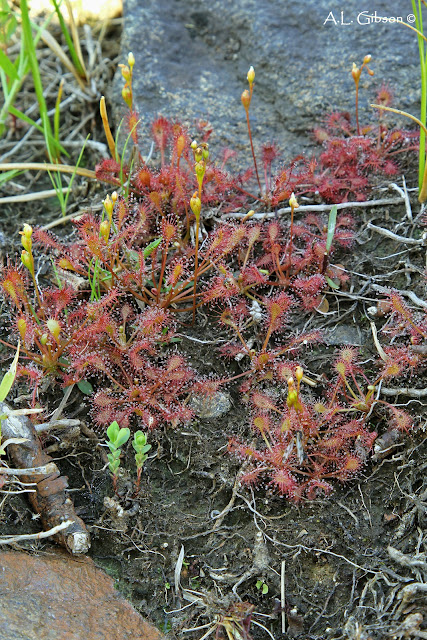

Spatulate-leaved Sundew (Drosera intermedia)

One of the first neat plants I noticed growing throughout the rocky terrain was the most robust and impressive clumps of spatulate-leaved sundew (Drosera intermedia) I'd ever seen.  Most were already past flowering stage and developing fruit capsules but the plant's unrivaled leaves covered in sticky 'dew' are always a welcome consolation; especially when it's an endangered species I rarely see in Ohio.


Large Cranberry (Vaccinium macrocarpon)

Another plentiful and dainty plant among the rocky crags and exposures in the ice meadows was large cranberry (Vaccinium macrocarpon).  The evergreen trailing mini-shrub was in full bloom during my visit and many plants were covered in the shooting star-like flowers that will eventually mature into the tasty cranberries some of us enjoy adorning our morning oatmeal with.


Lesser Purple Fringed orchid (Platanthera psycodes)

A prized plant Jackie had high hopes of finding and sharing with me while combing through the ice meadows was the lesser purple fringed orchids (Platanthera psycodes).  A threatened species in Ohio of swamp forests and wet thickets, they are much more frequent in New York but equally exciting to anyone who may come across some.  Jackie was disappointed that all seemed to be taking this year off and we were just about to leave before she spotted some clematis leaves and went over to inspect the vine to see if it was in flower yet.  No sooner had she started to shift the plant around when she gave out an excited shout of "purple fringed orchid!".  Hiding behind some clematis and other vegetation was a lone orchid, albeit a bit beat up, but in full bloom nonetheless!  Funny how things seem to work out sometimes.


Rocky shores of the Hudson's ice meadows

Interestingly enough, the ice meadows contained quite a few species of plants synonymous with west-cenral Ohio's fen complexes and sedge meadows.  The cold spring water that seeps from the ground and runs among the hummocks and rocks seems to imitate the typical fen environment enough to allow species such as Carex buxbaumii, C. flava, Twigrush (Cladium mariscoides), sundews (Drosera spp.), spike rushes (Eleocharis spp.), sticky tofielda (Triantha glutinosa) and horned bladderwort (Utricularia cornuta) to thrive.


Sticky Tofielda (Triantha glutinosa)

I'll admit and say I did a bit of cheating with the sticky tofielda photo above.  These were already in fruit during my visit to the ice meadows so I substituted in a photograph from earlier in the year from Cedar Bog.  Hailing from the lily family (Liliaceae), it gets its name from the tacky stems the flowering head sits on.  In fact, the scientific epithet of glutinosa translates to 'very sticky'.


Horned Bladderwort (Utricularia cornuta)

The horned bladderwort is an endangered species back here in Ohio but was very frequent in the sandy and marly shorelines of the Hudson.  Bladderworts can be a pain to identify to the species level sometimes, but the horned bladderwort lives up to its namesake and can be distinguished by the protruding 'horn' under the inflorescence.  Another helpful characteristic is it's an entirely terrestrial bladderwort and never grows in standing water like several other species are known to do.

Big Bluestem (Andropogon gerardii) along the Hudson River

It's a shame so many people, your blogger previously included, associate the Hudson with New York City and the polluted, dirty mess it is at its terminus.  I think I'd watched too many Law & Order: SVU reruns with washed up bodies and discarded victims to think of the river in any other way.  Not anymore!  After seeing and experiencing this mighty river firsthand hundreds of miles to the north, I don't think I'll ever think of this river in that lesser light ever again.

Take notice of the grass clinging to existence in the crevices and cracks of the boulders.  Those tall culms topped with turkey-like feet belong to the big bluestem (Andropogon gerardii); a widely-distributed native warm season grass that is synonymous with the tall grass prairies of the eastern great plains and Midwest.  New York never had the expanses of tall grass prairie like that of Ohio but the ice compacted, open areas of the ice meadows have allowed this species to take hold and exist outside its normal fashion.


Hop Sedge (Carex lupulina)

One of the most dominate species of sedge (Carex) growing in the ice meadows was the hop sedge (C. lupulina).  It's a common sedge of eastern North America and can be found in just about any moist, well-lit situation.  The large seed heads are really aesthetically pleasing to me and something worth using in cultivation.  You really know you're a botanist and plant-nerd when you're thinking of ways to introduce a sedge to your landscaping.


Sensitive Fern (Onoclea sensibilis)

Not uncommon by any stretch of the imagination but always a favorite of mine no matter where I go is the sensitive fern (Onoclea sensibilis).  The margins of the meadow and woodland had hundreds of their delicate fronds spread open and catching the valuable and plentiful sunlight.

After several hours exploring the shorelines and rocky boulders of the Hudson's ice meadows we decided it was time to get back in the car and drive to Jackie's friend's property to check out a couple species of orchid she had in bloom in her cedar forest/swamp.  I am very thankful and appreciative of Evelyn Greene for opening up her land to me and sharing some of the botanical bounties that lay within.  She first led us to a dry mixed coniferous forest mostly comprised of white cedar (Thuja occidentalis) and some eastern hemlock (Tsuga canadensis) to see an orchid that has long been extirpated to Ohio's soils.


Northern Green orchid (Platanthera aquilonis)


I hope you weren't expecting something as stupendous and angelic as the white fringed orchids.  The northern green orchid (Platanthera aquilonis) may get some votes as the most bland and boring of the indigenous orchid flora but I find a quiet and inherent beauty to it.  Evelyn had originally only found a few plants but after some searching with Jackie and I's extra pairs of eyes we ended up finding a handful more.


Northern Green orchid (Platanthera aquilonis


Upon closer inspection the details of the small green flowers come more into focus and, perhaps, allow for more appreciation from the casual observer.  The deep shade of the cedar forest caused for some pretty long exposure times but the wind was calm and that made things much, much easier.  I had only seen this species once before in the cedars forests and alvars on the Bruce peninsula of Ontario, so it was a big deal to see and photograph it again; especially such nice specimens.  As mentioned above, it's one of five species of orchids extirpated from Ohio causing for some out of state botanizing.


Ragged Fringed orchid (Platanthera lacera)


After photographing the northern green orchids, Evelyn took us through a secretive path into a cedar swamp where carefully planned steps and good balance was needed to weave in and out of the trees and stay on the dry hummocks.  We finally came to the spot where she had found three very robust and impressive specimens of ragged fringed orchid (Platanthera lacera).  Once again with some extra eyes we discovered a dozen or so more, each more impressive than the last it seemed.  I had seen this species on several occasions in Ohio where it grows in a variety of habitats but never anything approaching the size and proportions of these!


Ragged Fringed orchid (Platanthera lacera)


Seeing this orchid in such a new manner was an unexpected treat and delved me into even deeper botanical debt with Evelyn and Jackie.  As we made our way out of the swamp we passed through a more dry area that had some of the largest trees of their respective species I'd ever seen.  Perhaps the bordering swamp had prevented their cutting ages ago but massive white pines, red spruce, and eastern hemlock abounded and were quite the sight to an Ohioan who can't see such a sight at home.


Red Baneberry (Actea rubra)


We came to the gravel road and began to walk back to Evelyn's when I spotted something suspicious out of the corner of my eye.  Sitting right along the road were several large and fruiting red baneberry (Actea rubra) plants, a threatened species in Ohio I had never seen in person before.  It can be best separated from the very similar and much more common white baneberry (A. pachypoda) by fruit color (although some red baneberry plants can have white fruit) but most accurately by the thickness of the fruit's pedicel.  As you can see in the picture above, the pedicel is very thin while in white baneberry it is shorter and much thicker.  Randomly coming across this life species was a great cherry to the top of the day's sundae.

I had come to the end of day one and I had already seen and photographed five species of orchids; combed the botanically diverse and significant ice meadows of the Hudson; walked through the largest and most pristine sphagnum bog of my life; and trudged through a fine cedar forest/swamp.  It was a good sign for things to come as I would find out!  Come back soon for part II of my three-part series on my time in upstate New York!

*Part I* *Part II* *Part III*