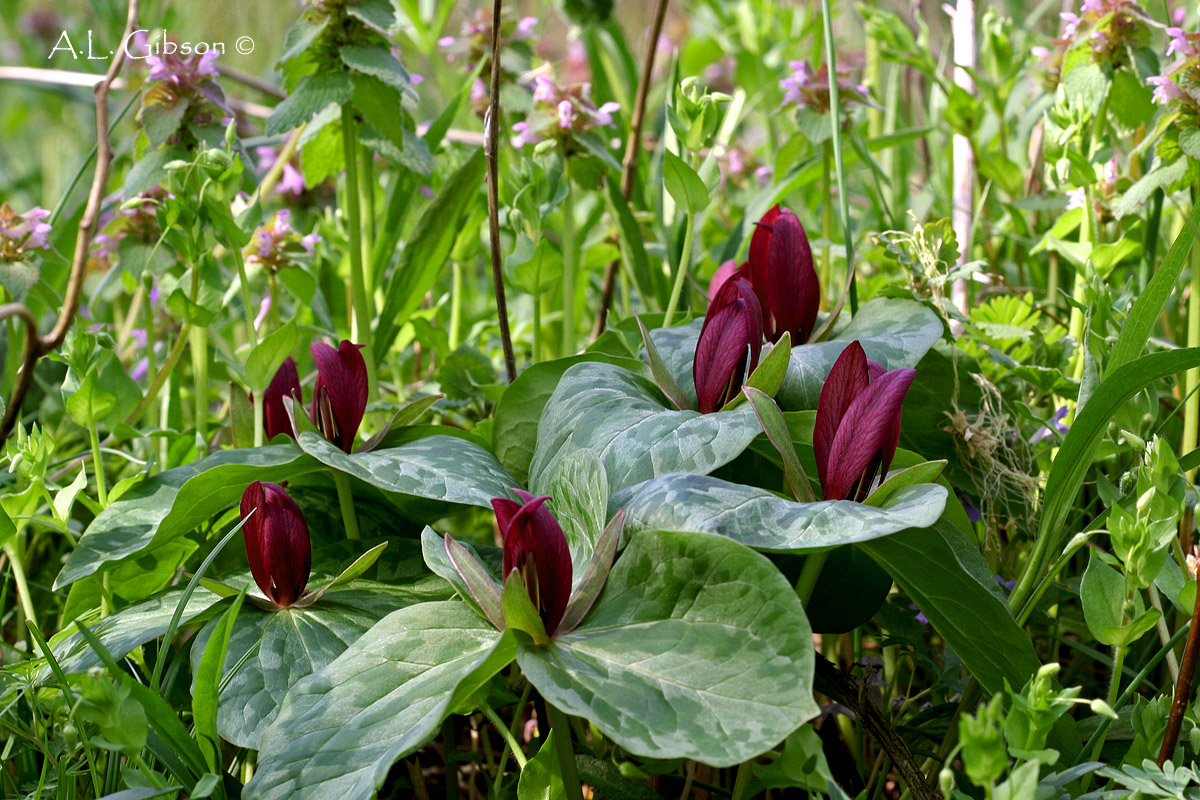
One of the most anticipated of spring's many bounties is the emergence and blooming of our woodland wildflowers. The natural world could not do a better job of rewarding winter-weary minds than with its magnificent displays of ephemerals that light up the forest understory come April and May. One particular genus of spring wildflowers seems to get more attention than just about any other during this time period and you'd be hard pressed to make an argument against them. Trilliums are the quintessential spring time wildflower and their long history of popularity and acclaim among their botanical and horticulutural admirers makes them the stuff of legends.
 |
| The eight species of Trillium native to Ohio (starting top left): T. nivale, T. grandiflorum, T. sessile, T. recurvatum, T. erectum, T. undulatum, T. flexipes, and T. cernuum. |
Traditionally many botanists and taxonomists placed the Trillium genus into the large lily family (Liliaceae), but modern research and revised studies have shown them and a handful of their close relatives belong in their own family: Trilliaceae. You can further break down the Trillium genus into two distinct subgenera: subgenus Trillium (the pedicellate trilliums) and subgenus Phyllantherum (the sessile trillium). From an evolutionary standpoint the pedicellate trilliums are older and more primitive than their sessile trillium counterparts.
Members of the Trillium genus occur as herbs in the temperate forests of the Northern Hemisphere in both eastern Asia (about five or six taxa) and here in North America (40+ taxa). Of the 40 or so species of trillium that are indigenous to North America, Ohio can claim eight of them as naturally-occurring in her soils around the time of European settlement. This post will act as a guide to all eight species of our native trillium and help to separate them from one another and include other valuable information on their characteristics and life history.
The Pedicellate Trilliums: Subgenus Trillium
The pedicellate trilliums of the subgenus Trillium are separated from the sessile trilliums by the presence of a pedicel (stalk) at the base of the flower. The size and length of the pedicel can vary greatly between species but is always present. Pedicellate trilliums are more showy and diverse than their sessile counterparts with six of Ohio's eight species belonging to this subgenus. Pedicellate trilliums also have flower petals that spread widely in a planer fashion and the stamens/ovary are clearly displayed.
Occurrences of snow trillium are quite infrequent in Ohio and largely restricted to the west-central and southwestern portions of the state. Its preferred habitat(s) in our state are areas of shallow, limestone-derived soils on wooded bluffs, stream/river terraces, and other wooded areas with exposed, weathered bedrock. Public sites like Clifton Gorge state nature preserve, Fort Hill state memorial, and Stillwater Prairie Preserve in Miami county are excellent places to witness this rarity in early spring.
Large-flowered trillium is another properly named plant as it is our largest trillium with flowers 3-4" in diameter and upwards of a foot and a half tall. Its luscious, waxy white petals overlap and whorl together to conceal the ovary and encompass its golden anthers. As the flowers age, their petals turn a varying intensity of pink to perhaps signal to pollinators they are too late to the party. This species of trillium grows in a variety of rich mixed deciduous woodlands under a diversity of soil conditions. This sense of habitat generalization is a large reason for its wide spread frequency throughout the state.
Snow Trillium, Dwarf White Trillium (Trillium nivale)
 |
| Snow Trillium - Trillium nivale |
Snow trillium or dwarf white trillium (T. nivale) is a true harbinger of spring for our state's flora and is one of the very first wildflowers to break dormancy in mid-late March. This species is aptly named for its early bloom time potentially coinciding with a late season snowfall; its scientific epithet of nivale translates to "of the snows, snowy". Sub-freezing temperatures and a coating of snow doesn't do much to hinder these dainty beauties!
 |
| Snow Trillium - Trillium nivale |
 |
| How many snow trillium can you see? |
Occurrences of snow trillium are quite infrequent in Ohio and largely restricted to the west-central and southwestern portions of the state. Its preferred habitat(s) in our state are areas of shallow, limestone-derived soils on wooded bluffs, stream/river terraces, and other wooded areas with exposed, weathered bedrock. Public sites like Clifton Gorge state nature preserve, Fort Hill state memorial, and Stillwater Prairie Preserve in Miami county are excellent places to witness this rarity in early spring.
 |
| North American distribution of T. nivale (courtesy BONAP) |
Snow trillium is largely a species of the Great Lakes region and Midwest and primarily follows the southern boundary of Pleistocene glaciation. This is no surprise as throughout its range it occurs on alkaline glacial drift.
Large-flowered Trillium, Large White Trillium (Trillium grandiflorum)
 |
| Hillside ensconced in hundreds of large-flowered trillium |
This next species of trillium has a special place in Ohio's heart as it has the distinction and honor of being our state's official wildflower. The large-flowered trillium (T. grandiflorum) is the most common pedicellate trillium taxon to be found in Ohio and occurs in just about every, if not all 88 of our counties. Under the right conditions they can grow into large, sprawling colonies that ensconce entire hillsides in hundreds of plants; something no other species of trillium can quite equal.
 |
| Large-flowered Trillium (T. grandiflorum) |
 |
| Large-flowered Trillium (T. grandiflorum) |
Large-flowered trillium is another properly named plant as it is our largest trillium with flowers 3-4" in diameter and upwards of a foot and a half tall. Its luscious, waxy white petals overlap and whorl together to conceal the ovary and encompass its golden anthers. As the flowers age, their petals turn a varying intensity of pink to perhaps signal to pollinators they are too late to the party. This species of trillium grows in a variety of rich mixed deciduous woodlands under a diversity of soil conditions. This sense of habitat generalization is a large reason for its wide spread frequency throughout the state.
 |
| North American distribution of T. grandiflorum (courtesy BONAP) |
This particular trillium is quite common throughout eastern North America and is most prevalent in the Great Lakes region, up into the Northeast, and down into the southern Appalachians. Populations of this plant seem to reach their greatest potential in second-growth forests with a relatively low deer presence; this trillium is seasonal candy for the quadrupeds.
Some trillium species are as striking as they are malodorous and the red trillium (T. erectum) certainly falls into that category. Red trillium also goes by the name of stinking benjamin for its aforementioned fetid aroma that is reminiscent of a wet dog to some. Of the six pedicellate trillium indigenous to Ohio, this is our only species that exhibits blood red petals/flowers on an erect peduncle.
Red trillium is restricted to eastern Ohio and its largely unglaciated, acidic soil regimes where it occurs in humus-rich, cool, moist mixed deciduous/conifer forests; especially under hemlocks and in association with heath family members (Ericaceae). It can also occur in swampier situations in woodlands and thickets as well as along streams and waterways in the northern part of its range. In my experience, the sandstone hollows and gorges of the Hocking Hills region is the best place to see this species, including its white-colored form described/explained below.
Throughout its range, red trillium can occur both in its typical deep maroon color form (var. erectum) or in a white-colored scheme (var. album) that can range from green-yellow to cream-bright white. This range of petal coloration can lead to some confusion between species, especially with drooping trillium (T. flexipes) which has a red and white color form as well. In regards to red trillium, it's best to look at the color of the ovary: regardless of what color form you are seeing, T. erectum will always have a distinctly red/maroon ovary. The petals are typically planer and not reflexed back like those of drooping trillium (T. flexipes) and have maroon to yellowish anthers to help with the ID as well. T. erectum is known to hybridize with T. flexipes to make things even more difficult.
Red trillium is one of the most common species of its genus in the northeastern part of its distribution before it becomes more isolated/infrequent as its range continues into eastern Ohio and down through the southern Appalachians at higher elevations.
Next up is a rather widespread and potentially confusing species that can be mistaken for the previously discussed red trillium. Drooping trillium (T. flexipes) can be found throughout the state but seems to do best in areas with corresponding limestone bedrock. It grows in a variety of deciduous forest habitats but prefers rich, mesic slopes (where it can occur in large, sprawling colonies of hundreds upon hundreds of plants); stream/river terraces; and even alluvial soils of floodplains. Its flowers are smaller than most other pedicellate trillium species in Ohio, but what they lack in size is made up for by its thick, waxy, textured petals and pronounced ovary.
Much like the aforementioned red trillium (T. erectum), drooping trillium (T. flexipes) can occur in its typical white-colored form (forma flexipes) and a dark red/maroon-colored form (forma walpolei). Unlike in T. erectum where the atypical color form (white in its case) can be the dominate color form in a population, I've never seen the red-colored form of T. flexipes be anything but an occasional mix-in among a strong majority of the typical white-colored flowers.
Drooping trillium gets its common name from the flower's common practice of drooping or hanging below its three leaves on a long peduncle. You may walk right past dozens of this trillium and think its solely in a vegetative state while its flower silently hides in the shade below. In some rare cases you can find specimens of this species exhibiting flowers on an erect peduncle with flat/planer petals (predominately in the southern part of its range) but the color of the ovary can help distinguish it from T. erectum: drooping trillium's ovaries are always white or have a speckling/light hue of pink in them, even in the red-colored forms.
Drooping trillium can also easily be mistaken for the extremely similar nodding trillium (T. cernuum). That will be discussed further on under the nodding trillium's dedicated section.
Trillium flexipes is predominately a species of the Midwest and southern Great Lakes region with an extension south into the central lowlands of Kentucky, Tennessee, and Alabama.
Of Ohio's eight species of native trillium, only one can no longer be found within her borders: nodding trillium (T. cernuum). This species of the north was only officially recorded once in our state way back in 1879 in Lake County. It hasn't been seen here since and is almost assuredly lost to the dusts of time. T. cernuum is the most northern of all North America's trilliums and was likely naturally weening itself from the state by retreating north around the time of settlement, only to be exponentially rushed into extirpation by means of human development and anthropogenic-derived climate change.
Nodding trillium prefers cool, low, moist-swampy woodlands and grows along stream banks/terraces and the wet, shrubby margins of bogs as well. Its white, waxy petals are strongly recurved and exhibit a large, white ovary much like the strikingly similar drooping trillium (T. flexipes). The best way to differentiate between these two white flowered, drooping trilliums is by carefully examining the plant's filaments (string-like threads that attach anthers to base of ovary). Looking at the photo above-right, you can clearly see the long filaments exerted out from the ovary/petals of the nodding trillium. In drooping trillium (see photos further up) the filaments are much shorter and hidden while the anthers appear to be sessile and attached directly at the base of the ovary. Nodding trillium's anthers also tend to be a pinkish/purple color when laden with pollen while drooping trillium's are chiefly cream/white.
If the painted trillium is our rarest and our most physically appealing, then it seems to fit the pattern that it would arguably be the easiest trillium to identify as well. No other species in Ohio, or anywhere else for that matter have the distinct combination of white petals accented with dark pink/magenta striping. The foliage of this plant seems to be unique as well with a reddish-green coloration easily visible in the initial photo of this section.
Painted trillium is a species that must have cool, humus-rich, and strongly acidic soils to survive. It occurs in a variety of mixed deciduous/conifer woodlands in the southern, high-elevation part of its range and in more low-lying, moist red maple/birch/oak/sugar maple forests (especially with an association of white pine) to the north.
Sessile trillium is one of the most common wildflowers to be found throughout the state come spring. Their erect maroon (rarely greenish-yellow) petals envelope the stamens and ovary and sit atop three sepals that can range in color from green to maroon. Their stalkless leaves can range from a uniform green color to a much more attractive mottled pattern of darker green. The flowers emit a pungent odor that when combined with their flower structure has led to the conclusion that unlike their showier relatives that are pollinated by bees and bumblebees, the sessile trillium are predominately pollinated by ground-dwelling insects such as beetles.
The last and final species of Ohio trillium left to share is the rare and potentially threatened prairie trillium (Trillium recurvatum). This sessile trillium at first seems nearly identical to the much more common sessile trillium (T. sessile) but can be told apart much easier and quickly than one would think. Prairie trillium's three leaves have a small, short but noticeable petiole at their base which helps separate it from the aptly named sessile trillium. Remember: the use of the word "sessile" for the subgenus Phyllantherum has to do with the flowers and not the leaves. Another character to look for in separating these two species is the sepals: prairie trillium's sepals are strongly recurved to a point where they are almost parallel to the stem (hence the scientific epithet of recurvatum).
Despite the moniker of "prairie" trillium, this species occurs in dry-mesic, open woodland habitats on calcareous soils here in our state rather than in open grassland as suggested by the name. The flowers typically exhibit a maroon color but can come across as more of a rust-orange color on occasion as well as occur in lemon-yellow forms. The habit of the plant also tends to be more erect with a longer stem than most sessile trillium I see.
Trillium recurvatum occurs primarily in the Midwest and then follows the Mississippi drainage into the deeper south. It is curiously absent from a large portion of Ohio despite being very common just across the Indiana border and only occurs in a handful of spots in southwestern Ohio. It's almost as if early state boundary drafters used this species' range as the north-south dividing line between Ohio and Indiana.
******************************************************************************************************
I hope this post will serve as a valuable and usable resource for Ohioans and other wildflower enthusiasts of the Midwest and Great Lakes states that are interested in learning more about our native trillium species and how to tell them apart. It won't be too much longer before they grace our thawing landscape once more!
Red Trillium, Stinking Benjamin, Purple Trillium (Trillium erectum)
 |
| Hillside full of Red Trillium and Large-flowered Trillium |
Some trillium species are as striking as they are malodorous and the red trillium (T. erectum) certainly falls into that category. Red trillium also goes by the name of stinking benjamin for its aforementioned fetid aroma that is reminiscent of a wet dog to some. Of the six pedicellate trillium indigenous to Ohio, this is our only species that exhibits blood red petals/flowers on an erect peduncle.
 |
| Red Trillium (Trillium erectum) |
 |
| Red and white colored forms of T. erectum |
Red trillium is restricted to eastern Ohio and its largely unglaciated, acidic soil regimes where it occurs in humus-rich, cool, moist mixed deciduous/conifer forests; especially under hemlocks and in association with heath family members (Ericaceae). It can also occur in swampier situations in woodlands and thickets as well as along streams and waterways in the northern part of its range. In my experience, the sandstone hollows and gorges of the Hocking Hills region is the best place to see this species, including its white-colored form described/explained below.
 |
| Red variety (T. erectum var. erectum) |
 |
| White variety (T. erectum var. album) |
Throughout its range, red trillium can occur both in its typical deep maroon color form (var. erectum) or in a white-colored scheme (var. album) that can range from green-yellow to cream-bright white. This range of petal coloration can lead to some confusion between species, especially with drooping trillium (T. flexipes) which has a red and white color form as well. In regards to red trillium, it's best to look at the color of the ovary: regardless of what color form you are seeing, T. erectum will always have a distinctly red/maroon ovary. The petals are typically planer and not reflexed back like those of drooping trillium (T. flexipes) and have maroon to yellowish anthers to help with the ID as well. T. erectum is known to hybridize with T. flexipes to make things even more difficult.
 |
| North American distribution of T. erectum (courtesy BONAP) |
Red trillium is one of the most common species of its genus in the northeastern part of its distribution before it becomes more isolated/infrequent as its range continues into eastern Ohio and down through the southern Appalachians at higher elevations.
Drooping Trillium, Bent Trillium (Trillium flexipes)
 |
| Small colony of drooping trillium (Trillium flexipes) |
Next up is a rather widespread and potentially confusing species that can be mistaken for the previously discussed red trillium. Drooping trillium (T. flexipes) can be found throughout the state but seems to do best in areas with corresponding limestone bedrock. It grows in a variety of deciduous forest habitats but prefers rich, mesic slopes (where it can occur in large, sprawling colonies of hundreds upon hundreds of plants); stream/river terraces; and even alluvial soils of floodplains. Its flowers are smaller than most other pedicellate trillium species in Ohio, but what they lack in size is made up for by its thick, waxy, textured petals and pronounced ovary.
 |
| White and red-colored form of drooping trillium |
 |
| Forested hillside ensconced with drooping trillium |
Much like the aforementioned red trillium (T. erectum), drooping trillium (T. flexipes) can occur in its typical white-colored form (forma flexipes) and a dark red/maroon-colored form (forma walpolei). Unlike in T. erectum where the atypical color form (white in its case) can be the dominate color form in a population, I've never seen the red-colored form of T. flexipes be anything but an occasional mix-in among a strong majority of the typical white-colored flowers.
 |
| White-colored form (T. flexipes f. flexipes) |
 |
| Red-colored form (T. flexipes f. walpolei) |
Drooping trillium gets its common name from the flower's common practice of drooping or hanging below its three leaves on a long peduncle. You may walk right past dozens of this trillium and think its solely in a vegetative state while its flower silently hides in the shade below. In some rare cases you can find specimens of this species exhibiting flowers on an erect peduncle with flat/planer petals (predominately in the southern part of its range) but the color of the ovary can help distinguish it from T. erectum: drooping trillium's ovaries are always white or have a speckling/light hue of pink in them, even in the red-colored forms.
Drooping trillium can also easily be mistaken for the extremely similar nodding trillium (T. cernuum). That will be discussed further on under the nodding trillium's dedicated section.
 |
| North American distribution of T. flexpies (courtesy BONAP) |
Trillium flexipes is predominately a species of the Midwest and southern Great Lakes region with an extension south into the central lowlands of Kentucky, Tennessee, and Alabama.
Nodding Trillium (Trillium cernuum)
 |
| Nodding Trillium (Trillium cernuum) |
Of Ohio's eight species of native trillium, only one can no longer be found within her borders: nodding trillium (T. cernuum). This species of the north was only officially recorded once in our state way back in 1879 in Lake County. It hasn't been seen here since and is almost assuredly lost to the dusts of time. T. cernuum is the most northern of all North America's trilliums and was likely naturally weening itself from the state by retreating north around the time of settlement, only to be exponentially rushed into extirpation by means of human development and anthropogenic-derived climate change.
Due to this species' extirpation from our state, the photographs used in this blog are from plants found in the southern Adirondacks of upstate New York during a botanical excursion there late last spring. Even there this species is starting to disappear from its familiar haunts; perhaps more evidence for this particular plant's sensitivity to a warming world?
 |
| Pair of nodding trillium in upstate New York |
 |
| Closeup of the anthers and noticeable filaments |
Nodding trillium prefers cool, low, moist-swampy woodlands and grows along stream banks/terraces and the wet, shrubby margins of bogs as well. Its white, waxy petals are strongly recurved and exhibit a large, white ovary much like the strikingly similar drooping trillium (T. flexipes). The best way to differentiate between these two white flowered, drooping trilliums is by carefully examining the plant's filaments (string-like threads that attach anthers to base of ovary). Looking at the photo above-right, you can clearly see the long filaments exerted out from the ovary/petals of the nodding trillium. In drooping trillium (see photos further up) the filaments are much shorter and hidden while the anthers appear to be sessile and attached directly at the base of the ovary. Nodding trillium's anthers also tend to be a pinkish/purple color when laden with pollen while drooping trillium's are chiefly cream/white.
 |
| North American distribution of T. cernuum (courtesy BONAP) |
Trillium cernuum is a species of the northern Great Lakes region and the Northeast with sparse and isolated occurrences further south. Looking at the distribution map above of all recorded occurrences (both historical and recent), I have to wonder what it would look like today with a current distribution map. I wouldn't be surprised to see the southern third of its range's populations and occurrences gone. This is, in my opinion a species worth more attention and observation.
Painted Trillium (Trillium undulatum)
 |
| Painted Trillium (Trillium undulatum) |
If you're supposed to save the best for last, then it's quite appropriate I would keep the painted trillium (Trillium undulatum) as the sixth and final species of Ohio's pedicellate trilliums. This stunning and breathtaking wildflower is our state's rarest species of trillium and is currently listed as an endangered species. For the last few decades its only known occurrence in the entire state has been a swampy woods residing in our most northeastern county of Ashtabula.
 |
| Painted trillium in its typical northern habitat |
 |
| Painted "quadrillium" |
If the painted trillium is our rarest and our most physically appealing, then it seems to fit the pattern that it would arguably be the easiest trillium to identify as well. No other species in Ohio, or anywhere else for that matter have the distinct combination of white petals accented with dark pink/magenta striping. The foliage of this plant seems to be unique as well with a reddish-green coloration easily visible in the initial photo of this section.
Painted trillium is a species that must have cool, humus-rich, and strongly acidic soils to survive. It occurs in a variety of mixed deciduous/conifer woodlands in the southern, high-elevation part of its range and in more low-lying, moist red maple/birch/oak/sugar maple forests (especially with an association of white pine) to the north.
 |
| North American distribution of T. undulatum (courtesy BONAP) |
Painted trillium occurs predominately in the northeastern states and down through the southern Appalachians. Its affinity for the strongly acidic, cool soils of the northeast are efficiently replicated by the high-elevation spruce/fir/hemlock forests and rhododendron balds/thickets of the Appalachians which have allowed it to persist for thousands of years in a warming climate.
The Sessile Trilliums: Subgenus Phyllantherum
The sessile trilliums of the subgenus Phyllantherum are the opposite of the pedicellate trilliums and are separated for their flower's lack of a pedicel. Instead the flowers sit at the apex of the plant with erect, less showy petals that mostly/partial conceal the stamens. Due to their arrangement, the sessile trilliums tend to be viewed as less showy than their pedicellate brethren. The subgenus Phyllantherum only occurs in North America and is less diverse than the subgenus Trillium, with two species calling Ohio home.
Sessile Trillium, Toad Trillium, Toadshade (Trillium sessile)
 |
| Patch of sessile trillium (Trillium sessile) |
It's hard to believe the comparatively bland sessile or toadshade trillium (Trillium sessile) can be so closely related to species as showy and charming as the large-flowered and painted trillium but all the parts are there, albeit in different shapes and sizes. Sessile trillium grows in a wide variety of woodland settings and can withstand more disturbance and habitat degradation than most any other trillium species in my experiences.
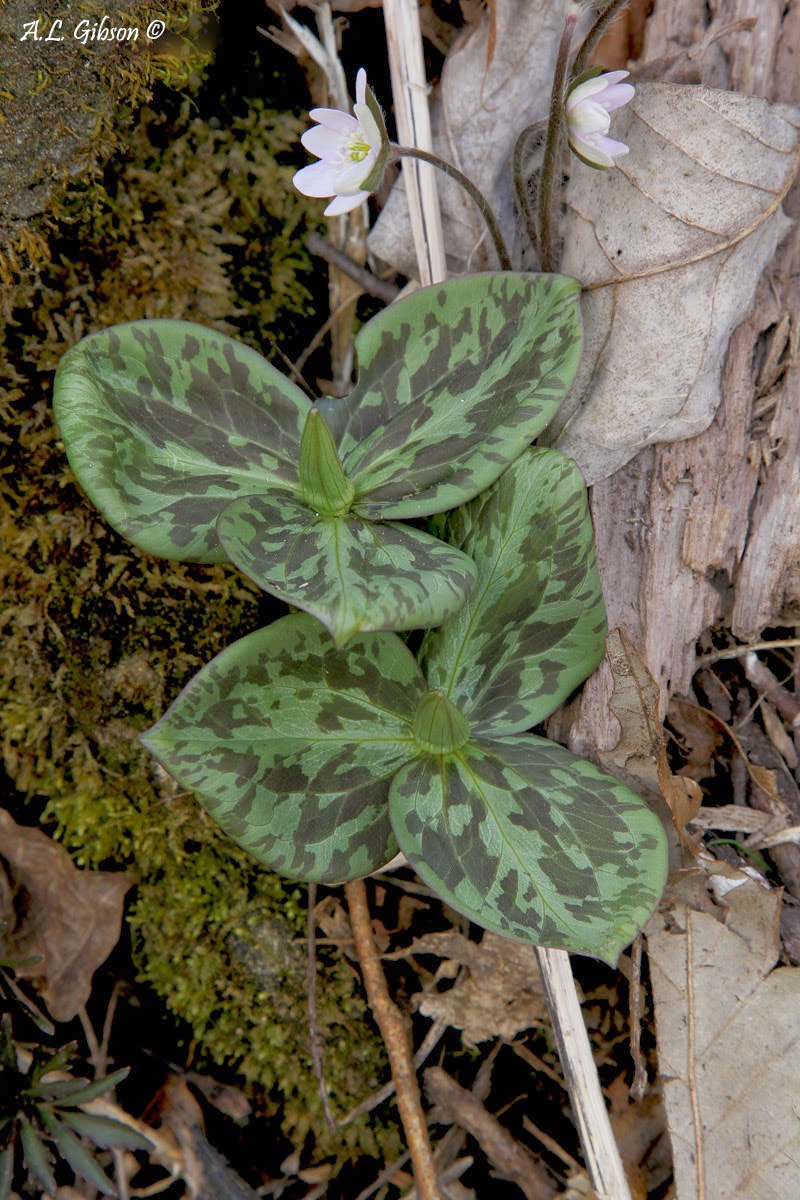 |
| Sessile trillium in bud with nicely mottled leaves |
 |
| Sessile trillium (T. sessile) |
Sessile trillium is one of the most common wildflowers to be found throughout the state come spring. Their erect maroon (rarely greenish-yellow) petals envelope the stamens and ovary and sit atop three sepals that can range in color from green to maroon. Their stalkless leaves can range from a uniform green color to a much more attractive mottled pattern of darker green. The flowers emit a pungent odor that when combined with their flower structure has led to the conclusion that unlike their showier relatives that are pollinated by bees and bumblebees, the sessile trillium are predominately pollinated by ground-dwelling insects such as beetles.
 |
| North American distribution of T. sessile (courtesy BONAP) |
Trillium sessile is most abundant in Ohio, Indiana, and northern Kentucky as well as in a "separate" population center in Missouri. It strangely peters out once you get beyond the center of those two regions but is quite frequent at the heart of its range.
Prairie Trillium, Bloody Butcher (Trillium recurvatum)
 |
| Prairie Trillium (Trillium recurvatum) |
The last and final species of Ohio trillium left to share is the rare and potentially threatened prairie trillium (Trillium recurvatum). This sessile trillium at first seems nearly identical to the much more common sessile trillium (T. sessile) but can be told apart much easier and quickly than one would think. Prairie trillium's three leaves have a small, short but noticeable petiole at their base which helps separate it from the aptly named sessile trillium. Remember: the use of the word "sessile" for the subgenus Phyllantherum has to do with the flowers and not the leaves. Another character to look for in separating these two species is the sepals: prairie trillium's sepals are strongly recurved to a point where they are almost parallel to the stem (hence the scientific epithet of recurvatum).
 |
| Closer look at the leaf petioles and recurved sepals |
 |
| Yellow-colored form (f. shayii) |
Despite the moniker of "prairie" trillium, this species occurs in dry-mesic, open woodland habitats on calcareous soils here in our state rather than in open grassland as suggested by the name. The flowers typically exhibit a maroon color but can come across as more of a rust-orange color on occasion as well as occur in lemon-yellow forms. The habit of the plant also tends to be more erect with a longer stem than most sessile trillium I see.
 |
| North American distribution of T. recurvatum (courtesy BONAP) |
Trillium recurvatum occurs primarily in the Midwest and then follows the Mississippi drainage into the deeper south. It is curiously absent from a large portion of Ohio despite being very common just across the Indiana border and only occurs in a handful of spots in southwestern Ohio. It's almost as if early state boundary drafters used this species' range as the north-south dividing line between Ohio and Indiana.
******************************************************************************************************
I hope this post will serve as a valuable and usable resource for Ohioans and other wildflower enthusiasts of the Midwest and Great Lakes states that are interested in learning more about our native trillium species and how to tell them apart. It won't be too much longer before they grace our thawing landscape once more!