Showing posts with label Federally threatened. Show all posts

Wednesday, May 21, 2014

The Hunt for the Small Whorled Pogonia: one of North America's Rarest Orchids

*Part I* *Part II*

Everyone has a dream that seems just beyond the reach of reality.  It's not out of the realm of possibility per se but rather something that has been more or less relegated as a thing of daydreams and wishful thinking.  For your narrator, few, if any thing on the botanical bucket list exceeds the lust and desire to see one of North America's rarest of orchids in full, spectacular flower.  The small whorled pogonia (Isotria medeoloides) is a taxon of legend when it comes to chasing orchids and rare plants in general.  Its fickle and unpredictable flowering cycle mixed with an encompassing scarcity make it a plant lucky few have witnessed in the flesh.  In my never-ending drive to see and photograph all of Ohio's indigenous orchids, the small whorled pogonia was one I thought might haunt my goal for years to come...

Mountains on the horizon at sunset in northern Georgia

Fortunately, that's where two of my fellow orchid aficionado Flickr friends in Alan Cressler and Jim Fowler come into play.  Both are marvelous photographers and have a very in-depth knowledge of the botanical world around them.  I highly encourage you to check out Alan's work on Flickr by clicking HERE and Jim's by clicking HERE.  Jim also writes and publishes a nature blog on his travels and discoveries which is second to none and accessible by going to jfowlerphotography.com.

Around this time last year I noticed both of them publish phenomenal photos of the small whorled pogonia that I couldn't take my eyes off of nor keep myself from salivating at the computer monitor.  If anyone was going to be able to help me finally cross this monumental lifer off my list, it was them.  Fortunately, Alan, Jim, and I were able to arrange a rendezvous in northern Georgia this past weekend to see if we could find these delightful wonders in flower.  It was over a seven hour drive to the town of Ellijay on the edges of Chattahoochee National Forest for me and with each mile my excitement grew tenfold.  I arrived into town on Friday night in anticipation for our Saturday morning meet up and enjoyed a fine dinner in a local establishment where I struck up some entertaining and enlightening conversation with the bartender and a few locals.  They were pretty intrigued a Yankee would drive so far south for a plant but their interest was genuine and I enjoyed filling them in on my passion and the details of my trip.

Saturday dawned bright and cool with a clear blue sky but by the time Alan, Jim, myself, and esteemed Georgia botanist, Max Medley met up at our predesignated meeting spot, dark clouds promising rain loomed on the horizon.  I greatly prefer overcast conditions when out to specifically partake in wildflower photography but rain rarely makes a photographer's life any easier.  Luckily the only rain that ever materialized was some light drizzle or passing showers and never caused much delay or problems for us.

After packing my gear into Jim's car and Max's into Alan's, we headed out for the first of two potential sites for the small whorled pogonia deep inside the mountains and valleys of Chattahoochee National Forest.  It produced a handful of blooming individuals last year and has proved to be pretty reliable in years past so we had high hopes of finding our bounty in good shape.  After pulling off at a very nondescript spot on the road, we shouldered our loads and headed off into the woods.  I had come a long way and spent countless hours dreaming of a moment that now seemed only minutes away.  Not long into our search, Alan and Jim located the specific spot for the orchids and beckoned Max and I to them and delivered some good and bad news...

Flowering and sterile specimens of small whorled pogonia

The good news was the location had produced five flowering individuals and a number of other sterile stems but the bad news was our timing could have been a little better.  The plants were four or five days past peak with some looking better than others.  I'd be a liar if I said I wasn't at least somewhat disappointed but by the same token I'd be called a liar too if I didn't say I was still enthralled with our discovery.  Not everyone is likely to find this green orchid very attractive and some might even think, "you drove all that way for that?!", but it was priceless to me and one of the most gorgeous plants I ever have or ever will see.

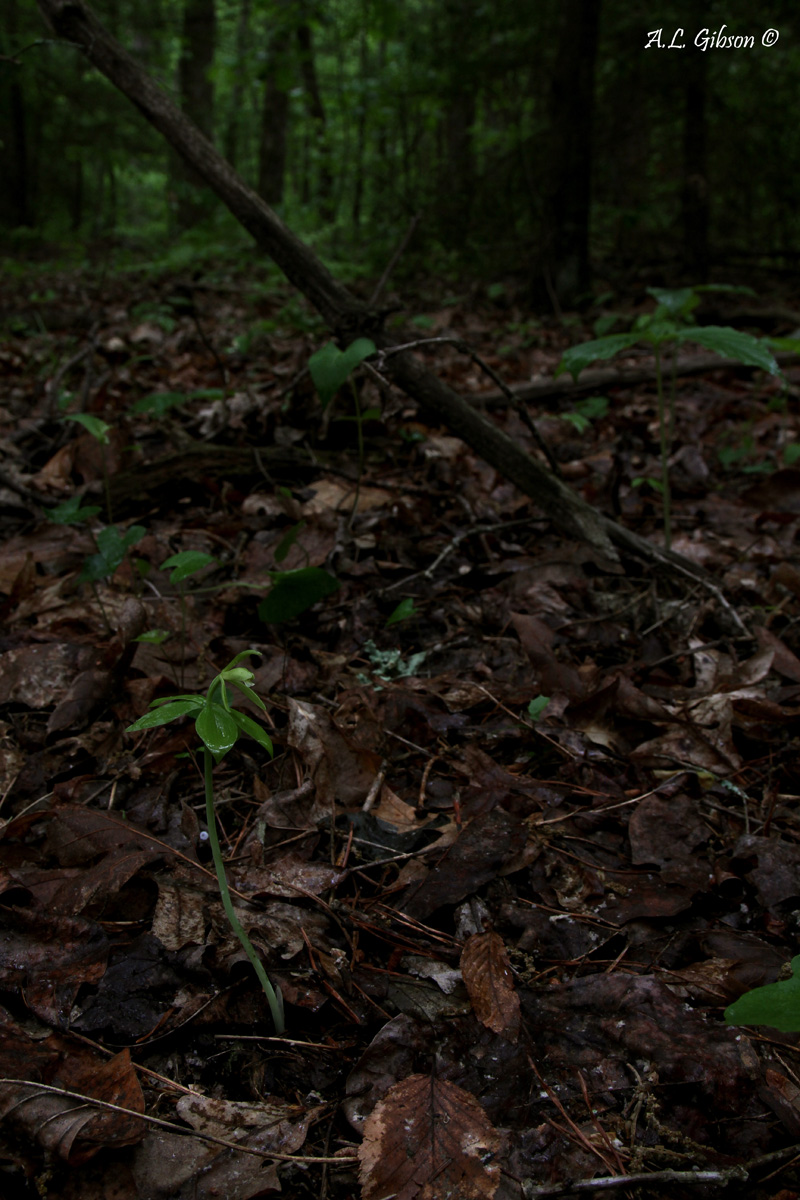
Federally threatened Small Whorled Pogonia (Isotria medeoloides)

I broke out my camera equipment and proceeded to attempt to capture what freshness the flowering plants had left and found myself in constant awe of just how tiny they were.  I knew they would be small, it's in their name after all but nothing quite prepares you for seeing them with your own two eyes.  As the rain started to patter down, we decided to make for the second site where we might have better luck at finding fresher orchids due to an increase in elevation.  It was only known to harbor a few individuals in any given year but I'd come too far to not enthusiastically and confidently move forward.

Alan led us through the mountains of Chattahoochee on a dazzling route full of hemlock and rhododendron-lined streams, acidic upland oak woodlands ensconced in flame azaleas at peak flower, and forested seeps full of alluring plant life and I will bring all that to you in my next post.  For now, I want to focus on the primary goal of my journey and devote this entire post to the splendor of the small whorled pogonia.

After several hours of exploring the roadsides and accompanying forest on our way to the second site and new lifer after new lifer photographed and scribbled down on my life list, we finally pulled into what would be my last hope at seeing an orchid that I would have driven 5,000 miles to see and not just the previous day's 500.  I had no idea what to expect and my stomach was in knots as we hiked up into a white pine forest where the plants were known to occur.  In the end my worries and nervousness were for naught as Alan, Jim, Max, and I found three pogonias in unspoiled, newly-opened condition!  Alan's hunch on these being in better shape due to cooler temperatures at a higher elevation was spot on.

Federally threatened Small Whorled Pogonia (Isotria medeoloides)

The small whorled pogonia is a federally threatened species and only occurs in a select number of locations throughout eastern North America, where populations usually only exist as a handful of plants or even just a lone individual.  Its habitat of second-growth, semi-open acidic woodlands is hardly a rare occurrence throughout its range and shouldn't act as any kind of limiting factor in its scarcity.  I believe it to be genuinely rare regardless of habitat availability but am under the impression there are still quite a few unknown stations left to discover.  Being tiny, green, and flowering during the awkward floral transition of spring to summer adds up to create quite the proverbial "needle in a haystack" scenario.

Federally threatened Small Whorled Pogonia (Isotria medeoloides)

Even at first glance it's easy to see the physical similarities and relations to its brethren, the large whorled pogonia (I. verticillata).  Both have succulent-esque stems with an emerald skirt of whorled leaves and are adorned with a dragon-like inflorescence.

Small Whorled Pogonia next to a nickel

As previously mentioned, I was flabbergasted at the miniscule nature of this lime green orchid.  If anything should get across the size and dimensions of the small whorled pogonia, it's the photograph above that shows a nickel placed alongside the plant.  No photoshop trickery or sorcery here, they legitimately can be that teeny and puny.  It makes you wonder how anyone, looking or not could ever come across these things.

Can you see what Jim is photographing in this capture?

Three small whorled pogonias in flower, three photographers itching to get some lens time with them; I'd say those numbers worked out perfectly.  We took our time carefully capturing the essence and character of each pogonia and moved in a circular fashion, trading off between plants.  Above is Jim admiring the dainty pogonia before him with his camera setup. Even when you know it's there and can follow the camera's stare down to it, it's still somewhat tricky to see the orchid.  Tiny things indeed!

The small whorled pogonia is ready for its closeup 

The history of the small whorled pogonia in Ohio is a very short and relatively recent story.  It has only ever been seen within the buckeye state at two sites: one in Shawnee state forest discovered by the late orchid great Fred Case in 1985, and the other discovered a few years later in the Hocking Hills region.  Only the latter occurrence is still "extant" today but hasn't been seen since 2008 when a single sterile stem came up.  A pipe dream of mine is to stumble across a new site in Shawnee state forest one time and know I could then die happy as a successful and accomplished field botanist and naturalist.

So tiny, so rare, so absolutely beautiful

The already darkened conditions of the white pine forest combined with the sullen gray clouds overhead made for some rather tricky lighting conditions but that hardly did anything to stop the onslaught of photographs being taken by the trio of orchid obsessers.  Even though Jim and Alan had photographed these very plants just a year ago, I wasn't the least bit surprised to see them enjoying another round with the treasures.  Small whorled pogonias are notorious for being able to go dormant and disappear into a subterranean holding pattern that can last for multiple years.  It's definitely best to take advantage of every opportunity with these unpredictable orchids as you never know if or when it could be your last.

Small Whorled Pogonia
Shot of the pogonia's habitat 


Of Ohio's 48 species/varieties/hybrids of naturally-occurring orchids, I have now had the pleasure of seeing 47. Being just barely shy of 98% complete with one of my most passion-driven and desirable botanical goals is something I take a lot of personal pride and happiness in and can't believe the long awaited small whorled pogonia is no longer orchid enemy #1.  I still have the highest of hopes to see this species within Ohio's borders one day in the near or far future but seeing it in the mountains of northern Georgia is undoubtedly the next best thing and a moment I'll cherish and treasure for the rest of my life.

Small whorled pogonia dwarfed by Alan's camera setup

While the first site's orchids were well past peak flowering condition and left something to be desired, I didn't realize just how unsatisfactory they were until I made the acquaintance of the second site's blooming plants.  They were so crisp, so detailed, so richly highlighted, we hypothesized they might have broken bud within the past 24 hours or so.  In the photo above, Alan's camera set up dwarfs one of the three pogonias at the second location. If only these orchids were sentient and could sense just how famous they were to us three Orchidaceae lovers.  The stories they might be able to tell of past visitors and what exactly makes them tick is an intriguing thought.

Jim, Alan, and myself (camera pictured) all with a pogonia each, attempting to capture its essence

After hundreds upon hundreds of photographs it was time to depart the site and allow the pogonias to return to the mists of the past.  I could not have had more fun out in the field with Alan, Jim, and Max, and am forever indebted to their efforts, knowledge, and willingness to share locations and information.  I hope I can repay them in the near future by playing host for a trip up north to explore what Ohio has to offer that Georgia lacks.  The same is to be said about heading back down to visit them again sometime this year.  Despite only meeting them in person for the first time earlier that day, I walked away feeling like we'd been old friends for years and went out botanizing and photographing once a week like clockwork.  It will be a long time before I forget what happened on this memorable weekend of botany in a place I'd never been before.  There's plenty more to share and talk about so stay tuned to more from my time spent in Chattahoochee National Forest.

*Part I* *Part II*

Tuesday, July 23, 2013

The Federally Threatened Appalachian Spiraea

I love the rare and unusual in the botanical world.  There's something about those hidden gems that make the hours, months, even years of anticipation and searching worth every second.  The more rare and disjunct a plant species is, the more interesting its accompanying story typically is and this featured botanical wonder certainly fits the bill.

Scioto Brush Creek flowing through wild and rural Scioto county

In the rolling, forested hills and deep, steamy valleys of Scioto county in extreme southern Ohio flows arguably our state's most pristine and high-quality waterway: Scioto Brush Creek.  Its waters and riparian habitat is home to dozens of rare species of flora and fauna such as some critically endangered species of freshwater mussels and the only site in the state for the endangered southern monkshood (Aconitum uncinatum).  In fact, this precious aquatic ecosystem is one of the few remaining in Ohio with breeding populations of the muskellunge (musky) and the extraordinary hellbender (our continent's largest salamander at nearly three feet long!).  This intact diversity is largely due to over 80% of its entire watershed still being forested and nearly unblemished.

Peering through the dense vegetation of the gravelbar

A couple weekends back your blogger finally got the opportunity to explore a particular stretch of the stream with a very specific type of habitat and plant on the menu.  On a gravelbar jutting out into the dirvese waters of the creek lives one of our state's rarest of vascular plants.  The dense thicket of vegetation certainly did a good job of concealing it but I knew with enough luck and tenacity the object of my quest couldn't hide forever.

Appalachian Spiraea (Spiraea virginiana)

Peering through the tangle of river birch, sycamore, and buttonbush finally paid off as my eyes were greeted with the majestic off-white blossoms of the Appalachian spiraea (Spiraea virginiana).  It's not too hard to see the relation to our other Spiraea species (S. alba and S. tomentosa respectively) by the showy clusters of flowers with its conspicuous protruding stamens.  Unlike the other two more common species with their elongated, wand-like inflorescence, the Appalachian spiraea has a flat-topped corymb that is the envy and desire of countless bee, beetle, and fly pollinators.

Appalachian Spiraea (Spiraea virginiana)

Perhaps the most interesting thing about the Appalachian spiraea is the dynamic habitat type it has evolved to occupy and utilize.  While most other plants tend to shy away from extreme episodes of disturbance and erosion, this peculiar plant has learned to cope and thrive with its destructive powers.  Appalachian spiraea grows in the specialized niche of gravelbars and scour-zones of mid-sized streams and waterways that are seasonally flooded and swept clean of competing vegetation.  Its underground root system is comprised of a fibrous root mass containing lateral rhizomes that allow the plant to send up shoots after a flood/erosion event and quickly bounce back.

North American distribution of Spiraea virginiana (courtesy BONAP)

Not only is the Appalachian spiraea very rare in our state but over much of its range as well.  This global rarity combined with dwindling habitat availability has earned it the right to be recognized as a federally threatened species; one of six Ohio species listed at the federal level.  It is still extant in seven states throughout the Appalachians and Cumberland plateau with historical records in Pennsylvania and Alabama.  Here in Ohio, it is only known to occur in a handful of locations along the banks of Scioto Brush Creek and that's it statewide.  Its presence here is owed to the extinct Teays River that flowed northwest up from the Virginians and into Ohio; bringing with it the Appalachian spiraea and other botanical rarities such as the flame azalea (Rhododendron calendulaceum) and Canby's mountain lover (Paxistima canbyi).

Appalachian spiraea setting to fruit

In addition to its restricted geographical range and rare occurrences, the Appalachian spiraea is fighting a losing battle genetically as well.  Today there are less than 30 total genotypes known; meaning there are less than 30 individual sets of genes for this species.  All the remaining plants belong to one of those 20-some individuals.  This has resulted in very poor seed production and little to no true sexual reproduction among populations.  Fortunately, their specialized trait of vegetative cloning is a saving grace and allows the species to continue to persist and potentially spread throughout its watershed post flooding events.

Appalachian Spiraea (Spiraea virginiana)

In regards to its uphill battle for survival and the odds stacked against it, I found myself overly pleased to be in its presence and witness to its stunning blooms concealed among thickening mass of shrubs and maturing trees.  How lucky is the Buckeye state to claim something so scarce and beautiful to her soils; brought here by ancient forces long extinct but hardly forgotten.  The Appalachian spiraea has called the scoured banks and gravelbars of Scioto Brush Creek home for thousands of years before its discovery by man and with any luck it will continue to call this remarkable waterway home for millennia to come.

Monday, July 1, 2013

A Rare Orchid on the Prairies

Late June.  When the heightened humidity begins to make your clothes stick and the hum of annual cicadas rings in your ears; when the sun seems to hang motionless in the western sky and the raspberries are just about ripe, I know it's time to make my annual pilgrimage to a very special slice of Ohio.

E. Prairie Fringed Orchid (Platanthera leucophaea)

In a wet sedge meadow that seems no different than the rest but for a few short weeks each summer lives one of North America's most rare and spectacular of orchids: the eastern prairie fringed orchid (Platanthera leucophaea). I've posted on this site and species in years past but it deserves a breath of fresh air and some more attention as one of your blogger's most treasured of plants.

Lone orchid among the sea of sedges, forbs, and willows

In the past few years a few willow species (Salix discolor, S. eriocephala, and S. interior) have aggressively invaded and taken over the previously woody-free meadow.  This added competition combined with the stress from heat and drought of summers past had the prairie fringed orchids bloom much less vigorously than in previous seasons.  What two years ago was a profusion of blooming orchids, this section had only one flowering plant that I could locate.

E. Prairie Fringed Orchid (Platanthera leucophaea)

That being said there was still quite a few specimens in stupendous shape if you knew where to look.  Finding and enjoying their beauty pre-settlement wouldn't have been too hard a task throughout the fen and wet prairie regions of Ohio and the mid west/great lake states.  Being a life long fan of Big Ten football and basketball, I nicknamed this the "Big Ten orchid" for almost its entire geographical range occurring within states that are home to a conference's campus.

Closer look at their charming individual flowers

Within its wet prairie/meadow/marsh, fen, and shoreline habitats, prairie fringed orchid can grow upwards of four feet tall and contain well over 20 greenish-cream flowers spiraled around its stalk.  Each individual flower is about the size of a quarter and has its lower lip (labellum) deeply cut in a fringed fashion; almost as if the wind had shred and tattered tissue paper.  Their scent is light and faintly detectable by day but intensifies at night when its hawk and sphinx moth pollinators are most active and in the hunt for a nectar snack.

Handful of orchids peaking out above the sedges and grasses

I could witness these wondrous summer rarities every summer for the next 50 years and each meeting would be as precious and held dear as the last.  For your blogger nothing beats the sight of the prairie fringed orchids dancing in the warm summer breezes and their cream, waxy flowers gleaming in the sunlight.  There's little comparable to seeing their conspicuous wands contrasted against the surrounding green vegetation and brilliant sapphire sky.

A lovely pair of prairie fringed orchids

It may be hard to believe but the plant on the left in the photograph above could very well be older than I am. Fred Case, a brilliant botanist and master of North America's orchids recorded some plants eclipsing 30 years in age as an individual.  That's a lot of time, energy, and luck that has gone into an orchid that has evaded and escaped drought, flood, disease, browsing, and any kind of negative habitat change.  Just another reason to respect and appreciate these orchids not just for their looks but for their brawn as well.

E. Prairie Fringed Orchid (Platanthera leucophaea)

One of the more fun aspects to writing and publishing this blog is the opportunity to bring rare and unusual plants and habitats/ecosystems (like the prairie fringed orchid) home to those who cannot see or experience it for themselves.  I do my best to bring these topics and photos to life on your computer monitors and have you travel vicariously into the field with me; especially at sites and places as sensitive and secret as the prairie fringed orchids.

Orchid hiding alongside a spotted joe-pye weed (Eupatoriadelphus maculatus)

It really does seem like just the other day I was alongside these very orchids, admiring their physical charm and ghostly appearance like I am again a year later.  Even more difficult to believe is July is upon us again with so many more wonderful wildflowers and orchids to grace our landscape with their presence.  But you can't have July before you have the prairie fringed orchids knocking on the summer solstice's door once more...

Saturday, May 18, 2013

Federally-Threatened Lakeside Daisy (Tetraneuris herbacea)

"I'll worry about it next year".  A phrase that enters my mind more often than I would prefer but one that is necessary to sometimes accept nonetheless.  I dislike few things more than getting my heart set on seeing or doing something and then not being able to follow through or see it to fruition.  If only there was 30 hours to the day; eight days to the week!  I bring up that phrase because for the past few years I have continually put off or not been able to fit in a mid-May trip up to the Marblehead peninsula on Lake Erie to see the federally threatened lakeside daisies (Tetraneuris herbacea) in spectacular full bloom.  Not this year!

Old limestone quarry full of the federally threatened lakeside daisy (Tetraneuris herbacea)

I arrived at the site bright and early under a clear and crisp sapphire sky.  As I got out of my car and glanced out across the old limestone quarry, I could see thousands upon thousands of the daisies all facing the sun as it climbed higher into the eastern sky.  It truly was a sight to behold seeing so many in bloom in one place; not to mention their overall global rarity.

Old limestone quarry full of the federally threatened lakeside daisy (Tetraneuris herbacea)

The first thing you notice as you walk out into the daisy paradise is just how hard and unforgiving the substrate is. These stunning wildflowers grow up out of the limestone rock pavement and eek out their living in the tiny grooves, cracks, and fissures where enough soil has accumulated to encourage growth.  Considering the lakeside daisies' natural habitat is limestone alvars and dry, rocky prairies it comes as no surprise it has come to do so well in these old and abandoned limestone quarries.

 Lakeside daisy (Tetraneuris herbacea)

As I slowly looked around and admired all the vibrant yellow flowerheads of the lakeside daisies, I couldn't help but have a bad taste in my mouth about their current situation in our state.  Beggars certainly cannot be choosers and I am indebted and grateful the Lakeside Daisy state nature preserve exists to help carry this species on into the future but it's a shame they are growing in a parking lot-like park and not their indigenous glacially grooved alvars. Their original habitat in Ohio was long destroyed by mining and quarrying to the point where no native and virgin pavement is left with these flowers.  All you have is the nature preserve with rescued and seeded plants as well as the introduction/establishment efforts on Kelly's Island.

Lakeside daisy alvars of the Bruce peninsula
Lakeside daisies on the Bruce peninsula


Perhaps it's a simple case of your blogger spoiling himself with the lakeside daisies the first time around.  My first and only experience with these rarities prior was on the pristine boulder-strewn shorelines and carved alvars of the Bruce peninsula in Ontario, Canada.  While their numbers were certainly far fewer and they were nearly done blooming, I still loved seeing them growing in the grooves and cracks of the limestone pavement with so many other native associate species; not to mention the incredible view across the aqua waters of the Georgian Bay too! There was just something superficial feeling about the Marblehead preserve that left me wanting more but that's not to say I did not thoroughly enjoy and appreciate the daisies one bit.

 Lakeside daisy (Tetraneuris herbacea)

So what makes these golden wonders so scarce?  Their habitat niche of glacially-carved limestone alvars are very rare world-wide and only occur in the Great Lakes basin and parts of Scandinavia.  That's it.  So even before you take another step that very limited habitat has already stacked the odds heavily against any plant species trying to survive.  It's been said that eons ago one of the western Tetraneuris species moved east, got isolated, and eventually evolved into the specific species we have today.  That "new" plant over the millennia persisted and survived in a handful of places: Marblehead peninsula in Ohio; Bruce peninsula and Manitoulin Island in Ontario; and a couple counties in Illinois (it's now extirpated from the state).  An additional population was discovered back in the 90's in Michigan but some botanists don't think it has enough evidence to claim being truly native and not introduced.

Lakeside daisy population range map

I certainly won't win any awards for artistic ability or creativity but this quickly put together map does the job to better show just how few places this plant naturally occurs.  The green dots represent extant indigenous populations of the lakeside daisy (I include Marblehead because it was never extirpated at any point); red points indicate the two Illinois county records that have since been extirpated from the state.  There are several re-introduction efforts going on though!  The yellow point is the still in question upper peninsula of Michigan record where it was found along a country road in the mid 90's.  It was discovered growing in a natural habitat (marly soil over limestone at the edge of a Thuja woods) with typical native associates of its environment.  I'm curious if genetic work is being done on it to see if it is truly original to this site/area or seed from one of the other extant populations in Ohio/Ontario.

Field full of lakeside daisies

The old limestone quarry isn't just home to a sea of lakeside daisies but also a handful of rare and exciting sedges as well.  Most readers can probably just skim over this part but for those sedge-heads like me out there, one can see Carex aurea, C. garberi, C. crawei, C. eburnea, and C. viridula to name a handful out on the thin-soiled pavement.

 Lakeside daisy (Tetraneuris herbacea)

In a perfect world I would still be able to stand out on the wind-swept, wave-sprayed alvar shorelines of Lake Erie to see this stupendous wildflower in Ohio.  But having them occur in a protected site with thousands of plants thriving isn't too bad a back up plan.  They certainly are one of our state flora's most gorgeous members and put on a show I won't soon forget.  Now to just get back up to the Bruce at the right time and cleanse my lakeside daisy palate with some true alvar daisies!

Sunday, August 7, 2011

The Federally Threatened Prairie Fringed Orchid

I've always had a collective attitude of sorts throughout my life.  First it was pogz.  Does any other person my age, maybe a bit older remember pogz from the early 90's?  They were cardboard poker chip-like things you played a game with, trying to flip them over with a weighted plastic piece.  I distinctly remember having an affinity for ones that had an eight ball design or a ying-yang.  Funny what the brain remembers huh?  Anyways.  From that I moved on to sports cards then autographs and movie memorabilia.  Like I said I always have to be working towards the completion of a set or goal.  Botany has been the most fun outlet for my never ending drive to find that next great piece or rarity and I don't see that stopping anytime soon.  Naturally as time goes by I have created a list of what species I want to see and photograph the most.  A 'life' list to say or maybe a 'hall of fame' to put it best.  I've been fortunate to have checked off quite a few species on this so far but one big one has evaded me the past few years.  As fate would have it this past late June I got the opportunity to strike off one mighty beast of a lifer.  Not only is it an orchid (go figure right?) but a federally threatened species to boot.  The Eastern Prairie Fringed Orchid (Platanthera leucophaea).

Typical muggy and steamy Ohio summer sunset

As I was making the drive back home from the Bruce peninsula my phone rang with excellent news on the other end.  The Prairie Fringed orchid I'd been waiting months, years to see was in perfect full-flower in a wet sedge meadow in Clark County.  By the time my muddy and bug covered Forester arrived at the site it was getting to be evening and the sun was waning in the sky with thunderstorms threatening on the horizon.  The potential storms only added electricity to the already charged situation at hand as my eyes gazed out across waving tops of vegetation swaying in the breeze.  My eyes immediately picked out the tall, dancing stalks of cream colored flowers mixed in with the shorter grasses and sedges.  There they were in all their majestic splendor.

Platanthera leucophaea mixed in among the grasses and sedges

I'd waited a long time for this moment.  I slowly waded into the sea of graminoids, carefully watching my step as dozens of other orchids were still in tight bud and blending in with the vegetation.  The thunder that rolled in the distance through the dense and muggy atmosphere could have easily been mistaken for my racing heartbeat as I approached the first creamy wand in the meadow.  "Perfection", I thought as I knelt down to inspect it's stunning inflorescence.  It really doesn't get much better than this.

Platanthera leucophaea


The first thing that really struck me about this orchid was its size and proportion.  Rising nearly four feet into the air with individual flowers the size a of quarter, the tall racemes of blooms appeared like small, white ghosts dancing about in the wind.  Each stalk can have upwards of 40 flowers, all with a very distinctive three-lobed lip.  Each lobe is heavily fringed as if some little fairy took an equally small pair of scissors and carefully cut the lobes into their delicately designed fringes.

Platanthera leucophaea
Just beginning to break bud


Each plant comes back year after year from an underground tuber that sends up a 1-4' stalk that matures and blooms in late June into early July.  Its leaves are alternately arranged up the stem decreasing in size as they ascend until they are merely bract-like protrusions.  Each leaf is narrow and lanceolate in shape and sheath the stem.  Like all other orchids this species can be very fickle from year to year in regards to blooming.  In fact, one Ohio population went dormant for decades before reacting to a burn.  The flowers are nocturnally scented like most Platanthera species of orchid.  Attracted by their sweet scent, Sphinx and Hawkmoths pollinate the flowers as they probe the inflorescences long, nectar-filled spur for a tasty meal.  An interesting fact about this plant is its surprising longevity.  In some cases individual plants are known to have lived for over 30 years, making large populations of this plant with healthy plants potentially an ancient organism as a whole.

North American distribution map for P. leucophaea (courtesy: BONAP(

As mentioned before the E. Prairie Fringed orchid is not just state listed as threatened in Ohio but its listed at the federal level as well.  Quite rare throughout its entire North American range, this orchid is listed as threatened, endangered or extirpated in every state and Canadian province (only Ontario) it's ever been found in.  Looking at the current distribution map above you can see it's concentrated mostly within the Great Lake states with a preference for those with a lot of wet prairie and meadow habitat (historically speaking), such as Illinois and Iowa.  Despite its current scarcity it was once much more common in the states highlighted above.  Unfortunately this plant and farmers share in the same love and preference for where it grows best and the farmers have won 99.99% of the time.  Most of Ohio's populations met their plow fate decades ago but some still cling to life in Clark, Lucas, Sandusky and Wayne counties to name a few.  Habitat destruction and degradation of its wetland habitat of fens, wet prairies, sedge meadows and even bogs have caused this species populations to decline severely across is range.  Even areas undisturbed by humans are still at risk from natural succession of the meadows and prairies to thickets and forest.  This orchid needs maximum amounts of sunlight and cannot compete with the shade producing woody vegetation that eventually encroaches.

Platanthera leucophaea


This population is under ownership and management by the city of Dayton from what I understand and is actively managed to keep woody competition at bay and its specific list of habitat needs met.  It's small slice of wet sedge meadow is in a sea of corn and soybean fields running along the Mad River.  I'd love to believe that 300 years ago many meadow and fen openings in the river valley were filled with tens of thousands of these plants come late June.  I can imagine cooling myself off from the humid summer heat in a deep and cold pool of fresh spring water from the Mad and climb up the bank to be greeted by that green and cream colored sea of Prairie Fringed orchids.  Ah, the mind is a wonderful thing that is truly a dream-maker that never disappoints.

Your blogger and a fresh orchid
Absolutely stunning aren't they?


I decided to snap a quick picture of your blogger and a particularly fine specimen to help show off this plant's impressive size and beauty.  I found it a bit humorous that this elusive and very sought after orchid ended up being just a 15 minute drive from my home town of Tipp City in Miami County.  Needless to say my first experience with these incredible plants was not my last as I came back on several occasions to do population counts (well over 200 flowering plants this year) and get lost in their perfection.

Louder cracks of thunder and more frequent flashes of lightning eventually caused me to give in to the approaching storm and I made for the car with several glances back to the meadow to catch the orchids dancing ever more hectically in the squalling winds.  This is not a day I would soon forget and am very thankful to have experienced, especially as the delicious cherry on top of my Bruce peninsula sundae I was just arriving back from.  I can't imagine my beloved state of Ohio welcoming home one of its native sons in any finer fashion.

One more look...

I entirely meant to write and publish this post well over a month ago but somehow time and opportunity seems to slip needlessly through the cracks in the floorboards but better late than never!  I don't know how many of you have ever seen or had the chance to experience this impossibly awesome orchid so I was really excited to help with the introduction.  Long may this species thrive in this little patch of fen sedge meadow full of other neat botanical goodies.  This was definitely one of my favorite posts to reminisce on and write up and I certainly hope you were half as entertained as I!