Showing posts with label Fall Foliage. Show all posts

Wednesday, June 1, 2016

Flashback to Fall in the Dolly Sods Wilderness

Dolly Sods is so nice why not visit it twice? As promised, I'm back to share some photos from my backpacking trip to eastern West Virginia's Dolly Sods Wilderness and Spruce Knob-Seneca Rocks National Recreation Area last fall. Your narrator had every intention of getting this out last October but it just never happened. So as I usually say on here: better late than never! I hope you enjoyed following along with Kara and I's trip to the same spots this past Memorial Day weekend in my previous post. If you missed it, I encourage you to go back and check it out for a depth of detail and history on this fascinating landscape. This time around I'll let my photos do most of the talking and just caption each one with a brief description. With that being said, I hope you enjoy this photo gallery of one of the eastern United States' most stunning locations to see autumn's glory at its peak.


* Remember to click on each photo to see it larger and in higher resolution! *

The wind-swept heath barrens and boulder fields of Dolly Sods' high plateau come alive in the most vivid of ways
come autumn when the chokeberry, blueberries and huckleberries are at their most scarlet!


Blackwater Falls State Park is an absolute must when in the area regardless of the time of year.
However, fall is especially nice when the gorge is spotted with the orange and gold colors
 of changing maples and birch trees.


Blackwater Falls from the other side of the gorge. The red maple at
peak autumn glory was an especially awesome touch!
Closer look at Blackwater Falls and its red maple. Definitely
one of the more stunning views of the entire trip!


Rolling forested mountains in peak fall foliage that go on and on and on.....


There's a special color of blue reserved for the autumn skies. I assume it's a matter of the sun's angle in
the sky combined with low humidity but whatever it is, it's always spectacular. Especially when above
such a setting as Dolly Sod's heath barrens.


I could never get tired of this landscape and its ephemeral beauty this time of the year.


Ripened cranberries (Oxycoccus sp.) abound in the boggy muskegs.
Stiff clubmoss (Spinulum annotinum) and its spore-bearing strobili. 


The Sods' tundra-like plateau is covered in boggy wetlands known as muskegs that harbor a whole wealth
of disjunct northern flora. Most everything had bloomed and set to seed long ago with only the white tuffs of
tawny cotton-sedge (Eriophorum virginicum) and ruby red pockets of sphagnum moss adding much to the scene.


However, with some careful searching there was still some of the conspicuous
narrow-leaved gentian (Gentiana linearis) blooming out in the muskeg meadows.
This was a life plant for me and one I was extremely satisfied to find still blooming!


Northern bog clubmoss (Lycopodiella inundata)
spore-bearing strobili hanging above its
sphagnum mat home.
Zoomed out view of the bog clubmoss and its
trailing vegetative stems with vertical strobili.
Such neat plants!


Phenomenal peak foliage under a perfect blue sky on the eastern edge of the Dolly Sods plateau. This view faces north
towards famed Bear Rocks of the wilderness area.


Dolly Sods showing off as if it were the Fourth of July.


The upper reaches of Red Creek on the northern end of the plateau. This small stream quickly grows in size as it
drains the entire Dolly Sods plateau and flows into a deep gorge at the southern end. 


Looking southeast over the mountain ridges and their corresponding valleys from the Bear Rocks area in the
golden light of early evening. Sort of makes you feel like you're on top of the world.


The golden light of the evening soon turned into a spectacular sunset with low light bouncing off the mountains.
This was easily one of my favorite captures of the entire weekend. Such incredible scenery.


A classic Dolly Sods sunset behind a pair of red spruce out on the heath barrens and boulder fields of Bear Rocks.


Clear cold nights and no light pollution made for some spectacular
star watching. The streaks of the Milky Way were easily visible as well.
If you  click on these night time exposures and view them in a larger format
 you can see the Milky Way even better and in higher resolution.


My friend, Tanner and I awoke early our last morning there to watch the sun rise above the Virginia mountains from
atop Bear Rocks. It was windy and freezing cold but nothing could keep us from enjoying one of the most
spectacular views in my entire life!


The fog-filled valleys and intense colors were awe-inspiring to say the least. I'll never forget this experience.


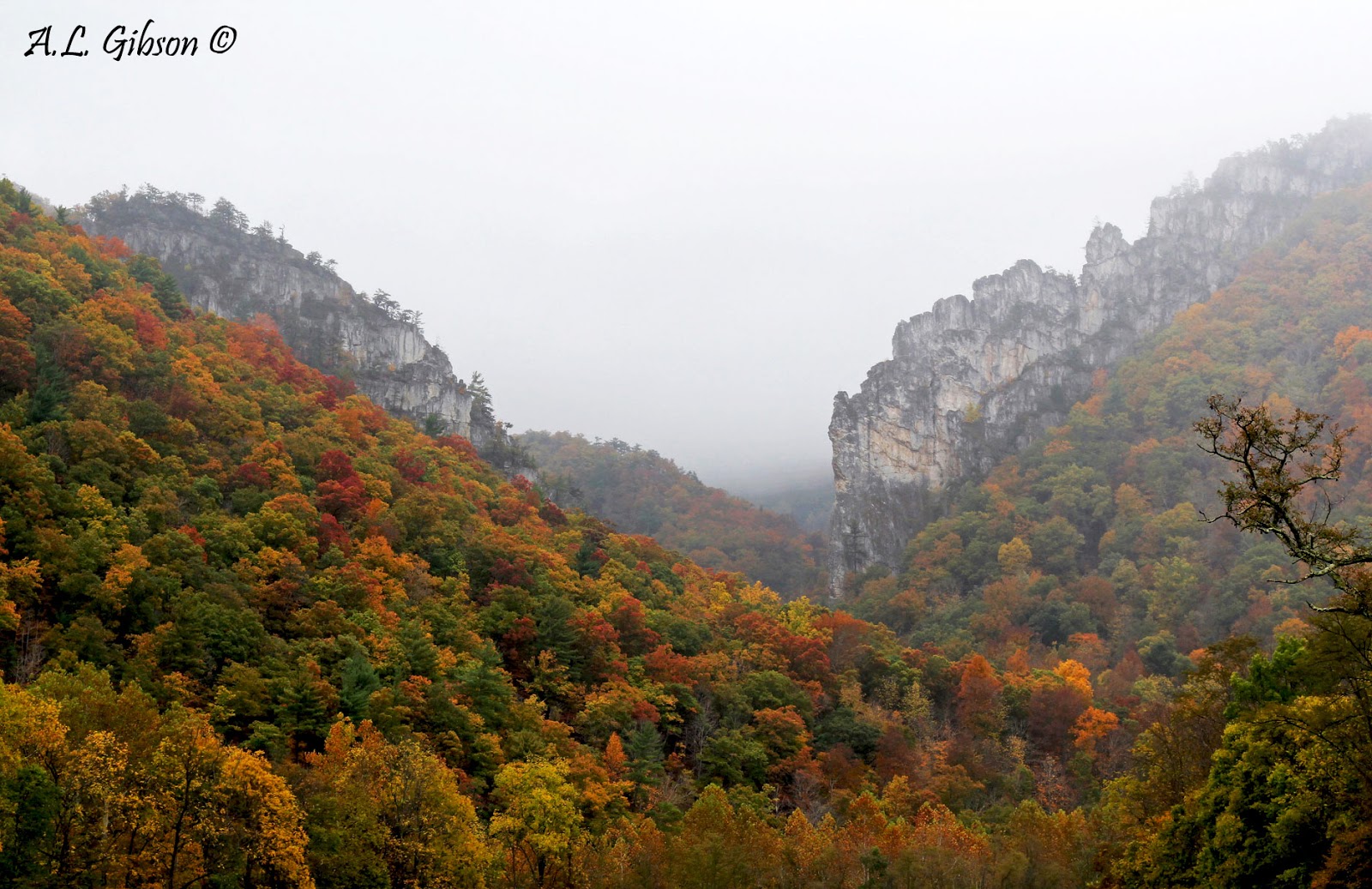
Champe Rocks emerging from the fog and mist, ensconced in autumn's finest.


Famed Seneca Rocks rocketing nearly 900 feet above the valley floor. The previous Champe Rocks photo and
 this and the next ones of Seneca Rocks were taken in 2014 but deserve their place in this post since we
 drove past these very places in the same foliage conditions but with intense light in the wrong places, 
making for poor photography conditions.


The entrance to another world through which a small stream flows at Seneca Rocks.


Tawny cotton-sedge (Eriophorum virginicum) filled bog meadow along the margins of Spruce Knob Lake.


I know I used this photo and view in my last post but I had to use it again from the actual trip it occurred on.
This view from atop Spruce Knob, West Virginia's tallest peak at nearly 4,900' was taken October 11th and while
the rest of the region was at peak foliage, here already looked like winter.


Our trip ended as it began with perfect fall foliage and clear blue skies. We took
the long way home through the Gandy Creek valley on the backside of Spruce Knob and
could not have enjoyed the bumpy gravel road drive more.


Needless to say, the foliage and weather cooperated perfectly for last fall's trip. It was easily one of the most photogenic weekend's of my life and I'd put even more photos in this post if it wasn't packed with them already. If you haven't taken the hint yet and need to have it spelled out for you: go visit Dolly Sods already! I don't know what else could be holding you back if you live within a day's drive. Hopefully these last two posts have proven just how special and magical a place it genuinely is. Spring, summer, fall or winter, you have to experience the Sods!

- ALG -

Thursday, October 23, 2014

Autumn Color at Conkle's Hollow State Nature Preserve

Fall coming to southeast Ohio is a moment I look forward to all year long.  It's a bittersweet moment at its core as another growing season has come to its inevitable end but the brief flux of color across the region's rolling, contiguously forested landscape makes winter's impending return seem not so rough.  Since moving down to the Athens area over five years ago, I've made sure to make the most out of living in such a spectacular part of the state.  In order to accomplish that there is one pilgrimage that must be made each and every October to a particular sandstone gorge in the renowned Hocking Hills region.

Looking into the bottleneck of Conkle's Hollow from the eastern gorge rim trail

If I've visited Conkle's Hollow state nature preserve once, I've visited it a dozen and a half times at just about every time of the year.  Its sheer sandstone cliff faces and bluffs rise precipitously from the cool, lush hemlock hollow below and is rimmed by an acidic mixed oak and pine forest community.  The views from the gorge rim trail are breathtaking no matter the season but let's not kid ourselves, nothing can best autumn's scene.

Incredible autumn color from all direcitons

The exposed layer of bedrock at Conkle's Hollow and the rest of the region is known as Black Hand sandstone and was laid down over 350 million years ago when an immense, warm shallow sea covered what is current-day Ohio.  The fine sand grains and rock particles that settled at the ocean's river deltas compacted under an ever-increasing amount of pressure and weight from the younger layers of sediment on top.  As the tectonic plates continued to shift and move over the Earth's surface, the eastern edge of the North American continent was forced up as the Appalachians formed, leaving Ohio high and dry and exposed to the elements.  Over the following hundreds of millions of years the softer surrounding bedrock material has been weathered away by the forces of water, ice and wind to reveal the resistant Black Hand sandstone.  Despite its heightened resiliency even it is not immune to the forces of time and erosion and has slowly but surely been carved out into the unique and fascinating gorges, promontories and rock houses we see today.

Stunted and gnarled Virginia pine along the very edges of the sandstone cliff edges and rock faces

When delving into the botanical aspect of any habitat or ecosystem it's important to know the geologic history and background for the corresponding area.  Geology and botany are intimately tied together and produce predictable results depending on the conditions present.  Conkle's Hollow's gorge rim is a harsh and acidic environment with very shallow, fast-draining soils and exposed bedrock with plant associations pretty similar to the Dolly Sods heath barrens I blogged about in the post prior to this.  Tree species such as chestnut/white/scarlet/post oaks, hemlock, Virginia pine, sourwood and serviceberry dominate with a shrub/herbaceous layer comprised of xeric acidophiles like mountain laurel (Kalmia latifolia), huckleberry (Gaylussacia baccata), hillside blueberry (Vaccinium pallidum), teaberry (Gaultheria procumbens), trailing arbutus (Epigaea repens), striped wintergreen (Chimaphila maculata), partridgeberry (Mitchella repens) and sawbrier (Smilax rotundifolia).

Unbeatable fall colors at Conkle's Hollow

As the story goes, Conkle's Hollow got its name from an inscription once visible on the western wall of the gorge that read -W.J. Conkle 1797-.  I can't imagine trying to rappel my way down the rock faces of the hollow with the technology and advancements of today, let alone over 200 years ago.  Whomever Conkle was, they certainly had more guts and adventure than I do; no way would I have been able to do such a task.  One wrong move and you're leaving your bones behind at the bottom of the hollow instead of your name!

Sheer sandstone cliffs rising nearly 200 feet above the valley floor

The sandstone cliffs look as imposing as they are impressive and boast vertical heights of nearly 200 feet, making it arguably the deepest hollow in the entire state.  The small creek that gently flows on the valley floor will continue to deepen the hollow millimeter by millimeter as time marches on and only add to its impressive physical relief statistics.  The mixture of evergreen hemlocks and bright yellow birch and tulip poplar at the bottom contrast nicely against the scarlet and orange of the oaks above the pale sandstone during the fall season.

Looking south out of the mouth of Conkle's Hollow and across the Hocking Hills

The fall foliage show has been exceptionally good this year with cool temperatures and wet weather sticking around for most of the month.  The leaves were nearing the end of their peak earlier this week during my visit but there's still time to get out there and see the views and scenery for yourself before it's done and gone for another year.  The view above is one I've admired and soaked in on numerous occasions and one that seems to get better upon each renewed visit.  No roads, no buildings, no powerlines, just ridge after ridge of contiguous forest ensconced in autumn's perfection.

Close up of one of Conkle's most prolific sandstone promontories 

I often tend to favor posts that take the reader places they've rarely, if ever been or perhaps never even heard of but sometimes it's hard to resist sharing a location that just about everyone is familiar with.  Conkle's Hollow is well-known, well-loved and certainly well-visited, as I can't recall a time when the parking lot hasn't had a majority of its spaces filled.  I'm thankful such a timeless and quintessential landscape for the region is preserved and protected as a state nature preserve and open for the public's enjoyment.  I highly encourage anyone reading to get out and visit for yourselves before winter clinches its cold and icy grip over Ohio; whether it's just one of a long string of visits or your first time!