Showing posts with label Canada. Show all posts

Tuesday, June 7, 2016

The Bruce Peninsula Part I: Intro

 *Part I* *Part II* *Part III* *Part IV* *Part V* *Part VI* *Part VII*
As mentioned in my recent posts since coming back from the blogging dead, I have more than enough topics to catch up on. The biggest one of all is my sensational week long trip up to Ontario's Bruce peninsula last early June. In fact, I was up there at exactly this time last year and figured what better time to reminisce than now? I have tons to share and have decided to break them up into a series of posts that will make them easier to digest and enjoy. I'll be sure to link each and every one at the top and bottom of each post for easy movement between them.

View from atop Cave Point on the Bruce's rugged eastern shoreline. 


This first post will set the table for the rest of the series and serve as a nice introduction. I first discovered the beauty of the Bruce peninsula, or 'the Bruce' as I'll come to call it from here on out, back in mid June 2011. I had an incredible time that only whetted my appetite for more with a promise to return sooner than later. I missed out on a number of plants I had the highest hopes of seeing and resolved to arrive earlier in the month to catch them all this time around. I certainly achieved that and so much more!

Location of the Bruce peninsula within the Great Lakes region (courtesy Google Maps)


When I mention the Bruce to most folks, their first question is usually where in the world is this place? The Bruce is an extension of the geologically significant Niagara Escarpment that helps separate Lake Huron's main body and the Georgian Bay on its southern end, as seen in the map above. The peninsula's southern end is comprised of a mostly flat landscape with some rolling hills and dominated by pasture and agriculture, while the more wild northern end is dominated by forest and countless wetlands. The Bruce provides southern Ontario with its largest remaining tracts of forest and natural habitat and contains two national parks and numerous nature reserves protecting priceless globally rare habitat.

Closer look at the Bruce and major areas of exploration during my trip marked on the map (Courtesy Google Maps)

The aforementioned Niagara Escarpment is a major geological player in the Great Lakes basin and forms the backbone of the peninsula. The escarpment's bedrock strata is comprised of dolomite limestone, much like my beloved Adams County, Ohio's prairie barrens, that is of Silurian Age in origin and laid down over 400 million years ago. Despite being thoroughly scraped and carved flat by glaciers over the millennia, the Niagara Escarpment has provided the Bruce with some stunning topography in its dramatic lakeside cliffs/bluffs, rugged shorelines, alvars, and waterfalls as you'll come to see.

Pit stop at a bog in SE Michigan to see the Dragon's Mouth orchid (Arethusa bulbosa)

The trip started with your narrator making the initial drive up to Detroit, Michigan to pick up good friend and fellow botanist/trip member, John Manion at the airport. John lives/works in Alabama and had it planned to join me for the rest of the drive up to the Bruce after flying in most of the way. It was a good thing he did, as our quick, albeit out of the way pit stop at a wonderful sphagnum bog near Ann Arbor produced a life plant for John in the mesmerizing dragon's mouth orchid (Arethusa bulbosa). It was a harbinger of amazing plants, places and things to come!
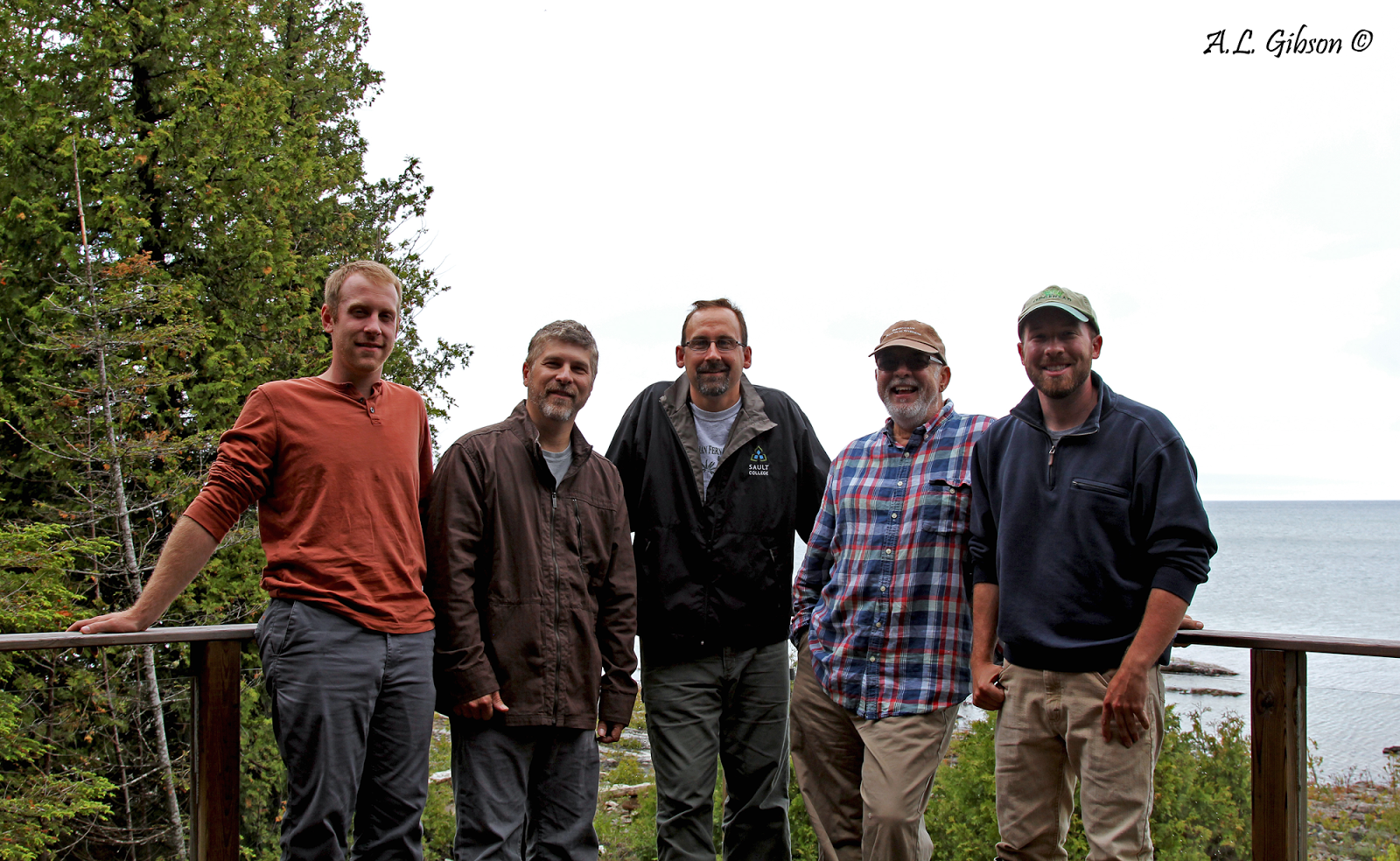
The Bruce Crew! L to R: Stefan Weber, Drew Monthie, Rob Routledge, John Manion, and your narrator


The rest of the crew met up at our lakeside cabin we'd rented for the week. All four other gentlemen were exceptional field botanists/naturalists and even better human beings! I can honestly say having the pleasure of experiencing the Bruce's splendor with all of them and the memories, laughter and camaraderie shared was second to none. Each one of us brought something unique and valuable to the table, but I must single out John's penchant for cooking as perhaps the best of all. We ate like royalty while up there and all pitched in to take his dish and meal ideas from paper to plate. I can't recall a better week of eating before or since. John, I'll never forget those honey drizzled, prosciutto-wrapped stuffed figs. Bliss!

One of our daily tributes to Jackie for being unable to join our trip due to a sudden knee injury


The only dark cloud to hang over our trip was the loss of our friend, Jackie. She was originally part of the Bruce Crew but suffered a fall and shattered her knee cap shortly before our departure that required surgery and lots of rest. Jackie is a dear, dear friend of mine whom you may recall has her own splendid blog, Saratoga Woods and Waterways. She's also graciously opened her home and favorite areas of upstate New York to me on two trips that I often still think about years later. Jackie was never far from our mind and we made sure she knew that by arranging her name in a variety of different items each day and sending her a get well email. My favorite was the one pictured above made of forget-me-not blossoms that abounded outside the cabin (no worries, it's a non-native species, so no harm done picking the plants!).

Our secluded cabin right on the Lake Huron shoreline nestled among the cedars, pine and spruce


I'd be remiss if I didn't take a moment to show off the location of our dreamy rented cabin. It resided in a secluded area on the western shorelines of the peninsula's northern end near Dorcas Bay. The interior was nicely furnished, comfy and quite spacious but nothing could beat the huge back deck and its phenomenal view. The surrounding coniferous woods and cobble shoreline was full of exciting flora and the morning serenade of warblers galore singing their hearts out outside my window is an alarm clock I'll never best or forget.

Keying out plants while drinking a beer was a favorite evening activity of mine


That gorgeous back deck saw lots of action with several nights of expert grilling by Rob; plenty of beer drinking and cigar smoking (at least for Rob and I); and provided a scenic spot to work out the day's unknown plants we collected/came across.


The Bruce Crew's combined naturalist library


Speaking of figuring unknown things out, our group was hardly in short supply of relevant literature and/or resources while up on the Bruce. Between the five of us, our combined library was impressive and came in handy. If anything, it provided a hands on chance to check out books I've yet to add to my naturalist bookshelf. In many cases, at least one of us already knew what most anything was others drew a blank on but with so many books it seemed like a lock we'd be able to nail down an ID on any mystery organism, no matter its place on the tree of life.

The adult sand hill crane is an obvious spot but can you find its little chick too?


The Bruce isn't just a botanist's dreamland but a birder's, too! I'm a casual birder at best most of the time with my attention usually fixated on the ground. It's easier to focus on plants and merely pay attention to the songs and calls filtering down from the canopy than actively seeking birds out with my binoculars. But I'd been a fool to not take advantage of the returned neo-tropical migrants and northern species rarely seen/heard in Ohio while up in Ontario. The highlight for me was stopping along a grassy meadow to observe a pair of sand hill cranes, only to realize they had two chicks with them! That was a new experience for me! Can you find the chick in the photo above?

Lake Huron sunset from the back deck of our cabin. Not too shabby, eh?

I know this wasn't the most exciting or captivating of posts but rest assured the next half dozen or so to follow will more than show just how unique and majestic a place the Bruce genuinely is. It's one of eastern North America's best kept secrets but certainly famous and popular with those who know and experienced its beauty. I hope you'll stay tuned and come back as I reminisce on one of the most fun and rewarding weeks of my life. Thanks for stopping by!

- ALG -

Monday, July 4, 2011

Ram's Heads on the Singing Sands (Bruce Peninsula)

My first full day of exploring the Bruce had finally arrived.  I walked out the door and into the morning sunlight where I was immediately greeted by American Redstarts and Black-throated Green warblers filling the air with their song.  A perfect way to start the day if you ask me.  I spent part of my evening the night before pouring over some maps and information on the area in an attempt to decide where I should start my dissection of this botanical wonderland.  I concluded on an area along the western shores of Lake Huron at Dorcas Boy known as the Singing Sands.  Singing Sands got its name from the sound of the sand blowing over the dunes and alvars.  This is one of the only sandy beaches on the northern end of the Bruce.  Most are dominated by huge boulders and slabs of the limestone bedrock as you will eventually see.

A huge fen complex along Lake Huron at Dorcas Bay

Singing Sands is home to many varying habitats and ecosystems within its section of Bruce Peninsula National Park.  One of the most inspirational and influential of Mother Earth's disciples and personal hero of mine, John Muir, visited the Bruce numerous times during his two year stay in Ontario in the 1860's.  Of the Bruce John said, "Are not all plants beautiful?  Would not the world be poorer for the banishment of a single weed?"  I don't think John ever met the Asian Lonicera shrubs but his point is very valid!  Upon arriving to Dorcas Bay it's hard not to notice the gargantuan fen complex stretching as far as the eye can see all around.  Hundreds and hundreds of acres of wet sedge meadow with pockets of White Cedar (Thuja occidentalis), Black Spruce (Picea mariana) and Tamarack (Larix laricina) scattered about was an unbelievable sight!  Coming from Ohio, most fens pale in comparison to Dorcas Bay's.  I was a couple weeks too early for the Dorcas Fen orchid fireworks show.  Thousands of pink specks of the Rose Pogonias (Pogonia ophioglossoides) and purple Grass Pink (Calopogon tuberosus) dot the fen in dizzying densities in late June and early July.

Sarracenia purpurea
Drosera linearis


However, there were thousands upon thousands of N. Pitcher Plants (Sarracenia purpurea) in full bloom out in the sedge meadow.  This is the same species found in the northeastern bogs and fens of Ohio but their leaves were quite a bit smaller and the flowers on shorter stalks up here.  Unlike most fens, including Ohio's that rely on ground/spring water, these shoreline fen complexes rely on close by Lake Huron for their water source.  Spring rains and higher lake levels flood the fens during the 'wet season', which was nearing an end during my time up there.  A carnivorous plant species first-timer for me was the cousin to our round-leaved Sundew, the Linear-leaved Sundew (Drosera linearis).  Essentially the same in habitat and functionality, the obvious difference is its leaves which are long and narrow versus rounded.  With the amount of mosquitoes, midges, black and biting flies I don't see how these plants, as many as there were, could go hungry.

Singing Sands beach at Dorcas Bay on Lake Huron
 
The biggest reason for wanting to do this hike first was in high hopes of seeing my most anticipated plant species and reason numero uno for coming up to the Bruce, the rare and elusive Ram's Head Lady's slipper (Cypripedium arietinum).  Even before I was really into botany or plants in general I had always heard of the Lady's slipper orchids and thought how cool and interesting they looked.  I guess it's only appropriate that they are one of my favorite genera of plants in our flora.  A major life goal of mine is to see all 12 Cypripedium species indigenous to North America in their native habitat.  There are three accepted varieties to C. parviflorum and a handful of naturally occurring hybrids as well.  With the addition of the Ram's Head I'm now batting .500, having seen C. acaule, C. candidum, C. kentuckiense, C. parviflorum, C. reginae and now C. arietinum.  I'll be packing my bags and exploring the northern Rocky Mountains, California and Alaska to complete the set but that's for another time and story.

Cypripedium arietinum done blooming
Already done for the season


I began walking very slowly through the mixed conifer woods a couple hundred yards in from the shore with my eyes peeled sharply to the ground, looking for a green stem with three to five leaves alternately arranged and topped with a tiny, marble-sized red and white slipper.  After nearly 30 minutes of careful scanning I finally picked out of the corner of my eye a suspicious plant.  As I moved closer it became evident this was the very plant I'd come all this way to see and...it was all but spent.  One after another, the Ram's Heads unveiled themselves to me but all were brown and shriveled, papery excuses of their former grandeur.  My stomach slowly sank as I found plant after plant further down the trail with the same results.  It really was a punch to the gut and soul to have daydreamed the whole ride up of seeing this amazing plant only to see it just days past prime condition.  I knew I was cutting it close by coming in mid-June when the Ram's Heads peak bloom is late May to early June.  They are a very short-lasting lady's slipper, with each flower rarely lasting more than a few days in prime condition.  Maybe next time I thought as I sulked down the trail but still keeping a lookout.  Good thing I kept going because just around the bend....

Ram's Heads under the Hemlocks
Ram's Head Lady's slippers


After observing so many past bloom plants, I took note of what specific niche in the habitat they were growing in.  Throughout its range it can be found in both dry conifer forests as well as wet, swampy woods and acidic bogs.  At Singing Sands they grew as solitary plants or loose clumps just underneath or along the Hemlock and Jack Pines on raised, mossy hummocks.  It was more a matter of looking for that kind of situation first, rather than looking specifically for the plants.  The first two I happened across still in bloom were just under the lowest bough of a Hemlock and were even better than I had imagined.

Size comparison
Such delicate beauties


I'd waited a long time to see these diminutive orchids and they did not disappoint in the slightest.  The spectacular snow white labellum is marked with purplish-crimson reticulate veination and densely pubescent along the rim of the mouth.  If the size and coloration of this Cypripedium doesn't sell its identity then the downward projection of the bottom of the lip sure does.  No other lady's slipper in North America has a similarly structured labellum.  Not only is this orchid striking in color and architecture but the sheer tininess of it as well.  It's certainly the smallest of the East's lady's slippers with even the largest flowers only being as big as my thumb nail.  While nowhere near as scented and sweet-smelling as the C. parviflorum var. makasin from my previous post, they do emit a pleasing and sugary aroma.

Ram's Head in typical habitat
Ram's Head in perfect condition


This lone plant was one of the few still in perfect shape on my hike.  The shots from above feature blooms that have already been successfully pollinated.  This is a fairly easy conclusion to surmise as the dorsal sepal ('petal' above the slipper) falls down over the mouth of the lip as if saying to its insect friends, "Sorry, closed for the season".  Botanist and orchid extraordinaire, Fred Case wrote that C. arietinum had a preferred habitat of conifer uplands in sandy areas characterized by Cedar and Pine, especially with an association of limestone beach cobble.  With that accurate observation it's no wonder the Bruce is one of the best areas within the entire range of the Ram's Head to see this increasingly rare orchid.  In the United States, this orchid is only found in the northern Great Lakes states as well as in northern New England.  With global warming and higher temperatures this northern, boreal species may become more and more rare within its U.S. range until disappearing completely.

Lake shore alvars
Ontario rarity Packera obovata


After spending more than enough time with the Ram's heads, I continued down the trail until it came to the lake shore where the forest gave way to large expanses of exposed limestone bedrock.  These areas of grooved and scraped stone are a globally rare habitat known as an alvar.  Only select areas within the Great Lakes basin (including Ohio's Kelley Island), Sweden and Estonia have alvars.  Created thousands of years ago when the mighty weight of the glaciers passed over the area, you can still see grooves and markings from where they scraped over the bedrock.  The yellow flowers scattered throughout the beach belonged to the Round-leaved Ragwort (Packera obovata).  While common in Ohio and found in a variety of habitats, the round-leaved Ragwort is quite rare in Ontario, growing predominately on the rocky shores of alvars; completely different than what I normally see.

Glacial groves on the limestone alvars
Iris versicolor


Water and small pockets of dirt gradually collect within the depressions and holes of the limestone bedrock.  This allows plants such as sedges (Carex spp.), spikerushes (Eleocharis spp.) and the photographed Blue Flag Iris (Iris versicolor) to grow and survive in the harsh and punishing conditions of the alvars.  That reality of just how little life can cling to up here really became the reoccurring theme of the trip.  Amazing what life will do when given the chance.

Pinguicula vulgaris
Pinguicula vulgaris


For the return hike back to the car I decided to stick along the lake shore to see what different sights and species I could find.  My eyes were quickly attracted to a patch of lime green rosettes with small purple flowers dancing in the wind.  I instantly recognized them as another exciting and unusual species I had hopes of seeing!  This is the carnivorous plant known as Butterwort (Pinguicula vulgaris).  The lime colored and slimy rosettes attract insects which become stuck to the surface and are then digested.  The purple solitary flowers have a Penstemon or Viola-esque look to them in my opinion.  This plant is only found in a handful of northern states where it is rare in just about all of them.

Prunus pumila var. pumila
Glacial alvars along Lake Huron


As I got closer to the car I came across an area with some of the most obvious signs of glacial evidence.  The ground was one huge, flat and continuous piece of dolomite limestone bedrock.  It almost looked like nature was reclaiming an old airport runway or section of concrete highway.  This is all the Bruce is; one huge hunk of Silurian age limestone with life still fighting for survival all those millennia later.  Crossing over the sand dunes just before the parking lot I spotted a scrubby-looking shrub species still clinging to a few white blooms.  It was the waning flowers of the Great Lakes Sand Cherry (Prunus pumila var. pumila), which was collected only once in Ohio over 100 years ago and never seen again.  This uncommon shrub plays a vital role as a sand and dune stabilizer, using its roots to prevent sand from shifting and loosening.

After getting to the car I realized my stomach was growling and my taste buds were watering for an ice cold beer back at the pub.  I'd spent all day exploring this fascinating area of the Bruce and finding so much more than I could ever fit into one blog post.  I was still on a high from finding the Ram's head lady's slippers as I cruised through the back roads to get that beer but I couldn't help but already start to plan for tomorrow's adventure...