Well, as promised I'm ready to start my blogging mini-series on my road trip and botanical foray up to the Bruce peninsula in Ontario, Canada. I can say without any real hesitation that this was one of the most exciting, adventurous, soul-cleansing and amazing weeks of my life! The wide array of varying habitats and ecosystems, plant communities, geologic wonders, flora and fauna...the list goes on indefinitely about just how diverse and fascinating that spit of limestone in Lake Huron is. I observed nearly 100 vascular plants in bloom and got the chance to find 18 different species of orchid either in flower or bud. From traversing the rugged, boulder-strewn shorelines to sloshing through fens and marshes, there was hardly a minute where I wasn't in complete awe of my surroundings...but we will get to all that soon enough! First I'd like to start things off by retracing my steps back to where it all begin. Every story has a beginning and mine was only an appetizer of things to come.
I awoke early Tuesday morning to sunny blue skies and loaded up my Forester for the first leg of my journey from home to the Buffalo area of New York state. The day's itinerary included several stops throughout Northeastern Ohio's bogs, fens and an old-growth White Pine (
Pinus strobus) and E. Hemlock (
Tsuga canadensis) forest. Each stop included a featured plant or two I had my sights on as well as the usual round of surprises along the way. As I made my way up I-71 towards Clear Fork Gorge state nature preserve inside Mohican State Forest I decided to quiet my growling stomach with a stop at Bob Evan's. As I settled in at my spot along the bar and began to sip the morning's first cup of coffee a large Greyhound bus rolled into the parking lot and proceeded to expel 50+ people from its doors. I was one of maybe 7-8 other folks in the restaurant at 8 in the morning with only two waitresses working. As the next half hour went by I don't think I've ever seen two waitresses and a cook move so fast in all my life. I finished my meal, drained my coffee mug and got back in the car with a new found sense of excitement and gratitude that I was about to have the week of my life and wasn't one of those poor workers I left behind.
 |
| Ancient Eastern Hemlocks |
 |
| A towering White Pine |
A little over an hour later I found myself wandering through a rare ecosystem nearly extinguished from Ohio's fertile landscape. Although only a small, 8 acre grove, these White Pines and E. Hemlocks were among the largest I've ever seen in Ohio. Trees 3+ feet in diameter abounded with many reaching heights well over 100' tall. The White Pines, while few and scattered amongst the Hemlocks, were the monarchs of the forest. The largest one I saw (pictured above right) was approaching 4 feet wide and easily 120-130 feet above my head. Residing on a steep slope in the gorge of Clear Fork, these escaped the ax and chainsaw to attain heights and diameters I've never seen before other than in the fleeting old-growth Pine/Hemlock forests of Northern Michigan. I wasn't here to just gawk at the impressive conifers in this grove but also to scan the thick bed of needles for one of Ohio's most unusual and intriguing early summer wildflowers, the Round-leaved Orchid (
Platanthera orbiculata).
 |
| Platanthera orbiculata |
 |
| Platanthera orbiculata |
The hand sized, round, green leaves are not hard to pick to out from the brownish mat of fallen needles. Of all the native orchids to Ohio this one has the largest leaves and arguably the most unique flowers. Upon closer inspection they look like little aliens crawling up the raceme towards their mothership. Little did I know this neat orchid would be just the first of a long list I would see over the course of the next week.
 |
| Brown's Lake Bog |
 |
| Sphagnum spp. |
Onward down the road was one of the coolest places I've had the chance to explore in Ohio, Brown's Lake Bog. As the glaciers receded, giant pieces of ice broke off and were buried by glacial outwash and debris only to melt and fill the resulting depression with water. These naturally occurring bodies of water are known as kettle ponds or lakes. In even more unique and special situations the waters of these kettle ponds become acidic as years of decomposing plant material accumulate and species of a moss called
Sphagnum begin to grow. As decades and centuries pass the
Sphagnum form a series of layers over the water of the kettle pond, becoming essentially a floating mat of vegetation. Taking a careful and slow walk across the mat gives the effect of walking on a firm waterbed. Throughout the dominant Poison Sumac (
Toxicodendron vernix) and Cinnamon Fern (
Osmunda cinnamonea) were many rare and fascinating boreal bog species of plants.
 |
| Cinnamon Ferns |
 |
| Scattering of Rose Pogonias |
Immediately catching my eye was a corner of the
Sphagnum mat heavily speckled with pink. These weren't your average 'pink specks', they belonged to the state threatened and breath-taking orchid known as the Rose Pogonia (
Pogonia ophioglossoides). These delicate beauties are the size of a quarter and range from deep pinks and magentas to very light pink and rose colors. An interesting note on habitat is I've seen this orchid bloom in acidic bogs such as Brown's Lake as well as in calcareous and limey fens along the shores of Lake Huron. Strange it seems to thrive and tolerate both ends of the soil pH spectrum.
 |
| Pogonia ophioglossoides |
 |
| Pogonia ophioglossoides |
Being able to stand on a floating mat of vegetation over the chilled waters of a naturally made kettle pond (with permission to go off trail, of course) was one of the coolest experiences yet in my botanical endeavors. Each step sent rippling shockwaves across the
Sphagnum mat with tiny, undulating motions felt throughout my body. Not even the clouds of deer flies buzzing around my head could penetrate my moment of zen. It was almost impossible to take a step in any direction without nearly stepping on some species of interesting or rare plant.
 |
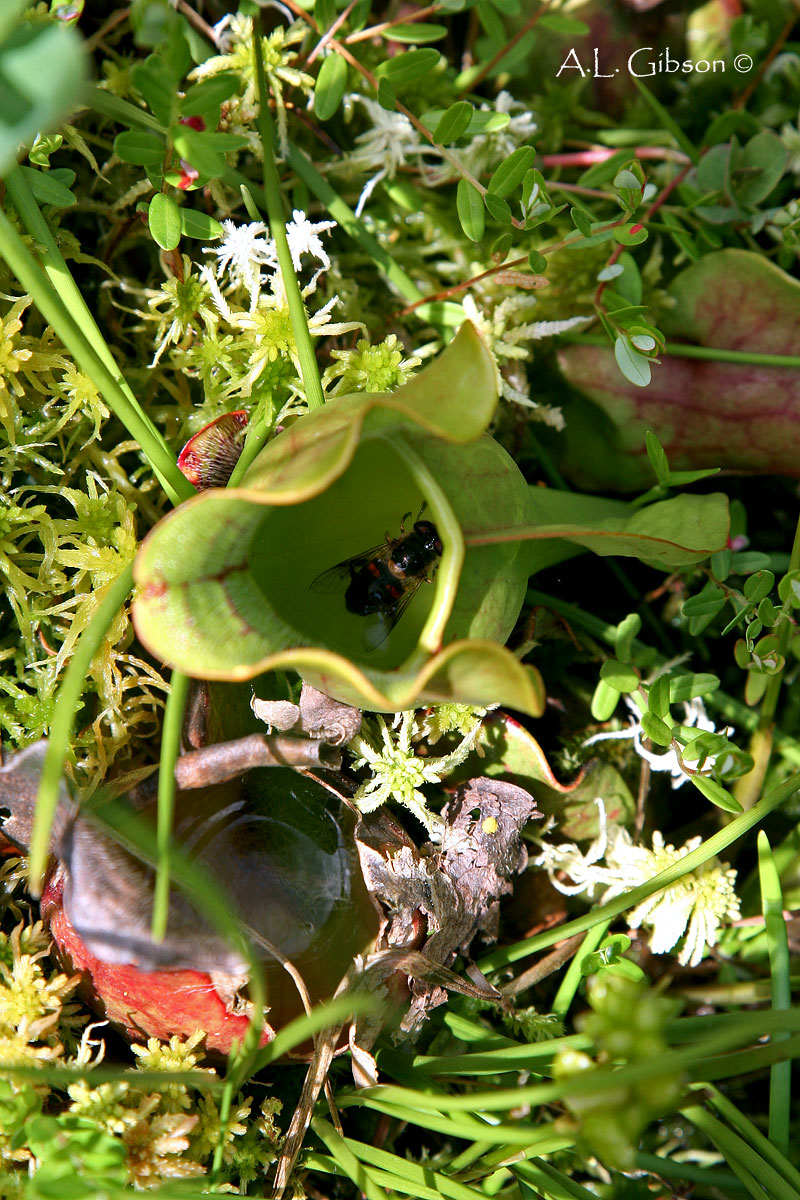
| Pitcher plant with an insect meal |
 |
| Sarracenia purpurea |
Speaking of interesting and rare plants, this one was quite common throughout the mat and easily one of my favorites. The Northern Pitcher Plant (
Sarracenia purpurea) is a potentially threatened species found scattered throughout Ohio's northeastern bogs and in rare cases fens as well. Their modified leaves form a sealed 'pitcher' which fills with rainwater and acts as a trap for visiting insects which in turn drown in the water. Invertebrates (such as mosquito and midge larvae) living in the trapped rain water as well as bacteria then break down the insects into a nutritional base usable by the plant. Studies have shown that new, first-year leaves do produce digestive enzymes but in the long run the plant relies on its symbiotic relationship with its invertebrate occupants for the most part.
 |
| S. purpurea flowers |
 |
| S. purpurea and Drosea rotundifolia |
Rising a foot or so above the pitcher-like leaves were the intriguing flowers of the N. Pitcher Plant. The reddish-green flowers are rather large, measuring about two inches across. The Bruce peninsula has thousands upon thousands of this species along its lake shore fens as I would come to find out. The picture above right shows two of Brown's Lake Bog's carnivorous plants. On the left are the fascinating leaves of the Round-leaved Sundew (
Drosera rotundifolia). The sticky 'dew' droplets glistening on the ends of the leaves attract insects to its sweet scent. Upon landing on the leaf the unassuming insects become stuck to the gluey hairs and slowly the leaf curls in, wrapping the insect up in its sticky tomb of death. Digestive enzymes are then secreted and used to decompose the insect into usable nutrients.
 |
| D. rotundifolia rosette closeup |
 |
| Vaccinium macrocarpon flowers |
Round-leaved Sundew is the more common of the two native
Drosera's in Ohio. All the sundew's are essentially the same only differing in the size and shape of the leaves. While not in bloom on my visit to this bog nor up on the Bruce, they are just starting to flower at Cedar Bog and I look forward to seeing their tiny, fragile but charming flowers. Seen in its vegetative form all over the
Sphagnum mat was Large Cranberry (
Vaccinium macrocarpon). After some searching I was able to find a couple flowers in bloom that will mature into the delicious and edible cranberry you enjoy as a tasty and healthy snack.
 |
| This year's female Tamarack cones |
 |
| Patch of Vaccinium oxycoccos |
After spending a good deal of time at Brown's Lake Bog I hit the road again and continued on my route through northeastern Ohio. Up next was Kent Bog, an Ice age relic boreal community with many rare and northerly plants. Kent Bog's claim to fame is it's home to the largest, southernmost stand of Tamarack (
Larix larcina) trees in the continental United States. It is also home to the rare northern tree Grey Birch (
Betula populifolia) as well as the state threatened Small Cranberry (
Vaccinium oxycoccos).
The next stop on my tour of northeast Ohio was Gott Fen in Portage County. According to the ODNR, this fen complex houses the largest population of Showy Lady's slippers (
Cypripedium reginae) in the state. This was peak blooming time for these on my arrival and I was rather excited to see some in large numbers. After finding the site it became increasingly clear to me the outer edges were so overgrown with shrubs and trees it was nearly impossible to gain access to the interior of the fen. I tried several attempts to enter but was denied and turned back by dense vegetation each time. "Gott Damn Fen" is a more appropriate name for this place until I get a proper tour of it! I was able to see some Showy ladies in bloom along the outer perimeter which made for somewhat of a satisfactory visit.
 |
| Mantua Bog |
 |
| Poison Sumac in flower |
Last on my string of stops and certainly the most anticipated was Mantua Bog just outside the village of Mantua. This permit only preserve is home to a great deal of rare plants with one calling my name louder than any other. This is the last location known to have the state endangered and very rare Dragon's-mouth orchid (
Arethusa bulbosa). A friend who works as a botanist for the state of Ohio was kind enough to send me a map with the location of the
Arethusa within the preserve. Despite a couple hours of trudging through the nearly knee high muck, weaving my way through a sea of Narrow-leaved Cattails (
Typha angustifolia) and avoiding large amounts of Poison Sumac, I never came across any evidence of the the Dragon's-mouth. Perhaps I arrived to the party too late or I just wasn't sharp-eyed enough to spot the gorgeous orchid but either way I left empty handed. You can't always see and get every plant on your list, there's always a few that will have to wait until next year!
After slipping off my boots and a quick change of clothes I made the rest of my journey along I-90 and watched a breath-taking sunset across Lake Erie end an exciting first day on the road. I pulled into my hotel in Hamburg, New York exhausted, filthy and craving a long, hot shower with the excitement of tomorrow flowing through my veins. It was early to bed and early to rise as the next day would take me into Canada and up to my ultimate destination of the Bruce peninsula! Stay tuned for my next installment in this series in the next day or so!