This past summer I had the pleasure of revisiting one of the most botanically interesting and diverse areas of my region of the country: the Cranberry Glades of West Virginia. If you'll remember correctly, I posted about this famed botanical area from last year's trip a ways back but wanted to give another, more detailed glance (at least photogenically) at its splendor for my readers. This post is designed to be more of a visual journey; if you're interested in learning more you can read the previous corresponding post
here.
 |
| View across the rolling green mountains of southeast West Virginia at 4,500 feet |
Deep in the bowl-like valley of the surrounding mountains lie the millennia-old open peat bogs of the cranberry glades. This antiquated relic of the last glacial epoch is a prime representation of a habitat type and ecosystem typically found hundreds of miles to the north. While the glaciers never made it far enough south to physically alter or shape West Virginia, their climatic influence and boreal conditions allowed its accompanying northern plants to invade its borders tens of thousands of years ago. As the massive sheets of ice receded back to the north, they left those unique plants behind in the refuge of the higher elevations that managed to replicate their cooler environmental requirements. Once the temperate deciduous forests began to creep back north from the south, they displaced these disjunct communities until just about all that remained today are the ancient, peat-filled bogs of the cranberry glades. Given enough time and the addition of an ever-warming climate, even this famous place will end up lost to the ages.
 |
| Large Purple Fringed orchid (Platanthera grandiflora) |
One of the best finds in the cranberry glades region are the forest springs and seeps that are home to the stunning large purple fringed orchids (
Platanthera grandiflora) growing along their moist, steep banks.
 |
| Large Purple Fringed orchid (Platanthera grandiflora) |
A closer look at their remarkable flowers shows just how complex and artfully sculpted each individual inflorescence is. This particular species was collected a few times in extreme northeastern Ohio back in the early 1900's and never seen again.
 |
| Allegheny Brookfoam (Boykinia aconitifolia) |
Growing and blooming in profusion with the large purple fringed orchids was the unusual and unique Allegheny brookfoam (
Boykinia aconitifolia).
 |
| Hay-scented Fern (Dennstaedtia punctilobula) |
Thick seas of hay-scented fern (
Dennstaedtia punctilobula) glowed a vivid green in the darkened understories of the surrounding woodlands.
 |
| Canada Lily (Lilium canadense) |
 |
| Canada Lily (Lilium canadense) |
Just beginning to open their gorgeous red-orange flowers in the higher elevations was Canada lily (
Lilium canadense) with their delicately speckled tepal undersides.
 |
| Mountain Laurel (Kalmia latifolia) |
The evergreen mountain laurel (
Kalmia latifolia) shrubs were in peak bloom at the highest elevations and gave off an appearance and aroma I wouldn't soon forget.
 |
| Running Clubmoss (Lycopodium clavatum) |
 |
| Fan clubmoss and tubercled orchid leaves |
The higher and drier, acidic conditions of the mountains were full of interesting fern allies such as these club mosses. Long runners of the aptly named running clubmoss (
Lycopodium clavatum) spread across the most open and barren of soils, while in more moist and shaded areas fan clubmoss (
Diphasiastrum digitatum) ruled.
 |
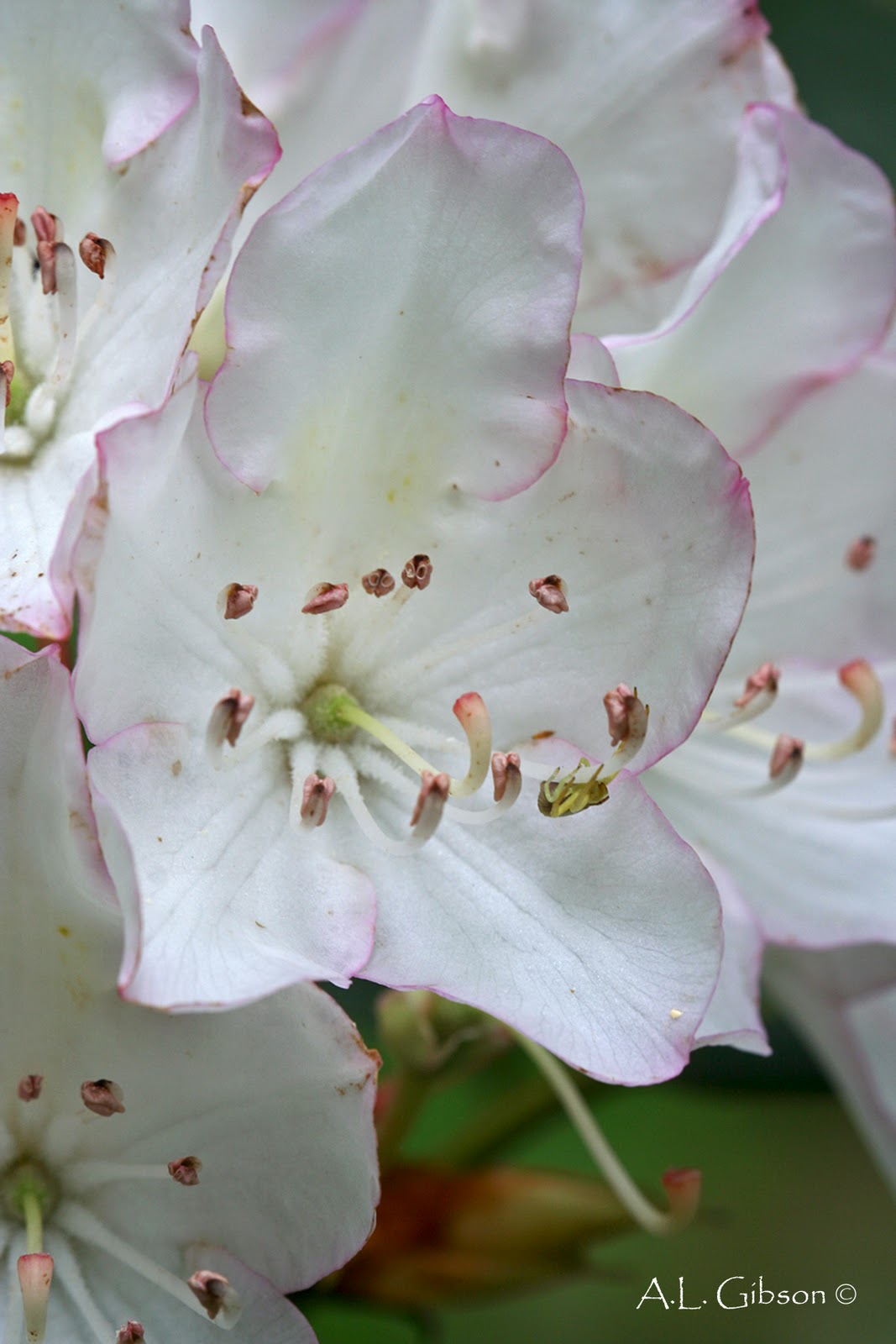
| Rosebay Rhododendron (R. maximum) |
 |
| Rosebay Rhododendron (R. maximum) |
While the mountain laurel was at peak, its heath family relative, rosebay rhododendron (
Rhododendron maximum) was just beginning to unfurl its tightly bunched pink buds. One glance at its flowers in full bloom and its not hard to understand why this species is West Virginia's official state wildflower.
 |
| The Cranberry Glades botanical area! |
At an elevation of about 3,400 feet above sea level, the cranberry glades remain relatively cool during even the summer months; especially with the supplementary chilled air flowing down from the surrounding mountains that rise an additional 1,000+ feet. It was late June during this visit and while I left a hot and muggy Ohio, I was greeted by temperatures in the upper 60's upon my arrival to the glades. It wasn't just the atmospheric conditions that were favorable and admirable but the flora too!
 |
| Looking across the open expanse of bog full of rare, disjunct plants |
A spectacular view across the open peat-filled bogs of the cranberry glades full of rare and disjunct flora and fauna.
 |
| Green False Hellebore (Veratrum viride) |
 |
| Red Elderberry (Sambucus racemosa) |
Two frequent and conspicuous plants in the understory of the glade's surrounding swamp woods was the green false hellebore (
Veratrum viride) and red elderberry (
Sambucus racemosa). Dozens of the hellebore's large basal leaves dotted the forest floor but only a handful of blooming stalks could be found.
 |
| Open swampy habitat in the cranberry glades |
The wetter areas of the swamp opened up into a more marsh-like habitat full of sedges and other emergent aquatic vegetation.
 |
| Appalachian Jacob's Ladder (P. vanbruntiae) |
 |
| Appalachian Jacob's Ladder (P. vanbruntiae) |
One of the most interesting and rare of the open swamp habitat's plant species was the very unusual Appalachian jacob's ladder (
Polemonium vanbruntiae). This scarcity only grows in a handful of northeastern states and is related to our common spring-flowering jacob's ladder (
P. reptans) but differs with larger, more erect flowers and habit.
 |
| Oblong-fruited Serviceberry (Amelanchier bartramiana) |
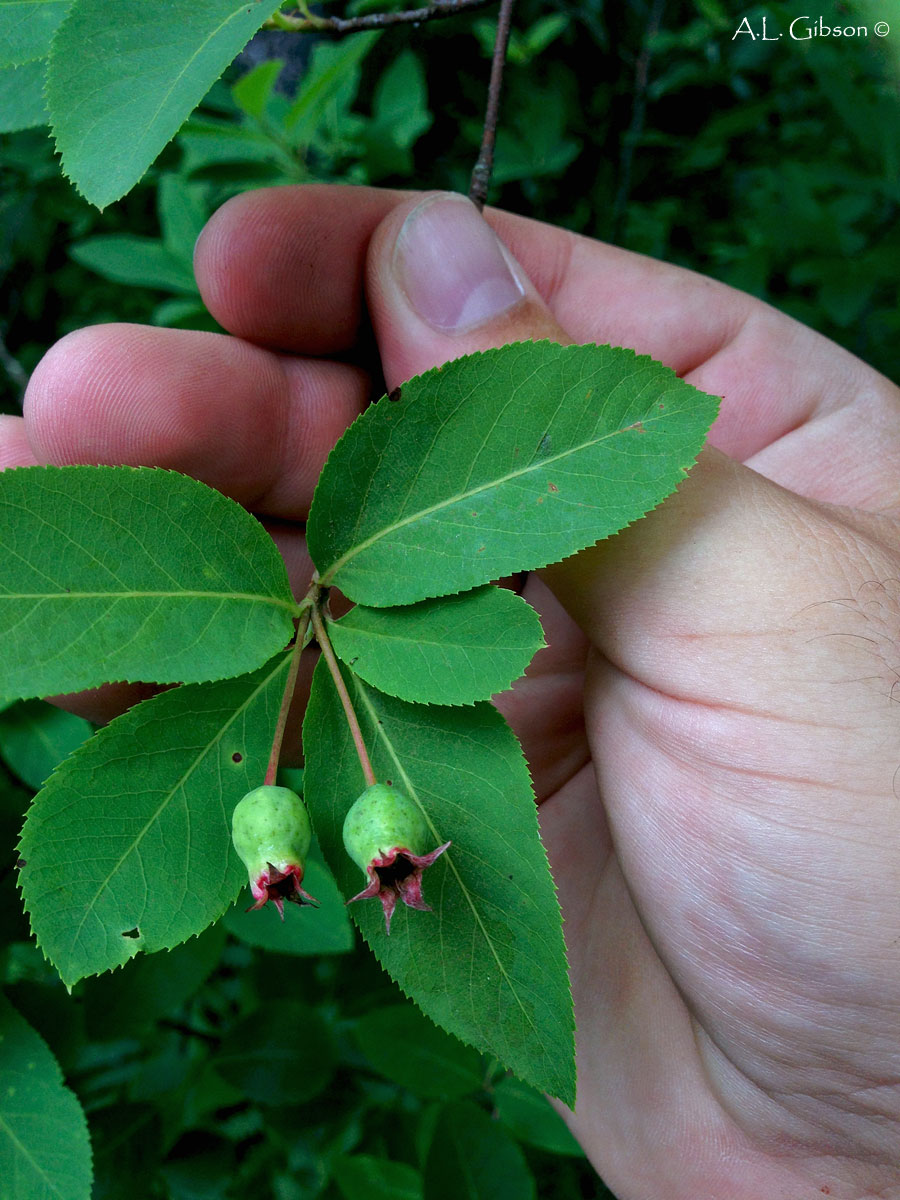
Another northern disjunct far from home in the glades is the oblong-fruited serviceberry (
Amelanchier bartramiana). This species only occurs in New England and the northern Great Lakes states and is at its most southern locale here in southeastern West Virginia. Its oblong-shaped fruit (duh) and leaves on very short petioles (seemingly sessile) are excellent identification factors.
 |
| View across the more filled-in part of the bog mat |
Looking out across the more filled-in areas of the peat bogs shows a great diversity of plants such as red spruce (
Picea rubens), black chokeberry (
Photinia melanocarpa), cinnamon fern (
Osmandastrum cinnamomeum), grass pink orchid (
Calopogon tuberosus), rose pogonia orchid (
Pogonia ophioglossoides), pitcher plant (
Sarracenia purpurea) and bristly dewberry (
Rubus hispidus).
 |
| Grass Pink orchids in full bloom above the sphagnum |
The bubblegum colored grass pink orchids (
Calopogon tuberosus) were in full bloom across the large, open expanse of sphagnum moss and cranberry. Their brilliant, jeweled pink appearance was set perfectly against the vibrant emerald green vegetation.
 |
| Grass Pinks (Calopogon tuberosus) |
 |
| Grass Pinks (Calopogon tuberosus) |
More looks at the gorgeous forms and displays of the lovely grass pink orchids. The adorable little mini Christmas trees in the photo on the right belong to another fern-ally lycopod called ground pine (
Dendrolycopodium obscurum).
 |
| Large Cranberry (Vaccinium macrocarpon) |
I would be remiss if I didn't make specific mention of the bog's namesake plant: the cranberry. Both large (Vaccinium macrocarpon) and small (V. oxycoccos) occur in the glades and were in full bloom during my visit. These pictured belong to the large cranberry species.
 |
| Rose Pogonia Orchid (Pogonia ophioglossoides) |
Another cute, pink member of the orchid family blooming in the large expanse of bog was the rose pogonia (Pogonia ophioglossoides). The open, windier conditions of the cranberry glades causes the orchids to grow more stunted and much closer to the ground than the specimens typically seen in kettle pond sphagnum bog mats.
 |
| Rose Pogonia Orchid (Pogonia ophioglossoides) |
 |
| Rose Pogonia Orchid (Pogonia ophioglossoides) |
You'd be hard pressed to find a more dainty, charming orchid growing in such an otherwise demanding and harsh environment.
 |
| Characteristic pitchers of the northern Pitcher Plant (Sarracenia purpurea) |
Another characteristic plant of the cranberry glades area is the always-popular northern pitcher plant (
Sarracenia purpurea). This species is much more at home in the north in acidic kettle lake bogs and shoreline fens of the Great Lakes but the similar climatic conditions at the glades do just fine as a substitute.
 |
| Characteristic pitchers of the northern Pitcher Plant (Sarracenia purpurea) |
Perhaps equally as unique and eye-catching as their leaves, the flowers of the pitcher plants sit high above the leaves on thick, red stalks. If you can think of a more alien-like flower, I'd love to know which one(s) you might suggest!
 |
| Looking upstream while crossing the mighty Ohio River |
After a morning and afternoon well spent in the glades it was time for the long trip home. I had plenty to digest and reflect on after time in one of the region's most exciting and pristine of places. I hope to head back sometime next year in late spring or fall to see what other botanical wonders await.