Showing posts with label Eastern Prairie Fringed Orchid. Show all posts

Friday, July 4, 2014

It's the Most Wonderful Time of the Year

Of all the countless things your narrator looks forward to throughout any growing season, there's one moment in particular that stands out among the rest.  For a brief week or two in the latter half of June, a handful of special wet meadows in our state come alive with my favorite and most anticipated of wildflowers in the federally threatened eastern prairie fringed orchid (Platanthera leucophaea).

Handful of prairie fringed orchids in perfect flower in their open wet meadow habitat

I've taken the time to publish a post commemorating their culmination of beauty each of the last few years and see no reason to give up on the tradition anytime soon.  You can view the previous posts and dig deeper into this great rarity's past by clicking the links HERE and HERE for more information.  There's just something about this magnificent species that I struggle to put into words but the least I can do is try, right?

Eastern Prairie Fringed Orchid

Only being 15 minutes or so away from my childhood home in west-central Ohio, the site and plants featured in this post and the ones previous are a quick and easy visit and allow for plenty of opportunities to soak in their detail and extraordinary charm.  An evening visit is the best of all as the late-June sun sits low in the sky and its last vestiges of sunlight seem to make the orchids glow in the twilight.  The allure of their off-white, creamish flowers is accented by a soft but sugared aroma that is nocturnally emitted and used to attract the plant's nighttime hawk moth pollinators.

Portrait of the rare prairie fringed orchid

The eastern prairie fringed orchid was once much more common across its Great Lakes and Midwest distribution with accounts from the early pioneers and settlers speaking of wet prairie and meadows ensconced with dense blazes of tall spikes of white flowers come late June into July.  Since then, habitat loss and degradation from both agricultural pressure and the forces of natural succession has pushed this species to the brink of extinction with nearly all of its former grandeur long lost to the plow or tile.  Its affinity for deep, rich, and moist soil was undoubtedly its own undoing as farmers replaced these marvelous orchids with their corn, soybeans, and wheat.

Impressive specimen of prairie fringed orchid

If I was ever asked to pick and elaborate on my favorite moment and view of my home state it would be an incredibly difficult and painful process to narrow down but I would most likely ultimately settle on the prairie fringed orchid in perfect full bloom out across a wide expanse of grasses, sedges, and rushes.  I don't expect everyone to appreciate let alone understand my passion for this plant or why its beauty intoxicates me the way it does; heck, I don't even know why exactly it strikes such a chord with me but it does and I am eternally thankful for that.  With as busy and hectic as life often is, it's important that we all seek out small opportunities of peace and happiness where we can feel whole and as one with everything else.  They may be fleeting and few and far between but even the smallest of things can have the biggest of impacts in our lives and for your narrator, any time out in the field with these wonders is time well spent.

A friend of mine recently mentioned that the great orchid mind that was Fred Case used to say that the blooming of the prairie fringed orchid was a bittersweet moment each year where the culmination of another growing season has come and gone and ushered in the waning sunlight and slow but steady return of fall and winter.  Wise words worth taking to heart if you ask me.

Monday, July 1, 2013

A Rare Orchid on the Prairies

Late June.  When the heightened humidity begins to make your clothes stick and the hum of annual cicadas rings in your ears; when the sun seems to hang motionless in the western sky and the raspberries are just about ripe, I know it's time to make my annual pilgrimage to a very special slice of Ohio.

E. Prairie Fringed Orchid (Platanthera leucophaea)

In a wet sedge meadow that seems no different than the rest but for a few short weeks each summer lives one of North America's most rare and spectacular of orchids: the eastern prairie fringed orchid (Platanthera leucophaea). I've posted on this site and species in years past but it deserves a breath of fresh air and some more attention as one of your blogger's most treasured of plants.

Lone orchid among the sea of sedges, forbs, and willows

In the past few years a few willow species (Salix discolor, S. eriocephala, and S. interior) have aggressively invaded and taken over the previously woody-free meadow.  This added competition combined with the stress from heat and drought of summers past had the prairie fringed orchids bloom much less vigorously than in previous seasons.  What two years ago was a profusion of blooming orchids, this section had only one flowering plant that I could locate.

E. Prairie Fringed Orchid (Platanthera leucophaea)

That being said there was still quite a few specimens in stupendous shape if you knew where to look.  Finding and enjoying their beauty pre-settlement wouldn't have been too hard a task throughout the fen and wet prairie regions of Ohio and the mid west/great lake states.  Being a life long fan of Big Ten football and basketball, I nicknamed this the "Big Ten orchid" for almost its entire geographical range occurring within states that are home to a conference's campus.

Closer look at their charming individual flowers

Within its wet prairie/meadow/marsh, fen, and shoreline habitats, prairie fringed orchid can grow upwards of four feet tall and contain well over 20 greenish-cream flowers spiraled around its stalk.  Each individual flower is about the size of a quarter and has its lower lip (labellum) deeply cut in a fringed fashion; almost as if the wind had shred and tattered tissue paper.  Their scent is light and faintly detectable by day but intensifies at night when its hawk and sphinx moth pollinators are most active and in the hunt for a nectar snack.

Handful of orchids peaking out above the sedges and grasses

I could witness these wondrous summer rarities every summer for the next 50 years and each meeting would be as precious and held dear as the last.  For your blogger nothing beats the sight of the prairie fringed orchids dancing in the warm summer breezes and their cream, waxy flowers gleaming in the sunlight.  There's little comparable to seeing their conspicuous wands contrasted against the surrounding green vegetation and brilliant sapphire sky.

A lovely pair of prairie fringed orchids

It may be hard to believe but the plant on the left in the photograph above could very well be older than I am. Fred Case, a brilliant botanist and master of North America's orchids recorded some plants eclipsing 30 years in age as an individual.  That's a lot of time, energy, and luck that has gone into an orchid that has evaded and escaped drought, flood, disease, browsing, and any kind of negative habitat change.  Just another reason to respect and appreciate these orchids not just for their looks but for their brawn as well.

E. Prairie Fringed Orchid (Platanthera leucophaea)

One of the more fun aspects to writing and publishing this blog is the opportunity to bring rare and unusual plants and habitats/ecosystems (like the prairie fringed orchid) home to those who cannot see or experience it for themselves.  I do my best to bring these topics and photos to life on your computer monitors and have you travel vicariously into the field with me; especially at sites and places as sensitive and secret as the prairie fringed orchids.

Orchid hiding alongside a spotted joe-pye weed (Eupatoriadelphus maculatus)

It really does seem like just the other day I was alongside these very orchids, admiring their physical charm and ghostly appearance like I am again a year later.  Even more difficult to believe is July is upon us again with so many more wonderful wildflowers and orchids to grace our landscape with their presence.  But you can't have July before you have the prairie fringed orchids knocking on the summer solstice's door once more...

Thursday, October 25, 2012

Looking Back on an Orchid-filled Year

Your blogger sits at his desk on a unseasonably warm fall afternoon, watching the last of the golden yellow black maple leaves swirl in the breeze out the opened window.  Each fall the tree consistently puts on a spectacular show just outside my door and this year has been no different.  Those few days of prime color and full branches can't be beat but is a sure sign the growing season has come to yet another inevitable close and leaves me with the memories and lingering excitement of the season's experiences.

Going through and organizing all my notes and checklists from the year is the final nail in the coffin for the growing season.  As I sort and compile the final number of vascular plant species I encountered on my botanical forays and romps, all the details are quickly recalled and allow me to reminisce on each outing into my beloved natural world.  Last year (2011) saw over 1,300 species grace my notes with this year falling a bit short of that number with just under 1,200.  That includes exploring all four corners of Ohio, parts of Indiana, Kentucky, Michigan, New York, and West Virginia along with quite a few miles on the Subaru.  The most anticipated and important final tally is of course the members from the Orchidaceae  family.  Likewise with my overall count, this year fell a bit short from the previous season (52) but 47 is still a mighty fine quota if you ask me!

I'd like to share some of my favorite orchid finds and experiences of the year and focus mostly on species that I have not shown on this blog before.  Some are old friends I've seen consecutive years now and never disappoint while others were personal firsts and left me with a lighter life list to chase in the future.  I've said it before but I'll say it again: there is almost nothing better than waiting all that time, getting over all the near misses, and finally making that elusive orchid's acquaintance.  My dream is to make every attempt at finding and photographing every indigenous species of orchid to North America before my time runs out.  I don't expect to ever achieve that goal but I'm more than willing to die trying!


Pink Lady's Slipper  ~  Cypripedium acaule


The season started out fast due to this past spring's hot start.  I can remember temperatures in the low 80's while photographing snow trillium (Trillium nivale) in early March.  Not exactly something one would normally expect but with the way the climate is changing, I fear it's a reality we'll be forced to get used to.  By mid-April the year's first orchids were up and blooming with the pink lady's slippers (Cypripedium acaule) leading the charge.  Despite having seen them more times than just about any orchid I'm still mesmerized by their unique structure and delicate beauty.


Spring Coralroot  ~  Corallorhiza wisteriana


Late April found me hiking the rolling hills of southwestern Ohio for the spring coralroot (Corallorhiza wisteriana) on its mesic lower slopes of deciduous forest.  Certainly much smaller and less noticeable than the pink lady's slipper but still has a charm all its own with its magenta speckled lower lip.
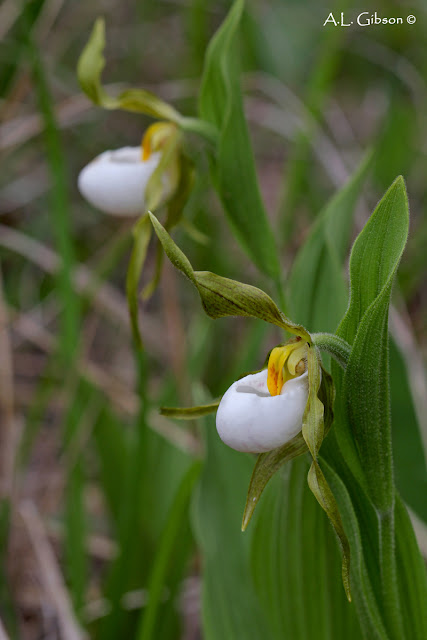

Small White Lady's Slipper  ~  Cypripedium candidum


Early May bestows the lucky few with one of the state's greatest moments and treasures in the small white lady's slippers (Cypripedium candidum).  This miniscule orchid has labellums (pouches) the size of a sparrow's egg and can only be found in an extremely limited number of counties in the state.  These particular plants were photographed in a hanging dolomite-limestone prairie in Adams county.


Shining Ladies'-tresses  ~  Spiranthes lucida


Not long after the small white lady's slippers have come and gone I know it's time to pay a visit to a mucky sedge meadow in nearby Pike county to see the earliest of Ohio's ladies'-tresses orchid to open up its flowers.  Scattered around the muddy seep by the dozens are the unmistakable white and yellow blooms of the shining ladies'-tresses (Spiranthes lucida).  While the Spiranthes  genus can cause some novice wildflower enthusiasts fits, this species is the easiest of all to identify by its spring bloom date and striking yellow throat.


Long-bracted Orchid  ~  Coeloglossum viride


A particular weekend in late May saw your blogger mark off two long-awaited life species in one long, road-weary day.  First up was one that won't win any beauty contests or make the normal person drive three hours to see but I've never claimed to be 'normal', especially when it comes to orchids.  The long-bracted orchid (Coeloglossum viride) is an endangered species in Ohio and one I had never been able to track down or find.  So when a friend suggested a site in northeastern Indiana, I jumped at the chance and was not disappointed in my search.  Even under close inspection its hard to see if the flowers are even open and believe it or not the photograph above shows a plant in full bloom.  The thin yellowish-green lip hanging below a darker green hood of sepals must have given someone the impression of a frog as this plant also goes by the common name of frog orchid.


Dragon's-mouth Orchid  ~  Arethusa bulbosa


Easily the most exciting and memorable of all the new orchid finds this year happened later in the day after coming across the long-bracted orchid above.  Growing in a floating sphagnum bog in southeastern Michigan was the subject of many a day dream and wish I had wanted to see for years on end with no luck.  The dragon's-mouth orchid (Arethusa bulbosa) is in my opinion one of the most stunning and perfectly sculpted wildflowers on earth.  Rising from a small bulb situated in the cold, water-saturated sphagnum below is a solitary bloom with its mythical jaws wide open and vivid pink crown situated above.  Averting one's eyes from its royal and piercing appearance is nigh on impossible, as is making the decision to depart and leave its timeless beauty behind.


Northern Tubercled Orchid  ~  Platanthera flava var. herbiola


Early June found myself ankle deep in mud and surrounded by an impenetrable cloud of mosquitos in the depths of a swamp forest in north-central Ohio.  What I paid for in blood and itchy welts was well worth the price as I looked out across a dense sea of northern tubercled orchid (Platanthera flava var. herbiola).  This small, green orchid gets its name from the small bump or tubercle at the back of the lower lip that is believed to direct its pollinators to one of the two pollinia above.


Lesser Purple Fringed Orchid  ~  Platanthera psycodes


If spring is the time of the Cypripedium  orchids then the summer months are the reign of the Platantheras.  Commonly called the 'fringed' or 'rein' orchids, these large or small wands of many individual flowers rank among the most charming and exquisite of our native wildflowers.  In the later half of June and early July, a few of Ohio's swamp forests are home to the lesser purple fringed orchid (Platanthera psycodes), a potentially-threatened species in our state.  Its dainty, purple inflorescences look like dancing angels under the darkened, murky forest canopy.


E. Prairie Fringed Orchid  ~  Platanthera leucophaea


There's no way I could pass over the chance to see my favorite of our orchids each June; especially when they are so close to my childhood home back in west-central Ohio.  The federally threatened eastern prairie fringed orchid (Platanthera leucophaea) was once more common in the wet meadows, prairies, and shorelines of Ohio and the surrounding great lake states but has been nearly eradicated by man's plow and development.  It really is hard to pick a favorite out of so many good and close friends but I am drawn to this species like none other and really have no specific reason why.  Seeing it in person should be on any botanist or naturalist's bucket list!


Greater Purple Fringed Orchid  ~  Platanthera grandiflora


Sometimes seeing a particular orchid requires one to leave Ohio behind and explore areas outside her borders to find what you're looking for.  One of those species is the greater purple fringed orchid (Platanthera grandiflora), an extirpated species in our state that hasn't graced our soils in nearly a century.  A drive down to the cranberry glades botanical area of West Virginia was just the trick to see this stunner this past late June and proved to be quite the botanical significant day.  I plan to take you along for the trip in its own blog post in the near future.


White Fringed Orchid  ~  Platanthera blephariglottis


July saw me pay a visit to good friend and brilliant naturalist/blogger Jackie in upstate New York.  There she would show me one of my other long-awaited orchid life species: the white fringed orchid (Platanthera blephariglottis).  The huge expanse of grounded black spruce and tamarack sphagnum bog produced many gorgeous plants that I couldn't get enough of.  For a detailed look at this experience you can check out this blog post right here.


Purple Fringeless Orchid  ~  Platanthera peramoena


Upon my return to Ohio from an unforgettable time in the southern Adirondacks, I ventured out not too far from my residence in southeastern Ohio to see another one of nature's floral perfections.  Looking strikingly familiar to the aforementioned greater purple fringed orchid, this is the purple fringeless orchid (Platanthera peramoena).  Take a glance at the lower lip of each individual inflorescence and you'll see the margins are largely entire and do not exhibit any 'fringing', hence its common name.


Cranefly Orchid  ~  Tipularia discolor


Arguably one of southern Ohio's most common species of orchid is also one of the hardest to see in flower.  The cranefly orchid (Tipularia discolor) gets its name from the flower's appearance to dancing craneflies; a large, short-lived type of insect from the Tipulidae  family.  Their greenish-purple racemes of flowers bloom in late summer in the darkened under stories of deciduous forests making for a frustrating experience.  It's best to find and mark these plants in the winter when their over-wintering leaves are visible and frequently encountered, then check back on them in mid-late July to catch them blooming.  The uniform, artificial black background really helps to make this orchid stand out when photographing it.


Grass-leaved Ladies'-tresses  ~  Spiranthes vernalis


You know the orchid season is approaching wrap up time when the Spiranthes  genus starts to really kick into gear.  One of the earliest to show its face is the grass-leaved ladies'-tresses (S. vernalis), a locally frequent species in the southeastern quarter of the state.  Another common name for this orchid is the spring ladies'-tresses due to its ability to flower as early as April in the southern parts of its range.  Since it doesn't bloom until August here in Ohio I see no reason to go by that name here.


Small Ladies'-tresses  ~  Spiranthes tuberosa


One particular species of late-summer flowering orchid isn't all that uncommon but its tiny stature makes it seem impossible to find.  The adequately named small ladies'-tresses (Spiranthes tuberosa) has pure white, crystalized flowers so small you could fit four or five on your pinkie nail alone!  I wish I had my finger in the photo above to show just how small these plants are!


Autumn Coralroot  ~  Corallorhiza odontorhiza


All good times must come to an end and I know the end is nigh when I see the autumn or late coralroot (Corallorhiza odontorhiza) blooming come September and into October.  While some say you save the best for last, I could hardly say that holds true for Ohio's orchids when your last species to bloom are these guys.

2012 was an incredible season for this passionately obsessed botanist and left me only wanting more and extremely hopeful and excited for 2013.  The only thing that gets me through the dark, cold winter months is the promise I get to do this all over again next year.  I'll be here to bring it all to you and hope you follow along as I'm sure there will be more than enough to share!

Friday, January 6, 2012

A Look Back on the Natural Treasures of 2011

It's hard to believe another year has come and gone.  It seems like just yesterday I was sitting in this same chair looking out my frosted windows and dreaming of the botanical wonders and discoveries that 2011 would bring.  As I read back through the dozens of entries I wrote this year I still find it incredible all the plant species, ecosystems, people and places I got to meet and experience.  Numerous botanical bucket list items were marked from the list while many more were penciled in for the future.  From the limestone cliffs and evergreen forests of the Bruce peninsula in Canada to the muggy depths of southern Kentucky, there were few places in-between not explored and investigated by myself and my fellow botanizing kin.  Five states and one Canadian province; hundreds of parks, forests and preserves; over 30,000 miles and 1,300+ plant species came together to easily make this a year I will never forget.

As I continue to brainstorm, write and work on future posts for the upcoming year I would like to take some time to reminisce on a number of my favorite experiences from 2011.  There was hardly a shortage of excitement and feelings of euphoria at any point and every month had a special memory to share.  I encourage you to scroll down through the corresponding photos and synopsis' and clink the links provided to read the specifics of each adventure.  Some posts you may remember while others may be getting your attention for the first time but each possesses a special moment in time and space in my heart and mind.  I hope you enjoy this look back at what a memorable and exhilarating year 2011 was!

A grove of old-growth Tulip-poplars in Davey Woods nature preserve

JANUARY brought in 2011 with plenty of snow, ice and frigid temperatures to my home state of Ohio.  I can remember snow being on the ground from the beginning of December all the way to the end of February.  Despite the low temperatures I could not resist getting out into the snow to explore one of my favorite ecosystems.  Old-growth forests are an incredible experience 365 days out of the year but to get the best grasp on their detail and magnificence one needs to see them in their winter state.  Davey Woods nature preserve outside Urbana, Ohio is a close-to-home answer for myself and worth a trip from any corner in Ohio.  Above you can see your blogger's father standing with a grove of large Tuliptrees within the preserve.  You can read more about our walk through this old-growth wonderland by clicking this link here.

Skunk Cabbage (Symplocarpus foetidus) emerging in a swamp woods

As the snow continued to fall and the temperatures kept their bitter grip on into FEBRUARY my mind began to crack under the weight of winter.  I knew if I could just hold on for a few more weeks my botanically-deprived mind would be rewarded with the annual blooming of Ohio's first native wildflower.  In the last week of February I made my yearly pilgrimage to a swamp woods not too far away from my home to witness the Skunk Cabbage's (Symplocarpus foetidus) emergence from their winter slumber.  Being the first species to bloom is not the only cool thing these fascinating plants are known for.  If interested in learning more about these fowl-smelling blossoms click this link here!

State-endangered Goldenstar-lily (Erythronium rostratum)

Finally!  MARCH arrived and the botanical floodgates started to open, releasing their bounty of beauty and color back into the natural world.  All the old faces and cherished favorites began to awaken and bloom as the sun ever waxed in the sky above their heads.  Trout-lilies (Erythronium spp.), Bloodroot (Sanguinaria canadensis), Hepaticas (Hepatica spp.) and even the Snow Trillium (Trillium nivale) greeted 2011 in a glorious display that could not have come any sooner.  The best waited until last with the stunning and surprising discovery of the state-endangered Goldenstar-lily (Erythronium rostratum) on the Edge of Appalachia preserve.  Only known from one locality in Ohio, this marks the first time this remarkable spring ephemeral had ever been found outside the Rocky Fork area.  I could not believe my luck on being there on the day and moment of discovery and documented the occasion which can be read right here!  Easily one of the top moments of the year!

Tribbett Woods nature preserve

The discovery of the Goldenstar-lily was certainly one amazing way to launch into 2011 and by APRIL I was already in full-swing as mother nature continued to awaken in greater diversity and detail.  On an incredible warm and sunny day in early April, my botanical mentor and dear friend Dan Boone and I decided to pay a visit to southeastern Indiana to see some early spring flora and explore a rare and breathtaking old-growth wet flatwoods.  Tribbett Woods ended up being one of the most exceptionally undisturbed and impressive old-growth forests I'd ever stepped foot in.  Enormous Beech, Sweetgun and Swamp Chestnut Oak trees towered well over 100 feet above my head as their canopies danced in the wind.  To see some of the most impressive trees you're likely to ever see in such a unique forest community be sure to check the post out right here.

Male Black and White Warbler perched in a Sycamore tree

April and the other months of spring are not only cherished by myself and other like-minded individuals for the return of the plants and wildflowers but the migrating birds as well!  While my passion is clearly devoted mostly to the flora of our world I still consider myself a well-rounded naturalist with numerous loves to accompany my plants.  Birds are one of those 'other loves' and I had a delightful time this spring watching and photographing as many of my winged friends as I could, especially the warblers.  If you'd like to get to know a couple of our most colorful species then head on over here!

The days begin to grow longer come MAY as the birds began to sing and couple, the leaves unfurl to cover the tree's naked canopies and most importantly to me the orchids begin to wake up!  If you are even a semi-regular reader of this blog you know my deep-rooted love for our native orchids never runs thin on here.  I attended Flora Quest on the first weekend of May and was overwhelmed with orchids, irises and other rare plants in Adams and Scioto counties.  Be sure to check out the Flora Quest webpage to get information on how to sign up for this year!

Kentucky Lady's-slippers (Cypripedium kentuckiense)

None of the orchids intrigue me more or make my heart beat faster than the lady-slippers (Cypripedium spp.).  I made it a goal in 2011 to see if I could find, photograph and enjoy all the eastern Cypripedium species and varieties of North America and had the pleasure to start with the one above (I did end up achieving that goal!).  The Kentucky Lady's slipper (Cypripedium kentuckiense) stole my heart and the show in early May as I traveled to Lewis county, Kentucky in search of them.  To read more about this fascinating orchid and see more photographs jump over to this page.  If you love orchids even half as much as I do check out one of my other favorite posts regarding my time with the Small White Lady's slippers as well!

Aqua waters of Lake Huron on the Bruce peninsula, Ontario, Canada

If May was a tornado of botanical activity and excitement then JUNE was a category five hurricane!  More happened in June than I could ever even begin to retell but it climaxed with my road trip and week-long stay on the botanical and geological wonder world of the Bruce Peninsula.  I had dreamed for years of experiencing the ancient cedar forests, alvars, fens and sheer limestone cliffs overlooking the gorgeous blue hues of the Georgian Bay and it exceeded every expectation tenfold!  You can find the first half of my road trip and time on the Bruce HERE, HERE and HERE.  This was truly the trip and experience of a lifetime and one I will cherish until my last breath.  I plan on finishing up the next set of posts to complete this saga in the next month or so stay tuned!

Eastern Prairie Fringed orchid (Platanthera leucophaea)

I could never close the book on June without re-sharing probably the greatest single-moment experience of 2011 with you.  Not even an hour after I returned home from Canada and I was back on the road to see something I had dreamed of seeing more than just about anything else.  In a wet meadow somewhere in Clark county, Ohio the federally threatened Eastern Prairie Fringed orchid (Platanthera leucophaea) was in perfect bloom and beckoned me to come pay it a once-in-a-lifetime visit.  I do my best to instill feelings of emotion and excitement in all my posts but I feel like non had the charge of this one on the Eastern Prairie Fringed orchid.  Enjoy!

Michigan Monkeyflower (Mimulus michiganensis)

June melted into JULY and the prairies and fens began to come to life as as the warm-season grasses and accompanying wildflowers display their colors and charm.  However, it was my week-long annual summer vacation to Leelanau county, Michigan with the family that took the honor for best July moment in botany.  I had long heard of a mysterious and globally rare wildflower that graced the secretive shorelines of Glen Lake and a select few other places in this area of Michigan and decided it was time to make its acquaintance.  With some help from a local botany professor I was turned onto one of the very few remaining populations of this mega-rarity, the Michigan Monkeyflower (Mimulus michiganensis).  If you have an affinity or taste for the interesting and rare then I highly encourage you to read the post dedicated to the daily battle this federally endangered curiosity has to bear by clicking right here!

Three-birds Orchid (Triphora trianthophora) in perfect bloom

It just wouldn't be a normal post if I didn't include a bit more focus on my orchid favorites now would it?  Once the calender hits AUGUST it was time to start checking on the secretive and fickle populations of one of Ohio's most intriguing of plants.  The Three-birds orchid (Triphora trianthophora) is a thing of beauty and nature's perfection.  These truly are more finicky and tricky to catch in sublime bloom than almost any other plant in Ohio.  A million thanks still goes out to Cheryl Harner who kept me in the loop on these plants and shared them with me when they couldn't have been any better!  Truly a day worth reading about by following this link!

Yellow Fringed Orchid (Platanthera ciliaris)

Speaking of August and orchids, if you want to see some of the most photogenic species of wildflowers Kentucky has to offer than I would love to point you in the direction of my post on four species of Platanthera orchids in the humid confines of southern Kenutcky! 

Big Bluestem (Andropogon gerardii) in an Adams county prairie

Gradually the humidity softens and the winds begin to cool as fall approached Ohio.  SEPTEMBER is one of my favorite times of the year as it means football is back (even if my Ohio State Buckeyes and Indianapolis Colts had quite sub-par seasons worth forgetting...) and the leaves will soon be changing.  September also brings a flux of special flora into the prairies, fens, fields and meadows.  I spent much of my sun-waned days exploring Ohio's prairie and fen ecosystems.  The feel of the drying grasses on my bare skin and the breeze on my face all mixed with that distinct blue hue to the sky makes for an infinite supply of intrinsic moments come this time of year, as fleeting as it is.  I started a series on these fascinating places and plants with the bluegrass region and prairies openings of Adams county, Ohio.  Look for the remainder posts to be published in the future!

Lesser Fringed Gentian (Gentianopsis virgata)

Seemingly as quickly as they came the flame orange and reddened leaves fell from the trees and the sunlight begun to hang low in the sky as OCTOBER and NOVEMBER arrived.  The time of the flowering plants was once again coming to an end and another exciting season was expiring.  Of course, there is one last gasp of color and life before the end as select fens show off their end-of-the-year fireworks display of blue.  The Lesser Fringed Gentians (Gentianopsis virgata) are a sight to behold as the sun's low rays catch their fringed petals just right to enhance their vivid blues.  Although, they too faded into oblivion as winter's chill once again hung in the air and I found myself bound in patience and anticipation for spring 2012...

I hope you enjoyed this look back on 2011 and that all of you had a very happy holiday season and an even better new years!  Here's to 2012 and the natural treasures of Ohio and beyond that I will be sharing with you!  Happy New Year!

Sunday, August 7, 2011

The Federally Threatened Prairie Fringed Orchid

I've always had a collective attitude of sorts throughout my life.  First it was pogz.  Does any other person my age, maybe a bit older remember pogz from the early 90's?  They were cardboard poker chip-like things you played a game with, trying to flip them over with a weighted plastic piece.  I distinctly remember having an affinity for ones that had an eight ball design or a ying-yang.  Funny what the brain remembers huh?  Anyways.  From that I moved on to sports cards then autographs and movie memorabilia.  Like I said I always have to be working towards the completion of a set or goal.  Botany has been the most fun outlet for my never ending drive to find that next great piece or rarity and I don't see that stopping anytime soon.  Naturally as time goes by I have created a list of what species I want to see and photograph the most.  A 'life' list to say or maybe a 'hall of fame' to put it best.  I've been fortunate to have checked off quite a few species on this so far but one big one has evaded me the past few years.  As fate would have it this past late June I got the opportunity to strike off one mighty beast of a lifer.  Not only is it an orchid (go figure right?) but a federally threatened species to boot.  The Eastern Prairie Fringed Orchid (Platanthera leucophaea).

Typical muggy and steamy Ohio summer sunset

As I was making the drive back home from the Bruce peninsula my phone rang with excellent news on the other end.  The Prairie Fringed orchid I'd been waiting months, years to see was in perfect full-flower in a wet sedge meadow in Clark County.  By the time my muddy and bug covered Forester arrived at the site it was getting to be evening and the sun was waning in the sky with thunderstorms threatening on the horizon.  The potential storms only added electricity to the already charged situation at hand as my eyes gazed out across waving tops of vegetation swaying in the breeze.  My eyes immediately picked out the tall, dancing stalks of cream colored flowers mixed in with the shorter grasses and sedges.  There they were in all their majestic splendor.

Platanthera leucophaea mixed in among the grasses and sedges

I'd waited a long time for this moment.  I slowly waded into the sea of graminoids, carefully watching my step as dozens of other orchids were still in tight bud and blending in with the vegetation.  The thunder that rolled in the distance through the dense and muggy atmosphere could have easily been mistaken for my racing heartbeat as I approached the first creamy wand in the meadow.  "Perfection", I thought as I knelt down to inspect it's stunning inflorescence.  It really doesn't get much better than this.

Platanthera leucophaea


The first thing that really struck me about this orchid was its size and proportion.  Rising nearly four feet into the air with individual flowers the size a of quarter, the tall racemes of blooms appeared like small, white ghosts dancing about in the wind.  Each stalk can have upwards of 40 flowers, all with a very distinctive three-lobed lip.  Each lobe is heavily fringed as if some little fairy took an equally small pair of scissors and carefully cut the lobes into their delicately designed fringes.

Platanthera leucophaea
Just beginning to break bud


Each plant comes back year after year from an underground tuber that sends up a 1-4' stalk that matures and blooms in late June into early July.  Its leaves are alternately arranged up the stem decreasing in size as they ascend until they are merely bract-like protrusions.  Each leaf is narrow and lanceolate in shape and sheath the stem.  Like all other orchids this species can be very fickle from year to year in regards to blooming.  In fact, one Ohio population went dormant for decades before reacting to a burn.  The flowers are nocturnally scented like most Platanthera species of orchid.  Attracted by their sweet scent, Sphinx and Hawkmoths pollinate the flowers as they probe the inflorescences long, nectar-filled spur for a tasty meal.  An interesting fact about this plant is its surprising longevity.  In some cases individual plants are known to have lived for over 30 years, making large populations of this plant with healthy plants potentially an ancient organism as a whole.

North American distribution map for P. leucophaea (courtesy: BONAP(

As mentioned before the E. Prairie Fringed orchid is not just state listed as threatened in Ohio but its listed at the federal level as well.  Quite rare throughout its entire North American range, this orchid is listed as threatened, endangered or extirpated in every state and Canadian province (only Ontario) it's ever been found in.  Looking at the current distribution map above you can see it's concentrated mostly within the Great Lake states with a preference for those with a lot of wet prairie and meadow habitat (historically speaking), such as Illinois and Iowa.  Despite its current scarcity it was once much more common in the states highlighted above.  Unfortunately this plant and farmers share in the same love and preference for where it grows best and the farmers have won 99.99% of the time.  Most of Ohio's populations met their plow fate decades ago but some still cling to life in Clark, Lucas, Sandusky and Wayne counties to name a few.  Habitat destruction and degradation of its wetland habitat of fens, wet prairies, sedge meadows and even bogs have caused this species populations to decline severely across is range.  Even areas undisturbed by humans are still at risk from natural succession of the meadows and prairies to thickets and forest.  This orchid needs maximum amounts of sunlight and cannot compete with the shade producing woody vegetation that eventually encroaches.

Platanthera leucophaea


This population is under ownership and management by the city of Dayton from what I understand and is actively managed to keep woody competition at bay and its specific list of habitat needs met.  It's small slice of wet sedge meadow is in a sea of corn and soybean fields running along the Mad River.  I'd love to believe that 300 years ago many meadow and fen openings in the river valley were filled with tens of thousands of these plants come late June.  I can imagine cooling myself off from the humid summer heat in a deep and cold pool of fresh spring water from the Mad and climb up the bank to be greeted by that green and cream colored sea of Prairie Fringed orchids.  Ah, the mind is a wonderful thing that is truly a dream-maker that never disappoints.

Your blogger and a fresh orchid
Absolutely stunning aren't they?


I decided to snap a quick picture of your blogger and a particularly fine specimen to help show off this plant's impressive size and beauty.  I found it a bit humorous that this elusive and very sought after orchid ended up being just a 15 minute drive from my home town of Tipp City in Miami County.  Needless to say my first experience with these incredible plants was not my last as I came back on several occasions to do population counts (well over 200 flowering plants this year) and get lost in their perfection.

Louder cracks of thunder and more frequent flashes of lightning eventually caused me to give in to the approaching storm and I made for the car with several glances back to the meadow to catch the orchids dancing ever more hectically in the squalling winds.  This is not a day I would soon forget and am very thankful to have experienced, especially as the delicious cherry on top of my Bruce peninsula sundae I was just arriving back from.  I can't imagine my beloved state of Ohio welcoming home one of its native sons in any finer fashion.

One more look...

I entirely meant to write and publish this post well over a month ago but somehow time and opportunity seems to slip needlessly through the cracks in the floorboards but better late than never!  I don't know how many of you have ever seen or had the chance to experience this impossibly awesome orchid so I was really excited to help with the introduction.  Long may this species thrive in this little patch of fen sedge meadow full of other neat botanical goodies.  This was definitely one of my favorite posts to reminisce on and write up and I certainly hope you were half as entertained as I!