This time of the year always leaves your blogger running around like a chicken with its head cut off. The waning sunlit hours and dropping temperatures coincide with the season's last gasp of wildflowers and with winter's chill just on the horizon the mad dash is on to soak in every last colorful detail. A couple weekends ago I decided to spend a Saturday roaming the famed Oak Openings region of northwest Ohio. I had been several times before in the spring and early summer but never this late in the growing season and was excited to see the changes and fall color that was sure to accompany my visit.
Located just west of Toledo in Lucas, Henry, and Fulton counties, the oak openings encompasses one of Ohio's (and the world's) most rare and endangered of habitats and is home to a very diverse number of the state's rare plants/animals. Comprised of over 150 square miles of oak savanna mixed with intermittent wet meadows and prairie, the ecosystem sits on a very sandy soil matrix over top an impermeable layer of clay. Why all the sand in the middle of landlocked Ohio? We'll get to that in a minute. This unique region got its name from the early pioneers and settlers that found the extensive tract of sandy, dry ridges and wet meadows scattered with groves of oaks (primarily black oak) and coined the seemingly inevitable name honoring the openings and the, well...oaks!
 |
| Wet sedge meadow within the Oak Openings |
So about all that sand. Rolling sand dunes with no water in sight can cause one to scratch their head but luckily there is a rather simple and interesting geological answer. Around 14,000 years ago as the most recent glacial epoch was winding to a close, the newly carved Great Lakes basin filled with melt water from the massive receding ice sheets and began to shape the landscape as we see it today. As the ice shelf shifted and water levels fluctuated, a distinct sequence of named and recognized pre-Erie lakes formed; each leaving behind a specific series of sand dunes and 'beaches' as the waters receded to current-day levels. The oak openings were laid down roughly 12,000 years ago during the time of Lake Warren, which was significantly larger than today's Lake Erie. After Lake Warren's water level dropped due to the opening of the now ice-free Niagara outlet, its beaches and wind-blown dunes were left high and dry; the only evidence of the ancient glacial lake. This sand-deposited area over time became the oak openings region we know and love today.
The following post may seem lengthy but that's due largely to the most 'fun' part of this blog, the photographs! I tried to keep the writing to a minimum and allow the attention to be kept where it belongs: on the gorgeous fall scenery and wildflowers of the oak openings.
 |
| Expanse of open oak savanna |
I tactfully planned my initial hike and stop of the morning to correspond with the freshness and newly-opened flowers of one of the day's most anticipated wildflowers. I just blogged about the
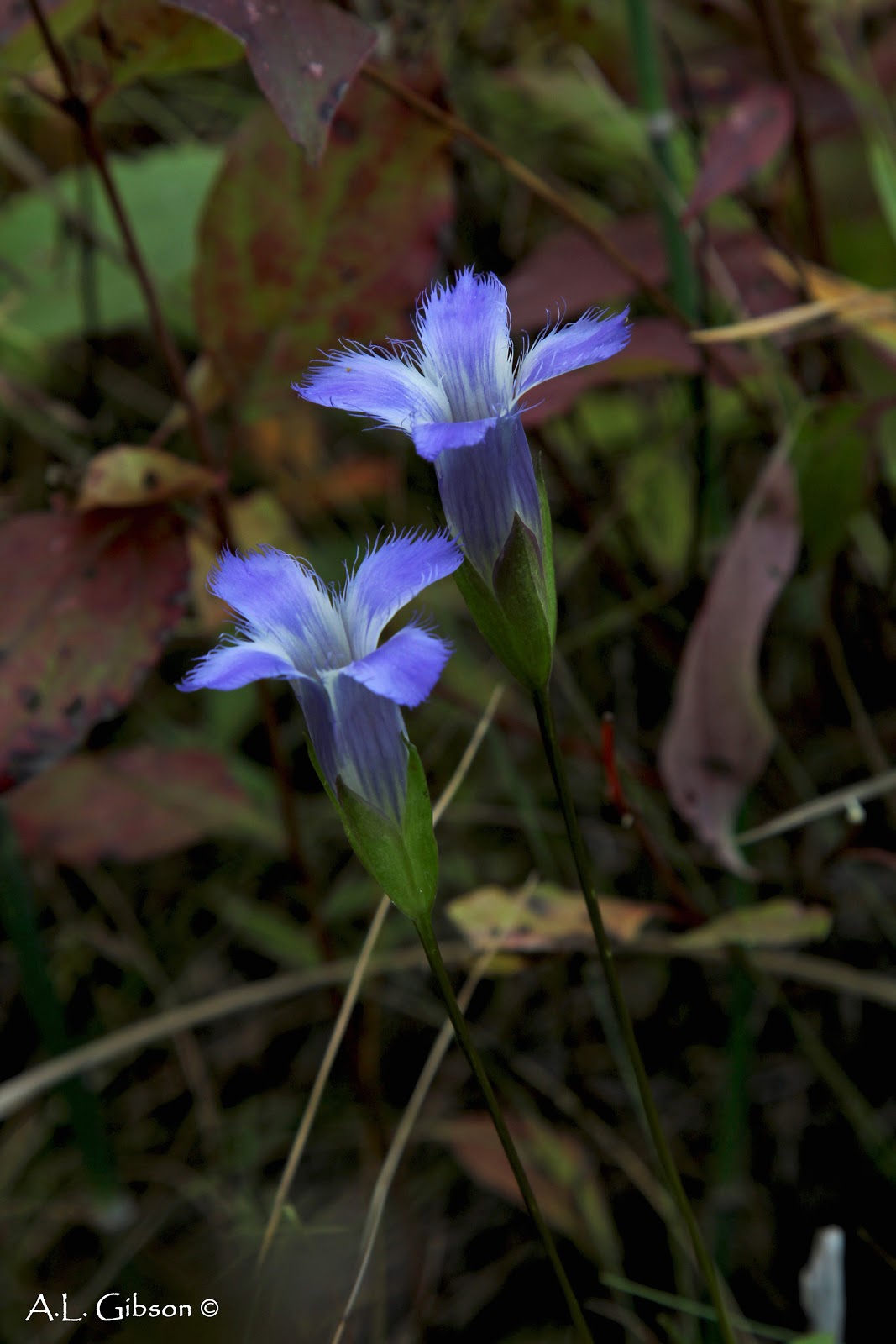
lesser fringed gentians (Gentianopsis virgata) and now it's time to meet its nearly identical brother: the greater fringed gentian (
Gentianopsis crinita).
 |
| Greater Fringed Gentian ~ Gentianopsis crinita |
Sparkling like brilliant sapphires scattered about the wet sedge meadow were the first showstoppers of the day and they alone were worth the two hour drive I had awoken so early for. While I had seen the lesser fringed species before, this was the first time I was laying eyes on these delicate beauties.
 |
| Greater Fringed Gentian ~ Gentianopsis crinita |
At first glance it seems there is very little different between the two species but as I mentioned in my earlier post the shorter and wider lanceolate leaves combined with the heavier fringing around the petal margins help differentiate the two. Each individual petal seems to have been sewn from the finest silk with the ends allowed to tatter and fray in the chilled autumn winds.
 |
| Greater Fringed Gentian ~ Gentianopsis crinita |
I was a bit late to catch the fringed gentians in peak performance but enough plants were still exhibiting their timeless charm to warrant plenty of photographs. The more robust plants certainly drew the most attention and I can only imagine what they must have looked like at their prime a few days before.
 |
| Greater Fringed Gentian ~ Gentianopsis crinita |
One thing I did begin to notice between the two species of fringed gentian was the slight color difference and apparent bi-color scheme many of the oak openings specimens exhibited. The two gentians pictured above showed off the white and blue color combination quite exquisitely and almost looked liked tasty pieces of candy. Almost.
 |
| Hillside Blueberry ~ Vaccinium pallidum |
The striking blue color of the gentians wasn't the only noticeable color to the landscape as I moved into the drier savanna habitat. A brilliant fireworks display of scarlet lit up the shrub layer underneath the oak groves from the endless patchwork of hillside blueberry (
Vaccinium pallidum). Planning an early summer trip to the oak openings to coincide with the ripening of practically an infinite number of blueberries is an excellent and delicious idea!
 |
| Flat-topped White Aster ~ Doellingeria umbellata |
Waving in the brisk morning breeze as white beacons set against the fiery blaze of blueberries and sumacs were the lovely flat-topped white asters (
Doellingeria umbellata). This attractive fall bloomer can reach heights of up to seven feet in more moist and rich soiled conditions and occurs predominately in the northeastern quarter of the state while more scattered to the west and south.
 |
| Cinnamon Fern ~ Osmundastrum cinnamomeum |
The brilliant golden glow from these sterile cinnamon fern (
Osmundastrum cinnamomeum) fronds were hard to ignore as I waded through the undergrowth of the oak savannas. With their photosynthetic jobs done for the year and the fronds drained of chlorophyll I guess it's only up to us humans to find any worth in their seasonal death.
 |
| Bushy Aster ~ Symphyotrichum dumosum |
Another aster bravely sporting its end of the season flowers was the state-threatened bushy aster (
Symphyotrichum dumosum). It's love and affinity for open, sandy habitat comes as no surprise for a species that makes one of its last strongholds in the state here in the oak openings.
 |
| Bushy Aster ~ Symphyotrichum dumosum |
The asters can certainly seem to blend together in their diversity and subtle differences but the bushy aster thankfully has a characteristic that routinely seems to set it apart. I say 'seems' to, as this particular plant doesn't show it off as clearly as I'd like. Looking along the terminal branching stems you can make out little leaf-like bracts that run up and down the stem. They are more appressed than normal on this plant but many others showed off the trait nicely. Naturally, the plant I decide to photograph would be the black sheep of the group!
 |
| The shrubby under story of the oak savannas and knolls |
With the oaks among the last species of trees to change color, it was an odd experience paying more attention to the under story and shrub layer for explosive fall foliage than up in the branches of the trees. The deep scarlet reds in the photo above belong to winged sumac (
Rhus copallina) and provided one of the best splashes of color under the oaks and hickories.
 |
| Yellow Ladies-tresses orchid ~ Spiranthes ochroleuca |
Probably the most anticipated and biggest reason for my drive up to the area was to search out one of the very few remaining Ohio native species of orchid I had yet to see. With some helpful suggestions from a good friend who lives in the area and teaches at Toledo University, plus a little luck I was able to succeed in marking orchid number 44 of 48 off my list: yellow ladies'-tresses (
Spiranthes ochroleuca)!
 |
| Yellow Ladies-tresses orchid ~ Spiranthes ochroleuca |
Long considered a mere variety in the
Spiranthes cernua complex, the yellow ladies-tresses was recently re-elevated to full species status after new and more conclusive genetic research had determined the species worthy. To a seasoned and experienced observer of the
Spiranthes genus I find this taxon to have inflorescences of a slightly different look to its close relatives
S. cernua and
S. magnicamporum. I plan on getting more into this confusing group of orchids in a later blog post but there is one nice to help separate this species.
 |
| Yellow Ladies-tresses orchid ~ Spiranthes ochroleuca |
It's not called the 'yellow' ladies'-tresses for no reason! The undersides of each individual inflorescence is colored with a honey-yellow patch that can be seen quite well in the photograph above. If you like the look of the
Spiranthes genus of orchids keep reading because there's more to come.
 |
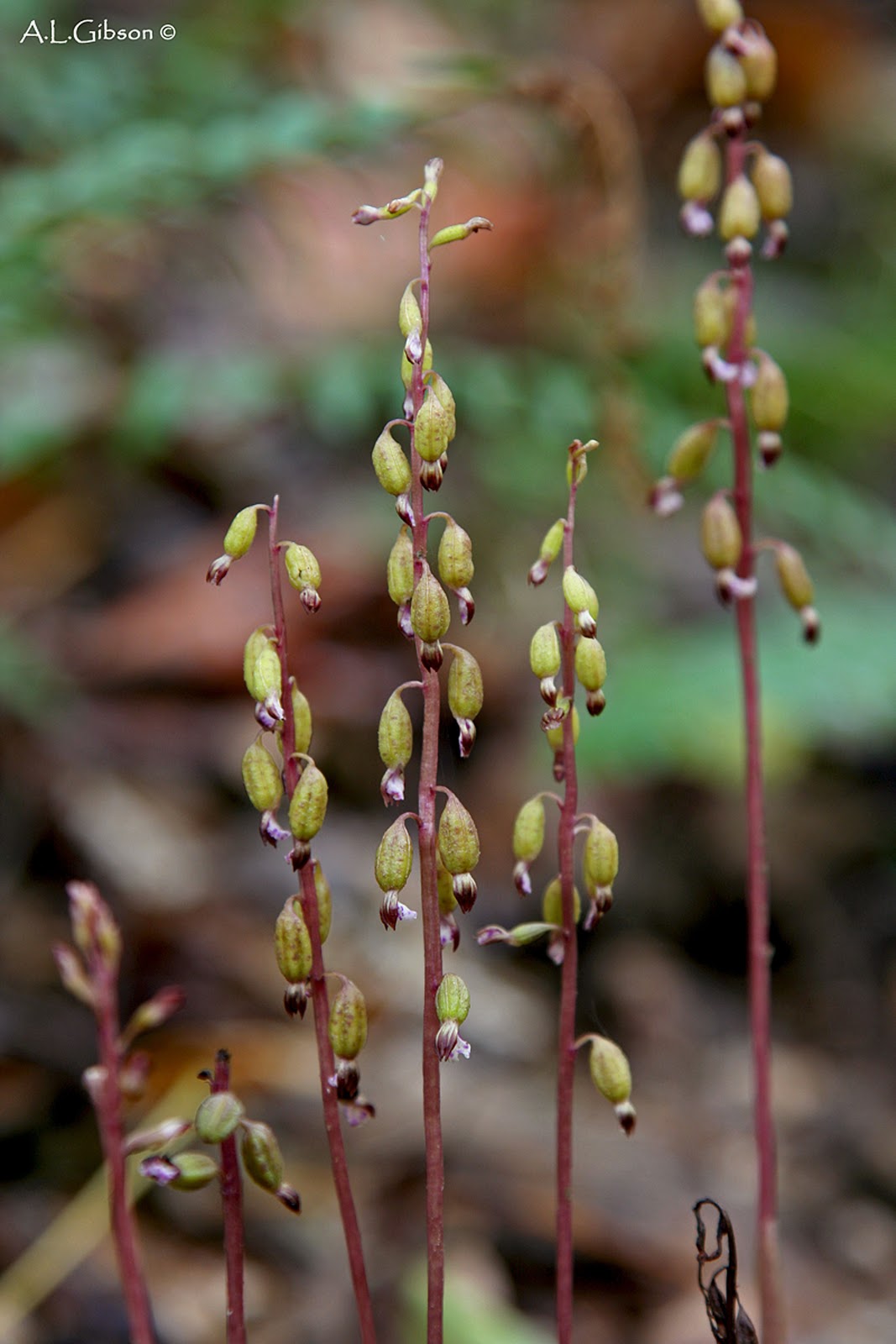
| Autumn Coralroot ~ Corallorhiza odontorhiza |
Not far from the patch of yellow ladies'-tresses was a scattering of another late-blooming orchid, autumn coralroot (
Corallorhiza odontorhiza). This is one of those plants where being lucky is better than being good when it comes to finding it. It rarely gets more than four to five inches tall with the flowers themselves being excruciatingly tiny and not very showy at all. In fact, the flowers pictured above are about as showy and 'open' as they ever get.
 |
| Autumn Coralroot ~ Corallorhiza odontorhiza |
It may not win any awards for beauty or interest but I still hold it by the same love and standards for the rest of its family's brethren. Much like the other members of the
Corallorhiza genus, this plant lacks chlorophyll and solely relies on its saprophytic habit of leeching nutrients out of other plants and organic matter.
 |
| Glaucous Greenbrier ~ Smilax glauca |
What happens to be the least formidable and prickly of the notorious greenbriers is also apparently the most colorful come fall! These gorgeous leaves of the glaucous greenbrier (
Smilax glauca) caught my eyes from a ways and I was unsure of what they were until I got closer. I affectionately call species of
Smilax 'shin-rippers' for their aggressive ability to go through your clothing and claw at your flesh underneath.
 |
| Low-bush Blueberry ~ Vaccinium angustifolium |
In the more open and drier areas of dune and knoll habitat were large continuous colonies of low-bush blueberry (
Vaccinium angustifolium), an uncommon species here in Ohio that's largely relegated to the northeastern quarter and oak openings region. This species is commercially valuable in the New England states where it is much more common and harvested for its exceptionally delicious blueberries.
 |
| Wet field full of nodding ladies'-tresses (Spiranthes cernua) |
As I approached an area with a seasonally wet depression I found it impossible to ignore the hundreds of brilliant white stalks blooming all around the margins. I had been here earlier in the year to see and photograph the Loesel's twayblade orchid (
Liparis loeselii) and decided it couldn't hurt to see what the spot was like this time around. Boy was I glad I did!
 |
| Nodding Ladies'-tresses ~ Spiranthes cernua |
The white stalks proved to be the ever-variable nodding ladies'-tresses orchid (
Spiranthes cernua); and more of them than I had ever seen in my life! I wonder due to the dense groupings and clusters of the plants if this species doesn't benefit from having the ability to spread vegetatively through creeping rhizomes and thus create such large masses.
 |
| Nodding Ladies'-tresses ~ Spiranthes cernua |
The nodding ladies did a wonderful job to brighten up the bleak and drab grass-dominated landscape of the depression and were just about the lone wildflower still doing its thing. Most of the orchids were located around and just inside the margins of the bowl but a few seemed pleased to hangout on the grassy hummocks raised above the sand.
 |
| Nodding Ladies'-tresses ~ Spiranthes cernua |
I don't think anyone can complain about seeing a few different species of orchid still in bloom this late in September. Certainly not your blogger, who everyone knows has just a little bit of a passion for them! I don't think the
Spiranthes get the credit they deserve from the average naturalist or wildflower enthusiast. Their snow-white, jeweled appearance and small stature create a perfect combination worth kneeling down to admire. Not to mention some have the most fresh and intoxicating of smells.
 |
| Soapwort Gentian ~ Gentiana saponaria |
After wandering all over the region and stopping at the more impressive nature preserves and parks like
Kitty Todd,
Irwin Prairie, and
Lou Campbell, it was time to make my last stop for the day and see if I could bat for the cycle and successfully find all my target plants. Not long into my search of wading around in the tall grasses and I spotted my prize in full, glorious flower.
 |
| Soapwort Gentian ~ Gentiana saponaria |
Soapwort gentian (
Gentiana saponaria) is an endangered species in the state that is only extant here in Lucas county. In my quest to see all of Ohio's native gentians this one had been a glaring hole on my list for quite a while and was graciously marked off upon seeing its stunning face for the first time.
 |
| Soapwort Gentian ~ Gentiana saponaria |
The soapwort gentian can easily be confused with the much more common bottled gentian
(
G. andrewsii) but there are a few ways to tell them apart: soapwort gentian is a more light to medium blue color with more loosely-arranged corolla tips that don't close nearly as tight as the bottle gentian which has much darker blue flowers. Also, soapwort gentian tends to appear in more dry and sandy habitats such as savannas, prairies, and thickets; while bottle gentian occurs in moist-wet ditches, thickets, and swampy areas.
Whew, what a day botanizing and exploring the oak openings! The weather started out as overcast and chilly but by afternoon's end the sun was shining and temperatures had warmed up to create the perfect fall day. I can't wait until next year to get up here again and spend more time out in this infinitely unique and fascinating ecosystem choked full of rare and interesting plant life.