Everyone remembers the first time they experienced the emotion of falling in love. That moment of realization and cognizance that nothing else can compare to what you have grown to hold so dear. If you're lucky those feelings never fade and only increase exponentially as time inevitably marches forward. For your blogger it was trees that first tugged at his heart strings, botanically-speaking, of course.
Trees are the modern day kings of the vascular plant world and among the most massive and oldest individual (and clonal) organisms on the face of our planet. There's just something about them that has kindled respect and astonishment from me at even a young age. Whether reacquainting myself with an old friend who has seen many a spring thawing and winter's chill or gazing upon a stately stranger I've only just met, each moment spent under their sprawling ceiling of limbs, branches, and twigs is precious. Their role and importance in any ecosystem cannot be understated and without them the world would be without us and millions of other beings. Trees truly are the heart and soul of our natural world.
In my travels both near and far, I've always kept a keen eye open for any spectacular individuals that just beg to be documented with the camera. Rarely does any photograph ever truly forge or recreate the same awestruck feeling of disbelief and/or amazement as in person but I've done my best pick out those that at least try their very hardest. The character and personality these mighty wooden sentinels are capable of displaying are not unlike our own as human beings when you take the time to notice. Trees are the ultimate prize of time, patience, and opportunity.
 |
| One of the largest Sitka spruce trees left on the planet |
Let's start off with a bang and an experience that left me feeling rather small and immensely humbled. This monstrosity of a conifer on the Olympic peninsula of Washington state is one of the largest Sitka spruce (
Picea sitchensis) trees left on the planet. It's thought to be over one thousand years old and is still packing on more and more wood annually. For more on this tree and other virgin temperate rain forest giants, you can check out the post about my visit to this lush land
HERE.
 |
| Forest-grown white oak in Gross Woods |
 |
| Old-growth bitternut hickory |
I often times enjoy making an attempt to liken the feel of my current-day photographs to that of a time over a century earlier with a black and white scheme. It gives the slight impression of what it might have felt like to stand next to the leviathans long lost to the saw and ax. It's a sad reality that we lose these relics of the past much faster and more frequently than nature can replace them; especially in a time where land development and alteration is occurring at an ever-accelerating pace.
.jpg) |
| Blogger and the great white oak of Logan, Ohio |
Few trees leave me more breathless than the Great White Oak in the old cemetery of Logan, Ohio. If someone knows of a plumper, more impressive tree specimen in the state I'd love to see it because I can't imagine many could ever compare. Estimates put this tree at near/over 500 years old. That's 500 years of Mother Nature's fury combined with human development and stress that hasn't seemed to slow this gargantuan beast down. Giving this white oak a hug should be on every nature-appreciating Ohioan's bucket list!
 |
| Ancient white pine in the Adirondack Mountains |
 |
| Ancient white pines in the Adirondacks of NY |
A road trip to the southern Adirondacks of upstate New York a couple summers ago introduced me to some genuine Northeast white pines (Pinus strobus) that I will never forget. White pine has long been a treasured and renowned species for its tall, straight growth habit that was perfect for ship building. Subsequently, almost all the old-growth pine stands in New England met their sawmill fates well over a century ago with very few groves still remaining. The tree pictured top left is believed to be one of the largest/oldest white pine's left in the Adirondacks at over 350 years old and 150'+ tall!
 |
| Giant white cedar on South Manitou Island in Lake Michigan |
Nestled in a remote corner of South Manitou Island in Lake Michigan survives a small grove of virgin white cedars (Thuja occidentalis) that have reached unbelievable dimensions like the one shown here. In fact, the largest white cedar on Earth once called this small island home before falling over in a violent storm not too long ago. Perhaps this one here is its successor?
 |
| Old-growth beech in a SE Indiana wet flatwoods |
 |
| An ancient beech at Fort Hill in Highland Co., OH |
Few trees have the same look and feel as the timeless beech (Fagus grandifolia) in my opinion. Their smooth, ghostly grey trunks always seem to emit a warm glow in the shade of the forest.
 |
| An exceptional tuliptree from southern Ohio |
If the white pine is the monarch of the conifers in Eastern North America, then the tuliptree or tulip poplar (Liriodendron tulipifera) is the monarch of its broadleaf brethren. This fast-growing but potentially long-lived species is the tallest angiosperm we have in our eastern forests and once scraped the heavens at over 200 feet tall in the primeval forests. Today, it doesn't reach nearly as high but 180'+ specimens do exist. This particular tuliptree from southern Ohio exhibits the remarkable diameters these behemoths are also known for.
 |
| Impressive red oak in Glen Helen |
 |
| Single-stem sycamore of nice proportions |
Not exactly record-setters but this red oak and sycamore from the Yellow Springs area are hardly anything to ignore. Single-stem sycamores of this size aren't an every day sight anymore despite trees like this (and much bigger) were nearly a dime a dozen along our waterways in pre-settlement times.
 |
| Dan Boone and Rick Gardner walking through Daughmer Oak Savanna in Crawford Co., Ohio |
Few places instill the flavor and atmosphere of a pre-settlement western Ohio like the few oak savannas we have left in our state. For centuries many a stalwart bur, white, and/or post oak watched over the open, seasonally wet grasslands that once pocketed the glaciated Wisconsin till plain before man's plow bit into its virgin sod...
 |
| Massive bur oak on a Columbus-area golf course |
Not even a rare appearance on the golf course can distract your blogger from noticing the ancient monoliths of Ohio's past. This hardy bur oak had its roots in the soil long before carts whizzed past without so much as a glance from their occupants. Standing next to this particular giant gave me pause when I considered its view of tall grass prairie choked full of spectacular summer wildflowers was only a distant memory and forever lost to the past. Just goes to show that nothing ever stays the same, even for a tree.
 |
| Huge white ash in a west-central Ohio woodlot |
 |
| Giant bur oak in Goll Woods in NW Ohio |
However, it's not all doom and gloom as even in a heavily farmed and developed state like Ohio, some woodlots still persist with scattered individuals linking the present to our storied past. The white ash (Fraxinus americana) pictured above left is the largest single trunked specimen I've yet seen even if its crown is largely dead and/or missing. Bur oaks like the one above are a mesmerizing sight upon entering one of the last vestiges of the Great Black Swamp in Goll Woods state nature preserve in extreme northwest Ohio.
 |
| Largest black walnut the blogger has ever laid eyes on |
Even better is coming across an example of a tree species you could barely believe still exists in such dimensions. Black walnuts (Juglans nigra) were, and still are quick to be harvested for their very valuable and beautiful wood and thus hard to find in a large size. While not prime lumber grade, this particular black walnut in Buck Creek state park was and still is by far the largest I've ever laid eyes on.
 |
| Snow covered scene in Davey Woods state nature preserve |
The winter woods and its bare, skeletal canopy is a silent testament to nature's beauty no matter the season. The forest seems to speak and beckon you in with its creaks and groans emitting from the chilled air. Each tree set against the snow becomes an individual with a unique story and form and a tranquility to it all that words can't quite touch.
 |
| Old-growth swamp chestnut oak/sweet gum/beech woods in southeastern Indiana |
A lovely example of an old-growth wet flat woods in southeastern Indiana full of trees three to four feet in diameter and rocketing over 100' into the sky. Swamp chestnut oak, sweet gum, and beech are the primary occupants with thick, stout trunks that are slow to taper as they ascend.
 |
| Dan Boone and a mighty swamp chestnut oak |
 |
| Looking up the column of the same oak |
The most impressive denizens of this particular wet flat woods were the swamp chestnut oaks (Quercus michauxii), a species that doesn't quite make it north/east enough to occur in Ohio. My good friend and brilliant botanist, Dan Boone poses next to one of the largest specimens of them all with the accompanying photograph showing the incredible volume of wood reaching into the heavens.
 |
| Exceptional sweetgum from SE Indiana |
But then again, the sweetgums (Liquidambar styraciflua) in the same woods and other nearby old-growth flat woods aren't anything to pass over either!
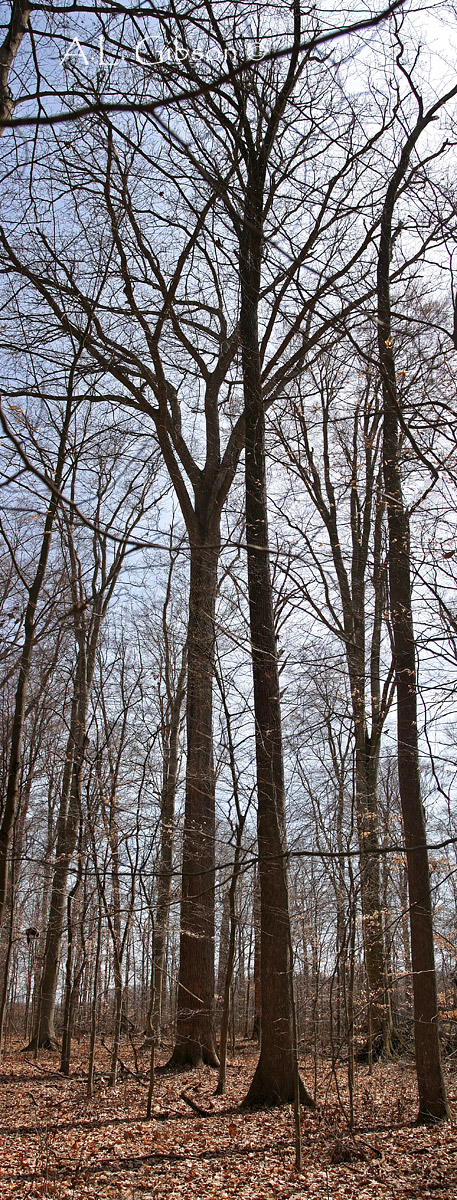
I could go on and on in sharing my favorite trees but I will end it with one of the most impressive trees (height-wise) I've yet seen. This shellbark hickory (Carya laciniosa) from another wet flat woods in southeastern Indiana is estimated at over 150' tall and three feet in diameter. I'd love to get back out with the necessary tools and information to get a more educated height but regardless it's one imposing tree! It's hard to fathom how this tree has survived who knows how many winter storms, squall lines, and ice events to still astound this tree-loving botanist today!


.jpg)