Showing posts with label Cypripedium acaule. Show all posts

Wednesday, May 14, 2014

Spectacular Spring Orchids

As promised, I'm here to deliver on some of the botanical treats I went searching for this past weekend during my foray into the famed and ever-mentioned Adams and Scioto counties in southern Ohio.  I've decided to dedicate this post purely to my cherished and timeless orchids I spend so much time admiring and photographing.  I've seen all the featured species on this post plenty of times but there's just something about them that draws me back in with each reawakened spring.  The anticipation and rush never wanes as I glance upon them for the first time, like old friends I only get to spend time with a handful of times a year.

Large Yellow Lady's Slipper (Cypripedium pubescens)

If I've seen the large yellow lady's slippers (Cypripedium pubescens) once, I've seen them dozens and dozens of times but that has done nothing to dull the excitement of discovery.  Their golden glow set against the shadowed greenery of its newly lush forest habitat is a sight for sore eyes after a long winter.

Trio of large yellow lady's slippers
An uncommon double-bloomed plant on the R


While not state-listed and occasionally locally common in select areas of the state, large yellow lady's slippers' numbers have dwindled in recent decades as poachers and logging activities negatively affect this slow-growing and fickle plant.  It can take upwards of a decade for these and many other orchids to reach flowering maturity and some are highly sensitive to even moderate levels of disturbance.

Showy Orchis (Galearis spectabilis)

Showy orchis (Galearis spectabilis) was the very first wild orchid I ever saw in flower and from that moment on it cemented itself as one of my favorites for carrying that distinction.  I tend to see this species reach its best numbers in mature mixed mesophytic woods on mesic N-NE-E facing slopes where yellow buckeye, beech, sugar maple, and tuliptree are common associates.  While I love to enjoy these orchids with my eyes only, the same cannot be said for white-tailed deer.  Showy orchis is like candy to them and observing large, impressive specimens is always a special find due to high levels of predation.

Pink Lady's Slippers (Cypripedium acaule

Pink lady's slippers (Cypripedium acaule) are the black sheep of Ohio's indigenous lady's slipper orchids in both habit and habitat.  All other Ohio Cypripediums have leaves occurring on their flowering stems, however pinks have a leafless scape that arises from an equally unique pair of basal leaves.  In terms of habitat preference, pinks utilize dry upland oak/pine/hemlock forests with an acidic substrate while our other species all have an affinity and/or requirement for more moist, basic-calcareous soils.

Pair of pink lady's slippers in a Virginia pine stand
Rare white-flowered form of C. acaule


The venation pattern on the front of the "slipper" or "moccasin" acts as a visual nectar guide for passing bumblebees to notice and buzz over to for an inspection.  A sweet smell hints at the promise of a reward inside but the bumblebee only finds an empty, air-filled pouch it must now back out of and hopefully pick up some granular pollen in the process.  With any luck the bumblebee will visit another flower in a vain attempt at a meal and cross-pollination/fertilization will occur.  As with many other orchids and species of wildflowers, pink lady's slippers are known to occur in rare white-colored forms as pictured above.

Spring Coralroot (Corallorhiza wisteriana)

Perhaps the least visually appealing of the early orchids, the spring coralroot (Corallorhiza wisteriana) is nonetheless charming in its own right.  If you take the time to carefully inspect each individual flower's lip you'll find a snow-white surface splotched with magenta polka dots in quite the artistic display.  This species is saprophytic and relies entirely on its relationship with mycorrhiza fungi in the soil for sustenance and cannot photosynthesize due to its complete lack of chloroplasts (hence why there's no green to it at all).

Small White Lady's Slipper (Cypripedium candidum

If there's any species of spring blooming orchid I look forward to the most and refuse to miss out on, it's the state-endangered and very rare small white lady's slippers (Cypripedium candidum).  These tiny wonders are only known to occur in a handful of high-quality prairie remnants in the extreme north and south parts of our state.  These particular plants are from a secluded dolomite limestone barrens in the depths of Adams county.

Small white lady's slippers with your narrators hand for scale

The word 'small' is in their common name for a reason as this lady's slippers' slipper is only about the size of the end of your thumb.  Their waxy white labellums are ringed with magenta dots and accompanied by yellowish-green dorsal and lateral sepals.  A soft but sweet fragrance is emitted from the bloom as well and gives the nose as much a reason to love them as the eyes.

Small White Lady's Slipper (Cypripedium candidum

Their miniscule stature takes by breath away every time I see them even though I know what to expect.  Each is so delicately designed and a one-of-a-kind masterpiece.  I could see these beauties for the next 50 years consecutively and I'd love them that much more on visit number 51.

Large Whorled Pogonia (Isotria verticillata)


Large whorled pogonias (Isotria verticillata) almost seem to be a floral ode to a mythical beast long lost to the past.  It appears like a dragon, ready to breathe fire and devour any prey foolish enough to come too close.  This orchid prefers more or less the same habitat conditions as the aforementioned pink lady's slippers and often times will even occur together in their acidic upland oak/pine woods.  It's common to see a population of dozens of sterile plants with (if you're lucky) one or a few blooming individuals mixed in.

Kentucky Lady's Slippers (Cypripedium kentuckiense) beginning to bud up

To end my day of plentiful orchids in peak bloom, I decided to cross the mighty Ohio River and check on a site for the rare Kentucky lady's slippers (Cypripedium kentuckiense) I've photographed and shared on this blog before. The typical eight plants were present and just beginning to bud up with one starting to get some color and open slightly.  Another week or so and they should be in peak shape and worth another visit.

Tuesday, May 15, 2012

Flora-Quest 2012: Part II

Better late than never but I am back to share the second half of Flora-Quest 2012!  Clearly I wanted to get this post out and published right after the first one but sometimes life has a way of keeping you busy elsewhere and preventing some things from happening on time.  Rest assured I haven't forgotten and am still plenty excited to share the fascinating flora that Sunday bestowed upon my group's hungry eyes.

Sunday dawned bright and sunny with the promise of a great day back on the forest roads of Shawnee state forest to search out some of the gorgeous and intriguing plants blooming throughout.  As mentioned before the early spring caused some interesting changes in the usual look of the flora at this stage in the year but I was still able to secure some wildflowers and spots that were sure to wow everyone.  I'm hard pressed to have such an attentive audience this fired up about plants in my normal day to day life.  It's beer, sports and women with the guys and not that there is anything wrong with those subjects but I can't always keep my love for the botanical world bottled up and unsung.

For Sunday's excursions out into Shawnee you were welcome to join any of the leader's vans and did not necessarily have to stick with your original group from the day before.  I was very happy to see more or less my entire group climb into my van, plus a couple extras who were, like me, pretty hot for the promise of the wild orchids we were likely to see.  I think the following photographs will be quick to show just how awesome a day out in the field we had.

Albino Pink Lady's Slipper (Cypripedium acaule forma albiflora)

Probably my favorite stop and wildflower seen during our outing was the long-awaited and sought after albino pink lady's slipper (Cypripedium acaule forma albiflora).  I have had the pleasure of seeing thousands of pink ladies in my botanical wanderings but the rare and elusive all-white albino form had always eluded me; well until this weekend!  If this particular plant could have known any better it would have felt like a rock star having so many people flock around it with camera shutters clicking and flashes going off left and right.  It was well deserved if you ask me!

Pink Lady's Slipper (Cypripedium acaule)

Scattered throughout the same area as the lone albino pink lady were dozens of others in their traditionally pink garb.  These Cypripediums are also called moccasin flowers by some for their bilateral labellums (pouch) appearing much like that of a moccasin or slipper (hence the other common name for this genus).

Large Yellow Lady's Slipper (Cypripedium parviflorum var. pubescens)

Just a stone's throw away from the pink ladies flowering under the oaks and pines were a few straggling large yellow lady's slippers (Cypripedium parviflorum var. pubescens) along the gravel road.  Getting to see two of Ohio's lady's slippers almost side by side is one of the many reasons Shawnee is an incredible place during the growing season.  Some sad news does go along with these wondrous plants I'm afraid to say.  What now only numbers a few scattered plants, this specific spot once supported upwards of 40-50 flowering plants of the yellow ladies before meeting their fates not long ago at the hands of a careless road grater.  I understand and appreciate the maintenance needed to keep the roads in drivable conditions in Shawnee but practicing some foresight and carefulness is crucial in keeping some of the state forest's key residents intact.  Decades of careful growth and existence snuffed out in an instant under a ton of welded metal and steel.  With any luck these magnificent plant's underground rhizomes survived and will bounce back in the years to come.

American Columbo (Frasera caroliniensis)

For many this next plant amazes and astonishes at first sight by its height and overall size.  Some may even deem it to be an introduced species from the tropics, hardly believing that something so large and unique could even be native to Ohio's soils.  Rest assured the American columbo (Frasera caroliniensis) belongs here and is a proud member of our flora.  While I wanted the photograph above to focus on the enchanting flowers it doesn't go very far in showing the true nature of this beast.  American columbo is a monocarpic species, which means it matures until it flowers once, sets to seed and dies.  This plant can spend up to 30 years (although typically much, much less) maturing as a large rosette of basal leaves on the forest floor before suddenly shooting for the heavens as an elongated stem with up to 100 flowers branched in whorls up the main stem.  This skyscraper of a plant can reach heights over seven feet tall, which you can imagine is quite the sight when in full bloom with its greenish-white perfect flowers.
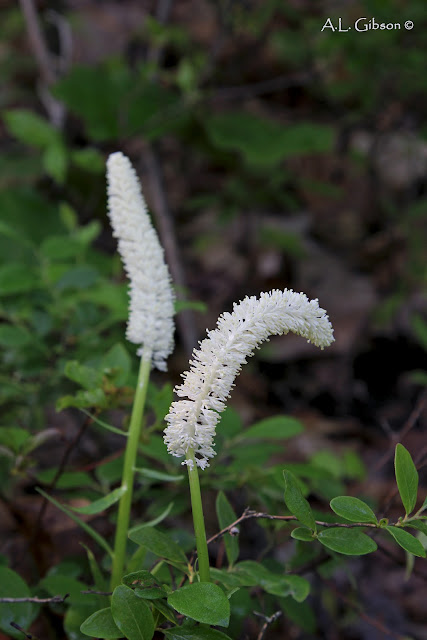
Fairy Wand ♂ (Chamaelirium luteum)

One of those interesting species not normally seen during Flora-Quest was this unparalleled member of the lily family (Liliaceae), fairy wand (Chamaelirium luteum).  Also known as devil's bit, this species is diecious, meaning it has both separate male and female plants.  The one's pictured above are both male staminate flowers and almost always greatly outnumber the females in any given population.  You aren't likely to find any other Chamaelirium species elsewhere as this is the sole member of its monotypic genus.

Trumpet Honeysuckle (Lonicera sempervirens)

As luck would sometimes have it, we stumbled onto a small population of the stunningly scarlet red flowers of the native trumpet honeysuckle (Lonicera sempervirens) vine along a select stretch of Shawnee.  While the invasive and exotic honeysuckle species of Asian decent get all the attention for all the wrong reasons it's nice and rewarding to see our native species still clinging to existence and showing off their beauty.

Early Stoneroot (Collinsonia verticillata)

Of all the flowering plants unusually ahead of schedule during this year's event, this one above was hands down my favorite of all.  The early stoneroot (Collinsonia verticillata) or otherwise known as whorled horsebalm is an endangered species in Ohio with only a few scattered locations in Shawnee state forest and that's it.  If you take the time to take a gander at a distribution map for this curious species it becomes instantly clear it has a strange and scattered range throughout the southern Appalachians, where it's not common or frequent anywhere.  Due to its strange distribution coupled with scattered and rare occurrences it was once under consideration for federal listing as a rare species.

Early Stoneroot (Collinsonia verticillata)

Taking a closer look at the unusual inflorescence of the early stoneroot it's not too hard to tell it is closely related to the much more common Yellow Horsebalm (C. canadensis).  Despite being quite similar they are easy to tell apart in several key ways.  The whorled horsebalm blooms in the late spring, has light pink to purple colored flowers that bloom along an unbranched stem while the common horsebalm blooms later in the summer and fall, has lemon-yellow flowers and can have a multi-branched inflorescence. 

Whorled Pogonia (Isotria verticillata)

Where these is victory there can also be defeat, which unfortunately is the category one would have to place this crowd-favorite orchid species in.  Normally just coming into bloom and rewarding Flora-Quest attendees with it's unique and charming dragon-mouthed flowers, the whorled pogonias (Isotria verticillata) instead greeted their seekers with maturing seed pods.

Whorled Pogonia (Isotria verticillata)

This is what these very same plants looked like just a few short weeks earlier in full, glorious bloom.  Their long, dark-colored sepals spreading out from the 'mouth', which appears ready to devour any pollinator that dares enter its space.  You can't always see it all, even at special events like Flora-Quest.  Sometimes you have to leave people wanting more and ready to come back the next year to catch what they missed this time around.

Small White Lady's Slipper (Cypripedium candidum)

I will leave you with this last photograph of the incredibly rare and endangered small white lady's slipper (Cypripedium candidum).  Only a lucky few got the chance to see this striking orchid but those that did walked away seeing what in my eyes is one of Ohio's most incredible plants.  The small white slipper is hardly bigger than the end of your pinkie finger and produces an intoxicating aroma on warm days that is an instant reward to anyone willing to take a whiff.

It was hard to tell the group to board the van and head back to the lodge to conclude another exciting Flora-Quest weekend but all good things must come to an end.  I think I can speak for my entire group that a great time was had by all and I was honored to have shared my experiences, excitement and Shawnee's secrets with each and every one of them.  I'm already looking forward to next year's installment in 2013!  When the dates are set be sure to check it out and sign up for an unforgettable weekend in extreme southern Ohio!

Saturday, February 25, 2012

Mark Your Calendars: Flora-Quest 2012!

Spring is almost upon us and it's never too early to begin planning on how you want to spend it!  If you regularly read this blog you will notice how much time I spend in the southern-most Ohio counties of Adams and Scioto.  It's no coincidence, as these two counties are the most botanically diverse in our state and harbor many rare and interesting species you won't see anywhere else in our state!  Southern species cross the Ohio River and cling to existence in the cedar glades and barrens on the Edge of Appalachia Preserve system and the continuous rolling forests of nearby Shawnee State Forest

How could you go wrong spending a weekend with some of Ohio's most knowledgeable and passionate naturalists, birders, botanists, lepidopterists etc. guiding you through the endless flora and fauna of these areas?  You can't!  So check your calendars and circle the weekend of May 4-6 for Flora-Quest!  A weekend spent at the lodge and conference center deep in Shawnee state forest; you will spend an unforgettable time learning all about the diversity and history of the area by those who know the area best!  I highly encourage you to check out the Flora-Quest website for more information on events, trips, accommodations, guides etc.  Yours truly is a guide this year and will be teamed up with birding extraordinaire Greg Miller of The Big Year fame.  If you aren't familiar with his epic birding quest, a book-turned-movie based on his and a couple other birder's experiences was released last fall.  For a fun review check out this link here!

There are plenty of other trips to choose from with out-of-this-world guides!  There are no wrong choices and each offers a unique experience with plenty of highlights and surprises.  I attended the event last year and had the time of my life.  A blog post about my experiences from last year's Flora-Quest can be found by clicking right here.  To cap off this advertisement for surely the most fun weekend you'll have this spring, here are a handful of wildflower species you are sure to see should you attend!  I hope you will check out Flora-Quest and give attending some serious thought.  I guarantee a great time, sun or shine!  The wildflowers, warblers and smiles will all surely be in peak numbers!

Dwarf Iris - Iris verna

Last year's wildflower species sponsor was the gorgeous Dwarf Iris (Iris Verna).  This showy species is a short bloomer but can be seen on the dry, acidic ridge tops just down from the lodge.  An easy and must see!

Flowering Dogwood - Cornus florida

An instantly recognizable and crowd-pleasing favorite of spring are the cream blooms of the Flowering Dogwood (Cornus florida).  These shrubs and small trees are a dime a dozen in the area and will be a guaranteed sight all weekend.

Prairie Phlox - Phlox pilosa

Some folks will get lucky and get to experience the marvelous flowers of the Prairie Phlox (Phlox pilosa) as they grace the small prairie openings throughout the Edge and Adams county.

Large Yellow Lady's slipper - Cypripedium parviflorum var. pubescens

On the mesic slopes throughout selective hollows in Shawnee and the Edge hide the Large Yellow Lady's slipper (Cypripedium parviflorum var. pubescens) orchids.  This event times the spring-flowering woodland orchids to perfection each season!

Star Chickweed - Stellaria pubera

Blooming throughout the lower slopes and valleys is the common but still striking Star Chickweed (Stellaria pubera).  It's still worth the time to appreciate and admire the common spring bloomers as well.

Pink Lady's slipper - Cypripedium acaule

On the acidic and dry ridge tops of Shawnee and in scrubby Virginia pine stands on the Edge are the lovely and delicate Pink Lady's slippers (Cypripedium acaule).  There are few other plants that will take your breath away like this one in large numbers.

Indian Paintbrush - Castilleja coccinea

Last but certainly not least is this year's wildflower sponsor, the Indian Paintbrush (Castilleja coccinea).  These showy plants are a common sight in the prairie openings on the Edge and sure to brighten anyone's day!

I hope to see some new faces at Flora-Quest this year and encourage you to seek me out and say hello!  Hope to see you all there!

Tuesday, May 10, 2011

The Best of Flora-Quest 2011

As promised I'm here to deliver to you, my faithful readers some botanical eye candy from the very fun and exciting Flora-Quest.  I know I'm over a week late but there's just never enough free time in my life between school, botanizing out in the field and doing this blog.  However I was able to squeeze in some time to sit down and put this post together for your enjoyment!  So without further postponement here are a few wildflowers close to my heart seen during this fantastic botanical excursion.  Does anyone like Orchids? :)

Iris verna
Iris verna


I think it's only appropriate I start off the beauty contest with Flora-Quest's official 2011 plant mascot, the Dwarf Iris (Iris verna).  I snapped these photographs just as the morning's first rays of sunlight washed over the dew covered plants.  This particular species of Iris is threatened in Ohio; only being found in the three southernmost counties of Adams, Lawrence and Scioto.

Iris verna
Iris verna


Dwarf Iris is quite the contrast from its other brethren when you consider its habitat requirements.  Most species of Iris are most commonly found growing alongside the banks and low terraces of streams and ponds but Iris verna occurs in the dry, acidic soils of Oak woodlands and sun-baked, open ridgetops.  There's just something mesmerizing about this species and its remarkable colors/patterns, I just couldn't take my eyes off it.

Iris cristata
Iris cristata


This is another woodland Iris native to our state, the Crested Dwarf Iris (Iris cristata).  Much more frequent than its aforementioned cousin, you can find it growing in forested stream valleys and ravine embankments throughout southern Ohio.  Iris cristata is a very short bloomer, its gorgeous and delicate flowers rarely lasting for more than a few days.  So whenever you come across a patch of these alongside a babbling brook in the dappled sunlight, take the time to admire their short-lived beauty.

Cypripedium acaule
Cypripedium acaule


Ah, it's orchid season once again in the hills of southern Ohio and not a moment too soon!  This very wet spring has caused some amazing displays of our native woodland orchids so you won't find me complaining too much about all the precipitation.  First up and an instant show-stopper was the Pink Lady's Slipper (Cypripedium acaule) coming up en masse in a Virginia Pine (Pinus virginiana) stand.

Cypripedium acaule
Cypripedium acaule


Also known as Moccasin Flower, the labellum or 'slipper' of this species of Cypripedium is quite different from the other four species found within our state lines.  It almost looks as if someone decided to discard their big wad of chewing gum on the end of a green stem.  This particular orchid prefers Ohio's dry, acidic upland conifer and Oak forests but is also found in sphagnum bogs as well.

Cypripedium parviflorum var. pubescens


Another Lady's-slipper that blooms around this time is the Large Yellow Lady's-slipper (Cypripedium parviflorum var. pubescens).  You wouldn't think that roadsides would make for a prime place to observe and photograph this charming plant but a secluded, dirt road inside the depths of Shawnee Forest provided this stunning clump shown above.  A thorough hike through southern and southeastern Ohio's rich forested hollows could reward you some of these orchids in late April and May.  The other variation of this species, the Small Yellow Lady's-slipper (Cypripedium parviflorum var. parviflorum) is critically endangered in Ohio and is down to just a handful of plants.  I'll be bringing you this rare, life species in the next week or so when I make the trek to its secretive haunt!

Prosartes maculata
Prosartes maculata


While not an orchid, this species is just as glamorous and equally as rare.  This is Nodding Mandarin (Prosartes maculata), a life plant for me that has escaped my camera lens the past couple years due to its very short blooming time.  The wait was certainly worth it as this is one of the most striking and beautiful wildflowers spring has to offer.  It’s six, snow white petals are delicately dotted with purple specks and surround the long, thread-like filaments each adorned with a large pale gold anther.  How could you not love this flower?

Isotria verticillata


Another very finicky and fickle orchid on my life list was the Whorled Pogonia (Isotria verticillata).  After some searching on my hands and knees in an Oak woodland, carefully looking between the Highbush Blueberry (Vaccinium corymbosum) bushes and Mountain Laurel (Kalmia latifolia) I spotted one in bloom, and then another, and another!  In the end over 20 plants were showing off their very unique flowers that look like some ancient mythical creature of Greek legend.  Making the chase even more challenging was the abundance of Indian Cucumber-root (Medeola virginiana) growing in the same area.  Both are strikingly similar in their respective vegetative forms of tall, straight stems topped with a whorl of leaves.  A lot like mushroom hunting, once I saw one I. verticillata and got the eye for it the rest quickly came out of the woodwork.

Bignonia capreolata
Bignonia capreolata


Another rare species high on my 'hit list' this spring was the captivating Crossvine (Bignonia capreolata).  Much more common to the southern states, it barely makes it north across the Ohio River and only occurs in a handful of river counties.  This particular population seemed to be thriving on its south-facing rock cliff along the Ohio River.  You might notice some familiarity with the flowers of the Crossvine.  The common and sometimes weedy Trumpet Creeper (Campsis radicans) is a closely related species, both occurring in the Bignoniaceae family.  Maybe it's because it's a new face and friend to me but I much prefer the Crossvine's flowers.  The striking red corollas fringed with a gold-yellow colored lip really create quite the visual experience.

Galearis spectabilis


To wrap up this picturesque posting about some of my favorite species observed during Flora-Quest weekend 2011 is the quaint and relatively common Showy Orchis (Galearis spectabilis).  Of all the orchids taking advantage of this wet season its the Showy Orchis that seems to be ahead of the rest.  I've never seen so many in bloom in my favorite haunts around Athens County, which is a very welcome sight to see!  Its Latin genus name of Galearis translates to "helmet-like", referring to the purplish-pink hood over the orchids male/female fused column, while the scientific epithet means "showy or spectacular" which this flower most certainly is.  Sometimes it really is all in the name!

I apologize again for the time lapse in-between the event and this post but better late than never!  I hope you enjoyed!  I have quite a few fun and visually stimulating topics planned for the future so continue to tune in!