Showing posts with label Rhododendron. Show all posts

Friday, May 4, 2012

Flame Azalea (Rhododendron calendulaceum)

Flame Azalea (Rhododendron calendulaceum)

If the plant kingdom had the ability to hold their own beauty contests I think it would be safe to say that the Flame Azalea (Rhododendron calendulaceum) would be a perennial powerhouse pick to take home the crown each and every year.  It's hard enough to compete with the other azaleas and rhododendrons within the Ericaceae family but the brilliant and unique flame orange blooms of this species really sets it apart from the rest.

Flame Azalea (Rhododendron calendulaceum)

Ohio is home to four indigenous species of Rhododendron : Rosebay (R. maximum); Rose Azalea (R. prinophyllum); Pinxter-flower (R. periclymenoides) and the featured Flame Azalea (R. calendulaceum).  All four are state-listed and quite rare in Ohio with the flame azalea being the rarest and currently listed as endangered.  Fathom that our most gorgeous and unsurpassed rhododendron species would also be our most uncommon.  Even in pre-settlement times these plants were infrequent and scattered in local populations throughout south-central Ohio, only to be dug up and transplanted by early pioneers and settlers for their homesteads and gardens; a practice still used today.  I can't say that I blame them for wanting to bring the beauty and 'fire' home with them to enjoy and cherish.

Rhododendron calendulaceum distribution map courtesy BONAP

Observing the range of the flame azalea reveals its southern Appalachian distribution from Alabama and Georgia, up through the Cumberland plateau and onto the Allegheny plateau in Ohio and West Virginia before suddenly ceasing before reaching into New England.  Ohio's outlier part of the range is a direct result of the antiquated and pre-glacial Teay's River flowing northwest from Virginia, though West Virginia and on into our state.  This long extinct river was a super highway for southern and coastal plain flora to migrate up into current day southern and southeastern Ohio; such as the flame azalea.

Flame Azalea (Rhododendron calendulaceum)

The scientific epithet calendulaceum translates to 'like a calendula', which is a genus of vascular plants with similarly colored flowers native to Macaronesia and the Mediterranean region.  The common name of flame azalea actually recognizes the resemblance of the shrubs swollen, unopened flower buds to the flame of a candle.  It's just as easy to assume it also refers to the scintillating orange color of the flowers.

Flame Azalea (Rhododendron calendulaceum)

Unlike the evergreen and leathery leaves of the later-blooming rosebay rhododendron, the flame azalea as well as the other two pink taxa have deciduous leaves.  Without such obvious and conspicuous leaves it can be pretty difficult to notice and locate these deciduous azaleas when not in their blatantly obvious flower-mode.  I can only imagine what was going through famed French botanist Andre Michaux's mind when he first came across this striking shrub back in the late 1700's in the southeastern United States.  Seeing large patches and colonies of these in full, glorious bloom must be something an individual is not likely to forget in their lifetime.

Flame Azalea (Rhododendron calendulaceum)

It's not too uncommon to see these remarkable shrubs planted and used in cultivation throughout the acidic soiled regions of Ohio.  It has become an increasingly difficult thing to determine the validity and origin of newly discovered populations of this species considering their ornamental value and popularity.  I'd find it hard to believe that there would be any natural populations left undiscovered in Ohio.  Being so pronounced and meretricious during a few weeks in late spring is an easy way to get noticed by even the most casual observer.

I'm very thankful to have come across the opportunity to see and photograph this flawless and superlative plant and mark it off my life species list.  The only thing better than the thrill of the hunt is the ecstasy of discovery!  I hope you enjoyed this post but now it's time to pack up and head down to Shawnee state forest for Flora-Quest 2012!  I can't wait for what adventures and experiences this year holds and will be sure to share it all upon my return.

Wednesday, March 16, 2011

An End of Winter Hike Through Clear Creek

The other day I decided to spend one of the first warm, Spring-like days on a romp through one of my favorite nature preserves in this area of the state.  Clear Creek Metro Park is huge at over 5,000 acres in size and protects one of the most unique valleys in Ohio.  Sandstone gorges, scenic vista views, rare flora, excellent birding opportunities and a clear, cold stream full of trout are among the biggest attractions to the park.    Honestly, I almost prefer this place to the popular Hocking Hills areas because on most days you have the entire place essentially to yourself.  No crowds or parking lots, Clear Creek offers nearly 20 miles of hiking trails ranging from deep Hemlock/Beech valleys to high Oak/Hickory ridge tops several hundred feet above the valley floor.  While it may not have the exact same "oh's" and "ah's" of nearby Ash Cave or Cedar Falls it still certainly deserves your time and attention.

Eastern Hemlock
Ancient Red Oak and E. Hemlock


I began my hike walking through a narrow valley that instantly made me feel like I was somewhere much farther to the north than Hocking and Fairfield counties in southerneastern Ohio.  I was surrounded by thick, towering cinnamon brown trunks of Eastern Hemlocks (Tsuga canadensis) and the ghostly grey and smooth barked American Beech (Fagus grandifolia) trees that rose precipitously skyward.  Enormous Red Oaks (Quercus rubra), such as the one pictured above on the right, added to the excitement that such a place still exists in today's world of chainsaws and dollar signs.  Looking up through the layered canopies of the Hemlocks took me back to my time spent in the rain forests of the Pacific Northwest.  There I gazed up into the branches of our eastern Tsuga's kin; Western Hemlock (T. heterophylla) and Mountain Hemlock (T. mertensiana).  Anyone who has spent any time out in those phenomenal gardens of Eden are sure to understand my reminiscence at the picture above right.

Rhododendron maximum


Meandering my way through the moist and darkened forest I was quick to notice large shrubs full of evergreen and leathery leaves catching the streaming sunlight through the thick needled marquee of Hemlocks.  Great Rhododendron (Rhododendron maximum) can be seen in home landscaping quite often in southeastern Ohio but Clear Creek offers one of the few indigenous and naturally occurring populations of this threatened species left in Ohio.  The pictures above capture the mood of the opposite ends of the blooming schedule.  In mid June the buds will open and reveal gorgeous white flowers that really set this plant apart.  The resulting capsules will persist through the winter creating a still rather aesthetic touch of scenery.

Lycopodium lucidulum
Lycopodium digitatum


Mixed in amongst the Christmas Ferns (Polystichum acrostichoides) and Hayscented Ferns (Dennstaedtia punctilobula) on the moist forest floor were two members of the Lycopodiaceae family.  On the left is Shining clubmoss (Lycopodium lucidulum) which bears its sporangium (where the reproducing spores are held)  in its leaf axils.  Those are the little yellow dots seen running along the stem.  While in the same family, Fan clubmoss (Lycopodium digitatum) differs in its growth habit and sporangium location.  The branches grow in a spread-out fashion and have a strobilus.  the strobilus is a club-like spike that rises up from the vegetative mat of branches and is where this species sporangium are found.  I found some Rattlesnake Plaintain (Goodyera pubescens) with its distinct evergreen leaves and fruit capsule growing in a sea of the Fan clubmoss and thought it made for a fun photograph.

Epigaea repens
Epigaea repens


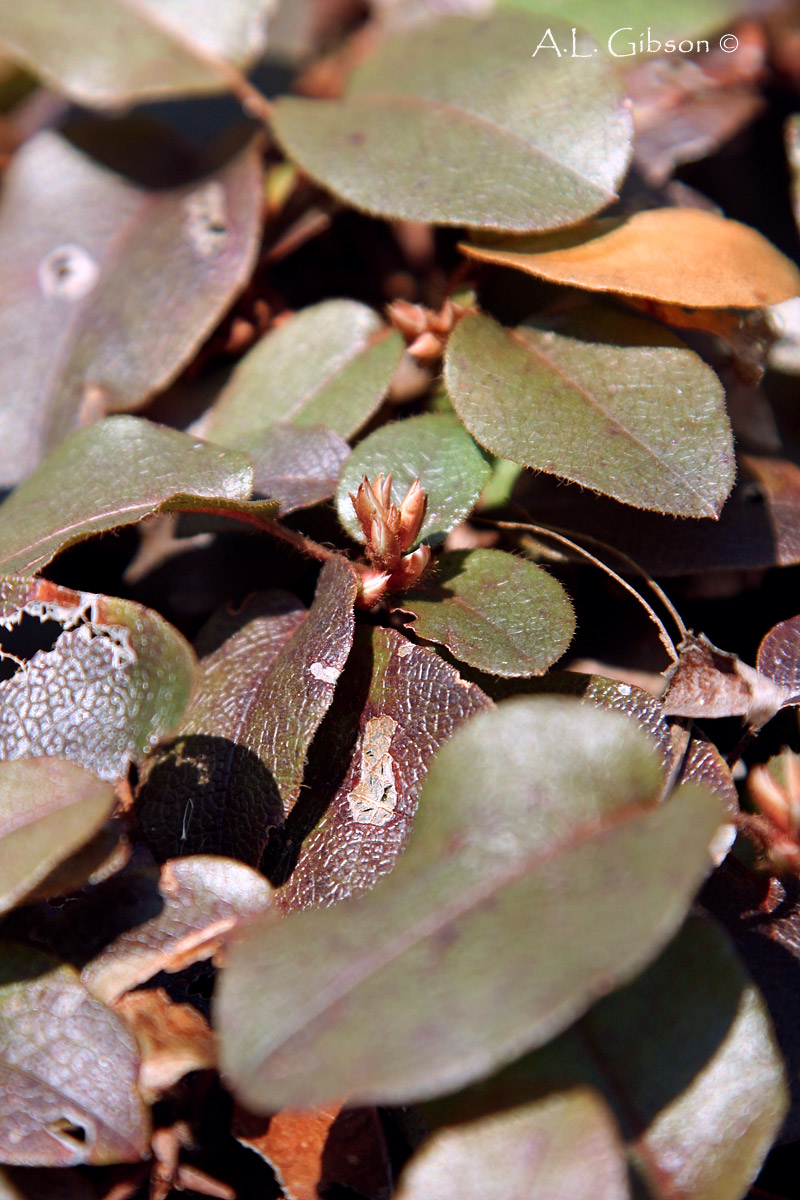
Making my way deeper into the narrowing valley I found myself coming across many rock faces and boulders strewn across the forest that had fallen from the gorge walls.  Taking a closer look at their moss and lichen covered  surfaces proved to be a good idea.  Delicately calling these seemingly barren growing conditions home was one of my absolute favorite little woody gems in Ohio; Trailing Arbutus (Egigaea repens).  On the plants I found their tiny little flower buds were just starting to mature and should reveal their inner beauty in the next couple weeks.  An event I am very excited to see and capture with the camera lens!

Aralia spinosa
Black Rat Snake


Shortly after making the acquaintance of the Trailing Arbutus plants on the rocks the trail took to higher ground and I quickly found myself climbing up and out of the valley onto the lower slopes of the adjoining hillsides.  I stopped to take notice at one of the more intriguing plants to be found locally in Clear Creek.  Reaching it's northern limits in southern Ohio is the spiny and intimidating Devil's Walkingstick (Aralia spinosa).  I can picture the first person describing this to science taking one look at the spine covered stems and branches of this shrub/small tree and immediately conceding it as a malevolent and cruel invention of Lucifer, thus the common name.  I don't think its intentions can be related to the dark lord of the underworld though.  What animal would ever want to even think about making that a snack?  While that question was being pondered in my head a rustle in the leaves a few yards up slope caught my attention.  Upon closer inspection I discovered a large Black Rat Snake warming himself in the sun.  He was kind enough to keep a good pose for a photograph and seemed just too happy about the years first warm day to pay much worry my direction.

Rock Polypody Fern
Rock Polypody Fern


Noticing the sun was starting to wane in the sky I decided to turn back and make my way back down into the valley and back to the car for the lovely drive back to the apartment.  A large patch of vibrant green on a rock caught my last glance and I decided to make a quick and short detour to investigate.  Growing profusely on the large boulder was the fern Rock Polypody (Polypodium virginianum).  If that name sounds familiar it's probably because I briefly mentioned in my earlier post on some over-wintering greenery.  It's just too attractive and photogenic a fern to just ignore it and not get at least a couple photographs.  Making my way back I noticed some fresh rosettes of green starting to work their way out of the ground as well as the swelling buds of the Red and Silver Maples.  Even the Red and American Elm buds were showing strong signs of Spring's arrival.  As I'm writing this many of the first species of plants are starting to flower and I look forward to bringing them to you as soon as possible!  I'll leave you with a photograph of two sister Hemlocks that really show the final product of time and opportunity for this species.  Hope you enjoyed the post and look forward to more Natural Treasures of Ohio.

Ancient twin Hemlocks