Wednesday, April 29, 2015

A Weekend of Birds & Botany in Shawnee State Forest

Whew.  It's been a hectic last few weeks and months for your blogger.  The necessary combination of precious free time and energy to put into new posts just hasn't materialized and is reason for the lack of activity.  I hope to rectify this going forward but for now let's catch up on a few items I'd like to make mention of.

First off, I'd like to take time to honor the life and legacy of an educator, mentor and good friend of mine whom the Ohio naturalist community recently lost.  Dennis Profant, author and publisher of the famed Field Biology of Southeastern Ohio blog and my former professor at Hocking College, unexpectedly passed away on April 15th.  He was one of the most influential professors I ever had and is a large contributor to who, what and where I am as a botanist, naturalist and human being today.  From birds and bugs, to wildflowers and trees, Dennis made learning fun with his unique wit and way of teaching things.  His mind was a walking encyclopedia on our natural world and his passion infectious.  I will always fondly remember our times in the field together or just kicking it in his office discussing everything from jazz to moths.  I'm beyond thankful to have gotten close to him in the years following my time at Hocking College and am greatly saddened to know our time together is done.  What I wouldn't do for one more foray into the woods with him...

On a more positive note, I'd like to personally thank all the kind people who took the time to say hello at the recent Ohio Botanical Symposium back in late March.  Meeting and talking to readers/fans of this website and the gracious words you have to say mean the world to me.  This blog would have slid into oblivion long ago if it wasn't for the compliments, encouragement and confirmation of interest from you all over the years.  I hope you'll continue to read and share my love for everything botanical and beyond.  And Ron G., I promise you'll have your Helianthus themed post to read and use in the next few months!

It's spring!  Taking a glance at my most recent post has this site locked in the depths of winter's chill but rest assured the wildflowers and trees have progressed anyways and thankfully so.  The last two weekends have had your blogger fulfill speaking gigs and lead field trips for the Arc of Appalachia's annual wildflower pilgrimage and Ohio Ornithological Society's annual conference, respectively. Both events were packed full of excited, eager naturalists ready to fully embrace spring's blossoming and an amazing time was had by all.  I would like to recap both events in blog form, starting with this past weekend and the OOS' invasion of Shawnee state forest.

Sunrise over Turkey Creek Lake in Shawnee State Forest

You might recall my post detailing last year's OOS event in Shawnee.  We had exquisite weather and phenomenal birding despite the botany being a bit behind.  This time around the tables were turned with excellent botany and mediocre birding.  Unseasonably cool temperatures and a steady all day rain on Saturday into Sunday kept the birds and their food sources from moving much.  A number of the usual migratory suspects seemed to be late and/or absent from this weekend but that doesn't mean it was a total washout.  The rare chance to see and catch up with old friends is one of the biggest draws for these kinds of events and in that this weekend did not disappoint in the slightest.

Winding dirt road leading through the beauty of Shawnee state forest

The cooler temperatures and rain might have quieted the birds but they did wonders for my floral friends.  Flowering dogwood, redbud, wild plums and serviceberry painted Shawnee's roadsides with their respective shades of cream, white and pink.  There's just something about the isolated, remote feeling of the forest's winding dirt roads as they take you along the ridge tops and down into the hollers.

Scarlet paintbrush (Castilleja coccinea) blooming in an Adams Co. cedar barrens

I arrived to the region early in the afternoon on Friday to do a bit of personal botanizing and birding before I was needed at the lodge.  I couldn't resist the temptation of hitting a few choice spots in Adams County for their rare and unusual inhabitants.  The globally rare dolomite cedar barrens were ablaze with scarlet paintbrush (Castilleja coccinea) in all their seasonal glory.
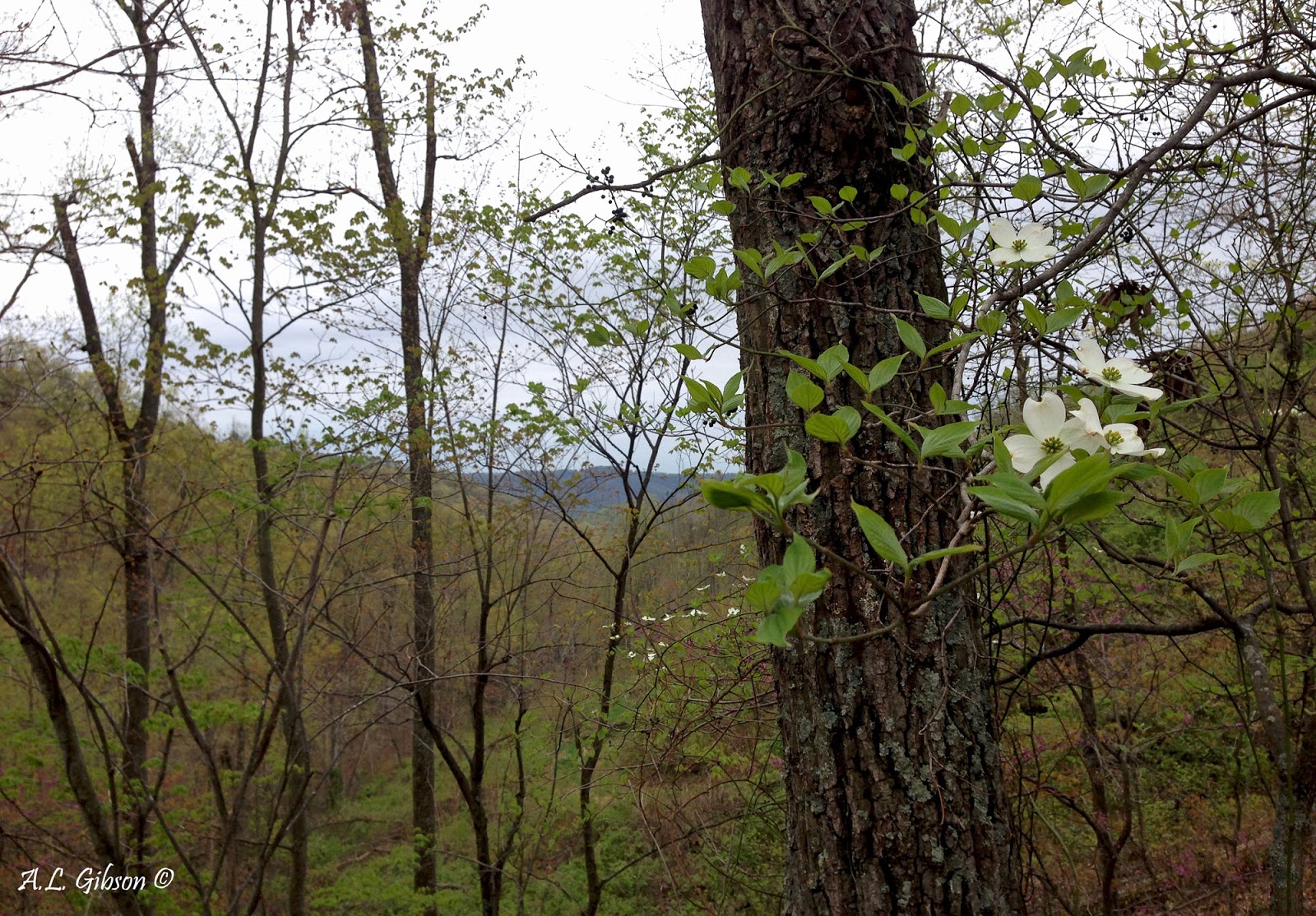
Flowering dogwood back dropped by the rolling hills of Shawnee

Don't let me fool you into thinking the birds were a complete and total bust.  Both my Saturday and Sunday field trips were rewarded with some great species and moments.  The best had to be a woman on Saturday wishing with all her might she'd get to see even a fleeting glimpse of the elusive Kentucky warbler; a long-awaited life bird for her.  Not more than five minutes later a male that had been singing from deep in the brush and tangle of the woods came out and perched himself in clear view for the entire group. Needless to say, the aforementioned woman was breathless in wonderment afterwards.  That's a sight any guide loves to see!

The rare vernal iris (Iris verna) blooming profusely along the forest's roadsides

One of the area's quintessential spring wildflowers was just starting to come online during the conference in the rare vernal iris (Iris verna).  Many folks think of summer and wetlands when irises are mentioned but this particular species loves the rocky, dry soil of Shawnee's sun-drenched ridge tops and roadsides.

Eastern Tiger Swallowtail nectaring on the ephemeral blooms of wild plum (Prunus spp.)

While cruising Shawnee's back roads during Friday's warm, sunny conditions, I came across numerous wild plums (Prunus spp.) in perfect flowering shape.  The air was heavy with their sweet scent and could be detected from hundreds of feet away with the nose alone.  I wasn't their only admirer as the plums were abuzz with dozens of bees and butterflies all looking for a taste of nectar.

Spotted Mandarin (Prosartes maculata)


Another of Shawnee's threatened floral denizens in full bloom was the delicate spotted mandarin (Prosartes maculata).  Their creamy white flowers hang like little lanterns under an emerald green umbrella.  A close look at the inside surface of their petals reveals a gorgeous smattering of magenta polka dots unlike anything else in Ohio's flora.

Pink Lady's Slipper (Cypripedium acaule)

As if the spotted mandarins and vernal irises weren't enough to wow my groups during breaks from our binoculars, Mother Nature had one more wildflower surprise up her sleeve in some pink lady's slippers (Cypripedium acaule).  I didn't expect to find any in this good of shape just yet, especially considering the last week's cooler weather but there this trio was in all their orchid splendor.  The program I gave this weekend was about Ohio's native orchids (fathom that one), so it was rewarding to be able to share these in the flesh with my group.

Sunday's group with their binoculars peeled along the forested ridge top roads of Shawnee

Sunday eventually cleared and warmed into a fine specimen of a spring day.  I had the added pleasure of close friends and phenomenal naturalists, Bob Scott Placier and Daniel Boone join me in leading this troop through Shawnee.  The birds responded accordingly to the improved conditions with better movements and vocalizations as the day waned.  Feathered highlights from the weekend included: scarlet tanager, wood thrush, purple finch, yellow-throated vireo, blue-headed vireo, sharp-shinned hawk and warblers (yellow-throated, yellow-rumped, black-throated green, cerulean, Kentucky, worm-eating, black-and-white, ovenbird, hooded, prairie, blue-winged, pine and redstart).

Birds Foot Violet (Viola pedata)

The theme of my hikes for the weekend was "Birds & Botany", so what could be better than getting the proverbial two birds with one stone in the birds foot violet (Viola pedata).  This state threatened species is arguably the most aesthetically exciting of Ohio's nearly 30 species of violet and they could not have looked better during our romp through Shawnee.

Shawnee enveloped in a steady rain

Fortunately, the rain didn't really hit and stick with us until towards the end of our time in the field on Saturday.  Regardless, I don't think I can really ever curse the rain this time of the year.  Without its life-giving powers there wouldn't be any wildflowers or birds to admire and spend the weekend chasing.  Rain is just fine by me and even gives the landscape a beauty all its own.

Female (L) and male (R) cones of the eastern hemlock

Even the minutiae of spring returning is something to behold.  Shawnee's eastern hemlocks (Tsuga canadensis) were doing their thing during our visit with their ephemeral yellow male pollen cones and adorable little female cones.  The male cones will quickly waste away after releasing their pollen, while the female cones will hang around for several years post maturity.  An interesting fact on gymnosperms is the very long temporal separation of pollination and fertilization.  It can take months for the sperm cells from the deposited pollen to reach the female cone's ovules and months more to mature into a seed.  Nature truly is all a matter of patience.

Oddly patterned common blue violets (Viola sororia) in Shawnee

Another floral oddity I enjoyed sharing with my group was a particular patch of common blue violets (V. sororia) that always display an interesting color pattern on their flowers.  I've witnessed these exact plants for several years running now and they always exhibit this strange, almost leucistic-like phenotype.  Definitely a fun twist on an otherwise common and forgettable plant.

Your blogger and the current/former* state champion yellow buckeye

I'll end this post in the same way I ended my memorable weekend down in Shawnee with one impressive specimen of a tree.  This particular yellow buckeye (Aesculus flava) has seen many winters melt into spring; so many in fact it was once (and perhaps still is?) the largest known tree for its species in the entire state.  Whether or not its title is intact is a bit moot for me.  It's a fabulous example of nature's work when given the time and opportunity to grow, grow, grow.

I can't begin to thank my hike's participants enough for their enthusiasm and thirst for the treasures of the outdoors.  Everyone's attitudes remained positive and cheerful during the entire weekend despite the weather.  I think it's safe to speak for everyone when I say we all had a great time and I'm already looking forward to future events with the OOS.

- ALG -

Sunday, February 22, 2015

A Winter Wonderland in the Hocking Hills

Earlier this week Southeast Ohio finally received what felt like its first appreciable snow event of the season.  We've had countless dustings and a few passing systems that left an inch or two on the ground but in the end nothing that made you want to throw your snow boots on.  So when a fresh five inches fell overnight and draped the world in a picture perfect winter wonderland, I immediately felt the urge to get out and enjoy it.

Quiet, snow-covered trail along Queer Creek in the Hocking Hills

I decided the best bang for my hiking buck would be to brave the cold and make the short drive to the Hocking Hills for the day. The snow coincided perfectly with a rare day where I had little on the schedule and I was determined to take advantage of it.  The road conditions were poor and air temperatures only in the single digits during the drive out but the crisp blue sky and bright sun really made the landscape pop under all the snow.

Blackhand sandstone is a work of art carved by wind, rain and ice

I passed hardly any cars during the drive and encountered even fewer people on the trails.  In fact, just about everywhere I went my tire and/or foot tracks were the first to tarnish the previously pristine snow.  The Hocking Hills is easily one of the state's most popular and heavily visited attractions year-round but I had it more or less entirely to myself for the day and loved every minute of it.

A frozen solid Cedar Falls

The morning started off with a quick stop by famed Cedar Falls.  With subzero temperatures the night before and daily highs well below freezing for days on end, I knew its typically graceful flow would be locked up in a tremendous display of ice.  I was not disappointed.  The silence of the scene was only broken by a slow trickle of water behind the massive mask of ice.

Wide view of frozen Cedar Falls in the Hocking Hills

One of the reasons the Hocking Hills was an easy choice for a snow-laden hike was its year-round presence of color.  Most of Ohio over-winters in a variety of depressingly drab shades of brown and gray.  The Hocking Hills bucks that trend with a rich display of iron-orange Blackhand sandstone and evergreen hemlocks.  I'm especially partial to the color of the uniquely patterned sandstone. It's deserving of its own color in a Crayola crayon box coming soon.

Appalachian rockcap fern (Polypodium appalachianum) tightly curled in the subfreezing temperatures

Multiple layers of wool and fleece kept your narrator warm and toasty despite hours spent out in the subfreezing temperatures.  The same could not be said for the rest of the plant and animal life trying to survive the winter.  The Appalachian rockcap ferns (Polypodium appalachianum) that grace many slump rocks and boulders throughout the region looked especially cold.  Their evergreen fronds were all tightly curled inward, as if to shiver off the arctic chill.

Snow, sandstone and hemlocks

Leaving Cedar Falls behind, I made for my next stop in a lesser known part of Hocking state forest in Edison Hollow.  It's off the beaten path but contains much of the same beauty and features that make the region so popular.

Mature forest within Edison Hollow

Walking back into the bottleneck of the hollow takes you through an impressive forest with a lofty canopy and mature timber. Hemlock, black and yellow birch, beech, tuliptree, red and white oak, sugar maple, black cherry and basswood were all present and combine to make a locally significant forest community.  The Hocking Hills rugged and rough topography creates a cool, moist micro climate in its deep hollows which allows for the typically more northern assemblage of trees and plants to persist.

80'+ waterfall at the back of Edison Hollow
 
Once I reached the back of the gorge my eyes were met with an impressive straight plunge waterfall over 80 feet tall.  Much like Cedar Falls, Edison's was nearly frozen solid and only had a small drip of life to it.  The ice pyramid at its base was especially impressive.  It dwarfed me when standing next to it at nearly 20 feet in height and emitted a soft greenish-blue glow through its complex layers of ice crystals.

Snow, wind and light combine for a stunning scene

My visit to Edison Hollow happened to coincide with the sun positioned behind the falls and illuminating the stand of hemlocks at its precipice.  For a few brief moments the wind would pick up and send the hemlock's accumulated snow into the air, creating a heavenly glow of light above the falls.  The sunbeams would stream through the haze of ice and dance in waves and ripples.

Abruptly ending squirrel tracks
Greenshield Lichen (Flavoparmelia caperata)


The winter woods has a silence and beauty all its own, even more so after a fresh snowfall.  Animal activity was sparse with only a few lines of tracks meandering through the trees.  My favorites were the squirrel prints.  Their tracks would abruptly end a few feet from a tree as if it was suddenly snatched up in an alien spaceship's tractor beam...instead of just jumping onto and scurrying up the tree.

Overlooking the Queer Creek valley from atop a sandstone rock outcropping

After experiencing some impressive upward views in the sandstone gorges and hollows, it was high time to gain some elevation.  I chose another secluded and hardly-traveled area in the south-facing ridge line of the Queer Creek valley.  The valley contains a number of nice rock outcroppings that show off their views across the rough terrain.  Once again the dominant presence of the evergreen hemlocks and their snow-covered branches really magnified the charm of the scene.

Virginia Pine (Pinus virginiana)
Mountain Laurel (Kalmia latifolia)


The hemlocks weren't the only source of seasonal greenery.  Stunted Virginia pines and tangles of mountain laurel grew all along the rocky cliff's edges and perimeter.  They were right at home with the other dry, acidic condition-loving plants of the ridge tops like chestnut, black and scarlet oaks, downy serviceberry, hillside blueberry, black huckleberry and sourwood.

Sandstone rock outcrop above Rooty Hollow along the Queer Creek Valley

This past summer was the first time I'd ever experienced this particular part of the Hocking Hills.  These same rocky outcrops and cliff edges above Queer Creek are home to the state endangered cow-wheat (Melampryum lineare) and were the subject of a day's monitoring and surveying back on a hot and humid day in June.  The views and off-trail seclusion of it all made an instant impression back then and I knew it had to be equally good come winter.

Walking back into the bottleneck of Conkle's Hollow

No trip to the Hocking Hills for me is ever complete without a stop by Conkle's Hollow.  I'm fortunate to have seen and experienced as much of our fine state as I have and even after the years and new places, Conkle's still makes me swoon.  Walking back into its deep gorge or walking the rim trails, I never tire of the feel or atmosphere of the preserve.

Sheer sandstone goodness

Conkle's hollow is one of the deepest in the entire state with depths of over 200 feet.  Many people consider Ohio to be flat and featureless.  It depends on where you're standing when you say that I suppose, but they'd best not be in the Hocking Hills!  Where else in the state do you get sheer walls of rock hundreds of feet tall right in your face?

Yellow birch roots exposed and growing down rock
Hefty hemlock


The predominate bedrock material of the Hocking Hills was laid down some 340 million years ago during the Mississippian Period. During that time the region was under a warm, shallow sea where several prehistoric waterways deposited their sediment loads over a series of deltaic complexes.  Over the eons the sediment layers cemented together to form the Blackhand sandstone we know today. Subsequent geological unrest in the region uplifted and exposed this strata of bedrock to the elements, where millions of years of wind, water and ice has carved out the incredible features we see today.

Frozen ice pillars at the back of Conkle's Hollow

Conkle's Hollow is supremely one of Father time and Mother nature's best works of erosion and patience in the state.  It's fun to think about what the preserve and hollow will look like hundreds of thousands of years into the future.  We live in such a brief flash of geologic time it's hard to comprehend the changes that have happened and will continue happening over the millions and billions of years.

Looking back into the bottleneck of Conkle's Hollow from the east rim trail

As the Blackhand sandstone was laid down, the sediments conglomerated into layers of varying erosion resistance.  The bottom and topmost layers are course-grained and firmly cemented, thus being very resistant to weathering.  These layers make up the basements of the region's hollows and their respective rims and tops of waterfalls.  The middle strata is comprised of a much finer grained sand that was crossbedded and weakly cemented, leaving it vulnerable to erosion.  This layer is where you see your recesses, caves and rock shelters.  Conkle's Hollow and the countless others in the Hocking Hills came to exist when a massive crack or fault in the previously more or less solid block of bedrock occurred and was gradually eaten away until it met more resilient rock.  Over millions of years it's gotten as far as what you see in the photo above.  It all comes back to time and the Earth has had a lot of it to work with.

Looking south out of Conkle's Hollow

This view just never gets old or boring, no matter how many times you've seen it

The afternoon skies had clouded up and a brisk wind was beginning to stir by the time I got to the eastern rim trail.  Temperatures had warmed into the low 20's but that new wind cut like a knife.  Still, it wasn't enough to dull the experience of the rim.  I've soaked in this view dozens of times and taken the same photo dozens more but it never, ever gets even one iota old.

The state-rare resurrection fern (Pleopeltis polypodioides)

I capped off my all-day Hocking Hills hiking extravaganza with a quick stop by a particular hunk of rock to see how one of our hardiest ferns was dealing with the harsh winter conditions.  Just as I expected, the state-rare resurrection fern (Pleopeltis polypodioides) looked just about dead.  But not to fear, it's just playing possum and will be back good as new with time.  This species gets its common name from its ability to dry and shrivel to a near-crisp during times of cold and/or arid conditions and snap right back to a lush, green state after getting a drink.  A fern that can come back from the "dead".  Resurrection, indeed.

I certainly got my wish for a good snowfall at some point this winter but it could be noted that you should always be careful what you wish for.  Another six-seven inches has fallen today to leave a solid foot of the white stuff on the ground.  That can only mean it's time to get out and do some more winter wonderland exploration, right?

~ ALG ~

Thursday, February 5, 2015

Top Ten Life Plants of 2014

Ah.  It's good to hear the clack of the keyboard again.  I'd like to apologize for the lack of activity on here the past few months. Lately too many things have come together to steal my attention and free time but rest assured your blogger is alive and well.  I'm still as busy as ever but hope to manage and keep a presence on here until the less burdened summer months return.  Regardless, it's nice to get something fresh out there for those who have anxiously awaited a new post.  In a perfect world I would have had this post written and published around the turn of the new year but better late than never, right?

The 2014 field season was one to remember for your narrator.  There's never enough time to see and do everything on your list during a calendar year but then that's what makes each and every new experience you do have all the more enduring.  For a botanist, or at least this botanist, one of the most rewarding tasks at the conclusion of a growing season is updating the life list.  As time goes on and I become more and more acquainted with my local and regional flora, the frequencies of making new floral friends decreases.  This makes each additional life species marked off the list feel just a bit more gratifying than the last.

With that being said, I'd like to reminisce on my personal top ten favorite "lifers" from 2014's botanical forays. It was not an easy task to achieve, believe me.  Many worthy contenders just couldn't make the last cut.  All ten plants were species I'd never had the pleasure of seeing in the flesh before; many only dreamily through a computer monitor.  Some I specifically set out to see, others I came across by complete chance.  If you're a regular reader of my blog, you might recognize a number of the forthcoming plants; some just deserve their own separate 15 minutes of fame at the time.

#10  -  Long Beech Fern (Phegopteris connectilis)

Number ten takes me back to the Hocking Hills this past June.  As a field botanist for the Ohio Division of Natural Areas and Preserves, my job sees me work with hundreds of our state's rare plant species.  Surveying, monitoring and managing their occurrences is a large component of that work and is what had me finally face to face with the state-rare long beech fern (Phegopteris connectilis).  Typically found further to the north, it manages to persist in a rather disjunct fashion in the Hocking Hill's more secluded cool, moist hollows.  It looks strikingly similar to its close relative (and much more common) broad beech fern (P. hexagonoptera).  Looking at the bottom pair of pinnae helps separate the two: long beech's rachis between the bottom two pairs of pinnae lacks any wings; while broad beech's rachis is winged between every pair of pinnae.  

#9  -  Catesby's Trillium (Trillium catesbaei)

The mountains of northern Georgia produced dozens of new lifers during my visit in mid May, and I don't think much of anything impressed more than the trillium.  If I had to play favorites of the four-five new species I encountered, Catesby's trillium (T. catesbaei) will do nicely.  To see and read more on the other lifers from this trip you can check out this link right here.  There's still more to come on this list from Georgia though.

#8  -  Limestone Adder's Tongue Fern (Ophioglossum engelmannii)

If you didn't already know what you were looking at, number eight might have you thinking little green ogres had been buried up to their ears.  This alien-looking organism is actually a species of fern known as limestone adder's tongue (Ophioglossum engelmannii) and is quite rare in our state.  In fact, it's only known to occur in a handful of limestone barrens and glades in Adams county and that's it.  The spore-containing fertile frond was thought to resemble a snake's tongue, hence the common name of adder's tongue fern for this genus.

#7  -  Rough Boneset (Eupatorium pilosum)

Lifer number seven has the distinction of being a very, very new lifer for any Ohio botanist, well their state list anyway.  Rough boneset (Eupatorium pilosum) was never known from our state until late summer 2013, when exceptional field botanist and good friend, Brian Riley discovered it growing (apparently) wild in Athens county. Come August 2014, Brian led your blogger and a few other distinguished Ohio botanists to the sites to discuss its native status.  After weighing and debating the topic we concluded it was very likely a natural occurrence and not an intentional (or accidental) introduction.  Just another excellent find by Brian!  For a more detailed account on our day with the rough boneset, you can check out Jim McCormac's post here.

#6  -  Bradley's Spleenwort (Asplenium bradleyi)

Here we are halfway through the countdown and we're on fern species number three.  Needless to say, they've recently become a bit of a hot topic for me and one I put more focus into studying during the 2014 field season. Bradley's spleenwort (Asplenium bradleyi) is one I'm quite pleased to finally have a check mark next to as it's arguably one of Ohio's rarest pteridophytes.  Listed as endangered, it's only known to occur in a handful of sites in southeastern Ohio, often on sheer, inaccessible sandstone rock faces.  That type of habitat niche made getting a photo of even a single fertile frond or two difficult and involved a bit of free hand rock climbing.

#5  -  Swamp Valerian (Valeriana uliginosa)

As I  alluded to earlier, some great plant finds come out of nowhere and catch you by complete surprise.  Those are the ones that are even harder to forget.  Enter life plant number five in the absolutely stunning swamp valerian (Valeriana uliginosa).  While wading through a sprawling fen meadow in southeast Michigan last June, my botanical cohorts and I came across a scattering of these snow white-capped flowers and despite never seeing them before it clicked almost instantly what they were.  Swamp valerian was a plant I'd only ever dreamed of seeing and wasn't sure where, if or when I'd ever get to mark it off the list.  It was only known from a single site in northeast Ohio and hasn't been seen since the end of the 19th century.  For more on this species and the other botanical goodies within its remarkable fen, you can check out this link here.

#4  -  Venus Flytrap (Dionaea muscipula)

In terms of new species added to the life list in 2014, nothing came close to my time on the Florida panhandle. I could have just as easily made this entire list out of Florida flora but I did my best to refrain from such a biased approach.  Of the hundreds of lifers I encountered in the swamps and pine lands of the panhandle, the fabled Venus fly trap (Dionaea muscipula) was the most anticipated. The plants were admittedly planted at the site I knew about decades ago and have persisted in the boggy habitat but that did little to take away from the experience.  For more photos of the fly traps and their other bog associate denizens you can check out this link here.

#3  -  Sweet Pinesap (Monotropsis odorata)

Most wildflowers people remember with their sense of vision.  The same could be said for lifer number three but I personally will always recall them most fondly with my olfactories.  Sweet pinesap (Monotropsis odorata) was the target of a late April excursion to the Red River Gorge of Kentucky, with the motto being, "follow your nose!".  Sweet pinesap gets its name from the intoxicating aroma emitted from its perfectly purple flowers.  I've never smelled anything more enchanting than these oddities and in fact smelled their presence before visually locating them.  For more photos and info on this trip and these odorous wonders you can follow this link.

#2  -  Pine Lily (Lilium catesbaei)

We're down to the two biggest plant finds of my 2014 and it's back to the hot and steamy confines of the Florida panhandle.  After my time with the Venus fly traps, I decided to explore the nearby depths of Apalachicola National Forest's longleaf pine savannas. Gazing out across their open expanses of graminoids and pitcher plants invoked feelings of nirvana and utter tranquility.  The cherry on top of the savanna sundae was stumbling across lifer number two dotting the seas of green with their fire orange-red tepals.  I adore lilies but had no idea just how much until the pine lily (Lilium catesbaei).  Much like the aforementioned swamp valerian, I hadn't even considered encountering such a remarkable wildflower but am overjoyed that I did.  There wasn't much else to compare the feeling of their discovery to except for the last species left.

#1  -  Small Whorled Pogonia (Isotria medeoloides)

If you know me and you read this blog, it probably isn't hard to surmise that my number one life plant from 2014 was hands down, no contest, how-could-it-not-be the federally threatened small whorled pogonia (Isotria medeoloides).  I made the 500+ mile trek to Chattahoochee National Forest in the mountains of northern Georgia last May to specifically see this most elusive orchid.  Many might wonder why a small, bland and green "if you can even call it a flower" would illicit such a strong reaction from me, and honestly I might ask myself the same.  Its genuine distribution-wide rarity, sporadic and poorly understood life cycle, and mythic nature all combine to make it an arduous chase.  I could go on and on about this particular experience and plant but I'll leave that up to you. An entire post dedicated to this little green blob can be found here.

I hope you enjoyed this retrospective look at my favorite field finds of 2014.  Perhaps one of these made your life list last year? Maybe one of these will be a target for your 2015?  I look forward to bringing you more botanical forays and treatments in 2015 and know I have a lot of catching up to do from years past.  So stay warm and dream of spring!  The snow trillium and hepaticas will be out before we know it.

~ALG~

Sunday, November 23, 2014

The Buckeye Botanist: New Name, Same Blog

For the last four plus years I've had the pleasure of keeping this nature blog to journal my travels, thoughts and passions.  I may not publish as often as I'd like or intend but each and every post has been worth the time and effort.  I thoroughly enjoy bringing my readers along for each ride but I'd be lying if I said I didn't keep this blog up and going for anyone more than myself.  Each one's experiences and/or information has led to me being the botanist and naturalist I am today and a fun barometer of how my views, knowledge and outlook on our natural world has evolved and matured.  I find myself going back and rereading old posts often and reliving the details and places within.   Having said all that, I think it's time for a change...

Not to worry, I have no plans to stop or ween myself off this blog and have every intention of seeing it go forward into the near and distant future.  The interest and drive is still there and while it certainly waxes and wanes, I find it refreshes itself more readily as time goes on.  The change I speak of is the name of this blog. Ever since the conception of The Natural Treasures of Ohio in the autumn of 2010, I've never fully settled and been overly content with the name.  It was honestly the hardest part about starting a blog.  I've frequently found myself struggling with the battle of changing it more and more.  

Each red dot represents an area and/or site a post on this blog has focused on over the last four years

I have built up a good following (a special and hearty thank you to all my readers and fans, you're the best!) and don't want to throw a wrench into the gears.  But I've found myself traveling more and more outside Ohio's borders and taking this blog along for the ride.  Not to mention being a botanist it was naturally heavily favored to take a botanical bias as it was.  The map above represents all the states (green) and areas/sites (red dots) I have blogged about.  Far from being the natural treasures of Ohio only, eh?  I plan to fill in this map with more of my previous travels in due time but for now I think it's not too shabby looking.

At the end of things I didn't think the old name was an accurate representation of myself or this blog anymore and the change was made to: The Buckeye Botanist.  It has a nice ring to it, I think.  I'm proud to have called the Buckeye state home my whole life and will continue to focus on its treasures and diversity but give a nod as well to my botanical forays all over our amazing continent.  I'd really appreciate any feedback, comments or opinions on the matter.  Perhaps I should adhere to the old name for recognition and brand purposes?  Or in the long run it won't matter and people will catch on pretty quickly?  I'd love to hear from you! I won't change the name officially on Blogger for a bit but baring any setbacks or overwhelmingly poor reviews, I think the future of The Buckeye Botanist is bright and filled with even more rare plants, fascinating ecosystems and of course wild orchids.  Thanks again to all who help make this possible and keep stoking the fire of interest inside my brain and fingers.  I may have fibbed earlier on after all...it wouldn't be as much fun or rewarding if I didn't have a viewership and faithful readers to please and keep updated!

- Andrew