Monday, June 24, 2013

The Quest for the Western Wallflower

So much to see and do with so little time.  The theme my life revolves around more and more it seems as my list of plants and places ever grows.  For every successful sighting and experience I scratch off the list, two more are sure to be added.  It's the law of nature for this botanist but how could I complain?  I count myself among the lucky and am very thankful my passion and career only seems to grow in the number of things I want/need to accomplish; a product of the "more you know, the more you don't know" line of thought.  That being said, I made sure to make some time this late spring for an attempt at seeing one plant that had been on my radar for years.

Looking east along the top of the limestone bluffs along the Ohio River 

Back in late May, myself and good friend Dan Boone, who is one of the best field botanists in the state decided to hunt down one of the rarest of the rare: the western wallflower (Erysimum capitatum).  Its only known site in the entire state of Ohio is along a stretch of steep limestone bluffs that hang a couple hundred feet above the Ohio River near the small town of Aberdeen.  Dan and I had a pretty good idea of where to look and were greeted by a very precipitous slope that made for a harrowing search.  In an awkward catch 22 situation, the dense thicket of bush honeysuckle (Lonicera mackii) allowed for something to grab and steady yourself on as our eyes scanned for a blip of unmistakable orange.  I never thought I'd be so thankful to have an invasion of honeysuckle around me.

The western wallflowers clinging to the steep bluff's slopes.

They took a while to find with some moments of nervousness that the plants had been crowded/shaded out but in the end our search was not in vain.  What had been recorded as an occurrence of over 30 plants a decade ago had unfortunately dwindled to just five flowering plants and six vegetative rosettes by our count.  Regardless of the low numbers it only takes one specimen in full flower to see just how striking a wildflower it is!

Close up look at the western wallflower's unique shade of orange

I can't say I've seen every plant known to Ohio, but I think proclaiming the western wallflower as the most unique and vibrant shade of orange in the vascular flora to be an accurate assessment.  It's definitely the most showy of its fellow mustard family (Brassicaceae) brethren!  Even under the thick shade of the oaks, maples, and honeysuckle its fire-orange petals beckoned us to them like a moth to a flame.

North American distribution map (courtesy: BONAP)

As mentioned earlier, the western wallflower is only known from this single site in Brown county along the Ohio River.  Even looking back over 150 years into Ohio's past the only other record for this plant was an 1838 collection from Franklin county by famed Ohio botanist (and Ohio University alum; yay for a fellow Bobcat!) William Starling Sullivant.  That ancient record, at least ancient in botanical terms, is probably what gives the most credit to our flora recognizing it as an indigenous species rather than adventive/introduced.  Looking at its distribution above you can see that once you get east of the Rocky Mountains the species tapers out almost instantly before popping up in a seemingly random scattered pattern as far east as the Virignias.

Dan standing with two of the handful of flowering western wallflowers we found

The photograph above shows Dan standing with two of the handful of blooming wallflowers.  Like I mentioned earlier the slopes really were a challenge to navigate and keep upright on.  Dan isn't holding on to the honeysuckle trunk for the sake of a pose.  The white colored background beyond the trees is actually water of the Ohio River, not sky if you can believe that.  I guess the common name of 'wallflower' was a valid one as its preferred habitat of limestone bluffs, slopes, and outcrops was being displayed picture perfectly.

Western Wallflower - Erysimum capitatum

With any luck this piece of priceless Ohio biodiversity will one day be under the management and protection of the state.  Better sooner than later, as the site could use much-needed habitat management to remove honeysuckle and open back up the upper slopes.  Hopefully long-dormant seeds that have been biding their time in the soil will germinate and spring forth with an increase in sunlight.

Once satisfied with our scouring of the river bluffs and getting an accurate count of the western wallflower, we climbed our way back up to the ridge top and walked back to the car with a very satisfied feeling of accomplishment.  Dan had never seen this particular taxa before either and was just as pleased as I was to finally have it on his life list.  Between what Dan and I have seen in our respective botanical experiences, it's not every day we both get to see something we've never seen at the same time.  The day seeing something as rare and breathtaking as this starts to bore me is a day I never want to know.

Friday, June 21, 2013

St. Marys River Wetlands

Last week I had the pleasure of having my job take me up to an area in northern Mercer county known as the St. Marys River wetlands.  It's slated to be dedicated sometime this summer as Ohio's newest state nature preserve; a very fitting and deserving recognition as I would come to find out!

Aerial view of the preserved wetlands via Google Maps

Being a botanist for the Ohio Division of Natural Areas and Preserves (DNAP) has opened the door to many of our state's most unique and interesting ecosystems and habitats and this place was no different.  Within the 69 acres of the preserve is river frontage, riparian floodplain forest, and adjacent flat woods with an abandoned river channel and accompanying button bush swamp.  Naturally, with that kind of territory comes mosquitoes and boy were they thick!  In the sections of the swamp woods with standing water it become necessary to breathe through your nose.  Trying to breathe with your mouth only resulted in the inhaling, and subsequent choking on the blood-sucking nuisances.

In the aerial photo above you can make out the standing pools of water in the old river channel as the darker botches and the St. Marys river itself as the northern border of the preserve.  It's incredible this riparian community stills exists today when you see the surrounding sea of agriculture.  Mercer county isn't exactly known as a nature-friendly area with some of the most heavily-farmed land in this section of the state.  That makes this preserve all the more valuable and worth protecting!

Panoramic view of the swamp flat woods full of sedges and other botanical goodies

Joining me that day was Ohio's chief botanist Rick Gardner and a number of other DNAP employees and volunteers with our task to update a couple rare plant records and continue a biological inventory of the preserve.  Being on the job, I never take my camera gear with me into the field so I make due with my iPhone's camera, of which all these shots were taken on.  I'm consistently impressed with its capabilities and good quality captures.

Canada anenome - Anenome canadensis

One of the first things to grab our attentions was a lovely display of Canada anenome (Anenome canadensis) in full flower on the edges of the forest.  This plant is sometimes used in cultivation for its fast-spreading ground cover foliage and lovely white flowers.  Just be sure to keep an eye on it as its aggressive rhizomes can and will quickly take over an area.

Carex muskingumensis
Carex grayi


For the sedge-loving members of the group like Rick, who is an expert in this intimidating and tricky group, and I, the preserve was heaven on earth.  Being a high-quality wetlands it should come as no surprise that the sedge diversity would be quite large.  Music to my ears!  Even better was the amount of personal favorites that called the swamp woods home such as: Carex grayi, C. crus-corvi, C. muskingumensis, C. typhina, C. squarrosa, C. lacustris, and C. lupulina.


Raven's Foot Sedge - Carex crus-corvi

In fact, one of the main reasons we were there was to check up on and update the occurrence of the state-listed raven's foot sedge (Carex crus-corvi).  Its gorgeous, large fruiting heads full of sharply pointed perigynia accompanied with the blue-green foliage weren't too hard to notice walking through the sea of other sedges and vegetation.  This particular sedge is threatened in the state of Ohio and only occurs in a handful of counties in high-quality swamps and floodplain woodlands.

Virginia Iris - Iris virginica

Beauty is certainly in the eye of the beholder and while I find the raven's foot sedge to be absolutely stunning, I think most others would be more interested in these flowering monocots instead.  Scattered throughout the open understory was the delicate and short-lived Virginia iris (Iris virginica) that certainly stood out against the surrounding greens.

Green Carrion-flower - Smilax pulverulenta

Despite being arguably the least-attractive of our finds that day, this species was hands down the most meaningful and exciting of them all.  After some careful examination and consideration it was decided (and later confirmed) this is the incredibly rare green carrion-flower (Smilax pulverulenta); an endangered species in Ohio and one with a confusing history in our state.  Of the eight species of Smilax native to Ohio, three are woody, spined perennials (e.g. S. rotundifolia, hispida, and glauca) and the most frequently encountered while the remaining five are more uncommon and herbaceous annuals that lack prickles/spines.  The latter group can be confusing and hard to tell apart with tedious differences.

Previously S. pulverulenta was a variety of S. herbacea along with S. lacioneura before both were given full species status.  S. pulverulenta can be differentiated from S. lacioneura (which was present in the area as well) by its lustrous, abaxially dark green leaves; hemispheric (one-sided) flower umbels; and black, non-glaucous mature fruit. Our specimen showed all these signs except for the mature fruit since the plant was still flowering.  Rick mentioned all the specimens in Ohio's herbaria labeled S. pulverulenta were mis-identified and were actually S. lacioneura; meaning as far as he or anyone else knew, this lone plant in front of us was the only known and confirmed site and specimen of the green carrion-flower in the state.  Pretty darn cool if you ask me!

Rough-Leaved Dogwood - Cornus drummondii

Ok, enough of the botanical jargon and nerd talk; even if I could go on and on.  A frequent shrub and/or small tree of the open swamp understory in full bloom was the rough-leaved dogwood (Cornus drummondii).  It certainly blends in with the half dozen or so other thicket-forming, shrubby dogwood species outside the obvious and more-showy flowering dogwood (C. florida) but with a quick touch it's not too hard to tell apart.  The top and bottom surfaces of the leaves have a scratchy, rough feel to them (hence the name) from their dense covering of wooly, rough hairs.  This species also has very showy white berries on red pedicels come late summer and autumn.

Baby bowfin (or dogfish) found in the shallow standing pools of water

After our exciting botanical discovery I suppose it's only appropriate we make another one; only this time it was of the ichthyological kind!  As our group passed through the area of the abandoned river channel, we took notice of the water 'boiling' with hundreds of little fish in the shallow waters of the buttonbush pools.  Rick scooped out the little fellow pictured above and we all scratched our heads at its identity.  As it turned out it was a baby bowfin (Amia calva), the sole surviving species of an ancient order of long extinct fish!  Also known as dogfish, the bowfins were a very unexpected surprise that caught all of us off guard.  I would assume a heavy flooding event isolated the adults from the main channel of the St Marys river into the swamp forest's pools sometime in the past.  We did observe large fish swimming around further out in the water but assumed they were carp but looking back now I believe them to have been adult bowfins!  How else would there have been so many fingerlings?

American Sweet Flag - Acorus americanus

Walking past the sunnier margins of a swamp woods or marshy area many would probably see this plant and pass right by thinking they were simply cattails.  How wrong they would be and why taking a closer look is never a bad idea!  This is the rare American sweet flag (Acorus americanus); a species of concern in Ohio that grows in scattered wetlands throughout the northern half of the state.  It can be told apart from the much more common introduced European species (A. calamus) by looking at the veins in the leaves and flowering/fruiting material.  Our native species has a raised midvein plus an additional two or so more raised veins, while the European species only has a single, obvious raised midvein.  The American species is also a fertile, flowering diploid versus the sterile triploid Europen taxa.

From L to R: Carex lupulina, C. squarrosa, C. lacustris, C. crus-corvi, C. typhina, and C. muskingumensis

All in all, I left the St. Marys River Wetlands very impressed with its botanical diversity, intact and pristine swamp forest habitat, and of course all the sedges!  I'm very thankful this gem of a place is in good hands and will see a long future of protection and management for myself and future generations to enjoy and hike through; if they aren't drained dry by all the mosquitoes that is haha.  I'd certainly like to visit at other times of the year to see what goodies and secrets this place still has to share.  Once dedicated and open to the public, I highly recommend getting out and experiencing its charm and sights for yourself!

Monday, June 17, 2013

Adventures in the Adirondacks I: Bog Meadow, Hudson Ice Meadows, and Cole's Woods

*Part I* *Part II* *Part III* *Part IV*

Ah, back to the Adirondacks!  For my devotees, you may recall your blogger making the trek to the Saratoga Springs area of upstate New York last July for a week of hiking and botanizing with my dear friend Jackie.  You can read all about the finds and wonderful discoveries by clicking here to see their respective posts.  It wasn't long upon my return back to Ohio that Jackie and I already began to plan for another visit in May 2013.  I'd seen the southern Adirondacks in the summer, now it was time to see what late-spring had to offer!

I came prepared with a list of plants I had the highest of hopes to find in blooming shape during my time in the area.  I'm constantly in the hunt for new wildflowers to mark off my life list (which recently eclipsed 2,000 species) and in similar fashion to my earlier trip, Jackie was my lucky charm.  By the end of the week just about every name on my list had a very satisfying and fulfilling check mark next to it.  I have to say that even if all I had seen was chickweeds and yard violets during my stay it would have still been completely worth the drive.  Being out in the beauty of the Adirondacks with Jackie are and forever will be some of my most treasured moments.  Her love, passion, and knowledge of the outdoors is palpable and very contagious!  I was also very pleased to have Jackie's naturalist friend, Sue take time off work in anticipation of my visit and join us on our forays!  Her eagle eyes and wonderful knowledge and lore of the area came in handy while out in the field.

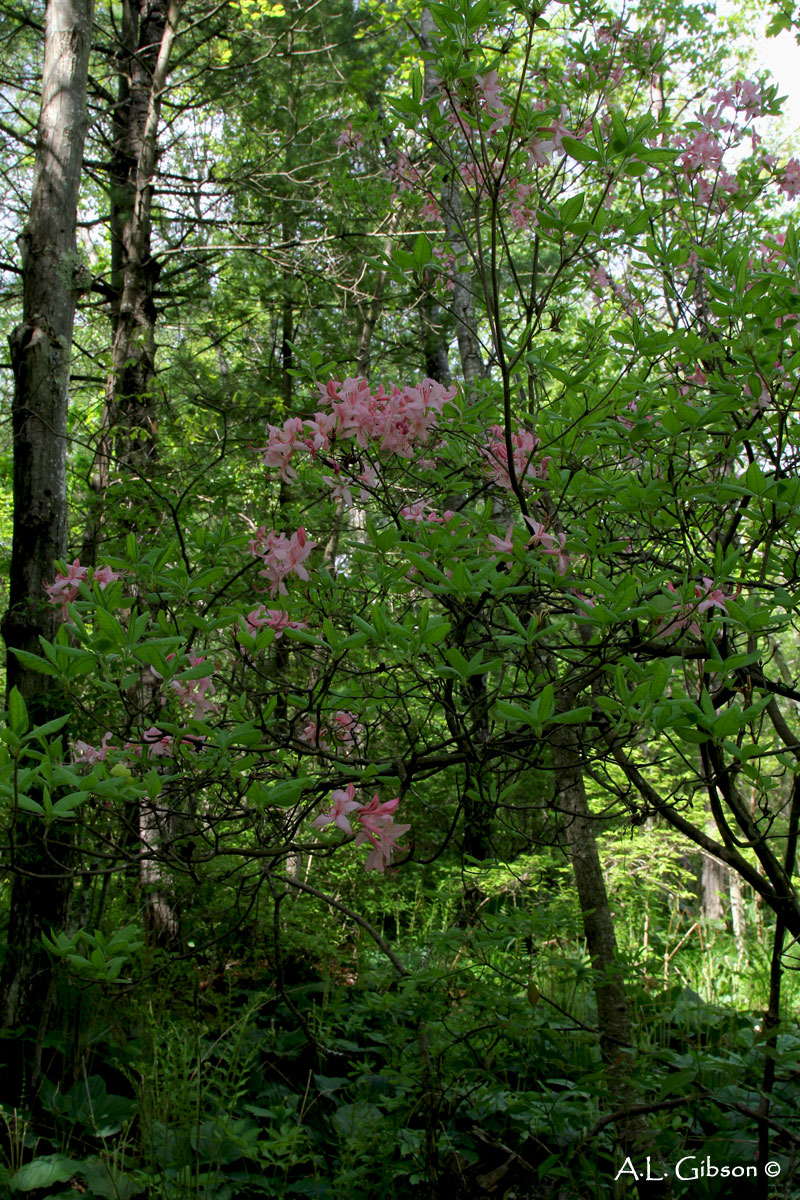
Early Pink Azalea - Rhododendron prinophyllum

My first full day back in the Adirondacks had Jackie, Sue, and I visit a few key places in the Saratoga Springs area to see what wildflowers we could happen across and to find a number of specifics I had my eyes on.  First up was the Bog Meadow trail outside of Saratoga Springs.  Its path through varying habitats of rich, moist woods; spring seeps; and marshes had plenty to see and enjoy.

Woodland horsetail in a sea of green false hellebore leaves

It wasn't more than five minutes into my first day of hiking before I came across a new and exciting scene for someone who lives and works in southern Ohio.  Growing in a swampy woods was a lush sea of varying greens that seemed to glow in the shade and shadows of the thick canopy.  The whorled, elaborate branches of woodland horsetail (Equisetum sylvaticum) glistened with dew in the waxing morning sunlight, intemixed with the lady's slipper orchid-like leaves of green false hellebore (Veratrum viride).

Water Avens - Geum rivale
Water Avens - Geum rivale


One of the first big plants to make it off my list was some of the unique water avens (Geum rivale) blooming alongside a small brook.  Their red sepals and yellow petals hang over its attractive green foliage in quite the aesthetic display.  Just about all our other avens (Geum spp.) are inconspicuous and easily over-looked but this one certainly stands out.

Nodding Trillium - Trillium cernuum

As nutty as I am over orchids, and rest assured there will be plenty of those in these posts, I am also a lover and appreciator of our native trilliums.  There's just something about their three-parted symmetry and having that "classic" spring wildflower look that sets them at a higher level for me.  Halfway through our morning at the bog meadow trail, I was able to finally make the acquaintance of the Ohio extirpated nodding trillium (Trillium cernuum).

Showing off those obvious filaments
Nodding Trillium


This particular trillium was first (and only) collected in Ohio back in 1879 in Lake county and subsequently never seen again.  It looks excruciatingly similar to our much more common drooping trillium (T. flexipes) but can be told apart by a close look at the flower's filaments.  T. cernuum has anthers that hang on longer, easily-noticed filaments, while T. flexipes' anthers seem almost sessile and their filaments are only visible upon pulling apart the flower's petals.  Unfortunately, this species is becoming more uncommon across its northern range; a probable response to warming climate conditions.  Jackie commented on how she doesn't see them with the frequency or consistency she used to.

The botanically-diverse Ice Meadows of the Hudson River 

Next up was a visit to the famed ice meadows of the Hudson River to see what plants we could find beginning to bloom along the newly ice-free shorelines.  Looking up and down the banks on either side it's easy to see just how open and free of woody encroachment this habitat is. This is created and sustained each winter when huge deposits of frazile ice accumulate on the margins of the Hudson.  The immense weight and pressure from the ice pack, which can reach and exceed 15 feet in height at this location, generate the pseudo-boreal habitat.  This annual "cleansing" of the shoreline prevents woody vegetation and invasive species from encroaching and keeps the intriguing plant diversity intact for the late spring and summer months.

Dwarf Sand Cherry - Prunus pumila var. pumila

During my visit last summer I arrived a few weeks too late to catch the ice meadows in their floral prime and this time around I was a few weeks too early for the same thing but that doesn't mean the meadows were completely devoid of anything botanically interesting! The first thing to catch my eye among the greening vegetation was dwarf sand cherry (Prunus pumila var. pumila) in full flower.  This small shrub of beaches, rocky shores, and dunes has long been extirpated from Ohio due to habitat loss and degradation of its already naturally rare home(s).

Large Cranberry - Vaccinium macrocarpon
N. Pitcher Plant - Sarracenia purpurea 


Growing and twining all over the place among the boulders and rock cobble of the ice meadows was large cranberry (Vaccinium macrocarpon) plants with last year's fruit still clinging to its wispy branches.  In select spots clumps of northern pitcher plant (Sarracenia purpurea) were just sending up their flower stalks.  I wonder if the pitcher plants generally have more success at the capture of their insect prey during flowering times than any other period of the year?

Alpine Bulrush - Trichophorum alpinum

Being the sedge-head that I am, I could never pass up the opportunity to admire and photograph a new life species hailing from the Cyperaceae family now could I?  While it may not look like much to most, I found the fuzzy white hairs on the fruiting heads of the alpine bulrush (Trichophorum alpinum) quite charming and worth the time to photograph.

Dog Violet - Viola conspersa
Ovate-leaved Violet - Viola fimbriaulata


Despite the vegetation just starting to wake up along the Hudson, we did see a couple violets blooming profusely in more open, sandy spots along the banks.  The dog violet (Viola conspersa) was a familiar face to your blogger but the downy pubescent leaves and flowers of the ovate-leaved violet (Viola fimbriaulata) were something I'd never seen before.  I adore the violets for their diversity and the countless habitat niches they fill, so it's always a pleasure to add yet another to the life list.

Stunning white and red pine forest along the Hudson full of botanical goodies

After an hour or so combing the western side of the Hudson's ice meadows, we jumped back in the car and drove over the river a short distance to another location on the eastern side to explore what goodies may be up and blooming over there.  What should have been a five minute hike through the woods to the river's edge ended up taking much, much longer after one exciting botanical find after another!

Pink Lady's Slippers - Cypripedium acaule

Under the cathedral of white and red pine, nestled in the soft bed of fallen needles were hundreds of pink lady's slippers (Cypripedium acaule) in pristine condition.  Heading due north during the spring is the closest thing to time-traveling I'll ever experience.  Back home in Ohio these orchids were long out of flower and something I wouldn't see again for another year but being in the Adirondacks gave me one more shot at soaking in their beauty.

Pink Lady's Slippers under the pines
Starflower - Trientalis borealis


It wasn't just the lady's slippers that abounded under the pines but many other typical northern woods associates as well; some of which were quite rare back home in Ohio.  The starflowers (Trientalis borealis) and their short-lived blooms were in prime shape for some len's time and rarely fail to impress with their delicate, dainty flowers.

Gay wings among the shining clubmoss
Gaywings - Polygala paucifolia


One of the aforementioned Ohio rarities still in bloom in the dappled shade of the pine woods was the bubblegum pink colored flowers of gaywings (Polygala paucifolia).  Their brightly colored flowers stand out like a sore thumb against the varying shades of green throughout the forest floor.

Sea of blue-beaded lily (Clintonia borealis)

As we plunged deeper into the pines, we started to spread out in an attempt to cover more ground in the hopes of coming across something that would catch our scanning eyes.  It wasn't long afterwards that my breath got caught in my throat and I involuntarily burst out with an, "oh my, God!" at the wildflower display laid out before me.  Completely surrounding the base of a red pine was dozens of blue-beaded lily (Clintonia borealis) in picture perfect bloom!

Blue-beaded Lily - Clintonia borealis
Blue-beaded Lily - Clintonia borealis


Blue-beaded lily is an endangered species in Ohio that is currently only known from a single population in the extreme northeastern part of the state so it was quite the big deal to find (and see) so much of it in such incredible shape!  Your blogger had come frustratingly close to seeing this species in bloom twice before; only to both times find their maturing fruit or petal-dropped blooms in place of their spectacular lemon-lime colored flowers.

Looking up into the towering pines

So much time looking at the ground can easily cramp one's neck, so it's only natural to stretch things out with an opposite gander into the heavens.  With that came a spectacular view through the layered canopies of the pines set against the brilliant sapphire blue skies.  There's few things better than aimlessly meandering your way through a northern pine forest with its spicy scent caught in your nose.  It's not something I get nearly enough of back home...

Thick carpet of Canada mayflower (Maianthemum canadense) in full bloom

Speaking of spicy aromas, the air of the pine woods was saturated with a sweet, spectacular odor that none of us could put on fingers on as we continued on towards the river.  Jackie eventually put two and two together that the en masse blooming of the Canada mayflower (Maianthemum canadense) in the under story was the culprit.  None of us had any idea this dainty little wildflower could put out such an intoxicating scent!

Mountain Maple (Acer spicatum)
More mass blooming Canada Mayflower


One of the best parts for any nature-lover is the seemingly endless places one can go to cleanse their pallet of the norm and experience something new that kindles the fire of interest inside.  I certainly have no qualms of quarrels with my typical botanical experiences but I'd be a liar if I didn't admit that my time spent in upstate New York made me fall in love with Mother Nature all over again.

Dwarf Ginseng - Panax trifolius

Once our time came to a close along the Hudson's ice meadows and pine forests, we had a little time left to visit nearby Cole's Woods in hopes of finding one plant that I had long missed out on seeing time and time again.  While not rare in Ohio overall, the dwarf ginseng (Panax trifolius) was just one of those plants I'd never had the fortune of crossing paths with until my visit to New York.  Most of the hundreds of plants at Cole's Woods were done flowering but as luck would have it a few were still in perfect shape for the camera!

With day one at a close, Jackie, Sue, and I decided to grab a bite at a delicious Thai restaurant to satisfy out growling stomachs after a long day in the field.  As we reminisced on the day's exciting finds, I couldn't help but let my mind wander to tomorrow and what it had in store.  Stay tuned for the installment and day two of my trip to the Adirondacks of upstate New York!

*Part I* *Part II* *Part III* *Part IV*

Sunday, June 9, 2013

Showy Lady's Slippers at Cedar Bog!

My previously promised series on my time in the Adirondacks of upstate New York are in the works and will be arriving this week.  I just wanted to take this time to get a quick public service announcement out there to all interested parties that the showy lady's slippers (Cypripedium reginae) are nearing peak bloom at Cedar Bog now! I wrote about them in much greater detail last year in a post that can be found right here.   I was too busy to publish the post before/during their flowering period last year and wanted to correct that this time around!

Showy Lady's Slipper Orchid - Cypripedium reginae)

If you've never seen these beauties in person before, I couldn't recommend some time spent with them more.  It's worth the drive from any corner of Ohio to see our largest and arguably "showiest" orchid in perfect bloom.  Your blogger was there earlier last week to do a census count on the population; something that had apparently never been done and I was more than happy to take the time to do so.  The final count was almost 500 flowering plants.  That's almost 500 gorgeous reasons to get in your car and make the drive to Cedar Bog sometime this week.  There's plenty more to see than just these so make sure to walk all around the boardwalk trail and see what other fascinating plants and habitats it has in store.

Just please be sure to remain on the boardwalk at all times; each year it seems to get worse with trampled "livestock" paths off the boardwalk to the best clumps of these orchids.  These rare plants take up to a decade or more to reach flowering maturing and can live for decades more as they grow into larger, double-flowered specimens.  No one wants to see all that time and potential lost because of our own over-eager attempts to see them closer and more personally.  So if you have telephoto lenses or good zooms on your camera utilize them and not your feet!

Cedar Bog is located near Urbana, Ohio in Champaign county.  You can check out their website for directions and more information here: http://www.cedarbognp.org/.

Saturday, June 1, 2013

Back to the Adirondacks!


I'm freshly back from another week long stent in the beauty and splendor of the southern Adirondacks of upstate New York and what an experience it was!  My dear friend and fellow nature blogger Jackie was once again kind enough to take me in to her home and spend her days showing me all the sites and unbelievable wildflowers of her home area.  I visited last summer in early-mid July to see a whole slew of rare and new-to-me plants and that same theme followed us perfectly this late spring trip as well!  I could never thank her enough for her kindness and knowledge; she's easily one of my favorite people to ever walk this diverse and wonderful planet.

I will be back to tell the tale in a trilogy of posts very soon; and I promise no obnoxiously long delays like last time!  It's going to be nigh on impossible to ever fully portray the sights and emotions I experienced on this trip but I will do my best to take you, my faithful readers vicariously along for the ride.  From trillium to orchids; climbing misty mountains in Vermont to walking on floating bog mats on a jewel of a lake; this trip was something I will never, ever forget as long as I live.  Stay tuned!