I know I promised a post or two about my experiences during this past weekend's phenomenal Flora-Quest put on by the very passionate and organized Cheryl Harner (
Weedpicker's Journal) and Paula Harper, and trust me they are coming! I first wanted to do a separate and very personal post about an experience I have been waiting years to happen that finally materialized Sunday afternoon just before I was ready to head back to the Athens area. It's experiences like this that truly allow me to feel alive and are exactly what my botanically obsessed brain craves.
 |
| Hanging prairie clinging to the edge of an Adams County hillside |
I awoke early Sunday morning to the pitter-patter of rain on the cabin roof, a sound that has become all too familiar this spring season. You won't hear me complain too much though as this unnatural deluge has provided us with an amazing bounty of wildflowers and boy have they been taking advantage; as is everything after last summer and falls excessive drought. As luck would have it the rain subsided and left with me dry, overcast skies to do a bit of solo botanizing before I called it a weekend.
On a whim I decided to check out a series of small, secretive hanging prairies on the Edge of Appalachia preserve. Hanging prairies, as you can see from the photograph above, seem to "hang" on the sides of the rolling hills in the foothills of the Appalachians. This event makes for a very aesthetically pleasing view as one gazes out across the trees. These openings in the forest are dominated by native warm season grasses such as Indian Grass (Sorghastrum nutans) and Big Bluestem (Andropogon gerardii) and sit on top of dolomite/limestone bedrock which causes some very neat and interesting plants to occur.
 |
| Castilleja coccinea - Indian Paintbrush |
 |
| Phlox pilosa - Prairie Phlox |
Two of the most instantly noticeable and easy to identify plants that give the still drab and brown prairie openings a dash of spring color is Ohio's very own native Indian Paintbrush (Castilleja coccinea) and the stunning Prairie Phlox (Phlox pilosa). I'm sure most of you are familiar with the dozens of species of Castilleja out in the mountain west states but did you know Ohio has one too? We do and it's a beauty! Those red 'petals' you see aren't part of the flower at all. They are in reality foliaceous bracts that help to attract passing pollinators; more or less colored ends to the leaves, very similar to your Christmas time Poinsettia's. The actual flowers are tucked away just in-between the vibrant red bracts and aren't much of a show. On the completely opposite end of the spectrum, Prairie Phlox's flowers will make your jaw drop. They can vary in color a great deal and sometimes lack the striking dark magenta pattern around the inner petals. Thankfully all the plants I saw exhibited that gorgeous ornament.
 |
| Prairie Warbler ♂ |
 |
| Prairie Warbler ♂ |
As I slowly made my way through the opening admiring the Indian Paintbrush and Phlox I heard the pleasing "zee, zee, zee, Zee, ZEE, ZEE ZEE" song of the Prairie Warbler emitting from the branches of a leafing Redbud (Cercis canadensis). He was very photogenic and politely posed for a few shots while trying to get a better look at his curious observer. The smell of the damp earth in the air, the pleasing ballad of the warbler and the visually stunning display of the wildflowers around me quickly put me into a state of nirvana.
As I made my way back to an even smaller patch of prairie my breathing became a bit faster and my pulse quickened in anticipation of what I may see next, the real reason I chose this specific prairie opening over the dozens and dozens of others scattered across the preserve. As my eyes scanned the flattened weave-work of grass they spotted some small stalks of green, parallel-veined leaves ascending from the moist soil and my heart skipped a beat.
 |
| Prairie Opening |
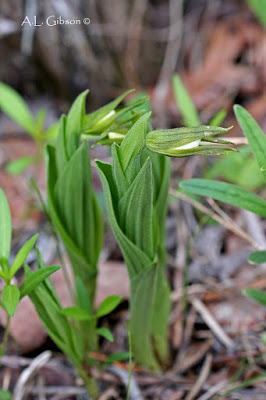 |
| Cypripedium candidum budding |
Rising from their subterranean homes was a plant I had dreamed of seeing for years and spent many a bored moment daydreaming of the day I'd make their acquaintance. What plant could cause such a stir of emotion and bliss? Just beginning to bud was the dainty and exceedingly charming Small White Lady's-slipper (Cypripedium candidum) orchid. Endangered in Ohio and quickly becoming a globally rare species, this orchid is only currently found in Adams, Erie, Sandusky and Seneca counties. As I wowed over the sight of the budding plants something in my peripheral vision caught my eye...
 |
| Small White Lady's Slipper - Cypripedium candidum |
Could it possibly be? It was! My jaw dropped and my eyes stared unblinking ahead at the beauty looking straight back at me. There it was in all its diminutive glory, the Small White Lady's-slipper saying hello for the first and certainly not the last time. You remember that feeling of being five years old and it's Christmas morning? That doesn't even compare to the pure state of euphoria I was experiencing at this moment in time.
 |
| Small White Lady's Slipper - Cypripedium candidum |
I've had many flowering plants leave my breathless before but this made all those affairs seem pedestrian. Never have I tread so softly or timidly in an area in all my life, being excruciatingly careful with each footstep as to not step on and damage a single cell of this plant. The word small is right in their name for a reason but I think adjectives like 'tiny' or 'miniscule' are a better fit. Take a look at my thumb next to the mature bloom of this plant. If you've been lucky enough to see the other species of
Cypripedium in Ohio (which you will see here soon enough if not!) you can begin to appreciate just how teensy-tiny these guys are.
 |
| Cypripedium candidum vs my thumb |
These rarities are found growing in wet prairies, sedge meadows, calcareous fens and in this instance, limestone barrens. One thing all these habitats have in common is ample sunlight and these plants need as much as they can get. They are the most light-sensitive and shade intolerant species of
Cypripedium in Ohio. Management of the few existing populations of this orchid is vital to its survival and staving of extirpation from our state. Removing any and all woody encroaching vegetation in its open habitat is key as is the potential use of fire for this method.
 |
| Small White Lady's Slipper - Cypripedium candidum |
I've read where populations greatly increased in number of flowering plants the year or two following an early spring burn. Add into the equation the fact that over 96% of this orchids habitat in Ohio was drained and plowed for agriculture and development decades ago and their very low seed/germination count, the management and preservation of this species habitat becomes even more critical.
 |
| Small White Lady's Slipper - Cypripedium candidum |
Rare in just about every state and Canadian province its indigenous to now, this wasn't exactly the case 150 years ago before the degradation and destruction of its prairie habitat. This was a rather common orchid of the Midwest's wet prairies and meadows. I can only imagine coming to the edge of the primeval forests and looking across the wide ranging prairies with hundreds of thousands of these plants soaking up the sun in mid-May, their intoxicating aroma on the breeze tingling my nostrils. What an transcending sight that must have been. If I'm this mind blown about a few dozen blooming plants I can't even begin to fathom if my brain could take the sight of their original display.
 |
| Small White Lady's Slipper - Cypripedium candidum |
Taking a closer look at the flower reveals its intricate and fairy-like structure. A pure, snow white 'slipper' or in orchid talk labellum, is speckled with an array of magenta dots around the inner rim and inside the pouch itself as you can see on the photograph above left. It's as though Mother Nature sits down with her tiny paintbrush and hand paints the remarkable detail onto this flower with painstaking precision. The yellow column sits above the pouch and contains the fused male and female parts (stigma and anthers) of the flower. The picture below is of a plant that for one reason or another did not produce a labellum and gives us an inside look at the inner workings of a Cypripedium orchid without causing any damage to the bloom. I've heard where the elves of the forest use the slippers from these orchids to walk around in silence through the misty forests at night. Perhaps that's why this plant is missing its slipper.
 |
| Cypripedium candidum |
After well over an hour of sitting amongst these great rarities of our time, admiring and appreciating them for their timeless beauty and splendor it was time to pack up the camera and make for home. I hated to leave them behind but I knew I'd be back before too long in hopes of getting to know them better and getting some more photographs. As I drove home I could not get their image or scent out of my head and I knew this experience and day would live with me for a long, long time to come. It's not every day I get to write off a 'life plant' of this magnitude and I certainly savored the moment for all it was worth. It really, truly is day's like this that make me know I've found my calling and purpose in life. Nothing ever felt so right.


