*Part I* *
Part II* *
Part III*
Better late than never! Life and its priorities have recently kept me away from the computer and the time and energy necessary to sit down and write. I've always kept this blog as something extracurricular and a fun way to share my travels, experiences, and discoveries and sometimes I just need a break to spend more time out in the natural world than at the keyboard. Rest assured the mood and free time has struck me and I'm here to deliver on my blissful and majestic time spent in the Adirondacks!
Note: it's a lengthy post but that's more to blame on the photos than the writing. I did my best to keep it short and sweet and allow the pictures to do the talking!
Upstate New York. What a transcendent place to escape to for a few days during the summer months. I certainly didn't mind trading the suffocating heat and humidity of Ohio for the comfortable days and crisp, cool nights of the Saratoga Springs area. My friend and fellow nature blogger
Jackie Donnelly was extremely gracious in opening up her home to me and was incredibly hospitable to someone she'd never personally met before. I've been a passionate follower of her blog, and her mine, the past couple years and inevitably a friendship was kindled by the mutual respect and admiration we both shared for the outdoors. If you don't already read her flowing words or gaze endlessly at her vivid photographs then you need to get over to
Saratoga Woods and Waterways right now! Well, after you read this post of course. For her detailed account of my stay and our forays check out
this link here!
It was an 11 hour drive from my hometown to Saratoga Springs and a large majority of it was rather forgettable. Fortunately, I had plenty of podcasts of my favorite sports talk shows (yes, I'm one of those guys) downloaded which really helped to break up the monotony. The stretch along Lake Erie in Pennsylvania and New York coming into Buffalo was scenic as were the large, rolling green hills of eastern New York on the thruway once I passed Utica. Speaking of the I-90 thruway, that has to be the closest thing to a North American autobahn I've yet experienced. I'm not much for speed to begin with but when you're cruising at 80 mph and still feel like you're going too slow as cars zip and fly past you, you'll white-knuckle grip the steering wheel too. I arrived at Jackie's in the afternoon after a thankfully uneventful drive and was treated to a delicious dinner and the week's itinerary before calling it a night early to get some sleep and recharge for the exciting events sure to unfold tomorrow.
 |
| Large expanse of tamarack and black spruce bog near Lake George |
The next morning dawned clear and dewy with a crisp chill to the air I hadn't felt in months. I knew just walking out the door it was going to be a day to remember. With our gear in the car we were off for my first taste of an entirely new region and ecosystem(s). Our first stop of the day was a secretive sphagnum bog near the southern tip of Lake George that was the primary reason for my visit and held something I had dreamed of seeing for years. What could lie within that kept me on pins and needles the entire drive there? Only one of the most stunning and intricately-designed orchids I'll ever have the honor of laying eyes on.
 |
| White Fringed orchid (Platanthera blephariglottis) |
We parked nearby and met Jackie's friend and naturalist,
Sue Pierce before proceeding on to the margins of a vast and seemingly endless grounded sphagnum bog comprised of tamarack and black spruce. Our feet squished into the cold, saturated mat of ruby red sphagnum as we started out into the bog. It wasn't long before our eyes were greeted with the brilliant snowy wands of the white fringed orchid (
Platanthera blephariglottis), the crowned jewel of the north.
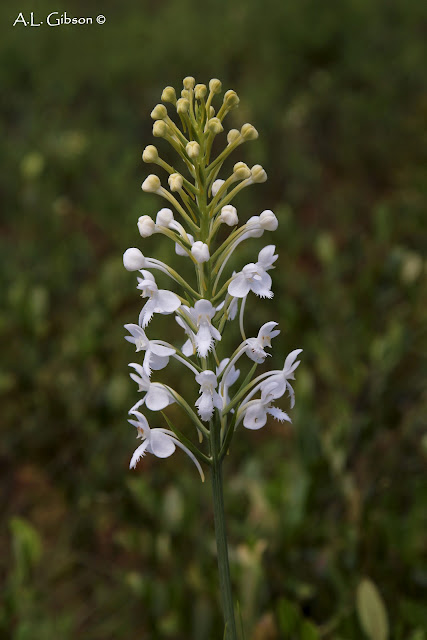 |
| White Fringed orchid (Platanthera blephariglottis)
|
Most of the orchids were still in bud throughout the bog but luckily a few dozen specimens were in fine shape, showing off their delicately fringed flowers and long nectar spurs. Back here in Ohio the white fringed orchid is an endangered species, only currently known from one bog in the northeastern part of the state where it was discovered in 1983; the first sighting in the state in nearly 50 years. Whether or not it flowers from year to year is an incredibly fickle cycle, which helps to complicate the situation of seeing it. When I saw Jackie post a blog last summer sharing a place where these grow by the hundreds I knew I had to make a pilgrimage the next year to finally make their acquaintance face to face. I challenge someone to find a more pure and vivid white flower anywhere else in the plant kingdom.
 |
| Your blogger photographing the white fringed orchids: courtesy Jackie |
Jackie and Sue disappeared off into the spruce and tamaracks to further explore the bog while I spent some long awaited camera time with the white fringed orchids. With it being just a wee bit tricky to photograph one's self in action, I was very thankful Jackie took the time to capture the above image. Being able to look back and relive this momentous occasion through this photograph means a lot.
 |
| White Fringed orchid (Platanthera blephariglottis)
|
A close look at the individual inflorescences reveal the evolutionary masterpiece that is this astounding orchid. Each lip (labellum) hangs below the eye-like pollinia with its wispy fringing around the margins. They seem to imitate little white birds bursting into flight with the long nectar spur trailing behind. I noticed Jackie was wearing black pants and asked her to stand behind the raceme of blooms to give a background that would really make those 'birds' pop. Like many other members of the
Platanthera genus, the white fringed orchid is pollinated by nocturnal species of moths that are attracted to the sweet-smelling scent of the nectar at the end of the long spur. As they probe the spur with their equally long proboscis their eyes incidentally come into contact with the pollinia. With any luck the pollinia will attach themselves to the moth's eye and be carried to another flower/plant where it can be deposited and pollinate the flower.
 |
| White Fringed orchid (Platanthera blephariglottis)
|
The brilliant orchids really stood out against the sapphire blue sky and reds/greens of the bog. A large portion of the photo shoot really came down to patience in waiting for a cloud to roll across the sun and cast some shade onto the bog. I'll never complain about a gorgeous sunny day but when I'm out specifically for photography I'll take a lightly overcast day every time.
 |
| Bog Rosemary (Andromeda polifolia) |
The white fringed orchids were hardly the only plants worth noticing or getting excited about growing throughout the sphagnum. Scattered all around were small shrubs of bog rosemary (
Andromeda polifolia), a unique boreal species of bogs and cold peatlands. The bluish-green linear, evergreen leaves help give its identity away. It hasn't been seen in Ohio in over 80 years and is more than likely permanently extirpated from the state due to habitat loss combined with never being a frequent species to begin with. I had only ever seen it before in northern Michigan, on the Bruce peninsula in Ontario, and at its curiously disjunct, southernmost population in the cranberry glades botanical area of West Virginia.
 |
| Black Huckleberry (Gaylussacia baccata) |
Almost as equally awesome as the white fringed orchids in the bog were the infinite amounts of perfectly ripened black huckleberries (
Gaylussacia baccata) and highbush blueberries (
Vaccinium corymbosum) everywhere. It's not everyday you can gorge yourself on blueberries and huckleberries free and fresh from the bush as you are surrounded by a pristine and spectacular ecosystem. I took full advantage of the situation and stuffed my face throughout my time there. Snap a photograph or two, hand full of berries, and repeat!
 |
| Habitat shot of the sphagnum bog |
Just about all of Ohio's sphagnum bogs and peatland was drained and removed years ago during settlement and the conversion to agriculture. All that's left are small, scattered kettle ponds and bogs restricted to the northeastern quarter of the state. Having the freedom and ability to walk through the endless expanse of bog and labyrinth of vegetation was a dream come true. I always find myself wishing I could travel back in time and see just what Ohio's different habitats and ecosystems were like pre-settlement. Not to say the native Americans didn't have any influence or affect on the land but certainly not at the scale of the white Europeans.
 |
| Northern Pitcher Plant (Sarracenia purpurea) |
A whole slew of interesting and rare-to-me plant species such as the bog rosemary, white fringed orchids, arrow arum (
Peltandra virginica), sweet gale (
Myrica gale), northern pitcher plant (
Sarracenia purpurea), grass pink orchid (
Calopogon tuberosus), swamp loosestrife (
Decodon verticillatus), tawny cottongrass (
Eriophorum virginicum), and black chokeberry (
Photinia melanocarpa) filled the bog and kept my mind racing and camera shutter clicking all morning.
 |
| Grass Pink orchid (Calopogon tuberosus) |
Surprisingly still in bloom along the margins of the bog were numerous grass pink orchids (
Calopogon tuberosus). Their interesting architecture and design combined with the bright purplish-pink coloration make them a hard sight to miss contrasting against the green sphagnum. I was pleased to have seen two orchids that early in the day but I had no idea just how many more awaited me later! With my task finished and the white fringed orchids freshly pressed in my mind we tromped out of the bog and decided to grab lunch along the sparkling blue waters of Lake George in the nearby village. I could hardly wait to continue on to the day's next spot we were headed to.
A particular stretch of shoreline on the Hudson River north of Saratoga Springs is home to one of the most diverse and fascinating habitats in the entire state of New York and a place I had seen Jackie blog about countless times accompanied with exciting photographs of rare and unusual plants.
 |
| The botanically-diverse ice meadows of the Hudson River |
Dubbed the 'ice meadows' of the Hudson, this unique ecosystem owes its continued existence to the harsh New York winters and the important task involved from the cold and ice. The open, grassland-like habitat along the shoreline is created and sustained each winter when huge deposits of
frazile ice accumulate on the margins of the Hudson. The immense weight and pressure from the ice pack, which can reach 15 feet in height at this location, generate the pseudo-boreal habitat which isn't cleared of ice until late in the spring. This annual 'cleansing' of the shoreline prevents woody vegetation from encroaching and keeps the intriguing plant diversity intact for the summer months. Unfortunately I was a couple weeks too late for the prime wildflower fireworks show the ice meadows put on each June but there was still plenty to be seen and appreciated all along the banks of the mighty Hudson.
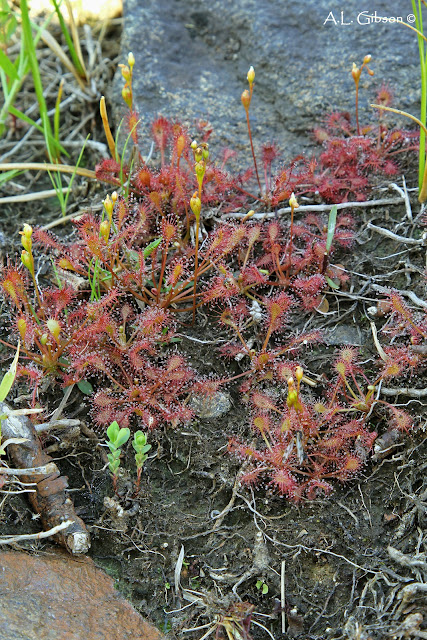 |
| Spatulate-leaved Sundew (Drosera intermedia) |
One of the first neat plants I noticed growing throughout the rocky terrain was the most robust and impressive clumps of spatulate-leaved sundew (
Drosera intermedia) I'd ever seen. Most were already past flowering stage and developing fruit capsules but the plant's unrivaled leaves covered in sticky 'dew' are always a welcome consolation; especially when it's an endangered species I rarely see in Ohio.
 |
| Large Cranberry (Vaccinium macrocarpon) |
Another plentiful and dainty plant among the rocky crags and exposures in the ice meadows was large cranberry (
Vaccinium macrocarpon). The evergreen trailing mini-shrub was in full bloom during my visit and many plants were covered in the shooting star-like flowers that will eventually mature into the tasty cranberries some of us enjoy adorning our morning oatmeal with.
 |
| Lesser Purple Fringed orchid (Platanthera psycodes) |
A prized plant Jackie had high hopes of finding and sharing with me while combing through the ice meadows was the lesser purple fringed orchids (
Platanthera psycodes). A threatened species in Ohio of swamp forests and wet thickets, they are much more frequent in New York but equally exciting to anyone who may come across some. Jackie was disappointed that all seemed to be taking this year off and we were just about to leave before she spotted some clematis leaves and went over to inspect the vine to see if it was in flower yet. No sooner had she started to shift the plant around when she gave out an excited shout of "purple fringed orchid!". Hiding behind some clematis and other vegetation was a lone orchid, albeit a bit beat up, but in full bloom nonetheless! Funny how things seem to work out sometimes.
 |
| Rocky shores of the Hudson's ice meadows |
Interestingly enough, the ice meadows contained quite a few species of plants synonymous with west-cenral Ohio's fen complexes and sedge meadows. The cold spring water that seeps from the ground and runs among the hummocks and rocks seems to imitate the typical fen environment enough to allow species such as
Carex buxbaumii, C. flava, Twigrush (
Cladium mariscoides), sundews (
Drosera spp.), spike rushes (
Eleocharis spp.), sticky tofielda (
Triantha glutinosa) and horned bladderwort (
Utricularia cornuta) to thrive.
 |
| Sticky Tofielda (Triantha glutinosa) |
I'll admit and say I did a bit of cheating with the sticky tofielda photo above. These were already in fruit during my visit to the ice meadows so I substituted in a photograph from earlier in the year from Cedar Bog. Hailing from the lily family (
Liliaceae), it gets its name from the tacky stems the flowering head sits on. In fact, the scientific epithet of
glutinosa translates to 'very sticky'.
 |
| Horned Bladderwort (Utricularia cornuta) |
The horned bladderwort is an endangered species back here in Ohio but was very frequent in the sandy and marly shorelines of the Hudson. Bladderworts can be a pain to identify to the species level sometimes, but the horned bladderwort lives up to its namesake and can be distinguished by the protruding 'horn' under the inflorescence. Another helpful characteristic is it's an entirely terrestrial bladderwort and never grows in standing water like several other species are known to do.
 |
| Big Bluestem (Andropogon gerardii) along the Hudson River |
It's a shame so many people, your blogger previously included, associate the Hudson with New York City and the polluted, dirty mess it is at its terminus. I think I'd watched too many
Law & Order: SVU reruns with washed up bodies and discarded victims to think of the river in any other way. Not anymore! After seeing and experiencing this mighty river firsthand hundreds of miles to the north, I don't think I'll ever think of this river in that lesser light ever again.
Take notice of the grass clinging to existence in the crevices and cracks of the boulders. Those tall culms topped with turkey-like feet belong to the big bluestem (
Andropogon gerardii); a widely-distributed native warm season grass that is synonymous with the tall grass prairies of the eastern great plains and Midwest. New York never had the expanses of tall grass prairie like that of Ohio but the ice compacted, open areas of the ice meadows have allowed this species to take hold and exist outside its normal fashion.
 |
| Hop Sedge (Carex lupulina) |
One of the most dominate species of sedge (
Carex) growing in the ice meadows was the hop sedge (
C. lupulina). It's a common sedge of eastern North America and can be found in just about any moist, well-lit situation. The large seed heads are really aesthetically pleasing to me and something worth using in cultivation. You really know you're a botanist and plant-nerd when you're thinking of ways to introduce a sedge to your landscaping.
 |
| Sensitive Fern (Onoclea sensibilis) |
Not uncommon by any stretch of the imagination but always a favorite of mine no matter where I go is the sensitive fern (
Onoclea sensibilis). The margins of the meadow and woodland had hundreds of their delicate fronds spread open and catching the valuable and plentiful sunlight.
After several hours exploring the shorelines and rocky boulders of the Hudson's ice meadows we decided it was time to get back in the car and drive to Jackie's friend's property to check out a couple species of orchid she had in bloom in her cedar forest/swamp. I am very thankful and appreciative of Evelyn Greene for opening up her land to me and sharing some of the botanical bounties that lay within. She first led us to a dry mixed coniferous forest mostly comprised of white cedar (
Thuja occidentalis) and some eastern hemlock (
Tsuga canadensis) to see an orchid that has long been extirpated to Ohio's soils.
 |
| Northern Green orchid (Platanthera aquilonis) |
I hope you weren't expecting something as stupendous and angelic as the white fringed orchids. The northern green orchid (
Platanthera aquilonis) may get some votes as the most bland and boring of the indigenous orchid flora but I find a quiet and inherent beauty to it. Evelyn had originally only found a few plants but after some searching with Jackie and I's extra pairs of eyes we ended up finding a handful more.
 |
| Northern Green orchid (Platanthera aquilonis) |
Upon closer inspection the details of the small green flowers come more into focus and, perhaps, allow for more appreciation from the casual observer. The deep shade of the cedar forest caused for some pretty long exposure times but the wind was calm and that made things much, much easier. I had only seen this species once before in the cedars forests and alvars on the Bruce peninsula of Ontario, so it was a big deal to see and photograph it again; especially such nice specimens. As mentioned above, it's one of five species of orchids extirpated from Ohio causing for some out of state botanizing.
 |
| Ragged Fringed orchid (Platanthera lacera) |
After photographing the northern green orchids, Evelyn took us through a secretive path into a cedar swamp where carefully planned steps and good balance was needed to weave in and out of the trees and stay on the dry hummocks. We finally came to the spot where she had found three very robust and impressive specimens of ragged fringed orchid (
Platanthera lacera). Once again with some extra eyes we discovered a dozen or so more, each more impressive than the last it seemed. I had seen this species on several occasions in Ohio where it grows in a variety of habitats but never anything approaching the size and proportions of these!
 |
| Ragged Fringed orchid (Platanthera lacera)
|
Seeing this orchid in such a new manner was an unexpected treat and delved me into even deeper botanical debt with Evelyn and Jackie. As we made our way out of the swamp we passed through a more dry area that had some of the largest trees of their respective species I'd ever seen. Perhaps the bordering swamp had prevented their cutting ages ago but massive white pines, red spruce, and eastern hemlock abounded and were quite the sight to an Ohioan who can't see such a sight at home.
 |
| Red Baneberry (Actea rubra) |
We came to the gravel road and began to walk back to Evelyn's when I spotted something suspicious out of the corner of my eye. Sitting right along the road were several large and fruiting red baneberry (
Actea rubra) plants, a threatened species in Ohio I had never seen in person before. It can be best separated from the very similar and much more common white baneberry (
A. pachypoda) by fruit color (although some red baneberry plants can have white fruit) but most accurately by the thickness of the fruit's pedicel. As you can see in the picture above, the pedicel is very thin while in white baneberry it is shorter and much thicker. Randomly coming across this life species was a great cherry to the top of the day's sundae.
I had come to the end of day one and I had already seen and photographed five species of orchids; combed the botanically diverse and significant ice meadows of the Hudson; walked through the largest and most pristine sphagnum bog of my life; and trudged through a fine cedar forest/swamp. It was a good sign for things to come as I would find out! Come back soon for part II of my three-part series on my time in upstate New York!
*Part I* *
Part II* *
Part III*


