Tuesday, February 15, 2011

Some Over-Wintering Greenery

Winter is by and far the easiest season to complain about and as such feels to last the longest.  The summer greens and blues fade into the drab browns and grays that adorn the landscape for months on end and can cause even the cheeriest of people to be a bit grumpy come January and February.  I do my best to take the winter months in stride and spend my days outside admiring and studying the changes one can only see during this time of year.  Despite the seemingly boring and cold months of winter a good botanist won't take this 'down time' sitting inside wishing for warmer and greener days.  It's important to not only know the plants during antithesis but also any other time of the year.  Not all plants disappear during the winter even though they met their seasonal fate with the first freeze months ago.  Many persist through the winter and let sharp-eyed hikers pick up on their evidence along the trails.  Let's take a look at a few of my favorite species I came across on a hike through Zaleski state forest the other day.

Over-wintering leaf
Puttyroot orchid


Poking out of the ground at the base of a Tuliptree (Liriodendron tulipifera) are the over-wintering leaves of the Puttyroot Orchid (Aplectrum hyemale).  This plant does best in rich, moist deciduous woods which is reason why it is most common in the southern half of the state and in the northeast quarter.   Commonly found in ravines and along the high terraces of streams and rivers (the latter being where this colony was found), this orchid can really be found in any appropriate forest community.  A. hyemale received its name from the mucilaginous fluid released from its root tubers when crushed and was used by early settlers as a glue to fix broken pottery while the Native Americans used it as a topical treatment for sores. 

Last year's emptied seed capsules
Leaf with attached corms


Aplectrum has a much different vegetative lifecycle than that of most plants.  A large majority of plants have a growing season of spring to autumn however this orchid reverses that order and grows from autumn to spring.  Come November the corms send up a single leaf that is light green in color and has many parallel white lines running down the center.  This robust and tough leaf survives the hardships of winter and is able to photosynthesize by avoiding the light competition during the normal growing season.  With the leaves completely off the trees and no plants growing above or around it, the leaf can soak up as much winter sunlight as nature can offer.  This leaf begins to wilt and wither just before the flowering stalk is sent up in mid-May and is completely decomposed and gone shortly after antithesis.  Usually only a few individuals within a colony of A. hyemale flower each season and can be hidden by surrounding vegetation quite easily causing this to a rather hard plant to find.  The flowers being a green color tinged with purple doesn't make the hunt any easier.   Winter is the best time to go looking for this plant when the large, green leaves stick out like a sore thumb among the brown fallen leaves.  Luckily the colony I stumbled across had a flowering stalk left over to show the dried capsules emptied of their tiny, minute seeds.  In late summer and early fall this is the only evidence that this plant ever existed at that spot; no leaf for another couple months and no colorful flowers to catch the eye.
 
After standing up and brushing myself off from my visit with Aplectrum hyemale it was only a few minutes later I found Ohio's only other orchid that sends up an over-wintering leaf, the Cranefly Orchid (Tipularia discolor).

Previous year's Tipularia capsules
Over-wintering leaf of Tipularia orchid


Worldwide there are only three species of Tipularia that are known to exist; two make their home in Asia and our T. discolor here in North America.  All three send up a single leaf each winter to provide the same photosynthesis purposes as the previously mentioned Puttyroot orchid.  This species of orchid has a pretty wide range of preferable habitat within its deciduous forest home.  From old-growth forests to second growth, mesic woods to dry or rugged landscapes to flat, this orchid has been recorded growing in all of those instances.  One critical aspect however is the pH of the soil where it grows.  This orchid is largely absent from areas that are composed mainly of basic soils, doing much better in acidic to neutral conditions.  The only large difference in the life history of this plant in regards to A. hyemale is that T. discolor blooms in the summer rather than spring.

An interesting note about this species is its noticeable range extension over the past century.  Not known to exist in Illinois until 1958, this orchid has been found in several more counties as time has gone on as well as been found for the first time in Missouri in the 1980's.  Several disjunct populations have been discovered in Indiana and Michigan counties as well that had no historical documentation of being found there previously.  The cause of this range expansion most likely can be chalked up to natural phenomenon.  Many, many native plants of the past have extended and restricted their natural ranges through the natural course of time, it's just a unique and exciting opportunity to witness and document this as it happens.
 
At a later time I want to get into depth about the pollination of this plant as its one of the most unique and interesting of any orchid but it's time to move on to another persisting plant of winter.

Chimaphila maculata
Chimaphila maculata


Spotted Pipsissewa, Spotted Wintergreen, Striped Prince's Pine...call it what you want but its botanical name is Chimaphila maculata.  This cute, little evergreen herb can be commonly found in a variety of sandy, acidic and dry environments such as pine stands, mixed oak woodlands and well-drained upland forests.  In Ohio the range is almost entirely in the eastern half of the state.  Common interstate highways can be a excellent way to provide an instantly communicable means of a plants range and with this plant it comes in pretty handy.  Almost every county in our state east of I-71 has this plant within its boundries, while only a few to the west can claim the same.  Creeping rhizomes sending up new stems can cause this plant to colonize an area and provide a beautiful mat of thick, dark green leaves with a striking white stripe down the middle.  In mid-summer stalks arise from the stems with a single whitish/pink flower per stalk to be pollinated by varying insects.  These stalks with their swollen capsules full of seeds can persist throughout the winter as shown in the photograph above.

Goodyera pubescens leaves
Old seed capsule


Arguably our states most common and easily found orchid is the Downy Rattlesnake Plantain Orchid (Goodyera pubescens).  The beautiful rosette of evergreen leaves this species displays is one of my favorite sights any time of the year.  Each leaf has a network of veins branching out across its surface creating almost a stained glass look.  Unfortunately this beauty is noticed by many who are not willing to just look with their eyes.  Thousands of these plants end up in terrariums and in plant stores for sale where they don't last long.  Diggings like these have caused sharp population declines in some areas and even extirpation in severe cases.

Close up of seed capsule
 
Frequently found in well-drained upland forests that have soil of an acidic makeup as well as moss covered rocks, ledges and outcrops.  Anyone can see the leaves anytime of the year but it takes a botanist willing to brave the heat and humidity of July to see this plant in flower.  Only older, matured plants send up an a raceme of tiny, white flowers to be pollinated by a a species of tiny bees.  The flowering stalk (as shown above) can persist throughout the winter as it releases its dust sized seeds to the wind.

Partridgeberry
Rock Polypody Fern


Growing right next to each other on a moss covered rock were the last two species I found interesting on my hike.  On the left is Partridgeberry (Mitchella repens), a creeping evergreen woody plant.  It can grow to form large mats on the ground and give a pretty green tinge to the blandness of the winter scene.  It grows in similar habitat to the aforementioned G. pubescens and is commonly found growing in rocky, inhospitable situations.  The small, red berries (one can be seen peeking out in the center of the picture) persist throughout the winter and are eaten by a variety of woodland critters and birds.

On the right is a species of fern found growing in similar situations as Partridgeberry, Rock Polypody (Polypodium virginianum).  The fronds are evergreen that can grow to be 6 to 12 inches long and shrivel up depending on how much moisture they have.  The tiny brown spots on the underside of the fronds are the spores which is how ferns reproduce.  In future posts I plan on getting into the many species of ferns Ohio has to offer but I'll leave it with just the one for today.


Sunday, January 16, 2011

Winter Stroll Through an Old-Growth Wonderland

Davey Woods old-growth forest

Everyone catches themselves daydreaming from time to time, myself being as guilty as the next of this common means of killing time.  It's an easy and fast way to travel away from your boring work cubical or class lecture and immerse yourself in a far away world, lost in its infinite possibilities.  For me it's the constant wonder of what Ohio's pre-settlement landscape looked like.  The seemingly endless tracts of primeval forest, the pristine tall grass prairies, fen and sedge meadows, bogs, swamps etc.  All cut, drained and plowed for agriculture and the never ending struggle to survive for the earliest settlers.  When the first white men stepped foot inside our borders in the early 1700's Ohio was well over 90% forested.  Over the next two centuries over 40,000 square miles of forest were cut and Ohio's forests dwindled to only around 15% by 1900.  Today Ohio is back to 33-36% forested with a large majority being in the southern and southeastern sections however it is all second growth and not representational of our ancestors forests.  While debatable, it's highly likely that no true "virgin" forest is left in our state.  Virgin forest is a highly open-ended term but my definition has always been forest that has never been logged in any way or been used for livestock grazing since before pre-settlement times.  The Native Americans had a large influence on the land even before the white settlers came here but obviously not nearly of the same magnitude.  However there are still some small, tiny pockets of forest left that can begin to give us a small idea of what primeval Ohio was like.


Davey Woods nature preserve in Champaign County near Urbana is one of the finest old-growth forests left in this area of the state.  It is named in honor of the Davey Tree Company, who in 1989 with the help of the Ohio chapter of the Nature Conservancy, purchased the 103 acres of woods to forever be preserved and protected for future generations enjoyment.  The prime attraction is the majestic and stately old-growth trees that tower like skyscrapers into the canopy as well as the Spring display of wildflowers.  Any time of the year supplies you with a long list of amazing features at Davey Woods but it's the winter that really draws me to it.  With no leaves in the canopy to block the view one can really appreciate the true height and size of the resident trees.  It may be weird to say but I love being in Ohio and getting the kink in my neck from looking up that I normally only receive from my time spent in the ancient forests of the Pacific Northwest!  So let's take an inside look at some of the timeworn monsters of Davey Woods.

Reminder!  Please click the photographs to see them in high resolution for better viewing!

Entering the primeval forest
Old-growth Tuliptrees


The preserve sits on the tailing end of the geologically important Bellefontaine Outlier.  Ancient layers of Devonian-age Columbus Limestone and Ohio Shale have resisted millenia of erosion while the surrounding layers of Silurian rock have slowly eroded away to leave the more resilient rock to form the abrupt hilliness of the area.  The extent of the old-growth area resides in the protective valley and adjoining slopes of the Nettle Creek valley.  Now only a small stream that runs through the forest, Nettle Creek was once much larger as a source of glacial runoff during the Wisconsinan glacial period.  The above picture is the blogger's father walking across Nettle Creek onto the higher slopes of the forest.  The picture to the right (that will never do true justice, as will none of the photos in this blog) shows a large stand of Tuliptrees (Liriodendron tulipifera) across the creek that are all over 100 feet tall and 3-4 feet in diameter, very impressive for today's standards!

Red Oak
Red Oak


The bottoms and lower slopes of the valley are dominated by Tuliptrees (L. tulipifera), American Beech (Fagus grandifolia), Sugar Maple (Acer saccharum) and Red Oak (Quercus rubra) with some American Basswood (Tilia americana) and Green Ash (Fraxinus pennsylvanica) mixed in.  The tree above is the preserve's largest Red Oak on display.  Consulting measurements taken by arborists from the Eastern Native Tree Society on the trees of Davey Woods this tree measures a whopping 4.5 feet in diameter and nearly 130' high!  As with many of the photo's seen in this post, the blogger would like to thank his father for accompanying him on this hike and being a good sport about posing with these magnificent trees so the reader can get a grasp on the size.

Wild Black Cherry
Wild Black Cherry


Sprinkled throughout the preserve are some of the largest and most beautiful specimens of Wild Black Cherry (Prunus serotina) left in Ohio.  You just don't see P. serotina trees like this anymore and in fact I'm pretty astonished these have survived the ax and chainsaw to attain such a size.  Black Cherry is one of and commonly is THE most prized and expensive hardwood native to eastern North America along with Black Walnut (Juglans nigra).  Tall, straight, forest grown trees such as the one above (125' tall with a D.B.H [diameter at breast height] of 2') with no knots or low limbs would make any logger drool like a dog at dinner time.  I'm no certified forester but I know trees like this can fetch a price tag of well over $10,000.  For just ONE tree too!  The one above is one of about a dozen or so that grace this preserve and show off a great rarity of our time.  Just about all the Black Cherry's like this met their sawmill fate decades ago.

Grove of ancient Tuliptrees
A skyscraper of a Tuliptree


The Tuliptrees are the true champions of Davey Woods without much argument.  Dozens and dozens break the 100' mark and range from 3-4.5' in diameter.  Tuliptrees are known as an early-successional species, usually being one of the first trees to come back when a forest regenerates and die out as the forest matures to the climax stages of Oak/Hickory and Beech/Maple.  However under the right circumstances these fast growers can stick around in their high canopy homes and live up to 200-250 years old.  The Davey Woods Tuliptrees are believed to have sprouted around the time of the American Civil War which puts them in the 150ish year range which has given Nature plenty of time to show what she can do.  The one featured above is just over 4' in diameter and scrapes Heaven at nearly 140' tall!  Early settlers and pioneers wrote of finding Tuliptrees in the primeval forest 7-8 feet in diameter and over 200' tall...unbelievable by today's standards.  The champions of today can be found in the virgin forest of the Great Smokey Mountains National Park.


Chinkapin Oak
Red Elm


As you move onto the higher slopes and ridge tops of the preserve the Oak (Quercus) and Hickory (Carya) species start to dominate.  White Oak (Q. alba), Chinquapin Oak (Q. muehlenbergii), Shagbark Hickory  (C. ovata) and Bitternut Hickory (C. cordiformis) with an association of White Ash (Fraxinus americana) and American and Red Elm (Ulmus americana, U. rubra) make up the canopy.  The picture on the left above is of an exceptionally large Chinquapin Oak that measures over 110' tall and 4.5 feet in diameter.  The Chinquapin Oak has some of the sweetest tasting acorns in the Quercus genus and are prized by wildlife.  Many of the Oaks and Hickories showed strong signs of animals scratching and digging around the bases in search of these tasty morsels.  On the right is one of the largest Red Elms (U. rubra) I have come across.  Unfortunately I discovered when I last visited over the summer that this Elm did not leaf out and is now dead.  Whether or not Dutch Elm disease claimed another victim is yet to be decided as there are several other large American and Red Elm in the vicinity that are healthy and alive.  While Dutch Elm disease largely affects American Elm the most, its close relative Red Elm is not immune to the onslaught of this terrible disease.

Nettle Creek valley

Walking down into the valley the trail leads you along Nettle Creek and into an area with some of my favorite trees found on the preserve.  Looking up and seeing the canopy consistently over 100' above your head is something I wish I could get used to seeing in more places than just this 103 acre preserve.  While beggars cannot be choosers it is my dream to live long enough to see more of Ohio's maturing second growth forest to be allowed to reach such lofty heights as Davey Woods.  Hopefully mankind will have the patience necessary to allow such an amazing aspect to our world to return for myself, my children and all those after me to enjoy and respect.


Green Ash
Green Ash


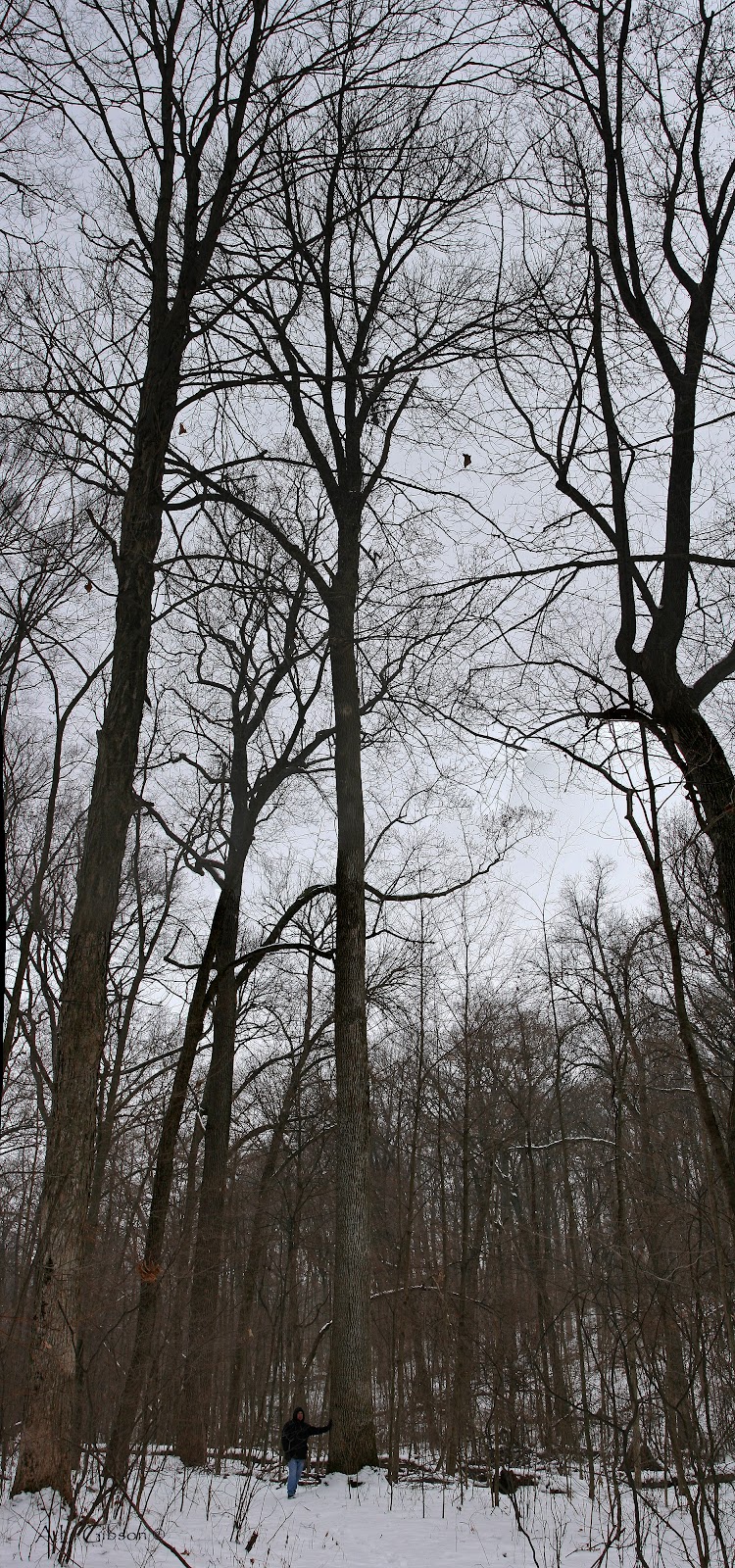
The tree above is probably the most perfectly formed and aesthetically pleasing to be found in the preserve, least to myself.  This Green Ash (F. pennsylvanica) along the banks of the creek soars into the canopy as straight and majestically as any tree I've ever seen.  While only 3 feet in diameter the top of its crown rests at a lofty 130' above my head!  If the mythical Paul Bunyan ever needed a mammoth arrow for his equally mammoth bow, this tree's trunk would fit the bill for sure!  Below is a panoramic shot of the tree in its entirety; from base of the stump to the highest twig so you can see what I'm talking about.  (I HIGHLY recommend clicking on this and the other panoramic photo's to see them in a larger, more detailed manner).

Green Ash

For my devotees who have read this far, and I sincerely thank you for doing so, I will leave you with a few more panoramic shots of these voluminous trees to enjoy.  Hopefully this post has inspired you to get out and see this wonderful nature preserve for yourself.  You can get detailed directions by clicking here.


Top Left: White Ash
Top Right: Sugar Maple
Bottom Left: Tuliptree 1
Bottom Right: Tuliptree (same one featured earlier)

Tuesday, December 28, 2010

Coral in the Woods?

Well, I'm finally back!  I apologize for the lack of attention I have paid to this blog the past couple months but with a heavy college schedule comes projects, assignments and papers and very little free time and energy.  I am going to do my best to publish a new post or two per week but I can't make any solid promises.  So to all my faithful and devoted readers please start checking back in regularly for updates taking you ever deeper into the wonderful natural world Ohio has to offer!

It's a bitterly cold evening in late December and my gaze out the frosted window is met with a wintry scene of snow and a few icicles hanging from the eaves of the roof like stalactites.  Almost instinctively my mind turns from the frigid conditions outside and begins to travel back to warmer days where the bleak and bland grays and browns of the landscape are adorned with the vibrant shades of summer green.  Back to a time when one of my favorite families of vascular plants, Orchidaceae, is showing off its intricate beauty and not imprisoned in its current subterrestrial hibernation.  As my previous posts are sure to point out and no doubt future ones to come, my botanical passion tends to run deepest in our native, wild orchids.  Their complexity, rarity and nigh on impossible beauty combined with the sheer excitement of discovery all add up to be almost unbeatable for someone like me.  Of the 47 species of orchids (46 native, 1 introduced) found in our state I have so far had the pleasure of making the acquaintance of 21.  I have high hopes of adding to this already pleasing number this growing season and look forward to writing future posts devoted to their splendor.

So let's leave this frozen world behind and travel back to the heat and humidity of mid July in Adams County and focus on one of the most weird, stunning and rare plants Ohio has to offer; the Crested Coral-root orchid (Hexalectris spicata).

L:ynx prairie in Adams County
 
The Hexalectris genus is made up of seven species of orchid mostly restricted to the arid lands of Texas and neighboring Mexico with only one species escaping to the north and east, that being H. spicata.  Like a number of other southerly distributed plant species, the Crested Coral-root's northern-most range barely makes it into three of Ohio's southern-most counties of Adams, Lawrence and Scioto.  The Edge of Appalachia preserve and nearby Shawnee State Forest during late July-mid August is your best bet of finding this elusive and fickle orchid.  A state threatened species, H. spicata resides in semi-shaded, open mixed Oak woodlands and limestone/Red Cedar glades.  While it is reported to be found in both acidic and alkaline (calcareous) soils it seems to have a preference for areas with a bedrock of limestone that is close to the surface.  In the well-drained, non compacted soils underneath Post Oak (Quercus stellata) and Chinquapin Oak (Q. muehlenbergii) groves in the picture above the Crested Coral-root put on a mighty display this summer.
Hexalectris spicata
Hexalectris spicata

While many of our native orchids are charming and unique in their own right I personally think H. spicata ranks among the highest and is in its own class.  Standing one to two feet tall, the yellowish-tan, fleshy stem is topped with a raceme of 8-15 flowers each about an inch wide that seem to have been carefully sculpted out of clay.  The honey-brown colored petals and sepals are delicately lined with brown/purple veins but it's the lip that really steals the show.  Set on a whitish-yellow background the most elegant and royal display of purple flows from the column (the main reproductive structure of an orchids flower which is composed of the fused stamens and pistils minus the ovary) and spills out across the lip like ribbons of silk.   While stunningly attractive and certainly different looking it's not just the floral display of this species that makes it so interesting to me.

Like the true Coral-roots of the genus Corallorhiza and a number of other plants/fungi/bacterium, Hexalectris spicata is a saprophyte, meaning it is unable to manufacture its own food and must derive its nutrition needs from other organic matter in the soil.  The underground rhizome (which looks like a piece of coral, hence its common name) is enveloped in mycorrhizal fungi which it forms a vitally important symbiotic relationship with.  The mycorrhizal fungi sends out a network of mycelia (the vegetative thread-like "root" structures of a fungus) throughout the soil and infect the roots of other nearby plants drawing out their nutrients and bringing it back to the orchids rhizome for use.  While all orchids have this symbiotic relationship with the fungi to aid them in their battle for nutrients many develop leaves for an additional source of food through photosynthesis.  However the Crested Coral-root never gets to that point and relies solely on the fungi to supply its nutrients.


Due to this symbiotic relationship H. spicata has no need to appear above ground other than to flower and produce seeds.   The rhizome will persist for years underground and only send up a flowering stalk when the needed environmental factors and conditions present themselves.  Wet conditions throughout the summer seem to coincide with a strong showing of Crested Coral-root however the inter-relationship of environmental factors and anthesis are still not fully known or understood.  So while one year there may be a profusion of flowering stalks (such as this summer, these guys were blooming all over the Preserve!) the next year may produce very few or in many cases, none at all.  All this adds up in making this orchid a potentially frustrating and very sporadic summer bloomer!

Maturing seed capsules

After pollination the flowers shrivel up and fall off the stalk leaving only the ovary to swell with maturing seeds inside.  Once matured, the capsule (dry fruit or seed pod of an orchid) dries and splits open releasing thousands and thousands of absolutely tiny, minute seeds.  If you pay careful attention during a light breeze you can see the capsules emit what appears to be a yellowish 'dust' into the air which are the nearly microscopic seeds being dispersed by the wind.  Orchids seeds do not have an endosperm and rely entirely on the mycorrhizal fungi to establish themselves and survive.  This is what makes almost all wild orchids nearly impossible to transplant, most specifically those that are saprophytic.  It always grinds my gears to hear reports of an orchid population, whether it be a few hundred plants or one individual, being devastated by people digging them up to sell or replant at home.  Not only is it illegal to do so it is also 99.9% of the time a vain effort.  Not even our orchids are safe from humanity's senseless greed and thoughtlessness.  So next time you stumble across an orchid in the wild appreciate it and admirer it with your eyes and not your hands.  Hundreds of years of careful, tedious growth and patience can be ruined in seconds.